【纯正英式口语】日常用语语速慢,非常适合B站的同学,坚持学完
共 25 集
剧集目录
| 集 | 标题 | 时长 |
|---|---|---|
| P1 | 【纯正英式口语】日常用语语速慢,非常适合B站的同学,坚持学完 | 6:02 |
| P3 | 【纯正英式口语】日常用语语速慢,非常适合B站的同学,坚持学完 | 6:16 |
| P4 | 【纯正英式口语】日常用语语速慢,非常适合B站的同学,坚持学完 | 5:46 |
| P5 | 【纯正英式口语】日常用语语速慢,非常适合B站的同学,坚持学完 | 5:53 |
| P6 | 【纯正英式口语】日常用语语速慢,非常适合B站的同学,坚持学完 | 6:05 |
| P7 | 【纯正英式口语】日常用语语速慢,非常适合B站的同学,坚持学完 | 5:59 |
| P8 | 【纯正英式口语】日常用语语速慢,非常适合B站的同学,坚持学完 | 6:40 |
| P9 | 【纯正英式口语】日常用语语速慢,非常适合B站的同学,坚持学完 | 6:06 |
| P10 | 【纯正英式口语】日常用语语速慢,非常适合B站的同学,坚持学完 | 6:13 |
| P11 | 【纯正英式口语】日常用语语速慢,非常适合B站的同学,坚持学完 | 6:02 |
| P12 | 【纯正英式口语】日常用语语速慢,非常适合B站的同学,坚持学完 | 6:03 |
| P13 | 【纯正英式口语】日常用语语速慢,非常适合B站的同学,坚持学完 | 6:01 |
| P14 | 【纯正英式口语】日常用语语速慢,非常适合B站的同学,坚持学完 | 4:11 |
| P15 | 【纯正英式口语】日常用语语速慢,非常适合B站的同学,坚持学完 | 5:54 |
| P16 | 【纯正英式口语】日常用语语速慢,非常适合B站的同学,坚持学完 | 6:02 |
| P17 | 【纯正英式口语】日常用语语速慢,非常适合B站的同学,坚持学完 | 6:04 |
| P18 | 【纯正英式口语】日常用语语速慢,非常适合B站的同学,坚持学完 | 6:04 |
| P19 | 【纯正英式口语】日常用语语速慢,非常适合B站的同学,坚持学完 | 5:56 |
| P20 | 【纯正英式口语】日常用语语速慢,非常适合B站的同学,坚持学完 | 7:19 |
| P21 | 【纯正英式口语】日常用语语速慢,非常适合B站的同学,坚持学完 | 5:06 |
| P22 | 【纯正英式口语】日常用语语速慢,非常适合B站的同学,坚持学完 | 6:02 |
| P23 | 【纯正英式口语】日常用语语速慢,非常适合B站的同学,坚持学完 | 6:16 |
| P24 | 【纯正英式口语】日常用语语速慢,非常适合B站的同学,坚持学完 | 5:05 |
| P25 | 【纯正英式口语】日常用语语速慢,非常适合B站的同学,坚持学完 | 6:03 |
| P26 | 【纯正英式口语】日常用语语速慢,非常适合B站的同学,坚持学完 | 6:02 |
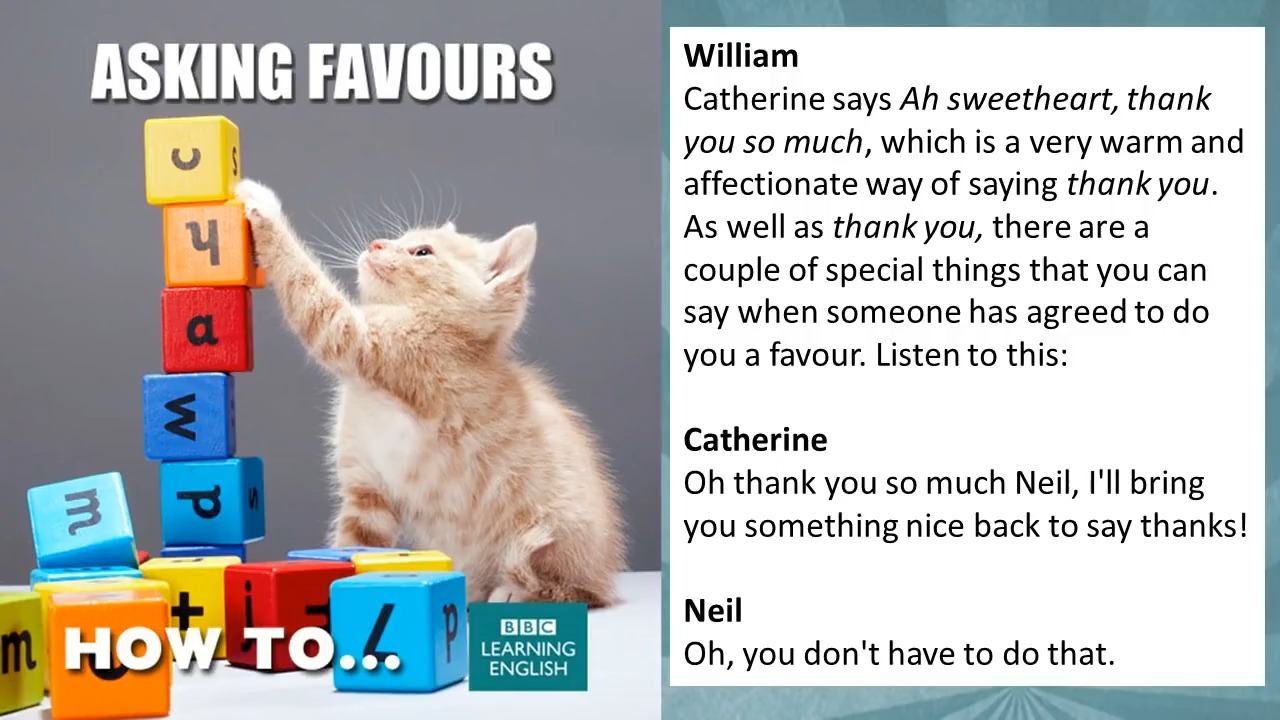
P1 · 【纯正英式口语】日常用语语速慢,非常适合B站的同学,坚持学完英语突飞猛进,沉浸式英语全方位提升!! p01 1. 1. How to ask a favour (P1)
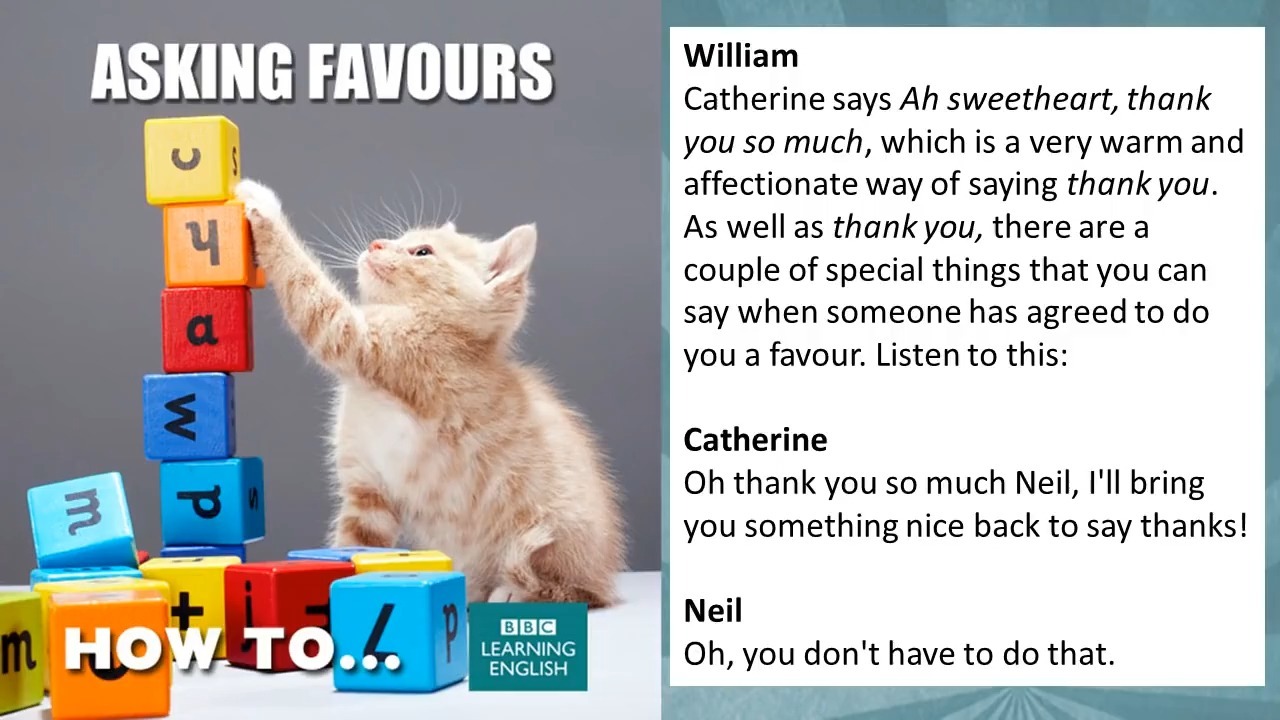
【纯正英式口语】日常用语语速慢,非常适合B站的同学,坚持学完英语突飞猛进,沉浸式英语全方位提升!! p01 1. 1. How to ask a favour (P1)
发布于 2026-07-17 · 时长 6:02字幕摘录
| 时间 | 英文 | 中文 |
|---|---|---|
| 0:12 | Hello, and welcome to How To, the series all about useful English. | 你好 欢迎来到How To 系列 讲的是有用的英语 |
| 0:17 | My name is William Kramer. | 我叫威廉・克雷默 |
| 0:20 | Today we're going to be looking at how to ask a favour. | 今当观心求恩. |
| 0:24 | That is, how to ask someone | 也就是说,如何问一个人 |
| 0:26 | to do something for you out of kindness or generosity. | 为你做一些事情 出于善意或慷慨。 |
| 0:30 | For example, you might ask a friend | 比如,你可能会问朋友 |
| 0:32 | to help you with your English. | 帮助你用英语。 |
| 0:34 | Or maybe you're going to go away and you want a neighbour | 或者你可能要离开 想要一个邻居 |
| 0:37 | to water your plants. | 给植物浇水 |
| 0:39 | Now, on one level, this is easy. | 现在,在一个层面,这是很容易的。 |
展开字幕全文(130 条)
| 序号 | 英文 | 中文 |
|---|---|---|
| 1 | Hello, and welcome to How To, the series all about useful English. | 你好 欢迎来到How To 系列 讲的是有用的英语 |
| 2 | My name is William Kramer. | 我叫威廉・克雷默 |
| 3 | Today we're going to be looking at how to ask a favour. | 今当观心求恩. |
| 4 | That is, how to ask someone | 也就是说,如何问一个人 |
| 5 | to do something for you out of kindness or generosity. | 为你做一些事情 出于善意或慷慨。 |
| 6 | For example, you might ask a friend | 比如,你可能会问朋友 |
| 7 | to help you with your English. | 帮助你用英语。 |
| 8 | Or maybe you're going to go away and you want a neighbour | 或者你可能要离开 想要一个邻居 |
| 9 | to water your plants. | 给植物浇水 |
| 10 | Now, on one level, this is easy. | 现在,在一个层面,这是很容易的。 |
| 11 | All you need to do is say, | 你只需要说 |
| 12 | Can you do me a favour? | 你能帮我个忙吗? |
| 13 | Or you could say, | 或者你可以说, |
| 14 | Can I ask a favour? | 我能请你帮个忙吗? |
| 15 | Say one of those things and then say what you want the other person to do. | 说其中之一 然后说你想让别人做什么。 |
| 16 | Could you help me with my English? | 你能帮我弄英语吗? |
| 17 | Can you water my plants next week? | 下周能给我的植物浇水吗? |
| 18 | Now, this gets a bit more complicated because we tend to be very polite when we're asking | 现在,这变得有点复杂 因为我们往往非常礼貌 当我们问 |
| 19 | favours. | 喜欢。 |
| 20 | So, instead of saying, Can you do me a favour? | 所以你可以帮我个忙吗? |
| 21 | What we might well say is, | 我们最好说的是, |
| 22 | Could I ask you to do me a favour? | 我能请你帮我个忙吗? |
| 23 | That's more polite than saying, Can you do me a favour? | 这比说"你能帮我个忙吗?" |
| 24 | Now, in the following clip, you'll hear Catherine and Neil, who are neighbours. | 现在,在下面的片段,你会听到凯瑟琳和尼尔, 他们是邻居。 |
| 25 | In this clip, | 在这个片段里 |
| 26 | Catherine checks that Neil isn't busy and then she asks a favour. | 凯瑟琳确认尼尔不忙 然后她请求帮忙 |
| 27 | She's going on holiday | 她要放假了,她要回来 |
| 28 | and she wants Neil to feed her cats while she's away. | 她想尼尔在她离开的时候喂猫 |
| 29 | Oh, hiya. | 哦,你好吗? |
| 30 | How are you doing? | 你好吗? |
| 31 | Hi Neil. | 嗨,尼尔。 |
| 32 | Hi, I'm fine. | 嗨,我没事。 |
| 33 | Have you got a minute? | 你有时间吗? |
| 34 | Yeah, sure. | 当然 |
| 35 | I'm not disturbing you, am I? | 我没打扰你吧? |
| 36 | No, no, no. | 不,不,没有。 |
| 37 | OK. Well, what it was, I don't know if I told you that I'm going on holiday next week for | 摆 好吧,是什么,我不知道 如果我告诉你,我要去度假 下周为 |
| 38 | a couple of weeks. | 几个星期 |
| 39 | Oh, right. | 对 |
| 40 | Cool. | 凉爽。 |
| 41 | Very nice. | 很不错 |
| 42 | Yes, and I was wondering if I could ask you a massive favour, which is, would you mind | 是的,我想请您帮个大忙,你介意吗? |
| 43 | popping in and feeding the cats while I'm away? | 趁我走的时候 来喂猫? |
| 44 | Yeah, yeah, that's fine. | 是啊,是啊,没关系。 |
| 45 | Sure. | 当然 |
| 46 | I mean, what sort of time do they need to eat? | 我的意思是,什么样的时间 他们需要吃饭? |
| 47 | Because | 因为 |
| 48 | I… sometimes I get home… | 有时候我回家... |
| 49 | Don't worry if you missed some of that. | 不要担心,如果你错过了一些。 |
| 50 | They were speaking very, very fast. | 他们说话非常,非常快。 |
| 51 | But listen | 听着 |
| 52 | again to how Catherine asks her favour. | 再次向凯瑟琳求情 |
| 53 | I don't know if I told you that I'm going on holiday next week for a couple of weeks. | 我不知道我是否告诉你 我下周要去度假 几个星期。 |
| 54 | Oh, right. | 对 |
| 55 | Cool. | 凉爽。 |
| 56 | Very nice. | 很不错 |
| 57 | Yes, and I was wondering if I could ask you a massive favour. | 是的 我想请你帮个大忙 |
| 58 | I was wondering if I could ask you a massive favour. | 我想请你帮个忙 |
| 59 | I was wondering if I could ask you | 我想问你 |
| 60 | a massive favour. | 一个巨大的帮助。 |
| 61 | There are a couple of things to note about this. | 关于这一点,有一些事情需要注意。 |
| 62 | Firstly, Catherine asks | 首先 凯瑟琳问 |
| 63 | her favour as an indirect question in the past continuous tense. | 她的偏爱是一个间接问题 在过去持续紧张。 |
| 64 | I was wondering if | 我在想,如果 |
| 65 | I could ask you. | 我可以问你。 |
| 66 | And I was wondering if I could ask you a massive favour. | 我想请你帮个大忙 |
| 67 | This is a very polite way to make a request. | 这是一个非常礼貌的方式 提出一个请求。 |
| 68 | Now, the second thing to note about what Catherine | 关于凯瑟琳的第二件事 |
| 69 | said is that word massive, which means really big. | 说这个词很大,意思是很大。 |
| 70 | When we ask favours, we tend to exaggerate | 当我们请求帮助, 我们往往夸张 |
| 71 | by saying, can I ask you a massive favour? | 我能请你帮个大忙吗? |
| 72 | Or can I ask you a big favour? | 或者我能请你帮个大忙吗? |
| 73 | Or maybe can | 也许可以 |
| 74 | I ask you a huge favour? | 我请你帮个大忙? |
| 75 | 你正在用bbclearningenglish.com来听《如何做到》 | |
| 76 | Now in the next bit of the clip, Catherine tells Neil all about her cats' eating habits | 接下来的片段 凯瑟琳告诉尼尔 她的猫的饮食习惯 |
| 77 | – how often they eat, what they eat and so on. | – 他们吃多少,吃什么等等. |
| 78 | I'm not going to play that to you, | 我不会对你弹的 |
| 79 | 但是如果你去Bbclearningenglish.com上的网页, 你可以听整个谈话 | |
| 80 | and read a transcript. | 并阅读一份记录。 |
| 81 | Right now, I'm going to fast forward to the end of the conversation. | 现在,我要快速前进 到谈话结束。 |
| 82 | Can you just give me a call and I'll show you where everything is? | 你能给我打个电话吗? 我会告诉你一切在哪里? |
| 83 | Yeah, that's fine, sure, no problem. | ⊿拜肈⊿拜肈 |
| 84 | Ah, sweetheart, thank you so much. | 啊,亲爱的,非常感谢。 |
| 85 | Where are you going? | 你们要去哪? |
| 86 | Vietnam. | 越南。 |
| 87 | No way, fantastic. | 没门,太棒了 |
| 88 | I can't wait. | 等不及了 等会儿 |
| 89 | Catherine says, ah, sweetheart, thank you so much, which is a very warm and affectionate | 凯瑟琳说,啊,亲爱的,非常感谢, 这是一个非常温暖和亲切的。 |
| 90 | way of saying thank you. | 谢谢你 |
| 91 | As well as thank you, there are a couple of special things | 谢谢,还有几件特别的事 |
| 92 | that you can say when someone has agreed to do you a favour. | 你可以说当有人同意帮你的时候 |
| 93 | Listen to this. | 听这个。 |
| 94 | Oh, thank you so much, Neil. | 哦,非常感谢,尼尔。 |
| 95 | I'll bring you something nice back to say thanks. | 我带些好东西回来说谢谢 |
| 96 | Ah, you don't have to do that. | 啊,你不必这样做。 |
| 97 | Catherine says, I'll bring you something nice back. | 凯瑟琳说 我会给你带些好东西回来的 |
| 98 | She's saying that she'll bring a gift | 她说她会带礼物来 |
| 99 | back from holiday to say thanks for the favour. | 从节日回来说谢谢 |
| 100 | It's quite common if someone agrees to do | 如果有人同意,这很常见 |
| 101 | you a favour to use the future tense to promise a reward. | 帮助你利用未来的紧张 来保证奖励 |
| 102 | So, for example, you might say... | 所以,举例来说,你可能会说... |
| 103 | Oh, thank you so much. | 哦,谢谢你这么多。 |
| 104 | I'll buy you a drink when I get back. | 我回来后请你喝一杯 |
| 105 | Thank you so much. | 非常感谢 |
| 106 | I'll buy you a drink when I get back. | 我回来后请你喝一杯 |
| 107 | And here's another way of doing | 还有另一种方法 |
| 108 | this. | 这个 |
| 109 | Oh, thanks so much. | 哦,非常感谢。 |
| 110 | I promise I'll return the favour sometime. | 我保证有一天我会报答你的 |
| 111 | I promise I'll return the favour. | 我保证我会报答你的 |
| 112 | This means that you will do the same favour for this | 也就是说,你也会为这个 |
| 113 | person in the future. | 未来的人。 |
| 114 | So, for example, when he goes on holiday, you'll feed his cats. | 所以,例如,当他去度假, 你会喂他的猫。 |
| 115 | You'll return the favour. | 你会报答你的 |
| 116 | Oh, thanks so much. | 哦,非常感谢。 |
| 117 | I promise I'll return the favour sometime. | 我保证有一天我会报答你的 |
| 118 | Lastly, you might want to use this phrase. | 最后,你不妨使用这一短语。 |
| 119 | Oh, thanks mate. | 谢谢,伙计。 |
| 120 | I really owe you one. | 我真的欠你一个人情 |
| 121 | Thanks, I really owe you one. | 谢谢,我真的欠你一次。 |
| 122 | You're saying that you owe your friend a favour. | 你说你欠你的朋友一个忙。 |
| 123 | Thanks, I really owe you. | 谢谢,我真的欠你的 |
| 124 | Or maybe, thanks, I really owe you one. | 或者,谢谢,我真的欠你一个人情 |
| 125 | Oh, thanks mate. | 谢谢,伙计。 |
| 126 | I really owe you one. | 我真的欠你一个人情 |
| 127 | 别忘了去Bbclearningenglish. | |
| 128 | this programme and some extra audio resources and a quiz. | 这个节目和一些额外的音频资源 和一个问答。 |
| 129 | Goodbye. | 再见 |
| 130 | 这是如何To与bbclearningenglish.com。 |
该视频共有字幕 134 条。解锁更多字幕为会员功能,请移动到 价格
P3 · 【纯正英式口语】日常用语语速慢,非常适合B站的同学,坚持学完英语突飞猛进,沉浸式英语全方位提升!! p03 2. 2. How to ask for directions and how to give directions (P3)
【纯正英式口语】日常用语语速慢,非常适合B站的同学,坚持学完英语突飞猛进,沉浸式英语全方位提升!! p03 2. 2. How to ask for directions and how to give directions (P3)
发布于 2026-07-17 · 时长 6:16字幕摘录
| 时间 | 英文 | 中文 |
|---|---|---|
| 0:00 | 你好,欢迎来到bbclearningenglish.com. 我是杰基・道尔顿。 今天的节目都是 | |
| 0:17 | about giving and understanding directions. Our reporter Helen is new to London and has | 关于给出和理解方向。 我们的记者海伦刚到伦敦 |
| 0:24 | been out asking people for directions to various different places. We'll take a look at some | 问人们去不同地方的路 我们来看看一些 |
| 0:29 | of the key phrases that come up as she tries to find her way around. Let's start with a | 关键词,她试图找到她的方式。 我们从一个开始 |
| 0:35 | simple one. Can you tell me how to get to the nearest toilet, please? The nearest toilet? | 很简单 你能告诉我怎么去最近的厕所吗? 最近的厕所? |
| 0:40 | Yes, you just go down the stairs here, turn right, and it's just on your right. Nice and | 是的,你只是走下楼梯 在这里,右转, 它就在你的右边。 不错 |
| 0:45 | easy. Turn right or turn left, a simple way of telling people in which direction they | 轻点 右转或左转 一个简单的方式告诉人们他们的方向 |
| 0:51 | should go. And if you want to describe the position of a particular place in relation | 应该走了。 如果你想描述 某个地方的位置 在关系上 |
| 0:56 | to the person, you can say it's on your right or on your left. Let's listen to that clip | 说在你的左右 让我们听听那段 |
| 1:03 | once more. Can you tell me how to get to the nearest toilet, please? The nearest toilet? | 再来一次 你能告诉我怎么去最近的厕所吗? 最近的厕所? |
展开字幕全文(59 条)
| 序号 | 英文 | 中文 |
|---|---|---|
| 1 | 你好,欢迎来到bbclearningenglish.com. 我是杰基・道尔顿。 今天的节目都是 | |
| 2 | about giving and understanding directions. Our reporter Helen is new to London and has | 关于给出和理解方向。 我们的记者海伦刚到伦敦 |
| 3 | been out asking people for directions to various different places. We'll take a look at some | 问人们去不同地方的路 我们来看看一些 |
| 4 | of the key phrases that come up as she tries to find her way around. Let's start with a | 关键词,她试图找到她的方式。 我们从一个开始 |
| 5 | simple one. Can you tell me how to get to the nearest toilet, please? The nearest toilet? | 很简单 你能告诉我怎么去最近的厕所吗? 最近的厕所? |
| 6 | Yes, you just go down the stairs here, turn right, and it's just on your right. Nice and | 是的,你只是走下楼梯 在这里,右转, 它就在你的右边。 不错 |
| 7 | easy. Turn right or turn left, a simple way of telling people in which direction they | 轻点 右转或左转 一个简单的方式告诉人们他们的方向 |
| 8 | should go. And if you want to describe the position of a particular place in relation | 应该走了。 如果你想描述 某个地方的位置 在关系上 |
| 9 | to the person, you can say it's on your right or on your left. Let's listen to that clip | 说在你的左右 让我们听听那段 |
| 10 | once more. Can you tell me how to get to the nearest toilet, please? The nearest toilet? | 再来一次 你能告诉我怎么去最近的厕所吗? 最近的厕所? |
| 11 | Yes, you just go down the stairs here, turn right, and it's just on your right. Now listen | 是的,你只是走下楼梯 在这里,右转, 它就在你的右边。 听着 |
| 12 | out for a slightly different way of telling someone to turn left or right. Can I ask you | 让别人左转或右转 我可以问你 |
| 13 | how to get to the nearest bus stop, please? Just go straight to the bottom there. Just | 如何到达最近的公交站,好吗? 直达底部 刚刚 |
| 14 | take a left turn. That's it? Yes, just round the corner. That's another way of telling | 左转 就这样? 对 就在拐角处 换句话说 |
| 15 | someone to go in a particular direction. Earlier we heard the phrase turn right or turn left. | 有人会朝某个方向走 早些时候我们听到这个短语右转或左转. |
| 16 | You could also say take a left or take a left turn. BBC Learning English. A word that's | 你可以说左转或者左转 BBC学习英语. 这个词 |
| 17 | already come up five times is just. Listen to how it's used. The nearest toilet? Yes, | 已经出现5次了 谛听其用. 最近的厕所? 对 |
| 18 | you just go down the stairs here, turn right, and it's just on your right. Just go straight | 你走下楼梯,右转 就在你右边 直说吧 |
| 19 | to the bottom there. Just take a left turn. That's it? Yes, just round the corner. Just | 到下面那边。 左转 就这样? 对 就在拐角处 刚刚 |
| 20 | is a sort of filler and a way of suggesting that what the person has to do isn't difficult. | 这是一种填充物, 一种暗示 人必须做的并不难。 |
| 21 | Just go down the stairs somehow sounds easier than go down the stairs. Listen again. The | 下楼去听起来比下楼容易 再说一遍 那个 |
| 22 | nearest toilet? Yes, you just go down the stairs here, turn right, and it's just on | 最近的厕所? 是的,你只是走下楼梯 在这里,右转, 它只是打开 |
| 23 | your right. Just go straight to the bottom there. Just take a left turn. That's it? Yes, | 你的权利。 直达底部 左转 就这样? 对 |
| 24 | just round the corner. One thing that can be confusing when it comes to directions is | 就在拐角处 说到方向,有件事会让人困惑 |
| 25 | the use of the word right. Listen to this clip. The word right is used in three different | 使用正确的词。 听这个片段。 右字用在三个不同的 |
| 26 | ways. Do you know how to get to Covent Garden? Yes, you just go to the end of the street, | 办法 你知道怎么去科文特花园吗? 是的,你只是走到街的尽头, |
| 27 | go left, and then go right, and take the second right around the Aldwych Theatre. Go right | 左转,右转,右转 第二右绕阿尔德怀奇剧院。 右转 |
| 28 | up there, then go left, and then Covent Garden Market, which should be right in front of | 然后往左走 然后Covent花园市场 应该就在前面 |
| 29 | you, just walk down the... Let's break that down. Go to the end of the street, go left, | 你只要走下来... 让我们打破这一点。 去街的尽头,往左走 |
| 30 | and then go right. Simple enough. Go right means the same as turn right or take a right. | 然后右转 很简单 向右走等于向右走或向右走 |
| 31 | What about here? Around the Aldwych Theatre, go right up there, then go left. Go right | 这里呢? 在奥尔德怀奇剧院周围, 右上,然后左转。 右转 |
| 32 | up there could be interpreted in two different ways, and even a native English speaker could | 上面可以有两种不同的解释方式,甚至一个讲英语的当地人也可以 |
| 33 | get confused here. The man could have meant turn right, or he could have meant go all | 弄糊涂这里。 他本可以指向右转 或者他本可以指向一切 |
| 34 | the way up there. Go right up there, go all the way up there. We say things like go right | 那边的路。 往上走,往上走,一直往上走 и弧琌癸 |
| 35 | to the end of the road to mean go all the way to the end of the road. Very different | 到路的尽头 是指一路走到路的尽头 非常不一样 |
| 36 | from taking a right turn. A clue is often in the prepositions. If you're telling someone | 从右转。 一个线索经常出现在预设中. 如果你告诉别人 |
| 37 | to turn, it often comes with a preposition at, for example, go right at the main road. | 转弯时,它往往有一个前置位置, 例如,走在主干道上。 |
| 38 | Whereas the preposition up, go right up the main road, tends to mean go all the way up | 前面的位置, 沿着主干道走, 往往意味着一直往上走 |
| 39 | the main road. But if you're not sure, just ask. So that's two different uses of right. | 主要道路。 但如果你不确定 就问吧 所以,这是两个不同的使用权利。 |
| 40 | What about the third? Covent Garden will just be right in front of you. Covent Garden will | 第三个呢? 科文特花园就在你眼前 科文特花园将 |
| 41 | just be right in front of you. He could also have said, Covent Garden will be directly | 就当着你的面 他本可以说:科文特乐园是直接的, |
| 42 | in front of you, or immediately in front of you. It's not far away. Right in front of | 在你面前,或马上在你面前。 不远. 就在我面前,我看见了 |
| 43 | you in this context means it's not far away. BBC Learning English. Let's listen to the | 也就是说离这里不远 BBC学习英语. 让我们听听 |
| 44 | next set of directions. Listen out for an expression in this clip, which means it's | 下一个方向 听听这段片段里的表情 也就是说 |
| 45 | very easy to see. I was wondering if I could ask you how to get to the nearest tube station. | 非常容易看见。 我想问你怎么去最近的管子站 |
| 46 | You could use Hoban tube station, which is straight down Harkin Street to turn right, | 你可以使用Hoban管站, 它直下哈金街右转, |
| 47 | and keep going up Kingsway, and you won't miss it. It's on the right. Did you spot the | 继续往金斯威前进 你不会错过的 右胁上. 你有没有发现 |
| 48 | expression? You won't miss it is a nice way of saying it's very easy to see. Now listen to the | 表达式 ? 你不会错过的 说这很容易看 现在听好了 |
| 49 | beginning of this sentence. I keep going up Kingsway and you won't miss it. Keep going is | 此句开头. 我继续上金斯威,你不会错过的 继续 |
| 50 | a good way of telling someone they'll have to walk or drive for a while before they get to a | 一个好方法告诉别人,他们必须步行 或开车一段时间之前,他们到达一个 |
| 51 | certain point. Let's end with a couple of questions to check you've understood some of today's | 有一点 最后我们来问几个问题 看看你们是否理解今天的一些 |
| 52 | language. Which is correct? The building is at your right or the building is on your right? The | 语言。 这是正确的吗? 大楼在你右边 还是大楼在你右边? 那个 |
| 53 | second is correct. We use the preposition on the building is on your right. Which of these would | 第二点是正确的。 我们用建筑的预设位置在你右边 其中哪一个 |
| 54 | be a correct way of telling someone to turn left? Take a left or have a left? The first one is | 是让别人左转的正确方法吗? 左转还是左转? 第一个是 |
| 55 | correct. Have a left doesn't make sense. Take a left is fine. Which of these phrases means turn | 没错 左撇子没道理 左转就好 哪个词是转弯 |
| 56 | right? Go right to the end of the road or go right at the end of the road? The second one with the | 对吧? 右到路的尽头还是右到路的尽头? 第二个 |
| 57 | preposition at means turn right. Go right up the road usually means go all the way up the road. | 预置位置表示右转。 直接上路通常意味着一路上路. |
| 58 | That's all for now but keep practicing your English with our quizzes, games and programs | 现在只好继续用我们的测验、游戏和节目练习英语了 |
| 59 | bbclearningenglish.com (英语). |
该视频共有字幕 59 条。解锁更多字幕为会员功能,请移动到 价格
P4 · 【纯正英式口语】日常用语语速慢,非常适合B站的同学,坚持学完英语突飞猛进,沉浸式英语全方位提升!! p04 3. 3. How to disagree politely (P4)
【纯正英式口语】日常用语语速慢,非常适合B站的同学,坚持学完英语突飞猛进,沉浸式英语全方位提升!! p04 3. 3. How to disagree politely (P4)
发布于 2026-07-17 · 时长 5:46字幕摘录
| 时间 | 英文 | 中文 |
|---|---|---|
| 0:00 | Hi, this is Finn. Now, as much as we all like to get along, it's important to know how | 嗨,这是芬恩。 现在,尽管我们都喜欢相处, 重要的是要知道如何 |
| 0:13 | to disagree in English. So in this programme, we're going to tell you how to do it politely | 用英语表达不同意见。 因此,在这个节目中,我们要告诉你如何 礼貌地做 |
| 0:19 | of course, but firmly as well. Now, as we'll see, in order to disagree well, you also need | 当然,但是也坚定。 现在,正如我们所见,为了有分歧,你还需要 |
| 0:27 | to know how to agree. Confusing? Well, let's go straight in and listen to Neil and Rob | 要知道如何达成一致。 困惑吗? 我们直接进去听尼尔和罗布 |
| 0:35 | disagreeing. Neil thinks the Beatles are the best band ever. Rob is not so sure. He thinks | 意见不同。 尼尔认为披头士乐队是有史以来最好的乐队. 罗布不太确定 他觉得 |
| 0:42 | their singer Paul McCartney is better than the whole band. Now listen to their conversation. | 他们的歌手保罗・麦卡特尼 比整个乐队都好。 现在听听他们的谈话 |
| 0:48 | What happens at the end? | 最后会怎样? |
| 0:51 | You know, Rob, there is absolutely no doubt at all that the Beatles are the best group, | 你知道,罗布,绝对毫无疑问 披头士是最好的团体, |
| 0:57 | the finest group in the history of popular music. I don't accept that Neil. I mean, you | 是流行音乐史上最好的团体 我不能接受尼尔。 我是说,你 |
| 1:02 | know, they've had some hits, but let's take the musicians individually. I mean, Paul McCartney | 你知道,他们得到了一些点击, 但让我们把音乐家单独。 我是说,保罗·麦卡特尼 |
展开字幕全文(69 条)
| 序号 | 英文 | 中文 |
|---|---|---|
| 1 | Hi, this is Finn. Now, as much as we all like to get along, it's important to know how | 嗨,这是芬恩。 现在,尽管我们都喜欢相处, 重要的是要知道如何 |
| 2 | to disagree in English. So in this programme, we're going to tell you how to do it politely | 用英语表达不同意见。 因此,在这个节目中,我们要告诉你如何 礼貌地做 |
| 3 | of course, but firmly as well. Now, as we'll see, in order to disagree well, you also need | 当然,但是也坚定。 现在,正如我们所见,为了有分歧,你还需要 |
| 4 | to know how to agree. Confusing? Well, let's go straight in and listen to Neil and Rob | 要知道如何达成一致。 困惑吗? 我们直接进去听尼尔和罗布 |
| 5 | disagreeing. Neil thinks the Beatles are the best band ever. Rob is not so sure. He thinks | 意见不同。 尼尔认为披头士乐队是有史以来最好的乐队. 罗布不太确定 他觉得 |
| 6 | their singer Paul McCartney is better than the whole band. Now listen to their conversation. | 他们的歌手保罗・麦卡特尼 比整个乐队都好。 现在听听他们的谈话 |
| 7 | What happens at the end? | 最后会怎样? |
| 8 | You know, Rob, there is absolutely no doubt at all that the Beatles are the best group, | 你知道,罗布,绝对毫无疑问 披头士是最好的团体, |
| 9 | the finest group in the history of popular music. I don't accept that Neil. I mean, you | 是流行音乐史上最好的团体 我不能接受尼尔。 我是说,你 |
| 10 | know, they've had some hits, but let's take the musicians individually. I mean, Paul McCartney | 你知道,他们得到了一些点击, 但让我们把音乐家单独。 我是说,保罗·麦卡特尼 |
| 11 | is obviously the one who's had the best career. As a solo singer, I think he's done best. | 很明显,是那个职业最好的 作为独唱歌手,我觉得他做得最好. |
| 12 | Well, I mean, that's not true really, is it? I mean, John Lennon died so young that you | 嗯,我的意思是,这不是真的,是吗? 我的意思是,约翰・列侬死得太年轻了,以至于你 |
| 13 | can't really compare. No, I don't agree. No, definitely Paul McCartney. I mean, he stood | 不能真正比较。 不,我不赞成。 不,绝对是保罗·麦卡特尼 我的意思是,他站着 |
| 14 | the test of time. You know, he writes his own songs. See, I understand what you're saying, | 时间的考验。 你知道,他写自己的歌曲。 我明白你在说什么 |
| 15 | but even so, there's no way that you can say that Paul McCartney is bigger than the Beatles. | 但即使如此 你也不能说保罗·麦卡特尼比披头士大 |
| 16 | The Beatles were, you know, and are the biggest group. I agree with that. But I mean, Paul | 披头士是,你知道, 是最大的团体。 我同意这一点。 但是,我是说,保罗 |
| 17 | McCartney went on to have a very long music career, you know, much longer than the Beatles. | 麦卡特尼继续有一个很长的音乐生涯, 你知道,比披头士乐队要长得多. |
| 18 | He's kind of covered all kinds of genres and he's very talented. He's the most talented | 他有点覆盖了各种流派,很有才华. 他最有才华 |
| 19 | Beatle basically. | 披头士基本上。 |
| 20 | Yeah, well, although you're right about that and his solo career being very long, I can't | 是啊,虽然你是对的 他的独奏生涯很长,我不能 |
| 21 | accept that Paul McCartney is more important or bigger than the Beatles. I'm afraid we're | 接受保罗·麦卡特尼比披头士更重要或更大的说法. 恐怕我们是 |
| 22 | going to have to agree to disagree. | 必须同意不同意 |
| 23 | So interesting discussion. And at the end they agreed to disagree. Now that's a really | 这么有趣的讨论。 最后,他们同意不同意。 现在,这是真的 |
| 24 | good phrase – to agree to disagree. And it's often used how Neil did it. So after | 说得好 同意不同意 并且经常被尼尔使用. 所以说之后 |
| 25 | a long argument, when nobody has won, you can say, ah well, we'll agree to disagree | 一个漫长的争论,当没有人赢了, 你可以说,嗯,我们同意不同意 |
| 26 | or let's agree to disagree. Or you can use it with have to. We'll just have to agree | 或者我们同意不同意 或者你可以用它与必须。 我们只需要同意 |
| 27 | to disagree. | 不同意这一点。 |
| 28 | OK, so let's look at the other parts of that conversation again. What do they do at | 好吧,让我们再看看 谈话的其他部分。 他们在做什么? |
| 29 | the start of each of these points that they make? | 这些要点的开始? |
| 30 | Although you're right about that and his solo career being very long, I can't… | 虽然你是对的 他的独奏生涯很长 我不能... |
| 31 | I agree with that, but I mean Paul McCartney went on to have a very long… | 我同意,但我是说保罗・麦卡特尼继续 有一个很长的... |
| 32 | I understand what you're saying, but even so, there's no way… | 我明白你在说什么 但即使这样 也不可能... |
| 33 | So what do they do? They agree with each other. They find something they agree about before | 他们做什么的? 他们彼此同意 之前他们找到了他们同意的东西 |
| 34 | moving on to the part they disagree about. Now it's a way of making your disagreement | 转向他们不同意的部分。 现在这是你不同意的方法 |
| 35 | seem less aggressive. Listen again. | 似乎没有那么凶猛 再说一遍 |
| 36 | Although you're right about that and his solo career being very long, I can't… | 虽然你是对的 他的独奏生涯很长 我不能... |
| 37 | I agree with that, but I mean Paul McCartney went on to have a very long… | 我同意,但我是说保罗・麦卡特尼继续 有一个很长的... |
| 38 | I understand what you're saying, but even so, there's no way… | 我明白你在说什么 但即使这样 也不可能... |
| 39 | But sometimes you can also use a phrase which shows quite clearly that you don't agree. | 但有时你也可以使用一个短语, 它非常清楚地显示你不同意。 |
| 40 | For example… | 比如说... |
| 41 | No, I don't agree. No, definitely Paul McCartney… | 不,我不赞成。 不,绝对是保罗・麦卡特尼... |
| 42 | I don't agree. That's pretty direct. And if it's what you mean, then just say it. | 我不这么认为 这是相当直接的。 如果你是这个意思 那就说出来 |
| 43 | Now you can also use phrases like these… | 现在你也可以用这样的短语... |
| 44 | I don't accept that, Neil. I mean… | 我不能接受,尼尔。 我是说... |
| 45 | Well, I mean that's not true really, is it? | 嗯,我的意思是不是真的,是吗? |
| 46 | I don't agree. I don't accept that. That's not true. These are all phrases we can use | 我不这么认为 我不能接受这一点。 这不是真的。 这些都是我们可以使用的短语 |
| 47 | before we go on to make our own point in the argument. | 在我们继续提出我们自己的观点之前 |
| 48 | So there we go. I hope you've enjoyed listening to this and no doubt you're now hoping for | 就这样 我希望你喜欢听这个 无疑你现在希望 |
| 49 | your next chance to have an argument with someone – just to practice! Anyway, let's | 你下次有机会和别人吵架, 无论如何,让我们 |
| 50 | listen to the whole thing again. What about you? Do you think The Beatles are the best | 再说一遍 你怎么样? 你觉得披头士是最好的吗? |
| 51 | pop band ever? Or do you disagree? Bye! | 流行乐团? 还是你不同意? 再见! |
| 52 | You know, Rob, there is absolutely no doubt at all that The Beatles are the best group | 你知道,罗布,毫无疑问 披头士是最棒的团体 |
| 53 | – the finest group in the history of popular music. | – 流行音乐史上最好的团体. |
| 54 | I don't accept that, Neil. I mean, you know, they've had some hits, but let's take the | 我不能接受,尼尔。 我的意思是,你知道,他们有一些点击, 但让我们采取 |
| 55 | musicians individually. I mean, Paul McCartney is obviously the one who's had the best career. | 音乐家个人。 我的意思是,保罗・麦卡特尼 显然是一个 谁有最好的职业生涯。 |
| 56 | As a solo singer, I think he's done best. | 作为独唱歌手,我觉得他做得最好. |
| 57 | Well, I mean, that's not true really, is it? I mean, | 嗯,我的意思是,这不是真的,是吗? 我是说... |
| 58 | John Lennon died so young that you can't really compare. | 约翰·列侬死得太年轻了 你根本无法比拟 |
| 59 | No, I don't agree. No, definitely Paul McCartney. I mean, he stood the test of time. | 不,我不赞成。 不,绝对是保罗·麦卡特尼 我的意思是,他经受了时间的考验。 |
| 60 | You know, he writes his own songs. | 你知道,他写自己的歌曲。 |
| 61 | See, I understand what you're saying, but even so, there's no way that you can say | 我明白你在说什么 但即使如此 你也不能说 |
| 62 | that Paul McCartney is bigger than The Beatles. The Beatles were, you know, and are the biggest group. | 保罗·麦卡特尼比披头士大 披头士是,你知道, 是最大的团体。 |
| 63 | I agree with that, but I mean, Paul McCartney went on to have a very long | 我同意,但我是说,保罗・麦卡特尼 继续有一个很长的时间 |
| 64 | music career, you know, much longer than The Beatles. He's kind of covered all kinds of | 音乐事业,你知道, 比披头士。 他有种覆盖各种 |
| 65 | genres, hasn't he? He's very talented. He's the most talented Beatle, basically. | 流派,不是吗? 他很有天赋 他基本上是最有才华的披头士 |
| 66 | Although you're right about that and his solo career being very long, I can't accept | 虽然你说的没错 他的独奏生涯很长 我不能接受 |
| 67 | that Paul McCartney is more important or bigger than The Beatles. | 保罗·麦卡特尼比披头士更重要或更大 |
| 68 | I'm afraid we're going to have to agree to disagree. | 恐怕我们得同意不同意 |
| 69 | That was BBC Learning English. | 那是英国广播公司学习英语。 |
该视频共有字幕 69 条。解锁更多字幕为会员功能,请移动到 价格
P5 · 【纯正英式口语】日常用语语速慢,非常适合B站的同学,坚持学完英语突飞猛进,沉浸式英语全方位提升!! p05 4. 4. How to express likes (P5)
【纯正英式口语】日常用语语速慢,非常适合B站的同学,坚持学完英语突飞猛进,沉浸式英语全方位提升!! p05 4. 4. How to express likes (P5)
发布于 2026-07-17 · 时长 5:53字幕摘录
| 时间 | 英文 | 中文 |
|---|---|---|
| 0:00 | 你好 我是Callum Robertson 这是How To 来自BBC 学习英语的系列 | |
| 0:15 | com that shows you how to do things in English. In this programme we're going to be looking | 告诉你如何用英语做事 在这个节目中,我们将寻找 |
| 0:20 | at different ways of saying that you like things. | 以不同的方式 说你喜欢的东西。 |
| 0:29 | There are many ways in English of saying that you like something and the language can change | 在英语中有很多方式 说你喜欢的东西 语言可以改变 |
| 0:33 | depending on what you're talking about, but in this programme we'll be looking at some | 看你在说什么, 但是在这个节目里,我们会看到一些 |
| 0:38 | simple responses to this basic question. | 简单回答这个基本问题。 |
| 0:44 | Imagine that a friend has invited you to her house for dinner and she's checking with you | 想象一个朋友邀请你到她家吃晚饭 她正在跟你查 |
| 0:49 | what she should prepare. We'll hear some different responses and I'll comment on them. Here's | 她应该准备什么 我们会听到一些不同的答复, 我会评论他们。 给你 |
| 0:56 | the first one with the most basic response. | 第一个有最基本的反应。 |
| 0:58 | Do you like Chinese food? | 你喜欢中国菜吗? |
展开字幕全文(78 条)
| 序号 | 英文 | 中文 |
|---|---|---|
| 1 | 你好 我是Callum Robertson 这是How To 来自BBC 学习英语的系列 | |
| 2 | com that shows you how to do things in English. In this programme we're going to be looking | 告诉你如何用英语做事 在这个节目中,我们将寻找 |
| 3 | at different ways of saying that you like things. | 以不同的方式 说你喜欢的东西。 |
| 4 | There are many ways in English of saying that you like something and the language can change | 在英语中有很多方式 说你喜欢的东西 语言可以改变 |
| 5 | depending on what you're talking about, but in this programme we'll be looking at some | 看你在说什么, 但是在这个节目里,我们会看到一些 |
| 6 | simple responses to this basic question. | 简单回答这个基本问题。 |
| 7 | Imagine that a friend has invited you to her house for dinner and she's checking with you | 想象一个朋友邀请你到她家吃晚饭 她正在跟你查 |
| 8 | what she should prepare. We'll hear some different responses and I'll comment on them. Here's | 她应该准备什么 我们会听到一些不同的答复, 我会评论他们。 给你 |
| 9 | the first one with the most basic response. | 第一个有最基本的反应。 |
| 10 | Do you like Chinese food? | 你喜欢中国菜吗? |
| 11 | Yes. | 对 |
| 12 | That's accurate, correct English and it does give the answer but it's very, very short | 这是准确的,正确的英语 它确实给出了答案,但它是非常,非常短 |
| 13 | and it's not really very communicative. It doesn't help the conversation to continue | 也不太能沟通 继续谈话没有用 |
| 14 | or flow. So let's hear a longer answer. | 或流动。 因此,让我们听到一个更长的答案。 |
| 15 | Do you like Chinese food? | 你喜欢中国菜吗? |
| 16 | Yes I do. | 是的,我会的。 |
| 17 | That's a little better. It's correct, it still gives an answer but short answers like | 这样好多了 这是正确的,它仍然给出了一个答案 但简短的答案像 |
| 18 | that aren't really good for continuing a conversation. Notice though that the answer | 这对继续谈话是不好的 通知,虽然答案 |
| 19 | is yes I do, not yes I like. But we still want to hear more so listen out now for something | 是的,我知道,不是我喜欢。 但我们还是想听更多 所以现在听着 |
| 20 | extra. | 额外。 |
| 21 | Do you like Chinese food? | 你喜欢中国菜吗? |
| 22 | Yes I do, I really like it. | 是的,我真的很喜欢。 |
| 23 | Now we're getting somewhere. At last there's the first sign of a personal response. We | 现在我们有进展了 终于出现了个人反应的第一个迹象. 我们 |
| 24 | find out not just that he likes Chinese food but he really likes it, really likes it. Really | 发现他不仅喜欢中国菜 而且喜欢中国菜 痷 |
| 25 | is a great adverb to use to highlight a strong feeling. It's stronger than like by itself. | 是一个很好的副词,用来突出强烈的感觉。 它比自己更强大 |
| 26 | I really like it. | 我真的很喜欢 |
| 27 | Notice how the adverb really is used. It comes before the verb. | 注意副词的用法 它来之前动词。 |
| 28 | I really like it. | 我真的很喜欢 |
| 29 | Adverbs like really are not grammatically necessary but they add colour and personality | 这样的副词在语法上并不必要,但是它们增加了颜色和个性 |
| 30 | to what you say. It helps to make you sound more interested and interesting. Now let's | 对你说的话。 它有助于让你听起来更感兴趣和有趣。 现在让我们 |
| 31 | hear some more expressions for things that you like. | 听到更多你喜欢的东西的表达。 |
| 32 | I like it a lot. | 我很喜欢 |
| 33 | I like it a lot. Notice the pronunciation of this phrase, how it flows together, how | 我很喜欢 注意这个短语的发音,它是如何流动在一起的,如何 |
| 34 | the words link. Like, it, a, all flow together. Like it a, like it a lot. This linking is | 词链接。 像,它,一个,所有流在一起。 喜欢,喜欢它很多。 此链接是 |
| 35 | a very common feature of pronunciation in English. When a word ends in a consonant sound | 发音在英语中非常常见的特征. 当一个词以一致的声音结束 |
| 36 | and the next word starts with a vowel sound, they can link together. So like, it, a becomes | 而下一个词从元音开始,它们可以连接在一起. 所以,它,一个变成 |
| 37 | like it a. I like it a lot. | 喜欢它a。 我很喜欢 |
| 38 | I like it a lot. | 我很喜欢 |
| 39 | And how do you think we can make that stronger? Yes, that's right, by adding the adverb really. | 你觉得我们怎样才能更强大? 是的,这是正确的, 通过添加副词真的。 |
| 40 | I really like it a lot. | 我真的很喜欢它。 |
| 41 | And here's one more thing that you can say. | 还有一件事你可以说。 |
| 42 | I love it. | 我喜欢它。 |
| 43 | I love it. Love, of course, is a very strong emotion but you can use the word to talk about | 我喜欢它。 爱情当然是一种很强烈的情感 但你可以用这个词来谈论 |
| 44 | things that you really like a lot. And you can make it stronger still by using the adverb | 你真的很喜欢的东西 也可以用副词来强化它 |
| 45 | really. | 痷 |
| 46 | I really love it. | 我真的很喜欢 |
| 47 | bbclearningenglish.com (英语). | |
| 48 | Now here's a little exercise to practice the phrases we've looked at today. I'm going to | 下面是练习一下我们今天所研究的词语。 我会 |
| 49 | say a phrase and I want you to repeat it but use the adverb really in the phrase. Don't | 说句句子,我要你重复一遍... ...但在句子中真正使用副词。 别 |
| 50 | forget, the adverb goes before the verb. And try and practice the linking where possible. | 忘了,副词在动词之前。 并尝试在可能的地方实践连接. |
| 51 | Here goes. | 开始 |
| 52 | I like it. | 我喜欢 |
| 53 | I really like it. | 我真的很喜欢 |
| 54 | I like it a lot. | 我很喜欢 |
| 55 | I really like it a lot. | 我真的很喜欢它。 |
| 56 | I love it. | 我喜欢它。 |
| 57 | I really love it. | 我真的很喜欢 |
| 58 | Now to end, here's a short listening activity. Let's go back to our food conversation and | 现在结束,这里有一个简短的倾听活动。 我们回去吃饭吧 |
| 59 | you'll hear one of today's phrases. Which one do you hear? And also, when is the dinner | 你会听到今天的一个词。 你听到哪个? 还有 晚饭是什么时候 |
| 60 | party? | 派对? |
| 61 | Hi Neil, I'm having a dinner party on Saturday night. Would you like to come? | 嗨,尼尔,我有一个晚餐 周六晚上。 你想来吗? |
| 62 | Yes, I'd love to. What are you cooking? | 是的,我很乐意。 你在做什麽? |
| 63 | I don't know. I haven't decided yet. Do you like Chinese food? | 师曰. 我还没决定呢 你喜欢中国菜吗? |
| 64 | Yes, I love it. It's my favourite. | 是的,我喜欢 这是我最喜欢的 |
| 65 | Great. Is seven o'clock OK? | 不错 七点可以吗? |
| 66 | That's fine. See you then. | 没关系 再见 |
| 67 | Well, Neil used the phrase, I love it. And the dinner party is at seven o'clock on Saturday. | 尼尔用了这句话 我喜欢 晚餐派对是星期六七点 |
| 68 | Listen again. | 再说一遍 |
| 69 | Hi Neil, I'm having a dinner party on Saturday night. Would you like to come? | 嗨,尼尔,我有一个晚餐 周六晚上。 你想来吗? |
| 70 | Yes, I'd love to. What are you cooking? | 是的,我很乐意。 你在做什麽? |
| 71 | I don't know. I haven't decided yet. Do you like Chinese food? | 师曰. 我还没决定呢 你喜欢中国菜吗? |
| 72 | Yes, I love it. It's my favourite. | 是的,我喜欢 这是我最喜欢的 |
| 73 | Great. Is seven o'clock OK? | 不错 七点可以吗? |
| 74 | That's fine. See you then. | 没关系 再见 |
| 75 | Well, that's all from this edition of How To. We've looked at some simple expressions | 这都是本版的《如何做》 我们看了一些简单的表情 |
| 76 | for saying that you like something. We've looked at using the adverb, really, to make | 说你喜欢什么 我们研究了副词,真的 |
| 77 | something stronger. And we've also seen how some words in English link together when speaking. | 更强壮的东西 我们还看到一些英文词在说话时是如何连在一起的。 |
| 78 | You can find more information, downloads and quizzes on this topic at bbclearningenglish.com. | 您可以在 bbclearningenglish.com 上找到更多关于这个话题的信息,下载和测试. |
该视频共有字幕 79 条。解锁更多字幕为会员功能,请移动到 价格
P6 · 【纯正英式口语】日常用语语速慢,非常适合B站的同学,坚持学完英语突飞猛进,沉浸式英语全方位提升!! p06 5. 5. How to give instructions (P6)
【纯正英式口语】日常用语语速慢,非常适合B站的同学,坚持学完英语突飞猛进,沉浸式英语全方位提升!! p06 5. 5. How to give instructions (P6)
发布于 2026-07-17 · 时长 6:05字幕摘录
| 时间 | 英文 | 中文 |
|---|---|---|
| 0:00 | HowTo from bbclearningenglish.com. 请检查date=中的日期值 (帮助). 每天都有英语节目 | |
| 0:08 | Hello, I'm Callum Robertson. In this How To, I'm going to be looking at how to give instructions. | 你好,我是卡伦・罗伯逊。 在这个"如何向"中,我将研究如何给出指示. |
| 0:15 | Now, we have looked at this topic before in the programme How to Describe a Process. | 现在,我们在方案“如何描述一个进程”之前已经研究过这个问题。 |
| 0:20 | In that programme, we saw that the imperative was the standard verb form to use | 在这个方案中,我们看到必须使用标准动词形式。 |
| 0:26 | and that linking words such as then and and were important when describing the sequence of instructions. | 以及将诸如当时之类的词语联系起来,在描述指令的顺序时很重要。 |
| 0:35 | So, a basic series of instructions could be given as do this, then do that, then do something else, for example. | 因此,可以像这样给出一系列基本指示,然后这样做,然后做其他事情,例如。 |
| 0:44 | Today, we're going to focus on some more words and phrases which help to link different instructions together. | 今天,我们将集中关注一些有助于将不同指示联系起来的更多词和短语. |
| 0:52 | To demonstrate this, we're going back into the kitchen. | 为了证明这一点,我们要回厨房去。 |
| 0:55 | On our Learning English staff blog, our colleague Carrie wrote the recipe for scones, | 在我们的学习英语员工博客上,我们的同事卡莉写了香肠的食谱, |
| 1:02 | very tasty traditional British small cakes. | 非常美味的英国传统小蛋糕 |
展开字幕全文(73 条)
| 序号 | 英文 | 中文 |
|---|---|---|
| 1 | HowTo from bbclearningenglish.com. 请检查date=中的日期值 (帮助). 每天都有英语节目 | |
| 2 | Hello, I'm Callum Robertson. In this How To, I'm going to be looking at how to give instructions. | 你好,我是卡伦・罗伯逊。 在这个"如何向"中,我将研究如何给出指示. |
| 3 | Now, we have looked at this topic before in the programme How to Describe a Process. | 现在,我们在方案“如何描述一个进程”之前已经研究过这个问题。 |
| 4 | In that programme, we saw that the imperative was the standard verb form to use | 在这个方案中,我们看到必须使用标准动词形式。 |
| 5 | and that linking words such as then and and were important when describing the sequence of instructions. | 以及将诸如当时之类的词语联系起来,在描述指令的顺序时很重要。 |
| 6 | So, a basic series of instructions could be given as do this, then do that, then do something else, for example. | 因此,可以像这样给出一系列基本指示,然后这样做,然后做其他事情,例如。 |
| 7 | Today, we're going to focus on some more words and phrases which help to link different instructions together. | 今天,我们将集中关注一些有助于将不同指示联系起来的更多词和短语. |
| 8 | To demonstrate this, we're going back into the kitchen. | 为了证明这一点,我们要回厨房去。 |
| 9 | On our Learning English staff blog, our colleague Carrie wrote the recipe for scones, | 在我们的学习英语员工博客上,我们的同事卡莉写了香肠的食谱, |
| 10 | very tasty traditional British small cakes. | 非常美味的英国传统小蛋糕 |
| 11 | Carrie's here with me now and she's going to read her recipe for us. | 卡莉现在和我在一起 她会为我们读她的食谱 |
| 12 | The recipe is a series of instructions, each with an imperative verb. | 配方是一系列指令,每个指令都有必然的动词. |
| 13 | Before the imperative verb, there is a linking word or expression. | 在必须动词之前,有一个连接词或表达. |
| 14 | Listen out for the different linking words and expressions | 注意不同的连接词和表达式 |
| 15 | and to help you, you'll hear this sound before each one. | 为了帮助你,你会听到这个声音 在每个人之前。 |
| 16 | To begin with, preheat the oven to 220 degrees centigrade. | 首先,将烤箱预热到220摄氏度. |
| 17 | While the oven's heating, prepare the scones. | 在烤箱加热时,准备松果. |
| 18 | Put the flour and butter in a bowl and use your fingertips to rub in the butter | 把面粉和黄油放进碗里 用手指尖擦进黄油里 |
| 19 | so that the mixture looks like breadcrumbs. | 所以混合物看起来像面包屑。 |
| 20 | When this is done, stir in the sugar and salt. | 完成后,在糖和盐中搅拌. |
| 21 | Next, use a knife to mix in the milk a little bit at a time. | 接下来,一次用刀将牛奶搅拌一点. |
| 22 | When it's all mixed in, use your hands to knead everything together into a soft dough. | 当它都混合在一起, 用你的手把一切 一起搅拌成软钱。 |
| 23 | After this, put the dough onto a floured surface and use a rolling pin to roll the dough. | 之后,把钱放在面粉表面,然后用一个滚开的钉子滚钱。 |
| 24 | The dough needs to be about two centimetres thick. | 钱要厚两厘米左右 |
| 25 | Once you've done this, use a round cutter to cut out circles and put them on a greased baking sheet. | 一旦你这样做了,使用一个圆形切割器 切掉圈子,并把它们放在一个油腻的烘焙板上。 |
| 26 | Then put them in the oven and bake for 12 to 15 minutes. | 然后把它们放在烤箱里烤12到15分钟. |
| 27 | Finally, when they're golden brown, take the scones off the baking sheet and leave them to cool | 最后,当它们金棕色的时候, 取下烤盘上的松果 让他们冷静下来 |
| 28 | or eat them straight away with butter and jam or clotted cream. | 或者直接用黄油 果酱 或凝胶奶油吃掉它们 |
| 29 | 你在听Bbclearningenglish.com的"如何" | |
| 30 | Thanks, Carrie. Sounds delicious. | 谢谢 Carrie 听起来不错 |
| 31 | Now, let's listen to some of this again and pick out the different linking expressions. | 现在,让我们再听一些 并选择不同的连接表达。 |
| 32 | How does she start? | 她怎么开始的? |
| 33 | To begin with, preheat the oven to 220 degrees centigrade. | 首先,将烤箱预热到220摄氏度. |
| 34 | To begin with. To begin with. | 以初发心. 以初发心. |
| 35 | The next instruction is for doing something that should be done at the same time as the first stage in the process. | 下一个指示是做一些应该与过程第一阶段同时完成的事情. |
| 36 | While the oven's heating, prepare the scones. | 在烤箱加热时,准备松果. |
| 37 | While the oven's heating. | 在烤箱加热的时候 |
| 38 | While something is happening, do something else. | 事情正在发生的时候 做别的事 |
| 39 | In this case, prepare the scones. | 在这种情况下,准备松果。 |
| 40 | This is a useful structure to know because sometimes it is possible for more than one thing to be happening at the same time. | 这是一个有用的结构来了解,因为有时有可能同时发生不止一件事。 |
| 41 | Compare this with the next expression I'm going to pick out. | 把这个和我要选的下一个表情比起来 |
| 42 | When this is done, stir in the sugar and salt. | 完成后,在糖和盐中搅拌. |
| 43 | When this is done. | 当此修行. |
| 44 | In this case, you have to complete the previous stage before continuing. | 在这种情况下,你必须在继续之前完成前一阶段的工作。 |
| 45 | When this is done. | 当此修行. |
| 46 | This is a passive structure, but you could also say, when you have done this. | 这是一个被动的结构, 但你也可以说, 当你这样做。 |
| 47 | The same idea is expressed later in two more ways. | 同一想法后来又以两种方式表达. |
| 48 | After this, put the dough onto a floured surface. | 之后,把钱放在面粉表面。 |
| 49 | Once you've done this, use a round cutter to cut out circles. | 一旦你这样做了,使用一个圆形切割器来切断圈子. |
| 50 | After this. | 此经之后. |
| 51 | And once you've done this. | 一旦你做了这个。 |
| 52 | Two more ways of linking a sequence of instructions together. | 再用两种方法将一系列指令联系起来. |
| 53 | And to finish the process, the following expression indicates the last stage. | 为了完成这一过程,以下表达式表示最后一个阶段. |
| 54 | But it also gives a condition to be satisfied before the final stage should be carried out. | 但它也给出了在最后阶段进行之前必须满足的条件. |
| 55 | Finally, when they're golden brown, take the scones off the baking sheet and leave them to cool, | 最后,当他们是金棕色的, 把松果从烘焙板上拿下来, 让他们冷静下来, |
| 56 | or eat them straight away with butter and jam or clotted cream. | 或者直接用黄油 果酱 或凝胶奶油吃掉它们 |
| 57 | Finally means it's the last thing to do. | 终于表示这是最后的事情了. |
| 58 | But when they are golden brown is the condition that needs to be satisfied before that final stage is done. | 但当它们为金棕色时,是完成最后阶段之前需要满足的条件. |
| 59 | Take the scones off the baking sheet and leave them to cool, | 把烘焙板上的香果拿下来 让他们冷静下来 |
| 60 | or eat them straight away with butter and jam or clotted cream. | 或者直接用黄油 果酱 或凝胶奶油吃掉它们 |
| 61 | Well, that's the end of the recipe and nearly the end of the programme. | 好了,这是食谱的结束 和几乎结束的节目。 |
| 62 | Before we go though, a quick recap of the language today. | 不过在出发之前,今天要简要地重述一下语言。 |
| 63 | We've looked at different expressions which link a series of instructions together. | 我们研究了不同的表达方式 把一系列指令联系起来 |
| 64 | In each case, the word or expression is followed by an imperative verb. | 在每一种情况下,词或表达之后都有一个必须的动词. |
| 65 | The words and phrases we've highlighted are to begin with, | 我们强调的词和句子首先是, |
| 66 | while something is happening, | 当事情发生时, |
| 67 | when this is done, | 当这一切完成时, |
| 68 | after this, | 在这之后, |
| 69 | once you've done this, | 一旦你这样做, |
| 70 | and finally. | 最终 |
| 71 | For a reminder of this language, more information on this topic, | 为了提醒大家注意这一语言,关于这一专题的更多信息, |
| 72 | and also another delicious recipe from Carrie, go to the how-to page on the website. | 还有卡莉的又一个美味的食谱, 去网站上的网页。 |
| 73 | 这是如何从bbclearningenglish.com。 |
该视频共有字幕 73 条。解锁更多字幕为会员功能,请移动到 价格
P7 · 【纯正英式口语】日常用语语速慢,非常适合B站的同学,坚持学完英语突飞猛进,沉浸式英语全方位提升!! p07 6. 6. How to greet people informally (P7)
【纯正英式口语】日常用语语速慢,非常适合B站的同学,坚持学完英语突飞猛进,沉浸式英语全方位提升!! p07 6. 6. How to greet people informally (P7)
发布于 2026-07-17 · 时长 5:59字幕摘录
| 时间 | 英文 | 中文 |
|---|---|---|
| 0:00 | How To with BBC Learning English dot com. Everyday English for everyday situations. | 如何与BBC学习英语点com. 每天都有英语节目 |
| 0:13 | Hello, welcome to How To with me, Jackie Dalton. In this programme, how to greet people in | 你好 欢迎来到我身边 杰基·道尔顿 在这个节目中,如何迎接人们 |
| 0:19 | informal contexts. | 非正规环境。 |
| 0:22 | There are lots of different phrases and expressions you can use and today you'll learn some of | 有很多不同的短语和表达方式 你可以使用 今天你会学到一些 |
| 0:26 | the most popular and useful ones. One of the first words you probably learnt in English | 最受欢迎最有用的 你可能学过英语的第一个词之一 |
| 0:32 | was hello, a very common way of greeting someone and suitable in both formal and more relaxed | 一种很常见的问候方式 适合正式和放松 |
| 0:39 | situations. | 情况 |
| 0:42 | Now we're going to hear some other expressions and these are for informal situations. | 现在我们要听到一些其他的表达, 这些是非正式的。 |
| 0:48 | So here we go. Listen to this short clip of Matt saying hello to Jane. What word is used | 我们开始吧 听这短片 马特打招呼简。 使用什么词 |
| 0:55 | here instead of hello? | 这里不是你好? |
展开字幕全文(91 条)
| 序号 | 英文 | 中文 |
|---|---|---|
| 1 | How To with BBC Learning English dot com. Everyday English for everyday situations. | 如何与BBC学习英语点com. 每天都有英语节目 |
| 2 | Hello, welcome to How To with me, Jackie Dalton. In this programme, how to greet people in | 你好 欢迎来到我身边 杰基·道尔顿 在这个节目中,如何迎接人们 |
| 3 | informal contexts. | 非正规环境。 |
| 4 | There are lots of different phrases and expressions you can use and today you'll learn some of | 有很多不同的短语和表达方式 你可以使用 今天你会学到一些 |
| 5 | the most popular and useful ones. One of the first words you probably learnt in English | 最受欢迎最有用的 你可能学过英语的第一个词之一 |
| 6 | was hello, a very common way of greeting someone and suitable in both formal and more relaxed | 一种很常见的问候方式 适合正式和放松 |
| 7 | situations. | 情况 |
| 8 | Now we're going to hear some other expressions and these are for informal situations. | 现在我们要听到一些其他的表达, 这些是非正式的。 |
| 9 | So here we go. Listen to this short clip of Matt saying hello to Jane. What word is used | 我们开始吧 听这短片 马特打招呼简。 使用什么词 |
| 10 | here instead of hello? | 这里不是你好? |
| 11 | Hey Jane, how you doing? | 嘿,简,你好吗? |
| 12 | It was simply hey, more informal than hello. | 嘿,比你好还非正式 |
| 13 | Hey Jane. | 嘿,简。 |
| 14 | It sounds a bit like hi, which you've almost certainly used before as another slightly | 这听起来有点像你好, 你几乎肯定已经使用 之前作为另一个略微 |
| 15 | less formal version of hello. | 不太正式的问候版本。 |
| 16 | Hi Jane with h i and hey Jane with h e y both sound relaxed. | 嗨,简和嘿,简 和Heyy两个听起来放松。 |
| 17 | Now for our next greeting. What's this one? | 接下来的问候 这是什么? |
| 18 | Alright Matt, how's it going? | 好吧,马特,怎么样? |
| 19 | Hi Carrie, how are you? | 嗨,卡莉,你好吗? |
| 20 | Alright, that's very informal. | 好吧,这是非常非正式的。 |
| 21 | Hi Carrie, how are you? | 嗨,卡莉,你好吗? |
| 22 | Alright Carrie. | 好吧,凯莉。 |
| 23 | In England and Australia, you often hear it with mate, an informal word meaning friend, | 在英格兰和澳大利亚 你经常和朋友一起听到 一个非正式的词 意思是朋友 |
| 24 | which refers to the person you're speaking to. | 指的是你正在跟谁说话 |
| 25 | Alright mate. | 好吧,伙计。 |
| 26 | So a reminder of our opening expressions for greetings so far. | 因此提醒大家注意,迄今为止,我们向大家致以问候。 |
| 27 | Hello Richard. | 哈罗,理查德。 |
| 28 | Hi Richard. | 嗨,理查德,你好吗? |
| 29 | Hey Richard. | 嘿,理查德,你好吗? |
| 30 | Alright Richard. | 好吧,理查,别这样 |
| 31 | Or alright mate. | 或好的伙计。 |
| 32 | So you've said hi to someone, what next? Well the normal thing, as in so many cultures, | 你和别人打过招呼,接下来呢? 嗯,正常的事情, 像在这么多的文化, |
| 33 | is to ask them how they are. | 问他们情况如何。 |
| 34 | How are you? | 你好吗? |
| 35 | The most straightforward phrase, how are you? | 最直接的一句话,你好吗? |
| 36 | But how else could you say that in a relaxed situation? | 但是在放松的情况下你还能说什么呢? |
| 37 | 你好 Carrie 你还好吗? | |
| 38 | You alright? | 你没事吧? |
| 39 | Of course the most correct way of saying this would be, are you alright? | 当然最正确的说法是,你没事吧? |
| 40 | But it often just becomes, you alright? | 但它常常只是变成, 你还好吗? |
| 41 | 你好 Carrie 你还好吗? | |
| 42 | And yes, you're right. We've just looked at alright as another way of saying hello. | 是的,你说得对。 我们只是把好看成是打招呼的另一种方式 |
| 43 | But we also use it to ask how someone is. | 但我们也用它来问一个人怎么样。 |
| 44 | Now listen for another way to ask how someone is. | 现在听彼法 问如何是人. |
| 45 | Hey Jane, how you doing? | 嘿,简,你好吗? |
| 46 | How are you doing? Again, how are you doing would be more correct. | 你好吗? 再说一遍,你怎么做才更正确 |
| 47 | But we often miss out the are, so it's just, how you doing? | 但是我们经常错过,所以你好吗? |
| 48 | Hey Jane, how you doing? | 嘿,简,你好吗? |
| 49 | A variation on that, which you're probably more likely to hear in Australia, is how you going? | 在澳大利亚你可能更可能听到的一个变化是,你怎么样? |
| 50 | Hi Carrie, how are you? | 嗨,卡莉,你好吗? |
| 51 | Yeah, I'm fine Neil, how you going? | 我很好,尼尔,你好吗? |
| 52 | How you going? | 你好吗? |
| 53 | How's it going? is another form you might hear. | 怎么样? 是另一种你可能听到的形式。 |
| 54 | Alright Matt, how's it going? | 好吧,马特,怎么样? |
| 55 | So how could you respond when you're asked how you are? | 你被问到情况如何,怎么回答? |
| 56 | One of the most common answers is, fine thanks. | 最常见的答案之一是,谢谢。 |
| 57 | But here are some more. All of them are quite informal. | 但这里还有一些 所有这些都是相当非正式的。 |
| 58 | Yeah, not bad, not bad. | 是啊,不错,不错。 |
| 59 | Good thanks. | 谢谢 |
| 60 | Not bad, which means quite good. And good thanks are both used here. | 不错,这意味着相当好。 不错的感谢都在这里使用。 |
| 61 | Yeah, not bad, not bad. | 是啊,不错,不错。 |
| 62 | Good thanks. | 谢谢 |
| 63 | You could also say, alright thanks, or ok thanks, or very well thanks. | 你可以说,好的,谢谢,或者说,非常好的感谢。 |
| 64 | So to sum up those last expressions we've got | 所以总结一下我们最后的表情 |
| 65 | Not bad. | 不错 |
| 66 | Good thanks. | 谢谢 |
| 67 | Alright thanks. | 好吧,谢谢。 |
| 68 | Or ok thanks. | 或者好,谢谢。 |
| 69 | Or very well thanks. | 或者非常感谢 |
| 70 | After you've answered that question, the most usual thing to do is to return the question | 你回答这个问题后,最常做的就是把问题还给我 |
| 71 | and ask the other person if they are well, as in these examples. | 并询问其他人是否还好,例如这些例子。 |
| 72 | Alright Matt, how's it going? | 好吧,马特,怎么样? |
| 73 | Yeah, no trouble, how about you, alright? | 是啊,没有麻烦,你呢,好吗? |
| 74 | Yeah, not bad. | 是啊,不错。 |
| 75 | Hey Jane, how you doing? | 嘿,简,你好吗? |
| 76 | Good thanks, and you? | 谢谢,你呢? |
| 77 | You can return the question with a simple, and you? | 你可以简单的回答问题 你呢? |
| 78 | Or, how about you? | 或者,你怎么样? |
| 79 | Alright Matt, how's it going? | 好吧,马特,怎么样? |
| 80 | Yeah, no trouble, how about you, alright? | 是啊,没有麻烦,你呢,好吗? |
| 81 | Yeah, not bad. | 是啊,不错。 |
| 82 | Hey Jane, how you doing? | 嘿,简,你好吗? |
| 83 | Good thanks, and you? | 谢谢,你呢? |
| 84 | So now a recap of the key phrases in this programme. | 所以,现在回顾一下这个方案的关键词。 |
| 85 | Hello | 哈罗 |
| 86 | Hi | 顿 |
| 87 | Hey | 顿 |
| 88 | And you? | 你呢? |
| 89 | How about you? | 你怎么样? |
| 90 | What about you? | 你怎么样? |
| 91 | 这是如何To与bbclearningenglish.com |
该视频共有字幕 92 条。解锁更多字幕为会员功能,请移动到 价格
P8 · 【纯正英式口语】日常用语语速慢,非常适合B站的同学,坚持学完英语突飞猛进,沉浸式英语全方位提升!! p08 7. 7. How to haggle (P8)
【纯正英式口语】日常用语语速慢,非常适合B站的同学,坚持学完英语突飞猛进,沉浸式英语全方位提升!! p08 7. 7. How to haggle (P8)
发布于 2026-07-17 · 时长 6:40字幕摘录
| 时间 | 英文 | 中文 |
|---|---|---|
| 0:00 | Hi, this is Finn and I've got some special language for you today. And how about this? | 嗨 我是Finn 我今天有特别语言给你 这个怎么样? |
| 0:10 | I might even save you some money. Learn English and save money? Well, today we're talking | 我甚至可以给你省点钱 学英语又省钱? 今天我们谈 |
| 0:17 | about haggling. Now that's what we do when we're trying to buy something for a cheaper | 谈争吵。 现在,这是我们做的 当我们试图买的东西 便宜 |
| 0:22 | price – like at a market or on holiday. Haggling is, of course, very common in many | 价格 — 比如在市场或节假日。 当然,在很多地方,摇摆是很常见的 |
| 0:29 | different cultures. Here in the UK, people do haggle but they don't really do it in | 不同文化。 在英国,人们会讨价还价 但其实他们不会这么做 |
| 0:35 | big shops. You might hear it maybe at a market or, as we're going to hear, if you're buying | 大店铺 你可能会听到,也许在一个市场, 或者,我们将要听到,如果你买 |
| 0:42 | something expensive like a second-hand car. Now, Rob is looking for a good deal. But will | 像二手车一样贵的东西 现在,罗布正在寻找一个很好的交易。 但是会的 |
| 0:51 | Neil, who's selling, be happy with the price? Let's listen. And while you do, listen out | 尼尔,谁卖, 高兴的价格? 让我们听。 一边听一边 |
| 0:58 | for a particular phrase. Instead of saying, could you sell it for… what does Rob say? | 对于一个特定的短语。 而不是说,你能卖掉它... 罗布怎么说? |
| 1:05 | Excuse me, how much for the Vauxhall over there? | 对不起 那边的Vauxhall多少钱? |
展开字幕全文(101 条)
| 序号 | 英文 | 中文 |
|---|---|---|
| 1 | Hi, this is Finn and I've got some special language for you today. And how about this? | 嗨 我是Finn 我今天有特别语言给你 这个怎么样? |
| 2 | I might even save you some money. Learn English and save money? Well, today we're talking | 我甚至可以给你省点钱 学英语又省钱? 今天我们谈 |
| 3 | about haggling. Now that's what we do when we're trying to buy something for a cheaper | 谈争吵。 现在,这是我们做的 当我们试图买的东西 便宜 |
| 4 | price – like at a market or on holiday. Haggling is, of course, very common in many | 价格 — 比如在市场或节假日。 当然,在很多地方,摇摆是很常见的 |
| 5 | different cultures. Here in the UK, people do haggle but they don't really do it in | 不同文化。 在英国,人们会讨价还价 但其实他们不会这么做 |
| 6 | big shops. You might hear it maybe at a market or, as we're going to hear, if you're buying | 大店铺 你可能会听到,也许在一个市场, 或者,我们将要听到,如果你买 |
| 7 | something expensive like a second-hand car. Now, Rob is looking for a good deal. But will | 像二手车一样贵的东西 现在,罗布正在寻找一个很好的交易。 但是会的 |
| 8 | Neil, who's selling, be happy with the price? Let's listen. And while you do, listen out | 尼尔,谁卖, 高兴的价格? 让我们听。 一边听一边 |
| 9 | for a particular phrase. Instead of saying, could you sell it for… what does Rob say? | 对于一个特定的短语。 而不是说,你能卖掉它... 罗布怎么说? |
| 10 | Excuse me, how much for the Vauxhall over there? | 对不起 那边的Vauxhall多少钱? |
| 11 | Ah, the Vauxhall. Oh yeah, that's a bargain. £700. | 啊,沃克斯霍尔。 哦,是的,这是一个交易。 700英镑。 |
| 12 | £700? | 700英镑? |
| 13 | Yeah. It costs you at least £800 anywhere else. | 对 它花费你至少800英镑 其他任何地方。 |
| 14 | Could you do it for £500? | 你能付500英镑吗? |
| 15 | £500? No, sorry, no. I can sell this car for £700, I'm sure of it. | 五百英镑? 我可以卖这辆车700英镑 我敢肯定 |
| 16 | I've got the cash. You couldn't do it for £550? | 我有现金。 你不能用550英镑? |
| 17 | No. | 没有 |
| 18 | You couldn't do it a bit cheaper, could you? | 你不能这样做 便宜一点,是吗? |
| 19 | Well, I tell you what, I could probably do it for about £650. | 好吧,我告诉你,我也许可以做 大约650英镑。 |
| 20 | OK, let's pause their haggling right there. Did you hear the phrase Rob used? Instead | 好吧,让我们暂停他们的争吵 在那里。 你听到罗布说的吗? 相反 |
| 21 | of saying, could you sell it for £500, Rob said… | Rob说 你能卖500英镑吗? |
| 22 | Could you do it for £500? | 你能付500英镑吗? |
| 23 | Do it. Simple, huh? Could you do it for £500? | 做到这一点。 很简单,是吧? 你能付500英镑吗? |
| 24 | Could you do it for £500? | 你能付500英镑吗? |
| 25 | You could also say, can you do it for £500? Can rather than could. But could is a little | 你也可以说 你能付500英镑吗? 不如这样吧 但可以有点 |
| 26 | bit more polite. Listen to these examples of it as well. You can use it in the negative | 有点礼貌 也听听这些例子。 你可以用在阴性 |
| 27 | with couldn't. | 与无法。 |
| 28 | You couldn't do it for £550. | 550英镑你做不到 |
| 29 | You couldn't do it a bit cheaper, could you? | 你不能这样做 便宜一点,是吗? |
| 30 | You couldn't do it for £550. | 550英镑你做不到 |
| 31 | You couldn't do it a bit cheaper, could you? | 你不能这样做 便宜一点,是吗? |
| 32 | Now remember, haggling goes both ways and the seller will use lots of language to keep | 记住 争吵是双向的 卖家会用很多语言来保留 |
| 33 | the price high. So did you notice the language Neil used? He called it a bargain. That's | 价格高涨。 你注意到尼尔用的语言了吗? 他称之为讨价还价。 这是 |
| 34 | a good price. And he said it would cost more in other shops. | 一个好价格。 他说其他店铺要花更多钱 |
| 35 | Ah, the Vauxhall. Oh yeah, that's a bargain. £700. | 啊,沃克斯霍尔。 哦,是的,这是一个交易。 700英镑。 |
| 36 | £700? | 700英镑? |
| 37 | Yeah. It costs you at least £800 anywhere else. | 对 它花费你至少800英镑 其他任何地方。 |
| 38 | But Rob is persistent. He doesn't give up. He's succeeded in getting the price down | 但罗布是坚持不懈的。 他不会放弃的 他成功把价钱调低了 |
| 39 | by £50 already. You could say, Neil has knocked off £50. Now knocked off means he's taken | 已经50英镑了 你可以说,尼尔已经打掉了50英镑。 现在打掉就意味着他被抓走了 |
| 40 | the price down by £50. Now let's listen to the end of their conversation, the end | 价格下跌50英镑。 现在让我们听听他们的谈话结束,结束 |
| 41 | of their haggling. How much does Neil knock off in the end? | 他们的争吵。 尼尔到底能打掉多少? |
| 42 | I tell you what, I could probably do it for about £650. | 我告诉你,我也许可以做 大约650英镑。 |
| 43 | £650? | 650英镑? |
| 44 | £650, yeah. | 650英镑,是的。 |
| 45 | £650. | 650英镑。 |
| 46 | You can't say fairer than that. | 你不能说更公平。 |
| 47 | Well, is that really your best price? | 那真的是你最好的价钱吗? |
| 48 | It's my best price, £650. Come on. | 这是我最好的价格,650英镑。 来吧。 |
| 49 | I've got all the cash here. I haven't got £650. I've got £600. I'll give you £600 for it. | 我这里有现金 我没有650英镑。 我有600英镑。 我给你600英镑 |
| 50 | £630. How about that? £630. I've just knocked off another £20. | 630英镑,怎么样? 630英镑。 我又打掉了20英镑 |
| 51 | It's too much. I haven't got that kind of money. Look, I saw it down the road for £600. | 太过. 我没有那么多钱 你看,我看到它在路上600英镑。 |
| 52 | In fact, I think I might go there and buy it. Thanks anyway. Bye. | 事实上,我想我可以去买它。 谢谢 再见。 |
| 53 | Hang on, hang on. Let's not be silly here. Let's not be silly here. I'll tell you what, £600. | 坚持住,坚持住。 别傻了 别傻了 我告诉你,600英镑。 |
| 54 | £600. It's a deal. | 600英镑 成交 |
| 55 | Go on then. | 继续 |
| 56 | So how much did Neil knock off? Well, the final price was £600 and it started at £700. | 尼尔砍了多少? 最终价格是600英镑,开始为700英镑. |
| 57 | So he knocked off £100. | 所以他敲掉了100英镑. |
| 58 | How did Rob do this? Well, he used another good phrase. | 罗布是怎么做到的? 他用了另一个好词 |
| 59 | I haven't got that kind of money. | 我没有那么多钱 |
| 60 | It's too much. I haven't got that kind of money. | 太过. 我没有那么多钱 |
| 61 | And he also did something I always do if I'm haggling and I can't get the price down. | 他也做了一些我总是做的事 如果我在争吵,我不能降低价格。 |
| 62 | He started to walk away. | 他开始离开。 |
| 63 | I saw it down the road for £600. In fact, I think I might go there and buy it. | 我从路上看到600英镑 事实上,我想我可以去买它。 |
| 64 | Thanks anyway. Bye. Hang on, hang on. | 谢谢 再见,等等,等等 |
| 65 | It's a bit naughty, isn't it? But it tends to work. | 有点顽皮,不是吗? 但它倾向于工作。 |
| 66 | Anyway, finally they reached a deal. And what did Neil say at the very end? | 总之 他们终于达成协议了 尼尔最后说了什么? |
| 67 | £600. | 600英镑。 |
| 68 | £600. It's a deal. | 600英镑 成交 |
| 69 | Go on then. | 继续 |
| 70 | Go on then. You'll often hear this in spoken English, in a haggling situation like this. | 继续 你会经常听到这个 用英语说, 在这种争吵的情况下。 |
| 71 | So if you hear it, well done, your haggling has been successful and it's time to pay up. | 所以,如果你听到它,做得很好, 你的争吵是成功的, 是时候支付。 |
| 72 | £600. | 600英镑。 |
| 73 | £600. It's a deal. | 600英镑 成交 |
| 74 | Go on then. | 继续 |
| 75 | And that's it for this time. But let me know if you manage to use any of this language next time you haggle. | 且道此时如何. 但是如果你下次争吵的时候 能用到任何一种语言的话 就告诉我 |
| 76 | You might even save some money. I'll leave you with their conversation one last time. | 你甚至可以省点钱 我最后再跟你谈一次 |
| 77 | Excuse me, how much for the Vauxhall over there? | 对不起 那边的Vauxhall多少钱? |
| 78 | The Vauxhall? Oh yes, that's a bargain. £700. | 瓦克斯霍尔? 哦,是的,这是一个交易。 700英镑。 |
| 79 | £700? | 700英镑? |
| 80 | Yes. It costs you at least £800 anywhere else. | 对 它花费你至少800英镑 其他任何地方。 |
| 81 | Could you do it for £500? | 你能付500英镑吗? |
| 82 | £500? No, sorry, no. I can sell this car for £700, I'm sure of it. | 五百英镑? 我可以卖这辆车700英镑 我敢肯定 |
| 83 | I've got the cash. You couldn't do it for £550? | 我有现金。 你不能用550英镑? |
| 84 | No. | 没有 |
| 85 | You couldn't do it a bit cheaper, could you? | 你不能这样做 便宜一点,是吗? |
| 86 | Well, I tell you what, I could probably do it for about £650. | 好吧,我告诉你,我也许可以做 大约650英镑。 |
| 87 | £650? | 650英镑? |
| 88 | £650, yes. | 650英镑,是的。 |
| 89 | £650. | 650英镑。 |
| 90 | You can't say fairer than that. | 你不能说更公平。 |
| 91 | Well, is that really your best price? | 那真的是你最好的价钱吗? |
| 92 | It's my best price, £650. Come on. | 这是我最好的价格,650英镑。 来吧。 |
| 93 | I've got all the cash here. I haven't got £650. I've got £600. I'll give you £600 for it. | 我这里有现金 我没有650英镑。 我有600英镑。 我给你600英镑 |
| 94 | £630. How about that? £630. I've just knocked off another £20. | 630英镑,怎么样? 630英镑。 我又打掉了20英镑 |
| 95 | It's too much. I haven't got that kind of money. | 太过. 我没有那么多钱 |
| 96 | Look, I saw it down the road for £600. In fact, I think I might go there and buy it. | 你看,我看到它在路上600英镑。 事实上,我想我可以去买它。 |
| 97 | Thanks anyway. Bye. | 谢谢 再见。 |
| 98 | Hang on, hang on. Let's not be silly here. Let's not be silly here. | 坚持住,坚持住。 别傻了 别傻了 |
| 99 | I'll tell you what, £600. | 我告诉你,600英镑。 |
| 100 | £600. It's a deal. | 600英镑 成交 |
| 101 | Go on then. | 继续 |
该视频共有字幕 101 条。解锁更多字幕为会员功能,请移动到 价格
P9 · 【纯正英式口语】日常用语语速慢,非常适合B站的同学,坚持学完英语突飞猛进,沉浸式英语全方位提升!! p09 8. 8. How to make complaints (P9)
【纯正英式口语】日常用语语速慢,非常适合B站的同学,坚持学完英语突飞猛进,沉浸式英语全方位提升!! p09 8. 8. How to make complaints (P9)
发布于 2026-07-17 · 时长 6:06字幕摘录
| 时间 | 英文 | 中文 |
|---|---|---|
| 0:00 | Hello. This is Finn and I've got some real language for you today. Some useful stuff | 哈罗 这是Finn 我今天有真实的语言给你 一些有用的东西 |
| 0:13 | that you hear in everyday life. In this case, we're going to learn how to make a complaint | 让你在日常生活中听到。 在这种情况下,我们要学会如何投诉 |
| 0:19 | when you're staying in a hotel. A polite complaint, of course. So picture the scene. You're on | 当你住在酒店。 当然是礼貌的抱怨 想象一下现场 开始吧 |
| 0:25 | holiday. You're in your hotel room. But there are a few problems. The kettle is not working. | 节日。 你在你的酒店房间。 但有一些问题。 水壶坏了 |
| 0:34 | There aren't any slippers and there's no hot water. What to do? Are there any strategies | 没有拖鞋 没有热水 怎么办? 有没有任何策略 |
| 0:40 | or special words and phrases that you could use? Well, yes, there are. So how about this? | 或者你可以用的特殊词和短语? 对,有的 这个怎么样? |
| 0:47 | We'll do a small role play. I'll be the receptionist. Ah yes, receptionist. There we are. And I'll | 我们会做一个小角色扮演。 我会是接待员。 对,接待员 我们到了。 我会 |
| 0:55 | wait for the guests to call me with their problems. Now, listen out for how they complain. | 等着客人给我打电话吧 听他们抱怨什么 |
| 1:01 | Do they say the problem straight away? | 他们直接说问题吗? |
| 1:05 | There's the phone now. | 电话到了 |
展开字幕全文(75 条)
| 序号 | 英文 | 中文 |
|---|---|---|
| 1 | Hello. This is Finn and I've got some real language for you today. Some useful stuff | 哈罗 这是Finn 我今天有真实的语言给你 一些有用的东西 |
| 2 | that you hear in everyday life. In this case, we're going to learn how to make a complaint | 让你在日常生活中听到。 在这种情况下,我们要学会如何投诉 |
| 3 | when you're staying in a hotel. A polite complaint, of course. So picture the scene. You're on | 当你住在酒店。 当然是礼貌的抱怨 想象一下现场 开始吧 |
| 4 | holiday. You're in your hotel room. But there are a few problems. The kettle is not working. | 节日。 你在你的酒店房间。 但有一些问题。 水壶坏了 |
| 5 | There aren't any slippers and there's no hot water. What to do? Are there any strategies | 没有拖鞋 没有热水 怎么办? 有没有任何策略 |
| 6 | or special words and phrases that you could use? Well, yes, there are. So how about this? | 或者你可以用的特殊词和短语? 对,有的 这个怎么样? |
| 7 | We'll do a small role play. I'll be the receptionist. Ah yes, receptionist. There we are. And I'll | 我们会做一个小角色扮演。 我会是接待员。 对,接待员 我们到了。 我会 |
| 8 | wait for the guests to call me with their problems. Now, listen out for how they complain. | 等着客人给我打电话吧 听他们抱怨什么 |
| 9 | Do they say the problem straight away? | 他们直接说问题吗? |
| 10 | There's the phone now. | 电话到了 |
| 11 | Hello reception. | 你好,招待会。 |
| 12 | Hello reception. It's Mr Carter here. I checked into the room on the fourth floor just a few | 你好,招待会。 卡特先生来了 我查了四楼的房间,只有几间 |
| 13 | minutes ago actually. | 其实几分钟前 |
| 14 | OK. | 摆 |
| 15 | Yes, well, everything's fine. It's a lovely room. The problem is, you know, I was really | 是的,嗯,一切都没事。 这是一个可爱的房间。 问题是,你知道,我真的 |
| 16 | desperate for a drink and the minibar's empty. | 渴望喝一杯 迷你酒吧空了 |
| 17 | It's me again. That sounded a bit like Rob. Anyway, his minibar was empty. That was his | 又是我师. 这听起来有点像罗布。 无论如何,他的小酒吧是空的。 这是他的 |
| 18 | problem. But he didn't tell me the problem straight away. First, he gave the background. | 问题。 但他没马上告诉我问题 首先,他提供了背景。 |
| 19 | He set the scene. He told me a little story about how he checked into the room a few minutes | 他安排了现场。 他告诉我一个小故事 他是如何检查进入房间 几分钟 |
| 20 | ago and everything was fine. He even gave a compliment that it was a lovely room and | 刚才一切都很好 他甚至赞美说那是个可爱的房间 |
| 21 | he also gave a reason for needing the minibar – that he was desperate for a drink. Listen | 他还给出了一个需要小酒吧的理由, 听着 |
| 22 | again. | 再来 |
| 23 | It's Mr Carter here. I checked into the room on the fourth floor just a few minutes ago | 卡特先生来了 我几分钟前就进入了四楼的房间 |
| 24 | actually. | 事实上 |
| 25 | OK. | 摆 |
| 26 | Yes, well, everything's fine. It's a lovely room. The problem is, you know, I was really | 是的,嗯,一切都没事。 这是一个可爱的房间。 问题是,你知道,我真的 |
| 27 | desperate for a drink and the minibar's empty. | 渴望喝一杯 迷你酒吧空了 |
| 28 | So this is quite common. People don't go straight into the problem. First, they tell the story | 所以这是很常见的。 人们不会直接进入问题。 首先,他们讲故事 |
| 29 | – how they came to the problem. Now, sadly, the lack of cold drinks isn't Rob's only | - 他们是如何找到问题的。 现在,可悲的是,缺乏冷饮 不是唯一的罗布 |
| 30 | problem here. Let's listen to a bit more of the conversation. What's wrong this time? | 这里的问题。 让我们多听一些谈话。 这次怎么了? |
| 31 | Well, there is one more thing. | 还有一件事 |
| 32 | Right. | 对 |
| 33 | I couldn't get a drink out of the minibar. I was trying to make a cup of tea but the | 我从小酒吧里拿不到酒 我本来想泡杯茶的 |
| 34 | kettle isn't working. I filled it up with water and plugged it in and I've switched | 水壶坏了 我装满了水,插进去,我换了 |
| 35 | the switch on but it doesn't seem to be working really. | 开关,但似乎不起作用 |
| 36 | Yes, this time the kettle's not working. Again he told a story about why he wanted | 是的,这次水壶坏了 他又说了一个他为什么想要的故事 |
| 37 | to use the kettle to make a cup of tea. And then he said how he tried and failed to use | 用水壶泡茶 然后他说,他是如何尝试和没有使用 |
| 38 | it successfully. But there's more. Listen to this phrase. What does he say instead of | 它成功地。 但还有更多 听此语. 他怎么说? |
| 39 | – it's not working? | - 它不起作用吗? |
| 40 | It doesn't seem to be working really. | 它似乎没有真正工作。 |
| 41 | It doesn't seem to be working. Now that's a softer way of saying it's not working. | 它似乎没有工作。 今此更柔软说无功用. |
| 42 | In fact, he doesn't directly say that it's not working at all. When he says it doesn't | 事实上,他并没有直接说这完全行不通. 当他说没有的时候 |
| 43 | seem to be working, it's as if there's even a possibility that it's Rob's fault. | 似乎在工作, 这就像甚至有可能是罗布的错。 |
| 44 | So this is a very soft way of making a complaint. You'll hear seem to quite often. It's often | 所以这是一个非常温柔的控诉方式。 你会经常听到的 经常这样 |
| 45 | used with a negative auxiliary like can't or doesn't. | 使用阴性辅助设备,如不能或不能。 |
| 46 | The hot water doesn't seem to be working. | 热水似不效. |
| 47 | I can't seem to find any slippers in the room. | 房间里好像找不到拖鞋 |
| 48 | But you can also use it in a positive sentence without an auxiliary. | 但也可以用在正面句子中,没有辅音. |
| 49 | There seems to be a problem with the hot water. | 热水似乎有问题. |
| 50 | There seem to be no slippers in here. | 这里好像没有拖鞋 |
| 51 | And there's another phrase which is very similar – appear to. Now again with a negative auxiliary. | 还有一个非常相似的短语, 现在又用负辅助器. |
| 52 | There don't appear to be any slippers in the room. | 房间里好像没有拖鞋 |
| 53 | The hot water doesn't appear to be working. | 热水似乎不起作用. |
| 54 | And in a positive sentence with no auxiliary. | 且以正句无辅. |
| 55 | There appears to be a problem with the hot water. | 看来热水有点问题 |
| 56 | There appear to be no slippers in the room. | 房间里似乎没有拖鞋。 |
| 57 | So those are my two top tips. Tell a bit of a story, give a little bit of background before | 所以,这是我的两个最高提示。 讲点故事,讲点背景 |
| 58 | going into your problem or complaint, and use phrases like seem to or appear to to soften | 进入你的问题或抱怨, 使用短语 喜欢或看起来软化 |
| 59 | your language. But remember, you do need to make your point clear, even though you're | 你的语言。 但记住,你确实需要 阐明你的观点,尽管你是 |
| 60 | being polite. | 礼貌点 |
| 61 | Well, that's it from me, but I'll leave you with one more conversation to listen to. | 好吧,这是我的, 但我会留你 更多的谈话听。 |
| 62 | Catherine seems to be having a problem in her room. And what is it with slippers in | 凯瑟琳好像在房间里出了点问题 拖鞋里装的是什么 |
| 63 | this hotel? | 这个酒店? |
| 64 | Hello, yes, reception, can I help you? | 你好,是的,接待,需要帮忙吗? |
| 65 | Hello, yes, it's Catherine here. I'm in room 207. | 你好,是的,这是凯瑟琳在这里。 我在207号房 |
| 66 | Hi there. | 顿 |
| 67 | Yeah, I wonder if you can help me. I've got a couple of problems. I've been running a | 是啊,我不知道你能不能帮我。 我有几个问题 我一直在运行一个 |
| 68 | bath and the water's cold. I can't get any hot water. | 浴则水寒. 我不能得到任何热水。 |
| 69 | Oh, I'm very sorry about that. I'll send someone to have a look at that right away. | 哦,我对此感到非常抱歉。 我马上派人去看一下 |
| 70 | Thank you. If you would, that'd be great. Thank you very much. And something else I've | 谢谢 如果你愿意的话 那就太好了 谢谢 还有别的 |
| 71 | spotted actually is in the room, there don't seem to be any slippers. | 发现在房间里 似乎没有拖鞋 |
| 72 | No slippers? | 没有拖鞋? |
| 73 | No, I'm afraid not, no. There's normally a pair of little paper slippers on there, but | 不,我恐怕没有,不。 通常上面有两只小拖鞋 但是... |
| 74 | I can't find any. | 我找不到任何东西。 |
| 75 | That was BBC Learning English. | 那是英国广播公司学习英语。 |
该视频共有字幕 75 条。解锁更多字幕为会员功能,请移动到 价格
P10 · 【纯正英式口语】日常用语语速慢,非常适合B站的同学,坚持学完英语突飞猛进,沉浸式英语全方位提升!! p10 9. 9. HOW TO Make polite requests (P10)
【纯正英式口语】日常用语语速慢,非常适合B站的同学,坚持学完英语突飞猛进,沉浸式英语全方位提升!! p10 9. 9. HOW TO Make polite requests (P10)
发布于 2026-07-17 · 时长 6:13字幕摘录
| 时间 | 英文 | 中文 |
|---|---|---|
| 0:00 | Hi, I'm Finn and I'm here with another programme teaching you real, functional English. | 嗨,我是Finn,我在这里还有另一个课程 教你真正的,实用的英语。 |
| 0:13 | Now this time it's making polite requests. | 现在它正在提出礼貌的要求 |
| 0:18 | Now that's when you want someone to do something for you. | 现在你想要有人为你做点什么 |
| 0:21 | So you could say something like, | 所以,你可以说一些类似, |
| 0:23 | Please write the report by the end of today. | 请在今天结束前写下报告. |
| 0:26 | But that sounds a little bit too direct. | 但这听起来有点太直接了 |
| 0:30 | There are other ways to make requests which are more polite | 还有其他更礼貌的要求 |
| 0:33 | and more likely to make the other person feel OK. | 更可能让对方感觉好 |
| 0:37 | So I've asked Neil and Rob to help out with these examples. | 所以我请尼尔和罗布帮忙解决这些例子. |
| 0:41 | Neil wants Rob to finish editing a programme, but Rob doesn't seem too keen. | 尼尔希望罗布完成一个节目的编辑,但罗布似乎不太热衷. |
展开字幕全文(118 条)
| 序号 | 英文 | 中文 |
|---|---|---|
| 1 | Hi, I'm Finn and I'm here with another programme teaching you real, functional English. | 嗨,我是Finn,我在这里还有另一个课程 教你真正的,实用的英语。 |
| 2 | Now this time it's making polite requests. | 现在它正在提出礼貌的要求 |
| 3 | Now that's when you want someone to do something for you. | 现在你想要有人为你做点什么 |
| 4 | So you could say something like, | 所以,你可以说一些类似, |
| 5 | Please write the report by the end of today. | 请在今天结束前写下报告. |
| 6 | But that sounds a little bit too direct. | 但这听起来有点太直接了 |
| 7 | There are other ways to make requests which are more polite | 还有其他更礼貌的要求 |
| 8 | and more likely to make the other person feel OK. | 更可能让对方感觉好 |
| 9 | So I've asked Neil and Rob to help out with these examples. | 所以我请尼尔和罗布帮忙解决这些例子. |
| 10 | Neil wants Rob to finish editing a programme, but Rob doesn't seem too keen. | 尼尔希望罗布完成一个节目的编辑,但罗布似乎不太热衷. |
| 11 | Listen to the different ways that Neil asks him to do this. | 听尼尔要求他这么做的不同方式. |
| 12 | How many different ways does he use? | 他用几种不同的方法? |
| 13 | Morning Rob. | 早罗布. |
| 14 | Hi Neil. | 嗨,尼尔。 |
| 15 | How's that programme coming along? | 节目进展如何? |
| 16 | Would you mind sending it to me when it's finished? | 你介意把它寄给我吗? |
| 17 | Yeah, sure I can do that. | 是的,当然我可以做到这一点。 |
| 18 | So Rob, is there any chance you could send me that programme you've been promising me? | 所以,罗布,你有没有可能 寄给我那个节目 你一直向我保证? |
| 19 | OK, I'll do my best. | 好,我会尽力的 |
| 20 | So Rob, are you OK to send that programme soon? | 罗布,你没事吧? |
| 21 | Yeah, sure. | 当然 |
| 22 | So Rob, that programme we were talking about earlier, | 罗布,我们刚才说的节目 |
| 23 | I'd really appreciate it if you could send it over to me. | 如果你能寄给我,我会很感激的 |
| 24 | I'll try. | 我会尽力的 |
| 25 | So Rob, if you could send me that programme for checking, that would be really great. | 所以罗布,如果你能给我 程序检查,那会很棒。 |
| 26 | Right, I'll do my best. | 好的 我会尽力的 |
| 27 | Have you started it? | 你开始了吗? |
| 28 | Soon, soon. | 很快的,很快的。 |
| 29 | So there we are. | 我们到了 |
| 30 | And oops, it sounds like poor Rob hasn't even started it yet. | 听起来可怜的罗布还没开始 |
| 31 | So Neil made five requests there. | 尼尔在那里提出了五个请求。 |
| 32 | He said, would you mind sending it to me? | 他说,你介意把它给我吗? |
| 33 | Is there any chance you could send it to me? | 你能寄给我吗? |
| 34 | Are you OK to send it? | -你还好吧? |
| 35 | I'd appreciate it if you could send it. | 如果你能寄给我,我会很感激 |
| 36 | And if you could send it, that would be great. | 如果你能寄出来 那太好了 |
| 37 | Let's look at each of those in turn. | 让我们逐个看看 |
| 38 | The first three we can learn as chunks. | 头三个我们可以学习作为块。 |
| 39 | Would you mind? | 你介意吗? |
| 40 | Are you OK to? | 你没事吧? |
| 41 | And is there any chance you could? | 你有机会吗? |
| 42 | Firstly, would you mind? | 首先,你介意吗? |
| 43 | Now this is really common. | 这很常见 |
| 44 | It's usually followed by a verb in the ing form, like this. | 通常之后以ing形式出现动词,如此. |
| 45 | Would you mind lending me five pounds? | 能借我5磅吗? |
| 46 | Or would you mind sending me an email with that information? | 或者你介意给我发个邮件吗? |
| 47 | There we are. | 我们到了。 |
| 48 | Would you mind? | 你介意吗? |
| 49 | Now next, are you OK to? | 接下来,你没事吧? |
| 50 | Now this is followed by the verb in the infinitive, like this. | 接下来是无限的动词,像这样。 |
| 51 | Are you OK to send it today? | 你今天可以寄吗? |
| 52 | Or are you OK to finish it this afternoon? | 还是你下午可以完成? |
| 53 | Now this one, are you OK to, is more often used in a work context, | 这个,你同意吗, 更常在工作场合使用, |
| 54 | rather than in a situation with someone you don't know. | 而不是和你不认识的人在一起 |
| 55 | Now the next chunk we can learn is, is there any chance you could? | 现在,我们可以学习的下一块是, 有没有你可能吗? |
| 56 | Neil said, is there any chance you could send it to me? | 尼尔说 你能寄给我吗? |
| 57 | So this one is followed by the infinitive as well. | 故此亦随无尽者. |
| 58 | Is there any chance you could send? | 你能寄来吗? |
| 59 | Is there any chance you could send me that information? | 你能给我这个消息吗? |
| 60 | Or is there any chance you could make a cake for her party? | 或者你可以帮她做蛋糕吗? |
| 61 | Great. | 不错 |
| 62 | Now finally, this is a really good one. | 最后,这是个非常好的。 |
| 63 | It's a very common and useful form, and it uses would and could, | 这是一个非常常见和有用的形式, 它使用会和可以, |
| 64 | and it can be in either order. | 也可以按顺序排列 |
| 65 | So listen to these. | 所以听这些。 |
| 66 | If you could finish it, that would be great. | 如果你能完成的话 那就太好了 |
| 67 | It would be great if you could finish it. | 如果你能完成的话 那会很棒的 |
| 68 | OK, so it sounds a bit like a second conditional in terms of its form. | 好吧,所以听起来有点像 第二个条件 就其形式。 |
| 69 | Let's remind ourselves of the second conditional. | 让我们提醒自己第二个条件。 |
| 70 | In a second conditional, you say if plus the past simple, | 在第二个条件,你说如果加上过去, |
| 71 | and then the would plus the infinitive. | 然后会加上无限 |
| 72 | So for example, if I had a million dollars, I would buy a big house. | 例如,如果我有一百万美金, 我会买个大房子。 |
| 73 | If I had a million dollars, I would buy a big house. | 如果我有一百万,我会买一个大房子。 |
| 74 | So coming back to our polite request, | 所以回到我们的礼貌要求, |
| 75 | here the if part always takes the modal verb could, if you could, | 在这里,如果部分总是采取 模式动词,如果你可以, |
| 76 | plus an infinitive, as Neil said, if you could finish the programme. | 如尼尔所说,如果你能完成节目 还要无限的 |
| 77 | And then the result part with would is generally something like, | 然后结果部分 将一般是, |
| 78 | it would be great, or that would be great. | 这将是伟大的, 或者这将是伟大的。 |
| 79 | We can use it or that. | 我们可以使用它或那个。 |
| 80 | Or you could say something like, that would be fantastic. | 或者你可以说一些类似的话 那会很棒的 |
| 81 | Or even, I would appreciate it. | 甚至,我会感激它。 |
| 82 | It's something very positive. | 这是非常积极的。 |
| 83 | If you could do something, that would be great. | 如果你能做点什么 那就太好了 |
| 84 | Or it would be great if you could do something. | 或者如果你能做点什么 那就太好了 |
| 85 | And now occasionally people sometimes make this request without the result part. | 现在人们偶尔会提出这个要求,而没有结果部分。 |
| 86 | They might just say, so Rob, if you could finish the report, thanks. | 他们可能只是说,所以罗布, 如果你可以完成报告,谢谢。 |
| 87 | So there we are. | 我们到了 |
| 88 | Lots of ways to make polite requests. | 有很多方式来提出礼貌的要求。 |
| 89 | Would you mind? | 你介意吗? |
| 90 | Are you OK to? | 你没事吧? |
| 91 | Is there any chance you could? | 有没有可能? |
| 92 | If you could do something, it would be great. | 如果你能做点什么 那就太好了 |
| 93 | And it would be great if you could do something. | 如果你能做点什么就好了 |
| 94 | So there we are. | 我们到了 |
| 95 | Five different ways of making polite requests. | 以五种不同礼求. |
| 96 | Hope you've enjoyed learning about it and make sure to practice these when you can. | 希望你们喜欢学习这些东西 并确保在可以的时候练习这些 |
| 97 | Let's listen to the whole thing again. | 复次谛听一切法. |
| 98 | Bye. | 再见。 |
| 99 | Morning, Rob. | 早上好,罗布。 |
| 100 | Hi Neil. | 嗨,尼尔。 |
| 101 | How's that programme coming along? | 节目进展如何? |
| 102 | Would you mind sending it to me when it's finished? | 你介意把它寄给我吗? |
| 103 | Yeah, sure. | 当然 |
| 104 | I can do that. | 我可以做到这一点。 |
| 105 | So, Rob, is there any chance you could send me that programme you've been promising me? | 那么,罗布,你有没有可能 寄给我你一直向我保证的节目? |
| 106 | OK. | 摆 |
| 107 | I'll do my best. | 我会尽力的 |
| 108 | So, Rob, are you OK to send that programme soon? | 那么,罗布,你没事吧 发送节目很快? |
| 109 | Yeah, sure. | 当然 |
| 110 | So, Rob, that programme we were talking about earlier, | 所以,罗布,我们刚才说的节目 |
| 111 | I'd really appreciate it if you could send it over to me. | 如果你能寄给我,我会很感激的 |
| 112 | I'll try. | 我会尽力的 |
| 113 | So, Rob, if you could send me that programme for checking, | 所以,罗布,如果你可以给我 程序检查, |
| 114 | that would be really great. | 这将是真正的伟大的。 |
| 115 | Right. | 对 |
| 116 | I'll do my best. | 我会尽力的 |
| 117 | Have you started it? | 你开始了吗? |
| 118 | Soon. | 马上就 |
该视频共有字幕 119 条。解锁更多字幕为会员功能,请移动到 价格
P11 · 【纯正英式口语】日常用语语速慢,非常适合B站的同学,坚持学完英语突飞猛进,沉浸式英语全方位提升!! p11 10. 10. How to react to bad news (P11)
【纯正英式口语】日常用语语速慢,非常适合B站的同学,坚持学完英语突飞猛进,沉浸式英语全方位提升!! p11 10. 10. How to react to bad news (P11)
发布于 2026-07-17 · 时长 6:02字幕摘录
| 时间 | 英文 | 中文 |
|---|---|---|
| 0:00 | Hello, and welcome to How To, the programme from BBC Learning English that gives you the | 你好 欢迎收看BBC的英语节目 |
| 0:15 | language tools to do a good job, whatever the situation. | 语言工具 做一个好的工作, 无论情况如何。 |
| 0:25 | My name's William Kramer. It's often said that a good friend is someone who is there | 我叫威廉・克雷默 常说一个好朋友就是那个在那里的人 |
| 0:31 | for the good times and for the bad times. But if your friend has some very bad news, | 为善恶时. 但如果你朋友有个坏消息 |
| 0:39 | what's the best way for you to react? Let's imagine that his or her marriage breaks down, | 你反应的最佳方式是什么? 让我们想象他的婚姻破裂, |
| 0:47 | or maybe a relative dies. What would you say? Well, this is a very difficult question, and | 也可能是亲戚死了 你会说什么? 嗯,这是一个非常困难的问题,而且 |
| 0:55 | of course the difficulty isn't just connected with language. Even if you're fluent in English, | 当然困难不只是语言 即使你精通英语 |
| 1:01 | it's often very difficult to know what to say and how to react. In this programme, I'll | 通常很难知道该说什么以及如何反应。 在这个节目中,我会 |
| 1:07 | be talking to a colleague from BBC Learning English about how she reacted to her friend's | 和BBC的一位同事谈话 学习英语 了解她对她朋友的反应 |
| 1:14 | bad news. So I'm joined in the studio now by my colleague, Nuala O'Sullivan. And Nuala, | 坏报. 所以我现在和同事Nuala O'Sullivan一起工作。 和努阿拉, |
展开字幕全文(48 条)
| 序号 | 英文 | 中文 |
|---|---|---|
| 1 | Hello, and welcome to How To, the programme from BBC Learning English that gives you the | 你好 欢迎收看BBC的英语节目 |
| 2 | language tools to do a good job, whatever the situation. | 语言工具 做一个好的工作, 无论情况如何。 |
| 3 | My name's William Kramer. It's often said that a good friend is someone who is there | 我叫威廉・克雷默 常说一个好朋友就是那个在那里的人 |
| 4 | for the good times and for the bad times. But if your friend has some very bad news, | 为善恶时. 但如果你朋友有个坏消息 |
| 5 | what's the best way for you to react? Let's imagine that his or her marriage breaks down, | 你反应的最佳方式是什么? 让我们想象他的婚姻破裂, |
| 6 | or maybe a relative dies. What would you say? Well, this is a very difficult question, and | 也可能是亲戚死了 你会说什么? 嗯,这是一个非常困难的问题,而且 |
| 7 | of course the difficulty isn't just connected with language. Even if you're fluent in English, | 当然困难不只是语言 即使你精通英语 |
| 8 | it's often very difficult to know what to say and how to react. In this programme, I'll | 通常很难知道该说什么以及如何反应。 在这个节目中,我会 |
| 9 | be talking to a colleague from BBC Learning English about how she reacted to her friend's | 和BBC的一位同事谈话 学习英语 了解她对她朋友的反应 |
| 10 | bad news. So I'm joined in the studio now by my colleague, Nuala O'Sullivan. And Nuala, | 坏报. 所以我现在和同事Nuala O'Sullivan一起工作。 和努阿拉, |
| 11 | you once had to help a friend through a difficult time, didn't you? Yes. Can you tell us a little | 你曾经帮助一个朋友渡过难关 不是吗? 对 你能告诉我们一点吗? |
| 12 | bit about that? Well, one Sunday morning my friend came round to visit me. We were just | 关于那个? 有个星期天早上 我朋友来拜访我 我们只是 |
| 13 | having a cup of coffee, and then she said, my husband's left me. So it was really shocking. | 喝杯咖啡 然后她说 我丈夫离开了我 所以,这是真的令人震惊的。 |
| 14 | I mean, I think I just must have said, oh my God, or that's awful, or something like | 我的意思是,我想我只是 说,哦,我的上帝, 或者那太可怕了,或者类似的东西 |
| 15 | that. But rather than remembering what I said, I do remember going across the room to where | 那个 但我不记我说过的话 我确实记得穿过房间走到哪里 |
| 16 | she was and just giving her a huge hug. And I think that's the thing that most people | 她只是给了她一个巨大的拥抱。 我觉得这是大多数人认为 |
| 17 | would do in that situation. Nuala said that she was just having coffee with her friend | 在那种情况下会做的。 Nuala说她只是和朋友喝咖啡 |
| 18 | when her friend told her that her husband had left her. How did Nuala react? I mean, | 当她的朋友告诉她 她的丈夫已经离开了她。 Nuala的反应如何? 我是说... |
| 19 | I think I just must have said, oh my God, or that's awful, or something like that. Oh | 我想我一定是说, 哦,我的上帝, 或这是可怕的,或类似的东西。 瓳 |
| 20 | my God. Oh my God. Oh my God, that's awful. That's terrible. We don't say, that's a pity, | 天呐 天呐 哦,我的上帝,这是可怕的。 这太可怕了 我们不说,那是可惜的, |
| 21 | or that's too bad, when someone has really bad news. That's awful. That's terrible. These | 或者太糟糕了 当有人有坏消息的时候 这太可怕了。 这太可怕了 这些 |
| 22 | are good ways to react. But words aren't everything. Rather than remembering what I said, I do | 是反应的好方法。 但言语不是一切. 而不是记得我说的话,我做 |
| 23 | remember going across the room to where she was and just giving her a huge hug. And I | 记得穿过房间到她所在的地方 给她一个巨大的拥抱 还有我 |
| 24 | think that's the thing that most people would do in that situation. Nuala gave her friend | 在那种情况下大多数人都会这么做 Nuala给她的朋友 |
| 25 | a huge hug. She embraced her. You might want to show your friend that you can imagine the | 一个巨大的拥抱。 她拥抱了她。 你也许想告诉你的朋友 你能想象到 |
| 26 | way he or she must be feeling. You must be feeling terrible. You must be feeling absolutely | 他或她一定有感觉 你一定感觉糟透了 你一定有种绝对的感觉 |
| 27 | awful. Very often we hear about someone's bad news from someone else. In this situation, | 糟透了,这下糟了 我们经常听到别人的坏消息 在这种情况下, |
| 28 | it's perhaps better to go to your friend and offer help than wait for your friend to come | 不如去找你的朋友帮忙 而不是等你的朋友来 |
| 29 | to you. But how can you raise such a difficult subject? I heard about your news. I heard | 给你的。 但你怎么能提出这么难的问题呢? 我听说你的消息了 我听说了 |
| 30 | about your terrible news. I'm so sorry to hear about your news. I'm so sorry to hear | 关于你的坏消息。 很遗憾听到你的消息 真遗憾 |
| 31 | about your awful news. Martin told me about what happened. So Nuala, how did you help | 关于你的坏消息。 马丁告诉我发生了什么。 Nuala 你怎么帮的? |
| 32 | your friend in the weeks after her husband left? The main thing was that I think in that | 你朋友在她丈夫离开后几周? 最重要的是,我认为 |
| 33 | situation is actually just being able to listen. I think when people are going through a hard time, | 情况实际上只是能够听。 我想当人们经历困难的时候 |
| 34 | that's one of the key things that we all do is we're just there to listen. And we say to them, | 这是关键的事情之一 我们都做的是 我们只是在那里听。 我们告诉他们, |
| 35 | you know, anytime you want to talk, just come around or just give me a phone call. You know, | 你知道,任何时候你想说话, 只是周围或只是给我一个电话。 你知道吗, |
| 36 | because I think when people are sad, that's one thing that actually really does help is | 因为我认为当人们感到悲伤时 这才是真正有用的一件事 |
| 37 | being able to talk about it. Anytime you want to talk, just come round. Anytime you need to talk, | 能够谈论它。 你想说话就过来 任何时候,你需要说话, |
| 38 | just call me. If you ever want to talk about it, just say the word. If you ever need to talk to | 只要给我打电话。 如果你想谈谈,就说吧 如果你有话要说 |
| 39 | someone, you know where I am. Is that how you saw your role then in the in the weeks that followed | 某个人,你知道我在哪里。 在接下来的几周里 你就是这样看待自己角色的 |
| 40 | that announcement that you were sort of there to listen? Or did you offer more practical help in | 宣布你在那里听吗? 或者你有没有提供更实际的帮助 |
| 41 | some way? There is a there's definitely a practical element, you know, so, you know, you say things | 有办法吗? 肯定有实用的元素,所以,你知道, 你说话 |
| 42 | that well, if there's anything I can do, just let me know. And you really do mean anything. And it | 好吧,如果有什么我可以做的, 只要告诉我。 而你真的做任何意义。 还有 |
| 43 | could be something simple like going for shopping, or it could be babysitting or, you know, or listening | 可能很简单 比如去购物 或者当保姆 或者听 |
| 44 | or, you know, or any of those things. If there's anything I can do, just let me know. If there's | 或者,你知道,或者任何这些东西。 如果有什么我可以做的, 只要告诉我。 如果有的话 |
| 45 | anything I can do, just let me know. OK, Nuala, thank you very much. My pleasure. You're a great | 任何我能做的,只要告诉我。 好吧,努阿拉,非常感谢。 我的荣幸 你是个好人 |
| 46 | friend. And if you would like to find out more about today's words and phrases, and also take | 哥们儿 如果你想知道更多 关于今天的言语, 和短语, |
| 47 | a quiz on the topic of reacting to bad news and supporting your friends, then do check out the | 回答坏消息 支持你的朋友 然后检查一下 |
| 48 | Bbclearningenglish.com上的How To网页. 再见 |
该视频共有字幕 48 条。解锁更多字幕为会员功能,请移动到 价格
P12 · 【纯正英式口语】日常用语语速慢,非常适合B站的同学,坚持学完英语突飞猛进,沉浸式英语全方位提升!! p12 11. 11. How to react to good news (P12)
【纯正英式口语】日常用语语速慢,非常适合B站的同学,坚持学完英语突飞猛进,沉浸式英语全方位提升!! p12 11. 11. How to react to good news (P12)
发布于 2026-07-17 · 时长 6:03字幕摘录
| 时间 | 英文 | 中文 |
|---|---|---|
| 0:00 | Hello, and welcome to How To, your weekly instruction manual for saying and doing things | 你好,欢迎来到How To, 你的每周指导手册 说和做事 |
| 0:16 | in English. | 英文。 |
| 0:24 | My name's William Kramer. Let's start today's programme with a piece of good news. I'm getting | 我叫威廉・克雷默 今日节目开播 片段好消息. 我开始 |
| 0:32 | married next month. So, what's the best way for you to respond to something like that? | 下个月结婚。 那么,什么是你最好的方法 回应这样的事情? |
| 0:39 | Well, English speakers are lucky to have a word that they can use whenever something | 嗯,说英语的人很幸运 能说出他们随时可以使用的话 |
| 0:44 | really good happens to another person. | 别人的下场也不错 |
| 0:48 | Congratulations! | 祝贺你! |
| 0:52 | If you're writing a card or a letter, you might want to say what you are congratulating | 如果你在写一张卡片或一封信, 你可能会想说 你在祝贺什么 |
| 0:58 | your friend about. To do this, you can say, | 你那个朋友 要做到这一点,你可以说, |
| 1:03 | Congratulations on your engagement! | 恭喜你订婚了! |
展开字幕全文(93 条)
| 序号 | 英文 | 中文 |
|---|---|---|
| 1 | Hello, and welcome to How To, your weekly instruction manual for saying and doing things | 你好,欢迎来到How To, 你的每周指导手册 说和做事 |
| 2 | in English. | 英文。 |
| 3 | My name's William Kramer. Let's start today's programme with a piece of good news. I'm getting | 我叫威廉・克雷默 今日节目开播 片段好消息. 我开始 |
| 4 | married next month. So, what's the best way for you to respond to something like that? | 下个月结婚。 那么,什么是你最好的方法 回应这样的事情? |
| 5 | Well, English speakers are lucky to have a word that they can use whenever something | 嗯,说英语的人很幸运 能说出他们随时可以使用的话 |
| 6 | really good happens to another person. | 别人的下场也不错 |
| 7 | Congratulations! | 祝贺你! |
| 8 | If you're writing a card or a letter, you might want to say what you are congratulating | 如果你在写一张卡片或一封信, 你可能会想说 你在祝贺什么 |
| 9 | your friend about. To do this, you can say, | 你那个朋友 要做到这一点,你可以说, |
| 10 | Congratulations on your engagement! | 恭喜你订婚了! |
| 11 | Or you can say, | 或者你可以说, |
| 12 | Congratulations on getting married! | 恭喜你结婚了! |
| 13 | But there are lots of things we can say to people who have some good news, other than | 但有很多事情我们可以对有好消息的人说 除了... |
| 14 | congratulations. I'm going to invite a colleague from BBC Learning English into the studio | 祝贺你 我要邀请BBC的一位同事 学习英语进入工作室 |
| 15 | and I'm going to tell him my good news about me getting married next month. And let's see | 我会告诉他下个月结婚的好消息 让我们看看 |
| 16 | what words he uses when he responds. | 他回答时用什么词 |
| 17 | And Matt has just come into the studio. Hello, Matt. | 马特刚进入工作室 你好,马特。 |
| 18 | Hello, William. | 哈罗,威廉 |
| 19 | Now, the reason I have called you into the studio today is because I have some good news. | 我今天叫你来工作室 是因为我有好消息 |
| 20 | Ah, excellent. I like good news. | 真不错 我喜欢好消息。 |
| 21 | I am going to be getting married next month. | 我下个月就要结婚了 |
| 22 | Oh, congratulations. That's fantastic news. Are you excited? | 哦,祝贺你。 真是个好消息 你兴奋吗? |
| 23 | I am very excited, yes. And, yeah. | 我很兴奋,是的。 还有,是的。 |
| 24 | Are you getting married in a church? | 你要在教堂结婚吗? |
| 25 | No, we're not getting married in a church, but we're doing the modern thing. | 不,我们不是在教堂结婚 但我们在做现代的事 |
| 26 | You're doing the modern thing rather than the traditional. | 你在做现代的事 而不是传统的事情 |
| 27 | Yes, that's right. | 没错 |
| 28 | Very good. | 很不错。 |
| 29 | That's my news. | 这是我的新闻。 |
| 30 | That's splendid news. I also have some very exciting news. | 这是好消息。 我也有一些非常令人兴奋的消息。 |
| 31 | I also have some exciting news. | 我也有一些令人兴奋的消息。 |
| 32 | What's your news? | 你有什么消息吗? |
| 33 | In one month's time, my wife is having a baby boy, our first child. | 一个月后 我妻子生了一个孩子 我们的第一个孩子 |
| 34 | Is she? | 是吗? |
| 35 | Yes, she is. | 对,她就是 |
| 36 | Wow, I didn't know that. Well, you must have found out a long time ago. | 哇,我不知道这一点。 你一定是很久前发现的 |
| 37 | I found out a long time ago, but we've been keeping it quiet. | 我早就知道了 但我们一直保持安静 |
| 38 | Oh, well, congratulations. Do you know if it's a boy or a girl? | 哦,好吧,祝贺你。 你知道是男是女吗? |
| 39 | I said it was a boy. | 我说是男孩 |
| 40 | Oh, yes. Good point. OK, Matt, that's all I wanted to tell you. | 对 说得好 好吧,马特,这就是我想告诉你的。 |
| 41 | Ah, fantastic. Well, good luck. | 啊,太棒了。 真不错。 祝你好运 |
| 42 | Good luck to you, too. Bye-bye. | 祝你们好运 再见 |
| 43 | OK, Matt's left the studio now. | 好吧,马特已经离开了工作室。 |
| 44 | Don't worry if you didn't catch all of that conversation, | 不要担心,如果你没有 赶上所有的谈话, |
| 45 | but let's listen back now to a few interesting bits. | 但是,让我们现在听听一些有趣的部分。 |
| 46 | Did you notice that after I told Matt my good news, he asked me some questions? | 你注意到我告诉马特我的好消息后 他问我一些问题吗? |
| 47 | Are you excited? Are you getting married in a church? | 你兴奋吗? 你要在教堂结婚吗? |
| 48 | Matt is interested in my wedding. | 马特对我的婚礼感兴趣 |
| 49 | In general, when people tell you something new, something exciting, | 一般来说,当人们告诉你一些新的,令人兴奋的东西, |
| 50 | a very good way to respond is to ask lots and lots of questions. | 一个很好的回答方式就是问很多问题。 |
| 51 | What other language did Matt use? | 麦特还用什么语言? |
| 52 | Oh, congratulations. That's fantastic news. | 哦,祝贺你。 真是个好消息 |
| 53 | This is a very common and a very easy way to respond to some good news. | 这是一个非常常见和非常容易的方式来回应一些好消息. |
| 54 | Simply describe the news as fantastic or great or brilliant | 简而言之,将新闻描述为奇幻或伟大或辉煌 |
| 55 | or use any other very positive word. | 或用任何其他非常积极的词。 |
| 56 | Oh, congratulations. That's fantastic news. | 哦,祝贺你。 真是个好消息 |
| 57 | That's splendid news. I also have some very exciting news. | 这是好消息。 我也有一些非常令人兴奋的消息。 |
| 58 | You don't... Do you also have...? | 你不会... 你还... |
| 59 | I also have... | 我还... |
| 60 | But you don't need to say, that's fantastic news. | 但你不用说,这是好消息。 |
| 61 | When we're talking, we can often use these very positive words, | 当我们说话的时候,我们常常可以使用这些非常积极的词语, |
| 62 | like fantastic or splendid, by themselves. | 喜欢奇幻或辉煌, 自己。 |
| 63 | Ah, fantastic. Well, good luck. | 啊,太棒了。 真不错。 祝你好运 |
| 64 | We can also use the words how and what by saying how splendid | 我们也可以用词 如何和什么 说有多棒 |
| 65 | or what splendid news. | 还是什么好消息? |
| 66 | But you don't hear these phrases very often nowadays. | 但你现在很少听到这些话 |
| 67 | They're quite old-fashioned. | 他们很老套 |
| 68 | One other thing to mention is that good news often involves surprise. | 还有一件事值得一提的是,好消息往往涉及惊喜。 |
| 69 | Listen again to me being surprised by Matt's good news. | 听着,我对马特的好消息感到惊讶 |
| 70 | In one month's time, my wife is having a baby boy. | 一个月后,我妻子生了个孩子 |
| 71 | Our first child. | 我们的第一个孩子。 |
| 72 | Is she? | 是吗? |
| 73 | Yes, she is. | 对,她就是 |
| 74 | Wow, I didn't know that. | 哇,我不知道这一点。 |
| 75 | When did... Well, you must have found out a long time ago. | 什么时候... 你一定是很久前发现的 |
| 76 | Wow. | 珃 |
| 77 | W -O | |
| 78 | and pleased. | 很高兴 |
| 79 | Well, some interesting language there. | 嗯,一些有趣的语言在那里。 |
| 80 | I just want to play you a couple of other phrases | 我只想跟你玩几句话 |
| 81 | that you might find useful. | 你可能会发现有用的。 |
| 82 | Here's the first one. | 这是第一个。 |
| 83 | I'm really pleased to hear that. | 我很高兴听到这个消息。 |
| 84 | And here's another phrase. | 还有一句 |
| 85 | I'm really happy for you. | 我真的为你高兴。 |
| 86 | These two phrases are a little bit more formal, | 这两个词比较正式 |
| 87 | so you're not so likely to hear them. | 所以,你不太可能听到他们。 |
| 88 | But they are very useful for when you're writing to congratulate someone, | 但是当你们写信祝贺某人时,它们非常有用 |
| 89 | maybe in a card. | 也许在一张卡。 |
| 90 | You can listen again to the dialogue from this programme | 您可以再次聆听此节目的对话 |
| 91 | and practise today's Language Point on the How To webpage | 并练习今天的语言点“如何网页” |
| 92 | bbclearningenglish.com (英语). | |
| 93 | Goodbye. | 再见 |
该视频共有字幕 96 条。解锁更多字幕为会员功能,请移动到 价格
P13 · 【纯正英式口语】日常用语语速慢,非常适合B站的同学,坚持学完英语突飞猛进,沉浸式英语全方位提升!! p13 12. 12. HOW TO Say ‘no’ to invitations (P13)
【纯正英式口语】日常用语语速慢,非常适合B站的同学,坚持学完英语突飞猛进,沉浸式英语全方位提升!! p13 12. 12. HOW TO Say ‘no’ to invitations (P13)
发布于 2026-07-17 · 时长 6:01字幕摘录
| 时间 | 英文 | 中文 |
|---|---|---|
| 0:00 | Hello, and welcome to How To, the programme from BBC Learning English that helps you find | 欢迎收看BBC的英语节目, |
| 0:16 | the words for some everyday situations. | 这些话是日常的 |
| 0:25 | My name's William Kramer. In recent programmes, we've been talking about how to make and | 我叫威廉・克雷默 在最近的节目中,我们一直在谈论如何制作 |
| 0:31 | accept invitations. Listen to this clip. It's of Dermot inviting Catherine to have a pint | 接受邀请。 听这个片段。 是德莫特邀请凯瑟琳来喝一杯的 |
| 0:40 | of beer with him after work. | 下班后和他一起喝啤酒 |
| 0:46 | Catherine says that she'd love to go, so she's accepting Dermot's invitation. But what does | 凯瑟琳说她很想去,所以她接受了德莫特的邀请. 但是怎样 |
| 0:52 | Catherine say when I ask her out for a drink? | 凯瑟琳说当我约她出去喝一杯? |
| 1:00 | Catherine says, I'd love to, but I'm really busy right now. So Catherine can't come for | 凯瑟琳说我很愿意 但我现在很忙 所以凯瑟琳不能来 |
| 1:06 | a drink because she's really busy. She's declining my invitation. She's saying no to my invitation. | 喝一杯,因为她真的很忙。 她拒绝了我的邀请 她拒绝我的邀请 |
| 1:15 | Now the language of that clip is very similar to the clip where she accepts Dermot's invitation. | 现在该片段的语言与她接受德莫特邀请的片段非常相似. |
展开字幕全文(64 条)
| 序号 | 英文 | 中文 |
|---|---|---|
| 1 | Hello, and welcome to How To, the programme from BBC Learning English that helps you find | 欢迎收看BBC的英语节目, |
| 2 | the words for some everyday situations. | 这些话是日常的 |
| 3 | My name's William Kramer. In recent programmes, we've been talking about how to make and | 我叫威廉・克雷默 在最近的节目中,我们一直在谈论如何制作 |
| 4 | accept invitations. Listen to this clip. It's of Dermot inviting Catherine to have a pint | 接受邀请。 听这个片段。 是德莫特邀请凯瑟琳来喝一杯的 |
| 5 | of beer with him after work. | 下班后和他一起喝啤酒 |
| 6 | Catherine says that she'd love to go, so she's accepting Dermot's invitation. But what does | 凯瑟琳说她很想去,所以她接受了德莫特的邀请. 但是怎样 |
| 7 | Catherine say when I ask her out for a drink? | 凯瑟琳说当我约她出去喝一杯? |
| 8 | Catherine says, I'd love to, but I'm really busy right now. So Catherine can't come for | 凯瑟琳说我很愿意 但我现在很忙 所以凯瑟琳不能来 |
| 9 | a drink because she's really busy. She's declining my invitation. She's saying no to my invitation. | 喝一杯,因为她真的很忙。 她拒绝了我的邀请 她拒绝我的邀请 |
| 10 | Now the language of that clip is very similar to the clip where she accepts Dermot's invitation. | 现在该片段的语言与她接受德莫特邀请的片段非常相似. |
| 11 | In both clips, she says, I'd love to. But there are two clues that tell you that she | 在两个片段,她说,我很愿意。 但有两个线索告诉你她 |
| 12 | is declining my invitation. Firstly, her tone of voice. She sounds very sad. Secondly, she | 我拒绝了邀请 首先 她的声音 她听起来很伤心 第二,她来了 |
| 13 | says that she's really busy. This is the reason why she can't come out for a drink with me. | 说她真的很忙 这就是为什么她不能出来和我喝一杯。 |
| 14 | Listen again. | 再说一遍 |
| 15 | Oh, William, I'd love to, but I'm really busy right now. | 威廉,我很愿意,但我现在很忙 |
| 16 | When we decline invitations, it's polite to give a reason why we can't accept them. | 当我们拒绝邀请时,给出我们无法接受邀请的理由是礼貌的. |
| 17 | In the next clip, what is the reason why Heena can't come for a drink with me? | 接下来的片段,为什么希娜不能来和我喝一杯? |
| 18 | Oh, Will, I'd like to, but I'm actually going to the cinema with a friend after work. | 哦,威尔,我想, 但我真的要去电影院 一个朋友下班后。 |
| 19 | Well, she said, I'd like to, but I'm actually going to the cinema. | 嗯,她说,我想, 但我真的要去电影院。 |
| 20 | Oh, Will, I'd like to, but I'm actually going to the cinema with a friend after work. | 哦,威尔,我想, 但我真的要去电影院 一个朋友下班后。 |
| 21 | So that's a very simple way to decline an invitation. I'd like to, but, or I'd love to, but. | 所以这是一个非常简单的方式 拒绝邀请。 我想,但是, 或者我很乐意,但是... |
| 22 | Practise declining some invitations using these words, but be sure to give a good reason. | 用这些词练习拒绝一些邀请,但一定要给出一个很好的理由. |
| 23 | I'd like to, but I'm actually going to watch TV is not a good way to decline an invitation. | 我想,但实际上我要去看电视 不是一个好的方式拒绝邀请。 |
| 24 | So, so far, I haven't had much luck finding someone to have a drink with me. | 所以,到目前为止,我还没有多少运气 找到一个人和我喝一杯。 |
| 25 | After Heena declined my invitation, I asked Callum if he wanted a pint after work. | 海娜拒绝了我的邀请后 我问卡伦他下班后要不要品脱 |
| 26 | Oh, no, sorry. I've got to meet someone then. Maybe another time. | 哦,不,对不起。 那我得见个人了 也许下次吧 |
| 27 | He said, I've got to meet someone. | 他说,我得见一个人。 |
| 28 | I've got to is an informal way of saying I have to. | 我不得不非正式地说 我必须这么做 |
| 29 | So Callum can't come for a drink because he has to meet someone later. | 所以卡伦不能来喝酒 因为他以后要见一个人 |
| 30 | I don't know if I believe Callum, but if he is telling the truth, then he has no choice. | 我不知道我是否相信卡伦 如果他说的是实话 那他别无选择 |
| 31 | He's got to meet someone, so he can't come for a drink with me. | 他必须见一个人,所以他不能来跟我喝一杯. |
| 32 | Oh, no, sorry. I've got to meet someone then. Maybe another time. | 哦,不,对不起。 那我得见个人了 也许下次吧 |
| 33 | Notice that in English it isn't rude to say no if you can't do something. | 注意,在英语中,说不是不粗鲁的,如果你不能做什么。 |
| 34 | In fact, it's often best to be clear when we're making arrangements. | 事实上,在安排的时候,往往最好要明确. |
| 35 | But Callum does say sorry, which is polite when we're declining an invitation. | 但卡伦确实说对不起, 在我们拒绝邀请时,这是礼貌的。 |
| 36 | What's the phrase that he uses at the end? | 他最后用什么词? |
| 37 | Oh, no, sorry. I've got to meet someone then. Maybe another time. | 哦,不,对不起。 那我得见个人了 也许下次吧 |
| 38 | Callum says, maybe another time. | 卡伦说,也许下次吧 |
| 39 | He's suggesting that we go for a drink on another day when he isn't busy. | 他建议我们改天在他不忙的时候去喝一杯 |
| 40 | Maybe another time. | 也许下次吧 |
| 41 | If I often go for a drink after work, he could also say, maybe next time. | 如果我经常下班后去喝酒 他也可以说,也许下次吧 |
| 42 | Now, if I asked Callum to come to my wedding, I do hope he wouldn't say, | 如果我让卡伦来参加我的婚礼 我希望他不会说 |
| 43 | Oh, no, sorry. I've got to meet someone then. Maybe another time. | 哦,不,对不起。 那我得见个人了 也许下次吧 |
| 44 | In general, if you decline an invitation to a bigger or a more important event, | 一般来说,如果你拒绝邀请 参加一个更大的或更重要的活动, |
| 45 | you'll probably take longer to explain why you can't come | 你可能需要更长的时间来解释你为什么不能来 |
| 46 | and to show how much you'd like to come if only you could. | 并展示你有多想来,如果只有你能。 |
| 47 | I asked Tim to come to my house for dinner. Listen to how he declines my invitation. | 我叫提姆来我家吃饭 听听他怎么拒绝了我的邀请 |
| 48 | I'd love to, Will, but sadly I'm actually going out for a meal with my girlfriend. | 我很愿意,威尔,但很不幸我正和我女朋友出去吃饭 |
| 49 | I really appreciate the invite, but sorry, I can't make it. | 我真的很感激邀请,但对不起,我不能做到这一点。 |
| 50 | Tim sounds so sad that I almost believe his excuse. | 蒂姆听起来很伤心 我几乎相信他的借口 |
| 51 | Tim also uses two useful phrases. | 蒂姆还使用了两个有用的短语. |
| 52 | I really appreciate the invite, but sorry, I can't make it. | 我真的很感激邀请,但对不起,我不能做到这一点。 |
| 53 | I really appreciate the invite. That's like saying, thanks for inviting me. | 我真的很感谢邀请 这就像说,谢谢你邀请我。 |
| 54 | Tim's using invite as a noun instead of the word invitation. | 蒂姆将邀请作为名词而不是单词邀请. |
| 55 | This is very informal modern English. | 这是非常非正式的现代英语. |
| 56 | I really appreciate the invite, he says, but sorry, I can't make it. | 我真的很感激邀请,他说, 但是,对不起,我不能做到这一点。 |
| 57 | I can't make it is also informal English, and it means I can't come to a meeting or an event. | 我不能让它也是非正式的英语, 这意味着我不能来参加一个会议或活动。 |
| 58 | I can't make it. | 来不及了 |
| 59 | So what do you think? Do I need to find some new friends? | 你觉得怎么样? 我需要找些新朋友吗? |
| 60 | I mean, when one person declines your invitation, it's a bit disappointing, | 我的意思是,当一个人拒绝了你的邀请, 这是一个有点令人失望, |
| 61 | but when four people do it in a row, you start to worry. | 但当四个人连续这样做, 你开始担心。 |
| 62 | Maybe it's something I said, or maybe I did something that they didn't like, | 或许是我说过的话 或者我做了他们不喜欢的事 |
| 63 | or maybe somebody said something about me. | 或者有人说起我 |
| 64 | bbclearningenglish.com (英语). |
该视频共有字幕 64 条。解锁更多字幕为会员功能,请移动到 价格
P14 · 【纯正英式口语】日常用语语速慢,非常适合B站的同学,坚持学完英语突飞猛进,沉浸式英语全方位提升!! p14 13. 13. How to show annoyance (P14)
【纯正英式口语】日常用语语速慢,非常适合B站的同学,坚持学完英语突飞猛进,沉浸式英语全方位提升!! p14 13. 13. How to show annoyance (P14)
发布于 2026-07-17 · 时长 4:11字幕摘录
| 时间 | 英文 | 中文 |
|---|---|---|
| 0:00 | HowToWithBBCLlearning English.com. (原始内容存档于2018-09-29). 每天都有英语节目 | |
| 0:12 | 你好,欢迎来到HowToWithBBCLearning English.com. 欢迎光临。 我是杰基・道尔顿。 | |
| 0:18 | In this programme we'll look at how to express anger and annoyance about something. | 在这个节目中,我们将研究如何表达对某件事的愤怒和烦恼. |
| 0:23 | Of course, there are all sorts of very strong words in English used to show annoyance, | 当然,英语中有各种非常强壮的词 用来表示愤怒, |
| 0:28 | some of which you probably already know. | 有些你可能已经知道了 |
| 0:30 | But we'll be focusing on those expressions which aren't quite so offensive, | 但我们将集中关注那些不那么冒犯人的表达方式, |
| 0:34 | so you don't find yourself upsetting people. | 那样你就不会觉得自己很烦人了 |
| 0:37 | Let's hear our first one. | 愿闻首座. |
| 0:41 | I'm at a party drinking a glass of wine, but then... | 我在派对上喝杯酒 但是... |
| 0:46 | Oh no, I dropped my glass. | 哦,不,我掉了我的眼镜。 |
展开字幕全文(62 条)
| 序号 | 英文 | 中文 |
|---|---|---|
| 1 | HowToWithBBCLlearning English.com. (原始内容存档于2018-09-29). 每天都有英语节目 | |
| 2 | 你好,欢迎来到HowToWithBBCLearning English.com. 欢迎光临。 我是杰基・道尔顿。 | |
| 3 | In this programme we'll look at how to express anger and annoyance about something. | 在这个节目中,我们将研究如何表达对某件事的愤怒和烦恼. |
| 4 | Of course, there are all sorts of very strong words in English used to show annoyance, | 当然,英语中有各种非常强壮的词 用来表示愤怒, |
| 5 | some of which you probably already know. | 有些你可能已经知道了 |
| 6 | But we'll be focusing on those expressions which aren't quite so offensive, | 但我们将集中关注那些不那么冒犯人的表达方式, |
| 7 | so you don't find yourself upsetting people. | 那样你就不会觉得自己很烦人了 |
| 8 | Let's hear our first one. | 愿闻首座. |
| 9 | I'm at a party drinking a glass of wine, but then... | 我在派对上喝杯酒 但是... |
| 10 | Oh no, I dropped my glass. | 哦,不,我掉了我的眼镜。 |
| 11 | Oh no. | 哦,没有。 |
| 12 | A simple reaction you can use in all kinds of situations when something bad has happened. | 一个简单的反应,你可以在各种情况下 当一些坏事发生了。 |
| 13 | Oh no, oh no. | 别 别 别 |
| 14 | You could also say, oh dear. This means the same thing. | 你也可以说,亲爱的。 意思是一样的 |
| 15 | Oh dear. | 天呐 |
| 16 | Let's hear those words in sentences with other expressions. | 让我们在句子中用其他的表达来听到这些词语. |
| 17 | Oh dear, he missed his plane. | 哦,亲爱的,他错过了他的飞机。 |
| 18 | Oh no, I can't believe I've just done that. | 哦,不,我不能相信 我刚刚这样做。 |
| 19 | Oh dear, I don't believe he's forgotten again. | 哦,亲爱的,我不相信他又忘了。 |
| 20 | In those last sentences we heard another expression worth knowing. | 在这些最后一句中,我们听到了另一个值得了解的表述。 |
| 21 | I can't believe, or I don't believe. | 我无法相信,或不相信。 |
| 22 | Again, a popular phrase when something bad has just happened. | 再说一遍,一个流行的句子,当事情刚刚发生了。 |
| 23 | Oh no, I can't believe I've just done that. | 哦,不,我不能相信 我刚刚这样做。 |
| 24 | Oh dear, I don't believe he's forgotten again. | 哦,亲爱的,我不相信他又忘了。 |
| 25 | Oh, I can't believe it. | 哦,我简直不敢相信。 |
| 26 | I can't believe that this is happening again. | 我不能相信,这是再次发生。 |
| 27 | Oh, I can't believe I've just done that. | 哦,我不能相信 我刚刚这样做。 |
| 28 | So those were our first three expressions. | 这就是我们最初的三个表达方式。 |
| 29 | Oh no, oh dear, and I can't believe it. | 哦,不,亲爱的,我不能相信它。 |
| 30 | Here's one you might use if something's gone wrong and it's happened to you before. | 如果出事了,你可能会用到这个 |
| 31 | Why does this always happen to me? | 为什么总是发生在我身上? |
| 32 | Why does this always happen? | 为什么总是这样? |
| 33 | Here are some more examples. | 还有一些例子。 |
| 34 | I've lost my keys. Why does this always happen to me? | 钥匙丢了 为什么总是发生在我身上? |
| 35 | They missed the train. Why does that always happen? | 他们错过了火车。 为什么总是这样? |
| 36 | Listen to this clip of an angry boss. | 听这段愤怒的老板的片段. |
| 37 | What expression does he start with to show he's annoyed? | 他从什么表情开始 来表明他很生气? |
| 38 | I mean, for goodness sake. He said he'd do it and now he hasn't done it, so that's just typical. | 我是说 看在上帝的份上 他说他会这样做,现在他还没有这样做,所以那只是典型的. |
| 39 | For goodness sake. | 以是义故. |
| 40 | Something to say when you're annoyed. | 烦恼时有言. |
| 41 | He said he can't help us. | 他说他帮不了我们 |
| 42 | Oh, for goodness sake. | 哦,老天爷啊 |
| 43 | A variation on this is, for heaven's sake. | 看在上帝的份上,这是个变化 |
| 44 | Oh, for heaven's sake. Why is she so unreliable? | 哦,看在老天爷的份上 为什么她这么不可靠? |
| 45 | One more handy and not-too-offensive expression is bother. | 再来一个方便和不过分的表达很麻烦。 |
| 46 | Isn't he coming to the party? | 他不会来参加派对吗? |
| 47 | Oh, bother. I forgot to invite him. | 麻烦你了 我忘了邀请他 |
| 48 | A word you might hear in similar context, but which some people might find a bit offensive, is damn. | 你可能听到一个类似语境的词 但有些人可能会觉得有点冒犯 |
| 49 | Ah, damn. They've cancelled the flight. | 啊,该死。 他们取消了航班 |
| 50 | Damn! I've forgotten my car keys. | 该死! 我忘了我的车钥匙 |
| 51 | Again, this is only for informal situations, and some people might be a bit offended by the word, | 再说一次,这只是在非正式的情况下, 一些人可能会有点冒犯这个词, |
| 52 | so do be careful how you use it. | 所以请小心如何使用它。 |
| 53 | Now let's do a summary of the expressions we've looked at. | 现在让我们总结一下我们所研究的表达方式。 |
| 54 | Listen closely and try to remember as many as you can. | 仔细听好,尽量记起来 |
| 55 | Oh, dear. | 哦,亲爱的。 |
| 56 | Oh, no. | 哦,没有。 |
| 57 | I can't believe it. | 不可思议. |
| 58 | Why does this always happen? | 为什么总是这样? |
| 59 | For goodness sake. | 以是义故. |
| 60 | For heaven's sake. | 为诸天故. |
| 61 | Bother, and with caution, damn. | 博瑟,小心点,该死 |
| 62 | Now go on to practice the phrases we've looked at with the exercise on the website. | 现在继续练习我们在网站上所研究的词句。 |
该视频共有字幕 62 条。解锁更多字幕为会员功能,请移动到 价格
P15 · 【纯正英式口语】日常用语语速慢,非常适合B站的同学,坚持学完英语突飞猛进,沉浸式英语全方位提升!! p15 14. 14. How to show interest (P15)
【纯正英式口语】日常用语语速慢,非常适合B站的同学,坚持学完英语突飞猛进,沉浸式英语全方位提升!! p15 14. 14. How to show interest (P15)
发布于 2026-07-17 · 时长 5:54字幕摘录
| 时间 | 英文 | 中文 |
|---|---|---|
| 0:00 | Hello, welcome to How To with me Anna Jones. In this programme I want to look at how to | 你好,欢迎来到 "如何与我安娜琼斯"。 在这个节目中 我想看看如何 |
| 0:22 | show interest when you're having an informal conversation. There are many ways to show | 当你在非正式交谈时 表现出兴趣 有很多方法可以显示 |
| 0:28 | interest in what someone else is saying and today we're going to look at some of the | 对别人说的话感兴趣 今天我们来看看 |
| 0:33 | most common ways of doing this. Just before we listen to some conversations it's worth | 最常见的方法 在我们听到一些谈话之前,这是值得的 |
| 0:39 | mentioning that it's not just the words themselves that express interest but how they | 提到不仅仅是表达兴趣的词本身, |
| 0:45 | are spoken. The change in sound produced by the rise and fall of the voice will also help | 被说。 声音的升降所产生的声音变化也会有所帮助 |
| 0:52 | the speaker to express interest in a conversation. In the following conversation listen out | 发言人对谈话表示兴趣。 在接下来的谈话中,听好 |
| 0:59 | for the expression used to show interest and how it sounds. | 用于表示兴趣的表达式及其声音。 |
| 1:04 | I'm going to the theatre next week to see a play my brother recommended. | 我下周要去看我弟弟推荐的戏剧 |
| 1:09 | Are you? Let me know what it's like and I might try to book tickets. It seems ages since | 是吗? 告诉我是什么滋味 我可能会订票 好久不见了 |
展开字幕全文(70 条)
| 序号 | 英文 | 中文 |
|---|---|---|
| 1 | Hello, welcome to How To with me Anna Jones. In this programme I want to look at how to | 你好,欢迎来到 "如何与我安娜琼斯"。 在这个节目中 我想看看如何 |
| 2 | show interest when you're having an informal conversation. There are many ways to show | 当你在非正式交谈时 表现出兴趣 有很多方法可以显示 |
| 3 | interest in what someone else is saying and today we're going to look at some of the | 对别人说的话感兴趣 今天我们来看看 |
| 4 | most common ways of doing this. Just before we listen to some conversations it's worth | 最常见的方法 在我们听到一些谈话之前,这是值得的 |
| 5 | mentioning that it's not just the words themselves that express interest but how they | 提到不仅仅是表达兴趣的词本身, |
| 6 | are spoken. The change in sound produced by the rise and fall of the voice will also help | 被说。 声音的升降所产生的声音变化也会有所帮助 |
| 7 | the speaker to express interest in a conversation. In the following conversation listen out | 发言人对谈话表示兴趣。 在接下来的谈话中,听好 |
| 8 | for the expression used to show interest and how it sounds. | 用于表示兴趣的表达式及其声音。 |
| 9 | I'm going to the theatre next week to see a play my brother recommended. | 我下周要去看我弟弟推荐的戏剧 |
| 10 | Are you? Let me know what it's like and I might try to book tickets. It seems ages since | 是吗? 告诉我是什么滋味 我可能会订票 好久不见了 |
| 11 | I've been to see a good play. | 我一直在看好戏 |
| 12 | Did you hear the expression and the tone of voice used? | 你听到声音的表达和语气了吗? |
| 13 | Are you? Are you? | 是吗? 是吗? |
| 14 | And as it's a question the voice naturally rises at the end. This short question, are | 而作为一个问题,声音在结尾自然地上升. 这个简短的问题是: |
| 15 | you, also uses the same tense as the other person, in this case the present tense. Have | 你,也使用同样的紧张 与其他人,在这种情况下,目前的紧张。 有过 |
| 16 | a listen to another example in the present tense. What is the expression used here? | 听听另一个例子 这里使用的表达式是什么? |
| 17 | I really enjoy going to my dance class every week. | 我很喜欢每周上我的舞蹈课 |
| 18 | Do you? I used to do ballet once a week but my teacher moved house and I haven't found | 是吗? 我以前每周做一次芭蕾 但我的老师搬家了 我还没找到 |
| 19 | another one yet. I really must get round to doing something about it. | 还有一个 我真的必须去做点什么 |
| 20 | And the expression is | 表达方式是 |
| 21 | Do you? Do you? | 是吗? 是吗? |
| 22 | As you can hear the person who is expressing interest will reply in the same tense. So | 正如你所听到的, 表达兴趣的人会在同一时态中回复。 这么说 |
| 23 | far we've heard the present tense used. Now listen to two examples in the past tense. | 我们听说了现在的紧张状态 现在听听过去紧张的两个例子。 |
| 24 | Listen out for the expressions as well as the tone of the speaker's voice. | 听好表达方式和说话者的语气。 |
| 25 | Did you go to Jack's birthday party last week? | 你上周去杰克的生日派对了吗? |
| 26 | I did. The party was great but I think I ate something that made me ill. I was in bed until | 没错 派对很棒 但我想我吃的东西让我不舒服 我躺在床上直到现在 |
| 27 | yesterday. | 昨日.. |
| 28 | Were you? You should have told me earlier. I could have come round to visit you. | 是吗? 你应该早点告诉我的 我可以来拜访你。 |
| 29 | Have you been to any good restaurants lately? | 你最近去过什么好餐馆吗? |
| 30 | Well, I tried that new Italian restaurant last week. | 嗯,我上周尝试了新的意大利餐厅。 |
| 31 | Did you? What did you have to eat? | 是吗? 你吃过什么? |
| 32 | And the expressions are | 表达是 |
| 33 | Were you? Did you? | 是吗? 是吗? |
| 34 | So far today we've heard four different expressions which show interest in conversations. | 目前为止,我们已经听到四种不同的表达方式 表现出对对话的兴趣。 |
| 35 | Are you? Do you? Were you? Did you? | 是吗? 是吗? 是吗? 是吗? |
| 36 | Now listen to three new conversations where the speakers use other common expressions | 现在听三个新的对话,演讲者用其他常用的表达方式 |
| 37 | to show interest. What are these expressions? | 显示兴趣。 这些是什么表情? |
| 38 | I found out today that I'm going to win a prize for a short story I submitted to a competition | 我今天发现,我要去赢得奖 我提交的短篇故事 竞争 |
| 39 | in a national newspaper. | 在全国性报纸上。 |
| 40 | Wow! That's a real achievement. I'm always entering competitions and I've never won a thing. | 哗! 即是真实成就. 我总是在参加比赛 我从来没有赢过任何东西。 |
| 41 | Did you hear that she got engaged, changed her job and moved house all in one week? | 你听说她订婚了 换了工作 一周内搬家了? |
| 42 | Really? That sounds like a busy week. | 真的吗? 这听起来像一个繁忙的星期。 |
| 43 | Did you know that if you sign up for a subscription for at least 12 months then you get a 25% discount? | 你知道,如果你报名 订阅至少12个月 然后得到25%的折扣? |
| 44 | That's interesting. I think I might take out a subscription myself. | 这很有趣。 我想我可以自己签个名 |
| 45 | And the three expressions are | 这三种表达方式是 |
| 46 | Wow! | 哗! |
| 47 | Really? | 真的吗? |
| 48 | That's interesting. | 这很有趣。 |
| 49 | Listen again and this time try to concentrate on the tone of each speaker | 再听一遍,这次要专心听每个发言者的语气 |
| 50 | who's expressing interest in the conversations. | 是谁在表达对对话的兴趣 |
| 51 | I found out today that I'm going to win a prize for a short story I submitted to a competition | 我今天发现,我要去赢得奖 我提交的短篇故事 竞争 |
| 52 | in a national newspaper. | 在全国性报纸上。 |
| 53 | Wow! That's a real achievement. I'm always entering competitions and I've never won a thing. | 哗! 即是真实成就. 我总是在参加比赛 我从来没有赢过任何东西。 |
| 54 | Did you hear that she got engaged, changed her job and moved house all in one week? | 你听说她订婚了 换了工作 一周内搬家了? |
| 55 | Really? That sounds like a busy week. | 真的吗? 这听起来像一个繁忙的星期。 |
| 56 | Did you know that if you sign up for a subscription for at least 12 months then you get a 25% discount? | 你知道,如果你报名 订阅至少12个月 然后得到25%的折扣? |
| 57 | That's interesting. I think I might take out a subscription myself. | 这很有趣。 我想我可以自己签个名 |
| 58 | So as you can hear, the tone of the speaker's voice also helps to express a real interest in what the other person is saying. | 所以,正如你所听到的那样,演讲者的语气也有助于表达对他人所说的话的真正兴趣. |
| 59 | Well that's about all from this edition of How To. | 嗯,这是所有 从这个版本的如何。 |
| 60 | Today we've looked at how to use different expressions to express interest during a conversation. | 今天我们研究了如何在谈话中用不同的表达表达兴趣. |
| 61 | Are you? | 是吗? |
| 62 | Do you? | 是吗? |
| 63 | Were you? | 是吗? |
| 64 | Did you? | 是吗? |
| 65 | Wow! | 哗! |
| 66 | Really? | 真的吗? |
| 67 | That's interesting. | 这很有趣。 |
| 68 | So next time you're having an interesting conversation with one of your friends | 所以下次你跟你一个朋友聊得很开心 |
| 69 | and you want to show them that you really are interested in what they're saying, | 你想让他们知道 你真的对他们说的很感兴趣 |
| 70 | then you know what expressions to use. | 然后你知道该用什么表情 |
该视频共有字幕 70 条。解锁更多字幕为会员功能,请移动到 价格
P16 · 【纯正英式口语】日常用语语速慢,非常适合B站的同学,坚持学完英语突飞猛进,沉浸式英语全方位提升!! p16 15. 15. How to use formal greetings (P16)
【纯正英式口语】日常用语语速慢,非常适合B站的同学,坚持学完英语突飞猛进,沉浸式英语全方位提升!! p16 15. 15. How to use formal greetings (P16)
发布于 2026-07-17 · 时长 6:02字幕摘录
| 时间 | 英文 | 中文 |
|---|---|---|
| 0:00 | HowTo... 与bbclearningenglish.com (英语). | |
| 0:07 | Everyday English for everyday situations | 日常生活中的日常英语 |
| 0:12 | Hello, I'm Jackie Dalton. | 你好 我是杰基・道尔顿 |
| 0:14 | This programme is about greetings | 这个节目是为了问候 |
| 0:16 | and the language you might use | 和您可能使用的语言 |
| 0:18 | if you're greeting people in quite formal situations | 如果你是在正式场合迎接人们 |
| 0:21 | when you want to sound polite. | 当你想要听起来礼貌。 |
| 0:23 | I'd like you to start by listening to this greeting. | 请先听此贺. |
| 0:27 | Try to guess what the situation might be. | 猜猜情况会怎样 |
| 0:30 | Good morning, sir. | 早上好,长官 |
展开字幕全文(155 条)
| 序号 | 英文 | 中文 |
|---|---|---|
| 1 | HowTo... 与bbclearningenglish.com (英语). | |
| 2 | Everyday English for everyday situations | 日常生活中的日常英语 |
| 3 | Hello, I'm Jackie Dalton. | 你好 我是杰基・道尔顿 |
| 4 | This programme is about greetings | 这个节目是为了问候 |
| 5 | and the language you might use | 和您可能使用的语言 |
| 6 | if you're greeting people in quite formal situations | 如果你是在正式场合迎接人们 |
| 7 | when you want to sound polite. | 当你想要听起来礼貌。 |
| 8 | I'd like you to start by listening to this greeting. | 请先听此贺. |
| 9 | Try to guess what the situation might be. | 猜猜情况会怎样 |
| 10 | Good morning, sir. | 早上好,长官 |
| 11 | Using sir in a greeting sounds very formal. | 先生的问候听起来很正式 |
| 12 | It gives extra status or importance | 它赋予额外地位或重要性 |
| 13 | to the person you're talking to, | 和你说话的人, |
| 14 | and there are several situations where you might hear it. | 有几种情况你可能会听到 |
| 15 | One of the most common situations is in the service industry. | 最常见的情况之一是服务业。 |
| 16 | It could be a hotel receptionist talking to a guest, | 可能是酒店接待员跟客人聊天 |
| 17 | a waiter talking to a customer in a restaurant, | 服务生在餐厅跟顾客聊天 |
| 18 | or it could be in a shop, | 或者可能在商店里 |
| 19 | anywhere where people are dealing with customers or clients. | 任何与顾客或客户打交道的地方 |
| 20 | If you were speaking to a woman, | 如果你和女人说话 |
| 21 | you wouldn't say sir, you would say madam. | 你不会说长官,你会说夫人。 |
| 22 | Good morning, madam. | 早,长官 |
| 23 | It's nearly always the people offering the service | 服务的人几乎总是这样 |
| 24 | who would use this kind of language. | 谁会用这种语言 |
| 25 | If a waiter says good evening, sir, | 如果服务员说晚安,先生 |
| 26 | you would just reply with good evening. | 你只是以晚上好的答复。 |
| 27 | You wouldn't say good evening, sir, back. | 你不说晚安,先生,回来。 |
| 28 | This is because in this particular situation, | 这是因为在这个特殊情况下, |
| 29 | you're the one being given the most importance, | 你才是最受重视的人 |
| 30 | so you don't need to show this extra sign of respect. | 这样你就不用再表现出尊重了 |
| 31 | Likewise, if you walk into a hotel | 同样,如果你走进酒店 |
| 32 | and the receptionist says good afternoon, madam, | 接待员说下午好,夫人 |
| 33 | it would usually sound strange to say good afternoon, madam, back. | 下午好,夫人,回来,听起来很奇怪 |
| 34 | As well as in the service industry, | 以及服务业, |
| 35 | there are other situations where you might hear sir and madam. | 还有其他情况你可能会听到 先生和夫人。 |
| 36 | Listen to this one and guess what the situation might be. | 听听这个 猜猜情况会怎样 |
| 37 | Good morning, sir. It's a real honour to have you here. | 早上好,长官 非常荣幸你能来 |
| 38 | The situation this makes me think of is of greeting a VIP, | 这让我想到的是迎接贵宾 |
| 39 | perhaps a very important politician or leader who you meet. | 或许你认识的一位非常重要的政治家或领袖 |
| 40 | In some cases, people use it | 在某些情况下,人们使用它 |
| 41 | when they're greeting someone much older than they are | 当他们迎接一个比他们大得多的人时 |
| 42 | as a sign of respect. | 以示尊贵. |
| 43 | Or you may occasionally hear it used in the workplace | 或者你偶尔听到在工作场所用过 |
| 44 | where employees want to show respect for their superiors. | 员工要尊重上级 |
| 45 | As you listen to this clip, | 当你听这个片段, |
| 46 | again note how only the employee uses the word sir. | 再说一遍,只有员工才会用这个词 |
| 47 | Good morning, sir. | 早上好,长官 |
| 48 | Hello, James. | 哈罗,詹姆斯。 |
| 49 | 你正在用bbclearningenglish.com来听《如何做到》 | |
| 50 | So far we've looked over some of those situations | 目前为止,我们已经研究过其中的一些情况 |
| 51 | where you might use very formal language in greetings | 在那里你可能会使用非常正式的语言来问候 |
| 52 | such as sir or madam. | 像先生或夫人一样 |
| 53 | You might use it in the service industry, | 你可能会在服务行业使用它, |
| 54 | with VIPs, with much older people | 与贵宾, 与许多老年人 |
| 55 | and sometimes with bosses at work. | 有时还有老板在工作 |
| 56 | But as well as using these kinds of words, | 但是,除了使用这些词语, |
| 57 | what else is it that makes language in greetings | 还有什么能让语言成为问候 |
| 58 | sound more formal and polite? | 听起来更正式和礼貌? |
| 59 | We're going to hear two different versions of a greeting | 我们将会听到两种不同版本的问候 |
| 60 | between James and his boss, Mr Jones. | 詹姆斯和他的老板琼斯先生之间 |
| 61 | Listen and decide which one is the most formal | 听着,决定哪一个是最正式的 |
| 62 | and think about why. | 想想为什么 |
| 63 | Here's the first one. | 这是第一个。 |
| 64 | Morning. | 晨报. |
| 65 | Hi, how's it going? | 嗨,怎么样? |
| 66 | Good, thanks. | 很好,谢谢。 |
| 67 | You? | 你吗? |
| 68 | Yeah, fine. | 是啊,没事。 |
| 69 | Now listen to the second greeting. | 现在听听第二个问候。 |
| 70 | Good morning, Mr Jones. | 早上好,琼斯先生。 |
| 71 | Hello, James. | 哈罗,詹姆斯。 |
| 72 | How are you? | 你好吗? |
| 73 | I'm very well, thank you. | 我很好,谢谢 |
| 74 | How are you? | 你好吗? |
| 75 | Fine, thank you. | 很好,谢谢 |
| 76 | The second greeting was more formal. | 第二次问候比较正式. |
| 77 | Why? | 为什么? |
| 78 | Well, one of the most obvious differences | 最明显的区别之一 |
| 79 | is in how long the phrases are. | 这句子有多久了 |
| 80 | Good morning sounds more formal than morning | 早上听起来比早上更正式 |
| 81 | because morning is shorter | 因为早上更短 |
| 82 | and it's a slightly lazier way of greeting someone, | 它是一个略懒的方式迎接某人, |
| 83 | if you like. | 如果你喜欢的话 |
| 84 | Hello is also a bit more formal than hi. | 你好也比你好一点。 |
| 85 | I'm very well, thank you | 我很好,谢谢 |
| 86 | also sounds more formal than fine thanks | 听起来也比好听多了 谢谢 |
| 87 | or good thanks, again, | 或者再次感谢 |
| 88 | mainly because it takes longer to say. | 主要是因为说起来需要更长的时间. |
| 89 | This doesn't mean you should never say hi | 这并不意味着你不应该打招呼 |
| 90 | in formal situations. | 在形式上。 |
| 91 | It's just that if you want to sound more polite, | 只是,如果你想 听起来更礼貌, |
| 92 | using more complete words and phrases will help. | 使用更完整的词和短语会有所帮助. |
| 93 | Listen again to the two exchanges | 再听两句 |
| 94 | and listen out for those differences. | 并倾听这些差异。 |
| 95 | First, the less formal one. | 首先是不太正式的 |
| 96 | Morning. | 晨报. |
| 97 | Hi, how's it going? | 嗨,怎么样? |
| 98 | Good, thanks. | 很好,谢谢。 |
| 99 | You? | 你吗? |
| 100 | Yeah, fine. | 是啊,没事。 |
| 101 | Now, the more formal one. | 现在,更正式的。 |
| 102 | Good morning, Mr Jones. | 早上好,琼斯先生。 |
| 103 | Hello, James. | 哈罗,詹姆斯。 |
| 104 | How are you? | 你好吗? |
| 105 | I'm very well, thank you. | 我很好,谢谢 |
| 106 | How are you? | 你好吗? |
| 107 | Fine, thank you. | 很好,谢谢 |
| 108 | So words that are longer tend to sound | 所以更长的词 往往听起来 |
| 109 | more formal and polite, | 更正式和礼貌, |
| 110 | while shorter, abbreviated words | 缩略语 |
| 111 | are more likely to sound informal and friendly. | 更可能听起来非正式和友好。 |
| 112 | Now let's look at some other handy phrases | 现在,让我们看看一些其他 方便的短语 |
| 113 | you could use in greetings. | 你可以用在问候。 |
| 114 | We're about to hear another clip. | 我们即将听到另一个片段。 |
| 115 | Madeleine and Angus are both at the same dinner party. | 马德琳和安格斯都在同一晚宴上 |
| 116 | They've met a couple of times before | 他们见过几次面 |
| 117 | but haven't seen each other for a while. | 但好久没见面了 |
| 118 | Listen to their conversation. | 听他们的谈话 |
| 119 | Hello, Madeleine. | 你好 马德琳 |
| 120 | It's lovely to see you again. | 再次见到你真好 |
| 121 | How are you? | 你好吗? |
| 122 | Hello, Angus. | 你好,安格斯,你好吗? |
| 123 | I'm very well, thank you. | 我很好,谢谢 |
| 124 | It's been a long time, hasn't it? | 久之,岂不 it乎? |
| 125 | How are things with you? | 你怎么样? |
| 126 | Lovely to see you again is a nice expression | 很高兴再见到你 表达得真好 |
| 127 | often used when you haven't seen someone for a while. | 当你很久没见的时候经常用 |
| 128 | Madeleine says, | 玛德琳说, |
| 129 | It's been a long time, hasn't it? | 久之,岂不 it乎? |
| 130 | Another nice thing you can say in that situation. | 在那种情况下你还可以说另一句话 |
| 131 | She finishes it with, | 她完成它与, |
| 132 | How are things with you? | 你怎么样? |
| 133 | Another way of saying, | 另一个说法, |
| 134 | How are you? | 你好吗? |
| 135 | Listen again. | 再说一遍 |
| 136 | Hello, Madeleine. | 你好 马德琳 |
| 137 | It's lovely to see you again. | 再次见到你真好 |
| 138 | How are you? | 你好吗? |
| 139 | Hello, Angus. | 你好,安格斯,你好吗? |
| 140 | I'm very well, thank you. | 我很好,谢谢 |
| 141 | It's been a long time, hasn't it? | 久之,岂不 it乎? |
| 142 | How are things with you? | 你怎么样? |
| 143 | Now here's a recap of the language from this programme. | 下面是本节目语言的概述. |
| 144 | Good morning. | 早上好,你好吗? |
| 145 | Good afternoon, sir. | 下午好,长官 |
| 146 | Good evening, madam. | 晚上好,夫人,你好吗? |
| 147 | How are you? | 你好吗? |
| 148 | How are things with you? | 你怎么样? |
| 149 | I'm very well, thank you. | 我很好,谢谢 |
| 150 | It's lovely to see you again. | 再次见到你真好 |
| 151 | It's been a long time, hasn't it? | 久之,岂不 it乎? |
| 152 | And that brings us to the end of the programme. | 这使我们不得不结束这个计划。 |
| 153 | But do keep practising your English on our website, | 但是,继续练习你的英语 在我们的网站, |
| 154 | bbclearningenglish.com. (原始内容存档于2019-09-29). | |
| 155 | 这是如何To与bbclearningenglish.com。 |
该视频共有字幕 155 条。解锁更多字幕为会员功能,请移动到 价格
P17 · 【纯正英式口语】日常用语语速慢,非常适合B站的同学,坚持学完英语突飞猛进,沉浸式英语全方位提升!! p17 16. 16. How to..._describe a process (P17)
【纯正英式口语】日常用语语速慢,非常适合B站的同学,坚持学完英语突飞猛进,沉浸式英语全方位提升!! p17 16. 16. How to..._describe a process (P17)
发布于 2026-07-17 · 时长 6:04字幕摘录
| 时间 | 英文 | 中文 |
|---|---|---|
| 0:00 | Hello, I'm Callum Robertson and today's How To is all about describing a process. | 你好,我是卡伦・罗伯逊 今天的《如何》 都是为了描述一个过程 |
| 0:16 | Describing a series of instructions that, when completed, create a finished thing. | 描述一系列的指令,这些指令完成后会生成一个完成的事物. |
| 0:22 | There are many situations where you might want to do this but a simple example is a | 在很多情况下你可能想这样做 但简单的例子是 |
| 0:27 | recipe describing how to make a particular kind of dish, a particular kind of food. | 描述如何制作一种特殊的菜肴,一种特定的菜肴. |
| 0:35 | Anita Cormack was one of our guests on our 2007 webcast about cooking. | Anita Cormack是我们2007年关于烹饪的网播的嘉宾之一。 |
| 0:41 | Listen to part of her instructions on how to make the perfect omelette. | 听她关于如何制作完美果酱的部分指示. |
| 0:46 | How many different instructions are there? | 有多少不同的指示吗? |
| 0:49 | How many different things are you told to do? | 你受命做多少不同的事情? |
| 0:52 | Use a minimum of four eggs per omelette. | 每颗蛋至少使用四个蛋. |
| 0:56 | You need a little bit of oil in the bottom of a non-stick omelette pan and just heat | 你需要点油 在非棒果酱锅的底部 只要加热 |
展开字幕全文(84 条)
| 序号 | 英文 | 中文 |
|---|---|---|
| 1 | Hello, I'm Callum Robertson and today's How To is all about describing a process. | 你好,我是卡伦・罗伯逊 今天的《如何》 都是为了描述一个过程 |
| 2 | Describing a series of instructions that, when completed, create a finished thing. | 描述一系列的指令,这些指令完成后会生成一个完成的事物. |
| 3 | There are many situations where you might want to do this but a simple example is a | 在很多情况下你可能想这样做 但简单的例子是 |
| 4 | recipe describing how to make a particular kind of dish, a particular kind of food. | 描述如何制作一种特殊的菜肴,一种特定的菜肴. |
| 5 | Anita Cormack was one of our guests on our 2007 webcast about cooking. | Anita Cormack是我们2007年关于烹饪的网播的嘉宾之一。 |
| 6 | Listen to part of her instructions on how to make the perfect omelette. | 听她关于如何制作完美果酱的部分指示. |
| 7 | How many different instructions are there? | 有多少不同的指示吗? |
| 8 | How many different things are you told to do? | 你受命做多少不同的事情? |
| 9 | Use a minimum of four eggs per omelette. | 每颗蛋至少使用四个蛋. |
| 10 | You need a little bit of oil in the bottom of a non-stick omelette pan and just heat | 你需要点油 在非棒果酱锅的底部 只要加热 |
| 11 | the oil, not too much heat, just heat it and then put just one tablespoon of water in with | 油,不是太多的热量,只是加热它 然后放一个水壶 |
| 12 | the egg and just mix the eggs up, just lightly beat them with the fork and then pour that | 把鸡蛋混在一起 用叉子轻轻地打他们 然后倒进去 |
| 13 | into the hot pan, all of it. | 进入热锅,全部。 |
| 14 | There were five different instructions. | 有五种不同指示. |
| 15 | Did you get them all? | 全部都拿下来了吗? |
| 16 | Let's listen one by one. | 一一谛听. |
| 17 | Unless you listened this time, pay attention to the verb form that she uses. | 除非这次你听,注意她使用的动词形式. |
| 18 | What is it? | 这是什么? |
| 19 | Here's the first one. | 这是第一个。 |
| 20 | Use a minimum of four eggs. | 使用至少四个鸡蛋. |
| 21 | This is the first instruction. | 此是第一义教. |
| 22 | The verb is use. | 动词是使用. |
| 23 | Here's the next. | 下个 |
| 24 | Heat the oil, not too much heat, just heat it. | 把油加热,不要太热,只是加热. |
| 25 | The same instruction is repeated here with the verb heat. | 同样的指令在此以动词热重复. |
| 26 | Here's the third instruction. | 下第三训. |
| 27 | Put just one tablespoon of water in with the egg. | 只要把一个水壶 与鸡蛋。 |
| 28 | The verb is put. | 动词已放. |
| 29 | Coming now is the fourth instruction. | 现在来是第四个指示。 |
| 30 | There are actually two different verbs here but they refer to the same action. | 这里实际上有两个不同的动词,但是它们指的是相同的动作. |
| 31 | Mix the eggs up, just lightly beat them with the fork. | 把鸡蛋混合起来 用叉子轻轻地击败它们 |
| 32 | Mix the eggs. | 混合鸡蛋。 |
| 33 | Beat them with a fork. | 用叉子打他们. |
| 34 | The verbs are mix and beat. | 动词是混合和节拍的. |
| 35 | And now the final instruction. | 现在最后的指令。 |
| 36 | Pour that into the hot pan. | 倒进热锅里 |
| 37 | Pour that into the pan. | 倒进锅里 |
| 38 | The verb is pour. | 动词为倾. |
| 39 | In each of these examples the verb form is the same. | 在这些例子中,动词形式都是一样的. |
| 40 | It's what we call the imperative. | 这就是我们所说的必须。 |
| 41 | And it's very simple to make. | 很简单 |
| 42 | It's just the infinitive of the verb without to. | 只是动词无穷无尽. |
| 43 | You'll also notice another feature of these examples of the imperative is that there's | 你也会注意到,这些例子的另一个特征是, |
| 44 | no subject. | 没有话题。 |
| 45 | She doesn't say you or we. | 她不说你和我。 |
| 46 | She just uses the imperative. | 她只是利用了义务 |
| 47 | This is very, very common when describing how to do or make something. | 这在描述如何做或制造东西时非常,非常常见. |
| 48 | Let's listen again to Anita. | 让我们再听安妮塔。 |
| 49 | Use a minimum of four eggs per omelette. | 每颗蛋至少使用四个蛋. |
| 50 | You need a little bit of oil in the bottom of a non-stick omelette pan and just heat | 你需要点油 在非棒果酱锅的底部 只要加热 |
| 51 | the oil, not too much heat, just heat it and then put just one tablespoon of water | 油,不是太多的热量,只是加热它,然后放一桶水 |
| 52 | in with the egg and just mix the eggs up, just lightly beat them with the fork and then | 用鸡蛋和鸡蛋混合, 用叉子轻轻地打它们,然后 |
| 53 | pour that into the hot pan, all of it. | 全部倒进热锅里 |
| 54 | 你在听Bbclearningenglish.com的"如何" | |
| 55 | Now we've seen that when describing a process or giving instructions, as in a recipe, the | 现在我们已经看到,当描述一个过程或给出指示, 如在食谱中, |
| 56 | imperative is used. | 强制使用。 |
| 57 | But when giving these kinds of instructions, we usually say more than just a list of imperative | 但当我们给出这些指示时, 我们通常会说不仅仅是一个必要清单 |
| 58 | sentences. | 句号。 |
| 59 | It makes the instructions easier to follow if we link the instructions together and give | 如果我们把指令联系起来 并给出 |
| 60 | some information as to the order that they should happen. | 某些信息 有关它们应该发生的顺序。 |
| 61 | Listen again to part of the instructions. | 复听部分指示. |
| 62 | This time don't concentrate on the verbs but focus on what Anita says when moving from | 这一次不要专注于动词,而要专注于安妮塔在从 |
| 63 | one instruction to another. | 一个指示另一个。 |
| 64 | She uses two different linking words. | 她使用两个不同的连接词. |
| 65 | What are they? | 他们是什么? |
| 66 | And just heat the oil and then put just one tablespoon of water, not milk, in with the | 只要加热油 然后放一个水壶 而不是牛奶 |
| 67 | egg and just mix the eggs up and then pour that into the hot pan, all of it. | 鸡蛋再把鸡蛋搅拌一下 然后把蛋倒进热锅里 全部都倒进去 |
| 68 | Did you catch them? | 你抓住他们了吗? |
| 69 | They're very quick and not stressed at all, so it's easy to miss them. | 他们动作很快,完全没有压力,所以很容易错过. |
| 70 | Here they are by themselves. | 他们就在这里。 |
| 71 | She uses and and also and then. | 她使用,还有后来。 |
| 72 | Listen again to them by themselves and then in the flow of what she says. | 自己再听她们的话 然后听她说的 |
| 73 | And just heat the oil and then put just one tablespoon of water, not milk, in with the | 只要加热油 然后放一个水壶 而不是牛奶 |
| 74 | egg and just mix the eggs up and then pour that into the hot pan, all of it. | 鸡蛋再把鸡蛋搅拌一下 然后把蛋倒进热锅里 全部都倒进去 |
| 75 | And then are two very simple but very common and natural linking words, particularly useful | 然后是两个非常简单但很常见的自然连结的词,特别有用 |
| 76 | when giving a series of instructions. | 当给出一系列指示时。 |
| 77 | As you've heard, they're not stressed. | 正如你所听到的, 他们没有压力。 |
| 78 | That helps to maintain the natural flow and rhythm of speech. | 这有助于保持语音的自然流畅和节奏. |
| 79 | Now there are many other different linking words that we can use when we are describing | 现在还有许多其他不同的连接词,我们可以在描述时使用 |
| 80 | processes and giving instructions, but we'll look at some more of those in another programme. | 过程和给出指示, 但我们会看看更多 在另一个方案。 |
| 81 | That's all we have time for in this edition of How To. | 我们只有这个版本的时间了 |
| 82 | And if you want to learn how to make the perfect omelette, you can download Anita's full instructions | 如果你想学习如何制作完美的煎蛋卷 你可以下载安妮塔的全部指示 |
| 83 | from the website. | 从网站。 |
| 84 | 这是如何从bbclearningenglish.com。 |
该视频共有字幕 87 条。解锁更多字幕为会员功能,请移动到 价格
P18 · 【纯正英式口语】日常用语语速慢,非常适合B站的同学,坚持学完英语突飞猛进,沉浸式英语全方位提升!! p18 17. 18. How to...give bad news (P18)
【纯正英式口语】日常用语语速慢,非常适合B站的同学,坚持学完英语突飞猛进,沉浸式英语全方位提升!! p18 17. 18. How to...give bad news (P18)
发布于 2026-07-17 · 时长 6:04字幕摘录
| 时间 | 英文 | 中文 |
|---|---|---|
| 0:00 | How To, with bbclearningenglish.com. 互联网档案馆的存檔,存档日期2013-12-22. | |
| 0:08 | Everyday English for everyday situations. | 每天都有英语节目 |
| 0:11 | Hello. | 哈罗 |
| 0:12 | Welcome to How To with me, Neil Edgeler. | 欢迎来到我身边 尼尔·艾德格勒 |
| 0:15 | This programme is all about how to give people bad news. | 这个节目就是如何给人们带来坏消息。 |
| 0:19 | How do you tell someone some bad news without making them too upset? | 你怎么告诉别人坏消息 而不让他们太生气? |
| 0:24 | Well, luckily for you, I've had a terrible week full of bad news. | 幸运的是,我有一个糟糕的一周 充满坏消息。 |
| 0:30 | You'll hear four people telling me what's happened. | 你会听到四个人告诉我发生了什么 |
| 0:33 | First of all, have a listen to my bad news. | 首先,听听我的坏消息。 |
| 0:36 | What's happened? | 发生什么事了? |
展开字幕全文(99 条)
| 序号 | 英文 | 中文 |
|---|---|---|
| 1 | How To, with bbclearningenglish.com. 互联网档案馆的存檔,存档日期2013-12-22. | |
| 2 | Everyday English for everyday situations. | 每天都有英语节目 |
| 3 | Hello. | 哈罗 |
| 4 | Welcome to How To with me, Neil Edgeler. | 欢迎来到我身边 尼尔·艾德格勒 |
| 5 | This programme is all about how to give people bad news. | 这个节目就是如何给人们带来坏消息。 |
| 6 | How do you tell someone some bad news without making them too upset? | 你怎么告诉别人坏消息 而不让他们太生气? |
| 7 | Well, luckily for you, I've had a terrible week full of bad news. | 幸运的是,我有一个糟糕的一周 充满坏消息。 |
| 8 | You'll hear four people telling me what's happened. | 你会听到四个人告诉我发生了什么 |
| 9 | First of all, have a listen to my bad news. | 首先,听听我的坏消息。 |
| 10 | What's happened? | 发生什么事了? |
| 11 | Well, Neil, I'm afraid I've got some bad news for you. | 尼尔,我有些坏消息要告诉你 |
| 12 | You didn't quite make the grades, which sadly means that you won't be able | 你考的分数不高 可惜你考不到 |
| 13 | to go to the university you chose this year. | 上你今年选择的大学 |
| 14 | Well, thank you very much for coming to the interview, first of all. | 非常感谢你来面试 首先 |
| 15 | You did very well on it, but unfortunately, I'm afraid we're not | 你做得很好,但不幸的是,我们不是 |
| 16 | going to be able to offer you the position this time. | 这次能给你这个位置 |
| 17 | I'm afraid that the holidays, actually, we've got to cancel it. | 我担心假期,实际上, 我们必须取消它。 |
| 18 | There's technical problems with the hotel. | 酒店出现技术问题. |
| 19 | I'm really sorry, but it's all off. | 我真的很抱歉,但这一切都关闭。 |
| 20 | I've got some bad news, Neil, I'm afraid. | 我有一些坏消息,尼尔,我害怕。 |
| 21 | Rex didn't make it through the operation, | 雷克斯没有通过手术 |
| 22 | and he died at about midnight last night. | 他昨晚午夜时分去世了 |
| 23 | I'm really sorry. | 对不起 |
| 24 | Did you hear what happened in my terrible week? | 你听到我糟糕的一周里发生的事了吗? |
| 25 | Firstly, I didn't get the right grades to do a university course. | 首先 我考不上大学 |
| 26 | Secondly, I didn't get a job I applied for. | 第二,我没有得到我申请的工作。 |
| 27 | Next, my holiday was cancelled. | 接下来 我的假期被取消了 |
| 28 | And lastly, my pet dog, Rex, died. | 最后 我的宠物狗Rex死了 |
| 29 | 始从 the. | |
| 30 | Listen to how they told me the news. | 听他们怎么告诉我新闻的 |
| 31 | Well, Neil, I'm afraid I've got some bad news for you. | 尼尔,我有些坏消息要告诉你 |
| 32 | You didn't quite make the grades, which, sadly, | 成绩你可不怎么好 可惜 |
| 33 | means that you won't be able to go to the university you chose this year. | 意味着你无法进入你今年选择的大学. |
| 34 | It's not all bad news, though, because you can apply to another one. | 这并非都是坏消息 因为你可以申请另一个 |
| 35 | He says, I'm afraid I've got some bad news for you, | 他说,我有些坏消息要告诉你 |
| 36 | and then tells me I haven't made the grade, which | 然后告诉我,我还没有达到等级, |
| 37 | means I didn't get a high enough score in my exams. | 表示考试成绩不够高 |
| 38 | I'm afraid I've got some bad news for you is a common way to give bad news. | 恐怕我有些坏消息要告诉你 是给坏消息的常见方式 |
| 39 | Using just, I'm afraid, is a very simple way of introducing bad news. | 使用公正,恐怕, 是一个非常简单的介绍坏消息的方法。 |
| 40 | Two of the other speakers used it as well. | 另有两名发言者也使用了该词。 |
| 41 | Listen to them. | 听他们的话。 |
| 42 | I'm afraid that the holidays, actually, we've got to cancel it. | 我担心假期,实际上, 我们必须取消它。 |
| 43 | I've got some bad news, Neil, I'm afraid. | 我有一些坏消息,尼尔,我害怕。 |
| 44 | When you give someone bad news, it's common to say something positive | 当你给别人坏消息, 常说一些积极的事情 |
| 45 | as well. | 临Τ |
| 46 | This helps to make things seem a little better than they are. | 这有助于让事情看起来比它们好一点。 |
| 47 | Listen to how it's done. | 谛听如何. |
| 48 | You won't be able to go to the university you chose this year. | 你将无法进入你今年选择的大学。 |
| 49 | It's not all bad news, though, because you can apply to another one. | 这并非都是坏消息 因为你可以申请另一个 |
| 50 | He said, it's not all bad news, though, and then said something positive. | 他说,这不是所有的坏消息,虽然, 然后说一些积极的东西。 |
| 51 | Fortunately, I can apply for another university. | 幸运的是,我可以申请另一所大学。 |
| 52 | 你正在用bbclearningenglish.com来听《如何做到》 | |
| 53 | My next piece of bad news is that I didn't get a job I applied for. | 我的下一个坏消息是 我没有找到一份我申请的工作 |
| 54 | Listen to how she tells me. | 听她怎么说 |
| 55 | Well, thank you very much for coming to the interview, first of all. | 非常感谢你来面试 首先 |
| 56 | You did very well on it, but unfortunately, I'm afraid, | 你做的很好,但不幸的是,我担心, |
| 57 | we're not going to be able to offer you the position this time, | 这次我们无法提供你的位置 |
| 58 | because there were other candidates who were stronger than you. | 因为还有其他候选人比你强 |
| 59 | Again, she says something positive. | 再说一遍,她说了一些正面的话 |
| 60 | This time, you did very well before giving me the bad news. | 这一次,你在告诉我坏消息之前做的很好。 |
| 61 | And did you hear how she gave the news? | 你听到她怎么给消息了吗? |
| 62 | She says, unfortunately, we're not going to be able to offer you | 她说,很不幸,我们无法提供你 |
| 63 | the position this time. | 这一次的位置。 |
| 64 | Unfortunately is another way of giving bad news. | 不幸的是,这是另一个给坏消息的方式。 |
| 65 | It's used in the same way as I'm afraid. | 其用法与我所畏无异. |
| 66 | Did you notice also that she gave a reason for the bad news? | 你也注意到她给坏消息的原因了吗? |
| 67 | In this case, the other candidates, meaning the other people who applied | 在这种情况下,其他候选人,意思是其他申请的人 |
| 68 | for the job, were stronger than me. | 为了工作, 比我强壮。 |
| 69 | Here she is again. | 她又来了 |
| 70 | Unfortunately, I'm afraid, we're not going | 不幸的是,恐怕我们不去 |
| 71 | to be able to offer you the position this time, | 能够给你这个职位,这次, |
| 72 | because there were other candidates who were stronger than you. | 因为还有其他候选人比你强 |
| 73 | In the third example, a woman is cancelling my holiday. | 第三个例子是 一个女人要取消我的假期 |
| 74 | I'm afraid that the holiday's actually... We've got to cancel it. | 恐怕假期实际上... 我们必须取消它。 |
| 75 | There's technical problems with the hotel, | 酒店有技术问题 |
| 76 | and so I'm really sorry, but it's all off. | 所以,我真的很抱歉,但这一切都关闭。 |
| 77 | She says, I'm really sorry, but it's all off, meaning it's cancelled. | 她说,我真的很抱歉,但这一切都关闭, 这意味着它取消了。 |
| 78 | I'm really sorry, but is similar to I'm afraid, but less formal. | 我真的很抱歉 但和我想的差不多 但不太正式 |
| 79 | In the last example, the man tells me my dog has died. | 在最后一个例子中,他告诉我 我的狗死了。 |
| 80 | I've got some bad news, Neil, I'm afraid. | 我有一些坏消息,尼尔,我害怕。 |
| 81 | Um... Rex didn't make it through the operation, | 那个... 雷克斯没有通过手术 |
| 82 | and he died at about midnight last night. | 他昨晚午夜时分去世了 |
| 83 | I'm really sorry. | 对不起 |
| 84 | He also uses sorry, but at the end this time, to offer sympathy to me. | 他也用抱歉,但最后这次, 向我表示同情。 |
| 85 | Also notice his voice. | 注意他的声音 |
| 86 | He speaks in a quiet and calm way, | 他说话安静冷静 |
| 87 | This is another way to show sympathy when you give someone bad news. | 这是另一种方式 表示同情 当你给某人坏消息。 |
| 88 | So, to recap, here are some common ways to introduce bad news. | 简而言之,这里有一些介绍坏消息的常见方法。 |
| 89 | Use I'm afraid, or unfortunately, or I'm sorry, but... | 使用我害怕,或不幸, 或者我很抱歉,但... |
| 90 | I'm afraid I've got some bad news for you. | 恐怕我有些坏消息要告诉你 |
| 91 | Unfortunately, I'm afraid we're not going to be able to offer you the position. | 不幸的是,恐怕我们无法提供这个职位 |
| 92 | I'm really sorry, but it's all off. | 我真的很抱歉,但这一切都关闭。 |
| 93 | Say something positive either before or after the bad news, | 在坏消息发生之前或之后说点正面的 |
| 94 | so things don't seem so bad. | 所以事情看起来没那么糟糕。 |
| 95 | It's not all bad news, though, because you can apply to another one. | 这并非都是坏消息 因为你可以申请另一个 |
| 96 | Use a soft tone of voice. It makes you sound kind. | 用声调柔软. 这让你听起来很善良。 |
| 97 | He died at about midnight last night. I'm really sorry. | 他昨晚午夜左右就去世了 他的病情很严重 对不起 |
| 98 | 这是如何To与bbclearningenglish.com。 | |
| 99 | Thank you for watching. | 谢谢你的观看。 |
该视频共有字幕 99 条。解锁更多字幕为会员功能,请移动到 价格
P19 · 【纯正英式口语】日常用语语速慢,非常适合B站的同学,坚持学完英语突飞猛进,沉浸式英语全方位提升!! p19 18. 19. How to...make polite invitations (P19)
【纯正英式口语】日常用语语速慢,非常适合B站的同学,坚持学完英语突飞猛进,沉浸式英语全方位提升!! p19 18. 19. How to...make polite invitations (P19)
发布于 2026-07-17 · 时长 5:56字幕摘录
| 时间 | 英文 | 中文 |
|---|---|---|
| 0:00 | Hello, and welcome to How To, the programme from BBC Learning English where we give you | 欢迎收看BBC的英语节目 |
| 0:15 | useful language for some everyday situations. | 用于某些日常情况的语言。 |
| 0:25 | My name's William Kramer. Now, you may remember that in a different programme we found out | 我叫威廉・克雷默 现在,你可能记得, 在不同的节目 我们发现 |
| 0:31 | how to invite people informally by saying things like, | 如何非正式邀请人们 通过说一些事情, |
| 0:35 | Are you up for a pint after work, Catherine? | 你下班后要来一品脱吗 凯瑟琳 |
| 0:38 | Today we're looking at making invitations again, but this time they're going to be a | 今天我们要再次邀请他们 但这次他们要成为 |
| 0:43 | little bit more formal. Let's start by listening to a short clip. | 更正式一点 我们先听一段短片 |
| 0:49 | Dermot is inviting Catherine to a barbecue, which is a kind of meal you can cook outside, | 德莫特邀请凯瑟琳去烧烤 这是一种你可以在外面煮的晚餐 |
| 0:56 | usually in the summer. | 通常在夏天。 |
| 0:58 | Catherine, are you free on Friday? | 凯瑟琳,你星期五有空吗? |
展开字幕全文(103 条)
| 序号 | 英文 | 中文 |
|---|---|---|
| 1 | Hello, and welcome to How To, the programme from BBC Learning English where we give you | 欢迎收看BBC的英语节目 |
| 2 | useful language for some everyday situations. | 用于某些日常情况的语言。 |
| 3 | My name's William Kramer. Now, you may remember that in a different programme we found out | 我叫威廉・克雷默 现在,你可能记得, 在不同的节目 我们发现 |
| 4 | how to invite people informally by saying things like, | 如何非正式邀请人们 通过说一些事情, |
| 5 | Are you up for a pint after work, Catherine? | 你下班后要来一品脱吗 凯瑟琳 |
| 6 | Today we're looking at making invitations again, but this time they're going to be a | 今天我们要再次邀请他们 但这次他们要成为 |
| 7 | little bit more formal. Let's start by listening to a short clip. | 更正式一点 我们先听一段短片 |
| 8 | Dermot is inviting Catherine to a barbecue, which is a kind of meal you can cook outside, | 德莫特邀请凯瑟琳去烧烤 这是一种你可以在外面煮的晚餐 |
| 9 | usually in the summer. | 通常在夏天。 |
| 10 | Catherine, are you free on Friday? | 凯瑟琳,你星期五有空吗? |
| 11 | I think so. Why? | 我想是这样。 为什么? |
| 12 | Well, I'm going to have a barbecue on Friday night in my back garden. | 周五晚上我要去后花园烧烤 |
| 13 | I wondered if you'd like to come along. | 我想知道你是否愿意一起来 |
| 14 | Yeah, I'd love to. That sounds really nice. | 是啊,我很乐意。 听起来很不错 |
| 15 | OK. You're not vegetarian, are you? | 摆 你不是素食主义者吧? |
| 16 | No, no, I'm not. | 不,不,我没有。 |
| 17 | Oh, you'll be fine with burgers. | 哦,你会没事的汉堡。 |
| 18 | Would you like to hear that clip again? Would you like to hear it now? | 你想再听一遍那个片段吗? 你现在想听吗? |
| 19 | Well, I'll play it again a bit later, but first I want to look at this phrase, | 好吧,我以后再弹一遍, 但首先我想看看这个短语, |
| 20 | Would you like? Would you like means, do you want? | 你想吗? 你想说,你想吗? |
| 21 | But it's slightly more polite, so a slightly more polite way of saying, | 但它有点礼貌, 所以一个稍微礼貌的方式说, |
| 22 | Do you want a banana? is, | 你想吃香蕉吗? 这是, |
| 23 | Would you like a banana? | 你想吃香蕉吗? |
| 24 | And a slightly more polite way of saying, Do you want to come for a drink? is, | 还有一点礼貌的说,你想来喝一杯吗? 这是, |
| 25 | Would you like to come for a drink? | 你想来喝一杯吗? |
| 26 | So, Would you like to do something? is a very good way of asking questions politely. | 你想做点什么吗? 是个很有礼貌的提问方式 |
| 27 | But usually, when we're being polite, we try and make what we say longer by using other phrases. | 但通常,当我们有礼貌的时候,我们尝试用其他短语来做我们所说的更长的时间. |
| 28 | Listen to Dermot. | 听听德莫特的话 |
| 29 | I wondered if you'd like to come along. | 我想知道你是否愿意一起来 |
| 30 | Dermot says, I wondered if you'd like to come along, | 德莫特说,我想知道你是否愿意一起来 |
| 31 | which is a shortened way of saying, I wondered if you would like to come along, | 这是一个简短的说法, 我想你是否愿意一起来, |
| 32 | but it's sometimes hard to hear the d, I wondered if you'd like to come along. | 但有时很难听到D, 我想知道你是否愿意一起来。 |
| 33 | To wonder means to think or to ask yourself, | 想着思考或问自己 |
| 34 | but the meaning of the word isn't that important here. | 但这个词的意义并不重要 |
| 35 | Dermot is just using the phrase to be polite. | 德莫特只是用这句话来表示礼貌. |
| 36 | Let's practice using this phrase, I wondered if you'd like. | 我们用这个词来练习吧,我想你愿意吗? |
| 37 | You're going to hear Eleanor. | 你会听到埃莉诺。 |
| 38 | After she says a direct question, see if you can change it into a sentence beginning, | 她直接问了之后 看看能不能把它改成句子开头 |
| 39 | I wondered if you'd like. | 我想知道你是否喜欢。 |
| 40 | You'll hear the correct answer after a short pause. | 你会听到正确的答案 经过短暂的暂停。 |
| 41 | Would you like a chocolate bar? | 要巧克力棒吗? |
| 42 | I wondered if you'd like a chocolate bar. | 我想问你要不要巧克力棒 |
| 43 | Would you like to come for a drink? | 你想来喝一杯吗? |
| 44 | I wondered if you'd like to come for a drink. | 我想问你要不要来喝一杯 |
| 45 | Would you like to see my photos? | 你想看我的照片吗? |
| 46 | I wondered if you'd like to see my photos. | 我想知道你想不想看我的照片吗? |
| 47 | How did you do? | 你好吗? |
| 48 | By the way, you can also say, I was wondering if you'd like. | 对了,你也可以说, 我在想你是否愿意。 |
| 49 | It has exactly the same meaning. | 它有完全一样的意义。 |
| 50 | I was wondering if you'd like to see my photos. | 我想知道你是否想看看我的照片。 |
| 51 | I was wondering if you would like to hear the whole conversation | 我想知道你是否想听听整个谈话 |
| 52 | between Catherine and Dermot again. | 又是凯瑟琳和德莫特之间 |
| 53 | You would? | 你会吗? |
| 54 | OK, here it is. | 好吧,在这里。 |
| 55 | Catherine, are you free on Friday? | 凯瑟琳,你星期五有空吗? |
| 56 | I think so. | 我想是这样。 |
| 57 | Why? | 为什么? |
| 58 | Well, I'm going to have a barbecue on Friday night in my back garden. | 周五晚上我要去后花园烧烤 |
| 59 | I wondered if you'd like to come along. | 我想知道你是否愿意一起来 |
| 60 | Yeah, I'd love to. | 是啊,我很乐意。 |
| 61 | That sounds really nice. | 听起来很不错 |
| 62 | OK, you're not vegetarian, are you? | 好吧 你不是素食主义者吧? |
| 63 | No, no, I'm not. | 不,不,我没有。 |
| 64 | Oh, you'll be fine with burgers. | 哦,你会没事的汉堡。 |
| 65 | Did you hear the question that Dermot asked Catherine at the beginning? | 你听到德莫特一开始问凯瑟琳的问题了吗? |
| 66 | Catherine, are you free on Friday? | 凯瑟琳,你星期五有空吗? |
| 67 | Dermot asked Catherine if she was free on Friday. | 德莫特问凯瑟琳星期五是否有空. |
| 68 | He's checking that she isn't busy. | 他在查她没空 |
| 69 | Another way of checking is to ask the opposite question. | 检查的另一种方法是提出相反的问题。 |
| 70 | Are you doing anything on Friday? | 你周五有事吗? |
| 71 | Hopefully, whoever you're speaking to won't be doing anything. | 希望无论你跟谁说话 都不会做任何事 |
| 72 | Or you could just ask, what are you doing on Friday? | 或者你可以问问,你周五做什么? |
| 73 | Now, before we finish, let's hear a different conversation. | 现在,在我们结束之前,让我们听听不同的谈话。 |
| 74 | This time, Dermot is asking Catherine to a dinner party. | 这次,德莫特请凯瑟琳参加晚宴. |
| 75 | What are you doing on Friday, Catherine? | 凯瑟琳,你星期五要干什么? |
| 76 | I'm not sure yet. | 我还不确定 |
| 77 | I might be going out, but I haven't made any firm plans. | 我可能要出门了 但我还没有做任何明确的计划 |
| 78 | Why? | 为什么? |
| 79 | OK, well, I'm going to have a dinner party at my house, | 好吧,好吧,我要去一个晚餐派对 在我家, |
| 80 | and I would very much like it if you could come along. | 我非常希望你能一起来 |
| 81 | Oh, right, yes, I'd love to. | 哦,对,是的,我很乐意。 |
| 82 | Is it a formal occasion? | 这是正式场合吗? |
| 83 | No, it's just a few old friends, really. | 不,这只是几个老朋友,真的。 |
| 84 | You'll have a good time. | 尔时善财童子. |
| 85 | You'll like the people. | 你会喜欢别人的 |
| 86 | About nine o'clock? | 九点左右? |
| 87 | That'd be lovely. | 这将是可爱的。 |
| 88 | Shall I bring a bottle? | 要我带瓶酒来吗? |
| 89 | Oh, I think so. | 哦,我想是这样。 |
| 90 | OK, then. | 好吧,那么,这是。 |
| 91 | This time, Dermot says, I would very much like it | 这次,德莫特说,我非常喜欢 |
| 92 | if you could come along. | 如果你可以一起来。 |
| 93 | This is very polite and very friendly, | 这是非常礼貌和友好的, |
| 94 | because it shows Catherine that her coming to his party | 因为它显示凯瑟琳 她来他的派对 |
| 95 | is important to him. | 对他很重要 |
| 96 | And I would very much like it if you could come along. | 如果你能一起来,我很乐意 |
| 97 | When Catherine says, shall I bring a bottle, | 凯瑟琳说,我会带一瓶, |
| 98 | she's offering to take a bottle of wine to Dermot's dinner party. | 她愿意为德莫特的晚宴喝一瓶酒 |
| 99 | That'd be lovely. | 这将是可爱的。 |
| 100 | Shall I bring a bottle? | 要我带瓶酒来吗? |
| 101 | You can listen to both the conversations in this programme | 你可以听节目中的两段对话 |
| 102 | 在Bbclearningenglish.com的网页上, | |
| 103 | where you can also find out more about today's phrases. | 在那里,你也可以发现更多关于今天的短语。 |
该视频共有字幕 103 条。解锁更多字幕为会员功能,请移动到 价格
P20 · 【纯正英式口语】日常用语语速慢,非常适合B站的同学,坚持学完英语突飞猛进,沉浸式英语全方位提升!! p20 19. 20. How to…chat someone up (P20)
【纯正英式口语】日常用语语速慢,非常适合B站的同学,坚持学完英语突飞猛进,沉浸式英语全方位提升!! p20 19. 20. How to…chat someone up (P20)
发布于 2026-07-17 · 时长 7:19字幕摘录
| 时间 | 英文 | 中文 |
|---|---|---|
| 0:00 | I'm not a photographer, but I can picture me and you together. I seem to have lost my | 我不是摄影师, 但我可以想象我和你在一起。 我似乎已经失去了我的 |
| 0:12 | phone number. Can I have yours? Do you believe in love at first sight or should I walk by | 电话号码。 能给我你的吗? 你相信一见钟情 还是我该走过 |
| 0:18 | again? Is it hot in here or is it just you? You're the most beautiful girl I've ever seen. | 又来了? 这里热还是只有你? 你是我见过最美的女孩 |
| 0:27 | OK, right. Thanks for those, Neil. I'm Finn and Neil has just said a few chat-up lines. | 好吧,对了。 谢谢你,尼尔。 我是Finn和Neil刚说了几句话 |
| 0:35 | They weren't from me, Neil, were they? | 他们不是来自我,尼尔,是吗? |
| 0:37 | No, they were just examples, Finn. Just examples. | 不,它们只是例子,芬恩。 举个例子 |
| 0:39 | That's a relief. Now, I'm no expert in chatting people up, of course, so I've just searched | 即是解脱. 现在,我不是专家 聊天的人,当然, 所以我刚刚搜索 |
| 0:46 | online and most websites say don't use a chat-up line like Neil just did. They're quite traditional, | 大部分网站都说不要像尼尔那样用聊天线 他们很传统, |
| 0:56 | even quite cheesy, which means they're of bad quality. They're the kind of thing that | 即使很俗气 也意味着他们质量很差 他们就是那种人 |
| 1:01 | make you groan like this. That's a groan. So maybe if you're very confident or if you | 让你这样呻吟 即叹曰. 所以也许如果你很有信心 或者如果你 |
展开字幕全文(99 条)
| 序号 | 英文 | 中文 |
|---|---|---|
| 1 | I'm not a photographer, but I can picture me and you together. I seem to have lost my | 我不是摄影师, 但我可以想象我和你在一起。 我似乎已经失去了我的 |
| 2 | phone number. Can I have yours? Do you believe in love at first sight or should I walk by | 电话号码。 能给我你的吗? 你相信一见钟情 还是我该走过 |
| 3 | again? Is it hot in here or is it just you? You're the most beautiful girl I've ever seen. | 又来了? 这里热还是只有你? 你是我见过最美的女孩 |
| 4 | OK, right. Thanks for those, Neil. I'm Finn and Neil has just said a few chat-up lines. | 好吧,对了。 谢谢你,尼尔。 我是Finn和Neil刚说了几句话 |
| 5 | They weren't from me, Neil, were they? | 他们不是来自我,尼尔,是吗? |
| 6 | No, they were just examples, Finn. Just examples. | 不,它们只是例子,芬恩。 举个例子 |
| 7 | That's a relief. Now, I'm no expert in chatting people up, of course, so I've just searched | 即是解脱. 现在,我不是专家 聊天的人,当然, 所以我刚刚搜索 |
| 8 | online and most websites say don't use a chat-up line like Neil just did. They're quite traditional, | 大部分网站都说不要像尼尔那样用聊天线 他们很传统, |
| 9 | even quite cheesy, which means they're of bad quality. They're the kind of thing that | 即使很俗气 也意味着他们质量很差 他们就是那种人 |
| 10 | make you groan like this. That's a groan. So maybe if you're very confident or if you | 让你这样呻吟 即叹曰. 所以也许如果你很有信心 或者如果你 |
| 11 | say them in a funny way, they might just work. But otherwise, what can you say if you want | 说来有趣,他们可能只是工作。 但是,否则,你会说什么 如果你想 |
| 12 | to chat someone up? Can we teach you anything to help you chat people up in English? Let's | 和别人聊天? 我们能教你点什么 帮你用英语聊天吗? 让我们 |
| 13 | listen to some examples. So we've got Neil here again with Helen. Let's see if he can | 听一些例子。 尼尔又和海伦在一起了 让我们看看他能不能 |
| 14 | do a better job this time. Let's imagine they're waiting at a bus stop. Does Neil do a good | 这次做得更好 想象一下他们在巴士站等 尼尔做一个好 |
| 15 | job? | 工作吗? |
| 16 | Hi. Have you seen the 185 go by? | 顿 你看见185路经过了吗? |
| 17 | No, I haven't. I've only just got here. | 没有 我刚刚才到 |
| 18 | Right, OK. It's really hot, isn't it? It's hot today. | 对,OK。 真热,不是吗? 今日热. |
| 19 | Yeah, it's a lovely day. | 是啊,这是一个可爱的一天。 |
| 20 | So, have you got a lighter? | 你有打火机吗? |
| 21 | No, I don't smoke. | 不,我不抽烟。 |
| 22 | No, neither do I. | 不,我也没有。 |
| 23 | Right. | 对 |
| 24 | So, can I have your phone number? | 所以,能给我你的电话号码吗? |
| 25 | No. | 没有 |
| 26 | Right. | 对 |
| 27 | OK, well that wasn't too good. It started well. Neil started by asking something about | 好,那可不怎么样 它开始的很好。 尼尔开始问一些事情 |
| 28 | their surroundings. He broke the ice. That's a good phrase. To break the ice is to say | 他们的周围。 他打破了冰块。 语善曰. 破冰就是说 |
| 29 | or do something in a situation where people don't know each other. Maybe the situation's | 或者在人们不认识的情况下做点什么 也许情况是 |
| 30 | a bit tense or a bit cold, like ice, and then you say something that helps people relax | 有点紧张或有点冷, 像冰,然后你说什么 帮助人们放松 |
| 31 | and talk to each other. | 和谈彼此。 |
| 32 | Hi. Have you seen the 185 go by? | 顿 你看见185路经过了吗? |
| 33 | Now Neil continued with another line about their surroundings. Is it hot today? Now that's | 现在尼尔继续另一条关于他们周围的线. 今天热吗? 现在 |
| 34 | fine but then after that it started to go a bit wrong. Listen again. What do you think | 好吧,但之后它开始 有点错了。 再说一遍 你觉得呢? |
| 35 | he did wrong? | 他做错了吗? |
| 36 | So, have you got a lighter? | 你有打火机吗? |
| 37 | No, I don't smoke. | 不,我不抽烟。 |
| 38 | No, neither do I. | 不,我也没有。 |
| 39 | Right. | 对 |
| 40 | So, can I have your phone number? | 所以,能给我你的电话号码吗? |
| 41 | No. | 没有 |
| 42 | Right. | 对 |
| 43 | Yeah, Neil was a bit too direct. He should have probably made sure that she was interested | 是啊,尼尔有点太直接了。 他应该确保她感兴趣 |
| 44 | or at least a little bit interested before asking for Helen's number. So, sorry, no points | 或者在问海伦的号码之前 至少有点感兴趣 所以,对不起,没有分数 |
| 45 | for Neil there. If you want to chat someone up, you do need to be confident but you also | 为了尼尔 如果你想和别人聊天,你需要自信 但你也要自信 |
| 46 | need to listen. So both listen to what they say and listen to their body language, the | 需要倾听。 所以两个都听他们说的话 并听他们的身体语言, |
| 47 | way they're sitting or looking at you. So ask questions, of course, but also listen. | 他们坐着或看着你 所以,当然,问问题,但也听。 |
| 48 | Now time for another example. Let's see if Catherine can do any better. She's just seen | 现在该是另一个例子的时候了。 看看凯瑟琳能不能做得更好 她刚刚看见了 |
| 49 | a very handsome man at a conference, that's Rob, and she wants to chat him up. It's lunch | 一个非常帅的男人在会议上,那是罗布, 她想和他谈谈。 这是午餐 |
| 50 | time and Rob is helping himself to a nice free sandwich at this conference. Catherine | 时间和罗布正在帮助自己 一个漂亮的免费三明治 在这个会议上。 凯瑟琳 |
| 51 | goes across to speak to him. How does she do? | 穿过他说话。 她怎么样? |
| 52 | Nice sandwiches? | 三明治好吃吗? |
| 53 | Yeah, yeah, you can't beat a free sandwich. | 是啊,是啊,你不能打 一个免费三明治。 |
| 54 | You can't, can you? Have you tried the sushi? It's quite good, you know. | 你不能,是吗? 你试过寿司了吗? 很不错,你知道的。 |
| 55 | Actually no, it does look good. | 实际上,它看起来不错。 |
| 56 | The salmon sashimi is incredible but your cheese sandwich looks nice as well. | 沙门沙司米是不可思议的 但你的芝士三明治看起来也不错 |
| 57 | Thanks very much. | 非常感谢 |
| 58 | Anyway, how was the conference? Are you having a good one? | 无论如何,怎么样的会议? 玩得开心吗? |
| 59 | Yeah, yeah, not bad. I'm doing a presentation this afternoon. | 是啊,是啊,不错。 我今天下午做一个演讲。 |
| 60 | Oh, what's it about? Anything good? | 哦,这是什么? 有什么好东西吗? |
| 61 | Yeah, water pipes. | 对,水管 |
| 62 | Water pipes! Fascinating, you'll have to tell me all about that. Can I join you while you | 水管头! 令人惊叹,你必须告诉我这一切。 我可以和你一起去吗? |
| 63 | have your cheese sandwich? | 有你的奶酪三明治吗? |
| 64 | Yeah, yeah, OK then. | 是啊,是啊,好吧,然后。 |
| 65 | Lovely. | 可爱 |
| 66 | Mmm, right. So Catherine did a few things there that helped keep Rob interested. She | 嗯,没错。 于是凯瑟琳在那里做了一些事情,帮助罗布保持了兴趣. |
| 67 | started by breaking the ice, which is good. She commented on their surroundings, in this | 开始于打破冰,这是很好的。 她评论他们的周围环境,在这个 |
| 68 | case lunch. She said… | 案例午餐。 她说... |
| 69 | Nice sandwiches? | 三明治好吃吗? |
| 70 | And then she suggested something just a bit different, maybe to make herself sound interesting. | 然后她建议了一些不同的东西 也许是为了让自己听起来有趣 |
| 71 | She said, I like the sushi and asked if he'd tried it. | 她说我喜欢寿司 问他有没有试过 |
| 72 | Yeah, yeah, you can't beat a free sandwich. | 是啊,是啊,你不能打 一个免费三明治。 |
| 73 | You can't, can you? Have you tried the sushi? It's quite good, you know. | 你不能,是吗? 你试过寿司了吗? 很不错,你知道的。 |
| 74 | Actually no. | 其实没有。 |
| 75 | Now Rob didn't seem too interested, so Catherine asked another question, but nothing too personal. | 现在罗布似乎没有太感兴趣,于是凯瑟琳又问了另一个问题,但没什么过于私人的. |
| 76 | Anyway, how's the conference? Are you having a good one? | 总之,会议怎么样? 玩得开心吗? |
| 77 | Mmm, they're at a conference, so asking about the conference isn't too personal. And she | 嗯,他们在开会,所以问 关于会议不是太私人。 还有她 |
| 78 | showed interest in what Rob was saying. | 对罗布说的话很感兴趣 |
| 79 | Yeah, yeah, not bad. I'm doing a presentation this afternoon. | 是啊,是啊,不错。 我今天下午做一个演讲。 |
| 80 | Oh, what's it about? Anything good? | 哦,这是什么? 有什么好东西吗? |
| 81 | Yeah, water pipes. | 对,水管 |
| 82 | Water pipes! Fascinating, you'll have to tell me all about that. | 水管头! 令人惊叹,你必须告诉我这一切。 |
| 83 | And then when she was confident that he was just a bit interested in her, she bravely | 然后当她相信 他只是有点对她感兴趣, 她勇敢地 |
| 84 | asked an important question. | 问了一个重要问题。 |
| 85 | Can I join you while you have your cheese sandwich? | 吃起司三明治的时候我可以加入你吗? |
| 86 | Yeah, yeah, OK then. | 是啊,是啊,好吧,然后。 |
| 87 | Lovely. | 可爱 |
| 88 | OK, so well done Catherine. And let's summarise some points from those two conversations. | 好的 凯瑟琳做的很好 让我们总结一下这两个对话的一些要点。 |
| 89 | First, break the ice by commenting on something around you. And then just ask a few questions. | 首先,通过评论你周围的东西来打破冰层. 然后问几个问题 |
| 90 | Nothing too personal. And remember, do listen to what they have to say. | 没什么太私人的事 记住,听他们说的话 |
| 91 | And finally, don't be scared to ask a slightly more direct question at the end. It might | 最后,不要害怕在结尾提出一个略为直接的问题. 也许 |
| 92 | be your only chance. | 成为你唯一的机会。 |
| 93 | Now all these skills are important in normal conversation too, so don't worry if you're | 现在这些技能在正常对话中也很重要,所以你不用担心 |
| 94 | married or you have a boyfriend or girlfriend, or you just don't want to chat someone up. | 或者你有一个男朋友或女朋友, 或者你只是不想聊天的人。 |
| 95 | You don't need to chat someone up to use these skills. It's still good to know how | 你不需要和别人聊天来使用这些技能 临笵或暗 |
| 96 | to break the ice and how to listen well. | 打破冰层,如何听好。 |
| 97 | 因此,我们走了,聊天的艺术, 由BBC Learning English介绍给你。 | |
| 98 | Before I go, has anyone ever told you you look like Angelina Jolie? | 在我走之前,有没有人告诉你 你看起来像Angelina Jolie? |
| 99 | That was BBC Learning English. | 那是英国广播公司学习英语。 |
该视频共有字幕 99 条。解锁更多字幕为会员功能,请移动到 价格
P21 · 【纯正英式口语】日常用语语速慢,非常适合B站的同学,坚持学完英语突飞猛进,沉浸式英语全方位提升!! p21 20. 21. How to…disagree (P21)
【纯正英式口语】日常用语语速慢,非常适合B站的同学,坚持学完英语突飞猛进,沉浸式英语全方位提升!! p21 20. 21. How to…disagree (P21)
发布于 2026-07-17 · 时长 5:06字幕摘录
| 时间 | 英文 | 中文 |
|---|---|---|
| 0:00 | Hello, welcome to the programme with me, Jackie Dalton. This programme is all about expressions | 你好 欢迎和我一起参加节目 杰基·道尔顿 这个节目只讲表达 |
| 0:10 | you can use when you think someone is wrong about something and you want to disagree with | 当你认为某人出错而想不同意时,你可以使用 |
| 0:15 | them. | 他们。 |
| 0:16 | Well, you added those bits. | 好吧,你加了这些位子。 |
| 0:17 | No, no, no, let's be absolutely clear because before any of those things… | 不,不,不,让我们说清楚 因为在那之前... |
| 0:21 | We're going to do this with the help of British Prime Minister Tony Blair. He was | 我们要在英国首相托尼·布莱尔的帮助下完成这项工作. 他曾经是 |
| 0:25 | recently interviewed by John Humphreys, a BBC journalist. Tony Blair disagreed with | 最近接受英国广播公司记者约翰·汉弗莱斯的采访. 托尼·布莱尔不同意 |
| 0:31 | John Humphreys说的许多话 我们要看看语言 | |
| 0:36 | he used when he did this. Language you could use in all kinds of situations when you disagree | 他这样做的时候用过 在各种情况下你可能会使用的语言,当你不同意 |
| 0:41 | with someone. In the first example, Tony Blair responds to John Humphreys by using one of | 和某个人 在第一个例子中,托尼·布莱尔通过使用其中之一来回应约翰·汉弗莱斯. |
展开字幕全文(81 条)
| 序号 | 英文 | 中文 |
|---|---|---|
| 1 | Hello, welcome to the programme with me, Jackie Dalton. This programme is all about expressions | 你好 欢迎和我一起参加节目 杰基·道尔顿 这个节目只讲表达 |
| 2 | you can use when you think someone is wrong about something and you want to disagree with | 当你认为某人出错而想不同意时,你可以使用 |
| 3 | them. | 他们。 |
| 4 | Well, you added those bits. | 好吧,你加了这些位子。 |
| 5 | No, no, no, let's be absolutely clear because before any of those things… | 不,不,不,让我们说清楚 因为在那之前... |
| 6 | We're going to do this with the help of British Prime Minister Tony Blair. He was | 我们要在英国首相托尼·布莱尔的帮助下完成这项工作. 他曾经是 |
| 7 | recently interviewed by John Humphreys, a BBC journalist. Tony Blair disagreed with | 最近接受英国广播公司记者约翰·汉弗莱斯的采访. 托尼·布莱尔不同意 |
| 8 | John Humphreys说的许多话 我们要看看语言 | |
| 9 | he used when he did this. Language you could use in all kinds of situations when you disagree | 他这样做的时候用过 在各种情况下你可能会使用的语言,当你不同意 |
| 10 | with someone. In the first example, Tony Blair responds to John Humphreys by using one of | 和某个人 在第一个例子中,托尼·布莱尔通过使用其中之一来回应约翰·汉弗莱斯. |
| 11 | the simplest words in the English language. | 最简单的英语词。 |
| 12 | Shouldn't you be apologising to those people? | 你不该向那些人道歉吗? |
| 13 | No, I don't think we should be apologising. | 不 我觉得我们不该道歉 |
| 14 | No, a direct way of disagreeing. Be careful about how you use such direct language as | 不,是直接不同意的方法。 当心你如何使用 这样的直接语言,例如 |
| 15 | with a lot of language we'll hear today, your tone of voice can be very important in | 用我们今天会听到的很多语言, 你的语气可以是非常重要的 |
| 16 | how you come across. This person disagrees quite politely. | 你怎么会发现的? 这个人相当礼貌地不同意. |
| 17 | You always come to work late. | 你总是来上班很晚。 |
| 18 | No, I don't. | 不,我没有。 |
| 19 | But here she sounds more aggressive. | 但在这里,她听起来更凶猛。 |
| 20 | No, I don't. | 不,我没有。 |
| 21 | Listen to this next clip. What phrase does Tony Blair use in these examples to express | 听这下段 托尼·布莱尔在这些例子中用什么短语来表达 |
| 22 | his disagreement? | 他的分歧? |
| 23 | You see, I mean, I don't agree with that. I understand that's the argument against what | 你看,我的意思是,我不同意这一点。 我知道这是反对什么 |
| 24 | we've done, but I don't agree with it. | 我们已经做了, 但我不同意它。 |
| 25 | Bending the intelligence. | 破坏情报 |
| 26 | Well, I don't agree with that at all. | 我一点也不同意 |
| 27 | Well, let me tell you what's... | 让我告诉你... |
| 28 | I'm a great admirer of Kofi's, but we obviously disagree about this issue. | 我非常崇拜科菲 但我们显然不同意这个问题 |
| 29 | He uses the verb to agree in the negative. I don't agree. And he uses the verb to disagree. | 他用动词来表示否定的认同. 我不这么认为 他用动词来表示异议. |
| 30 | I disagree. Now we'll hear Tony Blair using a slightly more formal structure. | 我不同意这个观点。 现在我们会听到托尼·布莱尔使用一种略为正式的结构. |
| 31 | And it's made this country a more dangerous place. | 也使这个国家变得更加危险. |
| 32 | Well, I don't accept that either. | 好吧,我也不接受这一点。 |
| 33 | I don't accept that. Another way of saying you don't agree with something that's just | 我不能接受这一点。 另一种说法,你不同意的东西 只是 |
| 34 | been said. | 有人说。 |
| 35 | The failure of that responsibility. | 责任的失败。 |
| 36 | Answer what we... Well, I don't accept that we've failed in that responsibility. Look, | 回答我们... 好吧,我不接受 我们失败了的责任。 听着 |
| 37 | the problem... | 问题... |
| 38 | bbclearningenglish.com (英语). | |
| 39 | Sometimes you may agree with part of what someone says, but disagree with other parts. | 有时候你可能同意别人说的一部分,但不同意其他部分。 |
| 40 | What structure does Tony Blair use to do that here? | 托尼·布莱尔用什么结构来做这个? |
| 41 | Many of them loyal to their own warlords. | 他们中许多人忠于自己的军阀. |
| 42 | Well, I think that although it is true to say that there are far too many parts of the | 嗯,我认为,虽然这是真的 说,有太多的部分 |
| 43 | police that are sectarian and so on... | 警察是教派之类的... |
| 44 | Tony Blair shows that he agrees with some of what John Humphreys has said, but he tries | 托尼·布莱尔表示他同意约翰·汉弗莱斯的一些说法,但他试图 |
| 45 | to go on to say that there are other things he disagrees with. We know he disagrees with | 继续说,还有其他 他不同意的东西。 我们知道他不同意 |
| 46 | part of what John has said because he uses the word although at the beginning of his | 约翰所说的部分话 是因为他用这个词 虽然在他的开头 |
| 47 | sentence. Although it's true to say... | 句号。 虽然真如说. |
| 48 | He never quite finishes his sentence to tell us what he doesn't agree with, so let's listen | 他从来没有完成他的句子 告诉我们他不同意什么, 所以让我们听着 |
| 49 | to a more complete example of that phrase in use. | 以更完整的例子说明该词的使用。 |
| 50 | He doesn't work hard enough and he's bad for the company. | 他工作不够努力,对公司不利. |
| 51 | Although it's true to say he doesn't work as much as he should, I think he's very clever | 虽然他说他的工作不尽如人意 |
| 52 | and could help the company a lot. | 可以帮公司很多忙 |
| 53 | You could also use while instead of although. | 你也可以同时使用 而不是尽管。 |
| 54 | While it's true to say he doesn't work as much as he should, I think he's very clever | 虽然他说他的工作不尽如人意,但我觉得他很聪明 |
| 55 | and he could help the company a lot. | 他能帮公司很多忙 |
| 56 | In this next clip, John Humphreys says something that Tony Blair disagrees with. What's the | 在接下来的片段里,约翰·汉弗莱斯(John Humphreys)说了一些托尼·布莱尔不同意的话. 怎么样 |
| 57 | phrase that Tony Blair uses to interrupt him? | 托尼・布莱尔用来打断他? |
| 58 | ...selected their own government, we're now telling the Iranians... | 选择了自己的政府 我们现在告诉伊朗人... |
| 59 | Well, hang on a minute, John, they excluded, I can't remember... | 等一下,约翰,他们排除了,我不记得... |
| 60 | Ah, no, well, you added those bits, you added those bits... | 啊,不,好了,你添加了这些位, 你添加了这些位... |
| 61 | No, no, no, before any of those things... | 不,不,不,在那些东西之前... |
| 62 | Hang on a minute. This sometimes just means wait, but here it's a way of saying stop, | 等一会 这有时只是意味着等待, 但这里是一种说停止的方式, |
| 63 | I don't agree and there's something I want to say. He then corrects him. | 我不同意,我有些话想说 然后他纠正了他。 |
| 64 | ...selected their own government, we're now telling the Iranians... | 选择了自己的政府 我们现在告诉伊朗人... |
| 65 | Well, hang on a minute, John, they excluded, I can't remember... | 等一下,约翰,他们排除了,我不记得... |
| 66 | Ah, no, well, you added those bits, you added those bits... | 啊,不,好了,你添加了这些位, 你添加了这些位... |
| 67 | No, no, no, before any of those things... | 不,不,不,在那些东西之前... |
| 68 | Let's end on some very strong statements of disagreement. | 我们结束一些强烈的分歧声明 |
| 69 | ...process, but... | ...处理,但是... |
| 70 | You'd already decided by then. | 你那时已经决定了 |
| 71 | That is really not true, but, I mean, there's no point, you know, we're never... | 这不是真的,但是,我的意思是, 没有意义,你知道,我们从来没有... |
| 72 | I most certainly do not accept that he was not a threat. | 我当然不接受他不是一个威胁。 |
| 73 | Both Tony Blair's words and his tone of voice make it very clear he disagrees. | 托尼·布莱尔的言语和声调都非常清楚地表明他不同意. |
| 74 | He uses the adverbs really and most certainly to show how strongly he disagrees with what's been said. | 他使用副词 真正和最肯定的 来表明他有多强烈 不同意已经说。 |
| 75 | That is really not true, but, I mean, I most certainly do not accept that he was not a threat. | 这不是真的,但我的意思是,我当然不接受他不是一个威胁。 |
| 76 | Finally, there are some very strong informal and sometimes quite rude ways of disagreeing with someone that you might come across. | 最后,有一些非常强烈的非正式的,有时非常粗鲁的方式,来不同意你可能遇到的人. |
| 77 | Although be careful about when you use them. Here they are. | 不过你用的时候要小心 他们来了 |
| 78 | That's nonsense. That's rubbish. | 胡说八道 胡说八道 |
| 79 | Again, these expressions can be made stronger, this time with adjectives. | 再说一遍,这些表达方式可以变强,这次是带有形容词的. |
| 80 | That's complete nonsense. That's absolute rubbish. | 胡说八道 这是绝对的垃圾。 |
| 81 | Although Tony Blair did seem to get quite cross in this interview, he never got quite angry enough to use those words. | 虽然托尼·布莱尔在此次采访中似乎颇有交情,但他从未获得相当的愤怒来使用这些词语. |
该视频共有字幕 81 条。解锁更多字幕为会员功能,请移动到 价格
P22 · 【纯正英式口语】日常用语语速慢,非常适合B站的同学,坚持学完英语突飞猛进,沉浸式英语全方位提升!! p22 21. 22. How to…give good news (P22)
【纯正英式口语】日常用语语速慢,非常适合B站的同学,坚持学完英语突飞猛进,沉浸式英语全方位提升!! p22 21. 22. How to…give good news (P22)
发布于 2026-07-17 · 时长 6:02字幕摘录
| 时间 | 英文 | 中文 |
|---|---|---|
| 0:00 | Hello, and welcome to How To with me, Neil Edgeler. This programme is all about how to | 你好 欢迎来到我身边 尼尔·艾德格尔 这个节目是关于如何 |
| 0:18 | give people good news. Perhaps you're a boss and you want to tell an employee they've been | 告诉大家好消息。 也许你是老板,你想告诉一个员工 他们已经 |
| 0:24 | given a promotion. We'd like to move you up a grade, that means promotion, and quite a | 获得晋升。 我们想把你升到一个级别, 这意味着晋升,而且相当 |
| 0:30 | bit more money every month. Or maybe you're a teacher and you want to tell a student they've | 一个月多一点钱 或者你是一个老师,你想告诉一个学生他们 |
| 0:35 | passed their exams. We've just heard that you've got a place at Oxford University. But | 通过了他们的考试。 我们刚听说你在牛津大学有个地方 不过 |
| 0:41 | how do you do it? How do you introduce the topic? In this programme, you'll hear some | 怎么样? 你怎么介绍这个话题? 在这个节目里,你会听到一些 |
| 0:47 | native speakers of English giving another person some good news, and we'll see how it's | 讲英语的本地人给另一个人个好消息 我们看看情况如何 |
| 0:52 | done. I'm just ringing about your job interview last week. I'd like to say that we were very | 结束了。 我只是在说你上周的面试 我想说,我们非常 |
| 1:02 | impressed by your job interview and we'd like to offer you the job. She says, we'd like | 你的工作面试给我们留下了深刻的印象 我们愿意为你提供这份工作 她说,我们想 |
| 1:08 | to say we were very impressed by your interview. We'd like to say is a formal way of introducing | 说我们对你的采访印象深刻 我们想说的是 正式的介绍方式 |
展开字幕全文(47 条)
| 序号 | 英文 | 中文 |
|---|---|---|
| 1 | Hello, and welcome to How To with me, Neil Edgeler. This programme is all about how to | 你好 欢迎来到我身边 尼尔·艾德格尔 这个节目是关于如何 |
| 2 | give people good news. Perhaps you're a boss and you want to tell an employee they've been | 告诉大家好消息。 也许你是老板,你想告诉一个员工 他们已经 |
| 3 | given a promotion. We'd like to move you up a grade, that means promotion, and quite a | 获得晋升。 我们想把你升到一个级别, 这意味着晋升,而且相当 |
| 4 | bit more money every month. Or maybe you're a teacher and you want to tell a student they've | 一个月多一点钱 或者你是一个老师,你想告诉一个学生他们 |
| 5 | passed their exams. We've just heard that you've got a place at Oxford University. But | 通过了他们的考试。 我们刚听说你在牛津大学有个地方 不过 |
| 6 | how do you do it? How do you introduce the topic? In this programme, you'll hear some | 怎么样? 你怎么介绍这个话题? 在这个节目里,你会听到一些 |
| 7 | native speakers of English giving another person some good news, and we'll see how it's | 讲英语的本地人给另一个人个好消息 我们看看情况如何 |
| 8 | done. I'm just ringing about your job interview last week. I'd like to say that we were very | 结束了。 我只是在说你上周的面试 我想说,我们非常 |
| 9 | impressed by your job interview and we'd like to offer you the job. She says, we'd like | 你的工作面试给我们留下了深刻的印象 我们愿意为你提供这份工作 她说,我们想 |
| 10 | to say we were very impressed by your interview. We'd like to say is a formal way of introducing | 说我们对你的采访印象深刻 我们想说的是 正式的介绍方式 |
| 11 | the topic. It's a way of paying someone a compliment before you give the news. A less | 主题。 这是在你给消息之前 给别人一个赞美 少一点 |
| 12 | formal way would be to say just, you did a great interview. But it's still common to | 正式的方式是说,你做了一个伟大的采访。 但还是很常见的 |
| 13 | pay someone a compliment before you deliver the good news. Next, she says, we'd like to | 在你传出好消息之前 向某人致敬 接下来 她说 我们想 |
| 14 | offer you the job. Again, we'd like to is a formal way of introducing good news. You | 提供你的工作。 再说一遍,我们想正式介绍好消息 你们 |
| 15 | can use it in any formal situation. For example, we'd like to give you a pay rise, or we'd | 可以在任何正式场合使用。 举例来说,我们想给你加薪,否则 |
| 16 | like to offer you a place at university. Right, well, we've got some good news for you. We'd | 喜欢给你一个大学的地方。 好吧,我们有些好消息要告诉你 我们 |
| 17 | like to move you up a grade. That means promotion and quite a bit more money every month. In | 喜欢让你升职 这意味着晋升和每月多一点钱。 内 |
| 18 | this example, the man says, we've got some good news for you. And then he tells it. This | 这个例子,他说,我们有一些好消息给你。 然后他告诉它。 这个 |
| 19 | is a very simple but common way of introducing good news. You could use it in lots of different | 这是一个非常简单但常见的介绍好消息的方法。 你可以用在很多不同的地方 |
| 20 | situations. For example, we've got some good news for you. You've been chosen to play football | 情况 例如,我们有些好消息要告诉你。 你被选为足球运动员 |
| 21 | for your country. Or we've got some good news for you. You've won a prize. Listen again. | 为你的国家。 或者我们有些好消息要告诉你 你赢得了一个奖项。 再说一遍 |
| 22 | Right, well, we've got some good news for you. We'd like to move you up a grade. That means | 好吧,我们有些好消息要告诉你 我们想把你提高一个等级。 就是说 |
| 23 | promotion and quite a bit more money every month. In the next example, the woman is telling someone | 促销和很多钱 每个月。 下一个例子,女人在告诉别人 |
| 24 | they've just won a large amount of money. Just like the last example, she introduces the subject | 他们刚刚赢得了大笔钱 和上个例子一样 她介绍了这个话题 |
| 25 | with a simple sentence. We've got a bit of news for you. But this news is not just good, | 以简句. 我们有一个小消息给你。 但这个消息并不只是好消息, |
| 26 | it's also very surprising and shocking. Listen to what she says to prepare the person for this | 这也非常令人惊讶和震惊。 听她说什么,让这个人做好准备 |
| 27 | piece of good news. We've got a bit of news for you. Are you sort of somewhere where you've got | 一个好消息。 我们有一个小消息给你。 你是在什么地方吗? |
| 28 | some company with you, or can you sit down somewhere? I'm really pleased to tell you that | 跟你来个伴 还是你找个地方坐下 我真的很高兴告诉你 |
| 29 | actually you've won the jackpot this week, and it's £45.2 million. She asks if the person's got | 这周你赢了大奖 一共是4520万英镑 她问这个人有没有 |
| 30 | some company, which means she wants to check if there are some people there. She also asks if the | 也就是说她想查一下那里有没有人 她还问,如果 |
| 31 | person's sitting down. This is a very common thing to say to someone before giving surprising or | 人坐下来。 这是很常见的事情 在给人惊喜之前对别人说 |
| 32 | shocking news. And to introduce the news itself, she says, I'm really pleased to tell you. Again, | 令人震惊的消息。 为了介绍新闻本身 她说 我很高兴告诉你 再说一遍 |
| 33 | this is a useful way to introduce any good news. You could say, I'm really pleased to tell you | 这是介绍任何好消息的有益方式。 你可以说,我真的很高兴告诉你 |
| 34 | you're the winner of our competition. Or, I'm really pleased to tell you you got the job. Here | 你是我们比赛的赢家 或者,我真的很高兴告诉你 你得到了这份工作。 给 |
| 35 | she is again. We've got a bit of news for you. Are you sort of somewhere where you've got some | 她又来了。 我们有一个小消息给你。 你是在某个地方 在那里你得到了一些 |
| 36 | company with you, or can you sit down somewhere? I'm really pleased to tell you that actually | 还是你可以坐下来? 我真的很高兴告诉你 |
| 37 | you've won the jackpot this week, and it's £45.2 million. Our last speaker gives not just one piece | 这周你赢了大奖 一共是4520万英镑 我们最后的发言者不止一个 |
| 38 | of good news, but several. To do this, she leaves the best news until the end. Before the part we | 好消息,但几个。 为了做到这一点,她把最好的消息留到最后. 在我们开始之前 |
| 39 | hear, the woman has already told someone they passed all of their exams. On top of that, I've | 那个女人已经告诉别人 他们通过了所有考试 再说,我已经... |
| 40 | got one extra bit of good news that I think you might want to hear. We've just heard that you've | 还有一点好消息,我想你可能想听 我们刚刚听说你 |
| 41 | got a place at Oxford University. She says, on top of that, I've got one extra bit of good news. And | 在牛津大学有个地方 她说 除此之外 我还有一个好消息 还有 |
| 42 | then she tells the person they've got a place at Oxford, a university with a very good reputation. | 然后她告诉那个人,他们在牛津有一个地方, 一个大学,有非常好的声誉。 |
| 43 | Again, this is a common way of delivering lots of good news. Save the best bit until the end. | 这也是传递许多好消息的一种常见方式。 保存最好的一点直到结束。 |
| 44 | On top of that, I've got one extra bit of good news that I think you might want to hear. We've | 此外,我还有一点好消息,我想你可能想听 我们已经 |
| 45 | just heard that you've got a place at Oxford University. That's all for this how-to. I hope | 刚听说你在牛津大学有个地方 都是为了这个 我希望这样 |
| 46 | the next time you have to give someone some good news, you have a better idea of how to do it. | 下次你必须给别人一些好消息, 你有一个更好的办法。 |
| 47 | Join me again for my next programme about how to give people bad news. | 再次加入我的下一个节目 如何给人们带来坏消息。 |
该视频共有字幕 47 条。解锁更多字幕为会员功能,请移动到 价格
P23 · 【纯正英式口语】日常用语语速慢,非常适合B站的同学,坚持学完英语突飞猛进,沉浸式英语全方位提升!! p23 22. 23. How to…say goodbye (P23)
【纯正英式口语】日常用语语速慢,非常适合B站的同学,坚持学完英语突飞猛进,沉浸式英语全方位提升!! p23 22. 23. How to…say goodbye (P23)
发布于 2026-07-17 · 时长 6:16字幕摘录
| 时间 | 英文 | 中文 |
|---|---|---|
| 0:00 | Hello, welcome to How To with BBC Learning English and me, Jackie Dalton. This programme | 你好,欢迎收看《如何与英国广播公司学习英语》和《杰基·道尔顿》 本方案 |
| 0:18 | is about ways of saying goodbye. There are plenty of expressions in English you can use | 是关于说再见的方法。 有很多英文表达式可以使用 |
| 0:23 | other than just goodbye, of course, and we'll look at some of the situations where they | 当然,除了告别之外,我们会看看他们的一些情况 |
| 0:28 | might be appropriate. | 也许合适 |
| 0:31 | Let's take a trip to the pub. Imagine Alex is with friends. It's getting late and Alex | 我们一起去酒吧吧 想象亚历克斯和朋友在一起 已经很晚了,亚历克斯 |
| 0:38 | decides he wants to go home. | 决定他想回家。 |
| 0:40 | Right then, I suppose it's time I made a move. | 现在,我想我该行动了 |
| 0:44 | It's time I made a move is a way of saying it's time for me to go. He starts the sentence | 我该搬家了 可以说我该走了 他开始判刑了 |
| 0:52 | with right then. | 和右边的。 |
| 0:53 | Right then, I suppose it's time I made a move. | 现在,我想我该行动了 |
展开字幕全文(93 条)
| 序号 | 英文 | 中文 |
|---|---|---|
| 1 | Hello, welcome to How To with BBC Learning English and me, Jackie Dalton. This programme | 你好,欢迎收看《如何与英国广播公司学习英语》和《杰基·道尔顿》 本方案 |
| 2 | is about ways of saying goodbye. There are plenty of expressions in English you can use | 是关于说再见的方法。 有很多英文表达式可以使用 |
| 3 | other than just goodbye, of course, and we'll look at some of the situations where they | 当然,除了告别之外,我们会看看他们的一些情况 |
| 4 | might be appropriate. | 也许合适 |
| 5 | Let's take a trip to the pub. Imagine Alex is with friends. It's getting late and Alex | 我们一起去酒吧吧 想象亚历克斯和朋友在一起 已经很晚了,亚历克斯 |
| 6 | decides he wants to go home. | 决定他想回家。 |
| 7 | Right then, I suppose it's time I made a move. | 现在,我想我该行动了 |
| 8 | It's time I made a move is a way of saying it's time for me to go. He starts the sentence | 我该搬家了 可以说我该走了 他开始判刑了 |
| 9 | with right then. | 和右边的。 |
| 10 | Right then, I suppose it's time I made a move. | 现在,我想我该行动了 |
| 11 | Right then is a way of getting attention and often signals that the speaker is about | 右,这是一个引起注意的方式 并经常信号 发言者是有关 |
| 12 | to do something or make a suggestion. | 做点什么或提出建议。 |
| 13 | Right then, it's time to go. | 现在该走了 |
| 14 | Right then, let's go shopping. | 好了,我们去买东西 |
| 15 | There are several other expressions you could use which also serve as a way of getting attention | 还有其他几种表达方式 也可以用来引起注意 |
| 16 | which you could use before you want to announce that you're leaving. Listen to these variations. | 在你想宣布你要走了之前 你可以用到的 听这些变化。 |
| 17 | Well I suppose it's time I made a move. | 我想我该行动了 |
| 18 | OK, I suppose it's time we made a move. | 好吧,我想我们该行动了 |
| 19 | Alright guys, I suppose it's time to make a move. | 好了,伙计们,我想是时候行动了。 |
| 20 | Anyway, I suppose it's time I made a move. | 无论如何,我想是时候我做了一个动作。 |
| 21 | Well, OK. Alright guys. | 好吧,没关系。 好吧,伙计们。 |
| 22 | And anyway are all ways of signalling that there's something you want to suggest or do. | 无论如何,所有的方式 发出信号,有 你想要建议或做什么。 |
| 23 | In this case, make a move. Listen again. | 在这种情况下,做一个动作。 再说一遍 |
| 24 | Well, I suppose it's time I made a move. | 好吧,我想是时候我做了一个动作。 |
| 25 | OK, I suppose it's time we made a move. | 好吧,我想我们该行动了 |
| 26 | Alright guys, I suppose it's time to make a move. | 好了,伙计们,我想是时候行动了。 |
| 27 | Anyway, I suppose it's time I made a move. | 无论如何,我想是时候我做了一个动作。 |
| 28 | Instead of saying, I suppose it's time I made a move, you could make a more definite statement | 与其说,我想我该行动了 你可以做一个更明确的声明 |
| 29 | telling everyone you're going. I'm going to make a move. | 告诉大家你要去。 '二举. |
| 30 | Right, I'm going to make a move. See you later. | 好吧,我要行动了。 再见 |
| 31 | I'm going to make a move. See you later. | '二举. 再见 |
| 32 | See you later is an expression we hear very often when friends or colleagues say goodbye | 再见 我们经常听到朋友或同事说再见 |
| 33 | to each other, generally when they're going to see each other quite soon. | 一般说来他们很快就会见面的 |
| 34 | See you later guys. | 回头见 |
| 35 | You could of course be more specific about when you'll see them. | 当然,你可以更具体地说,什么时候你会看到他们。 |
| 36 | That's me finished for the day. See you all tomorrow everybody. | 今天我玩完这游戏了 大家明天见 |
| 37 | See you tonight. | 今晚见 |
| 38 | Alright, well I'll see you on Monday. | 好吧,周一见 |
| 39 | See you at the party. | 派对见 |
| 40 | You're listening to How To with bbclearningenglish.com | 你在听《如何学英语》 |
| 41 | So we've explored the expressions it's time I made a move and see you later. | 因此,我们探索了各种表达方式, 是时候我做一个动作,然后看到你。 |
| 42 | Listen to this next clip. What expression does Callum use to say he's leaving? | 听这下段 Callum用什么表情说他要走了? |
| 43 | Right guys, I'm off. I'll see you later. | 伙计们,我走了。 后见. |
| 44 | I'm off, which is another quite informal way of saying you're going. Listen to some more | 我要走了,这是另一个相当非正式的方式 说你要去。 再听一点 |
| 45 | examples. | 实例。 |
| 46 | Right, lovely to see you all. I'm off now. Bye. | 很高兴见到你们 我现在要走了。 再见。 |
| 47 | OK, I'm off. See you tomorrow. | 好吧,我走了,我来了。 明天见 |
| 48 | Right, that's me off guys. | 好吧,这就是我关闭的家伙。 |
| 49 | In that last clip we also heard that's me off, a variation on I'm off. | 在最后的片段里,我们听说,我关闭, 一个变异我关闭。 |
| 50 | Another thing you might do when saying goodbye is showing pleasure at having seen the person. | 说再见的时候你可能做的另外一件事 就是对见到这个人感到愉快 |
| 51 | You could use phrases like it's been lovely to see you or good to see you again. | 你可以用这些话来形容 很高兴见到你 或者很高兴再次见到你 |
| 52 | It's been lovely seeing you. | 见到你真好 |
| 53 | Right, lovely to see you all. I'm off now. Bye. | 很高兴见到你们 我现在要走了。 再见。 |
| 54 | Good to see you again. | 很高兴再次见到你。 |
| 55 | Nice to see you. | 很高兴见到你。 |
| 56 | If it's someone you hadn't seen for a while you could say it's been nice to catch up. | 如果这是一个你很久没见到的人 你可以说这是很好的赶上。 |
| 57 | Well, I'm going to have to go but it's been great to catch up. | 好吧,我得走了,但这是很好的赶上。 |
| 58 | Nice to catch up with you again. I'll see you soon. | 很高兴再次赶上你。 后见. |
| 59 | And it's always nice to wish people a pleasant time. | 祝大家愉快总是很好 |
| 60 | Good to see you. Have a good night. | 很高兴见到你。 边 |
| 61 | Bye James. Have a good day. | 再见,詹姆斯。 祝你们愉快 |
| 62 | Alright, well, have a good weekend. | 好吧,祝你周末过得愉快。 |
| 63 | If you've been someone's guest it is of course normal to thank them when you say goodbye. | 如果你曾经是某人的客人... ...那当然是正常的... ...当你说再见的时候... |
| 64 | Andrew, thanks. It's been a lovely evening. Thank you. Thank you very much but we must | 安德鲁 谢谢 这是一个可爱的夜晚。 谢谢 非常感谢,但我们必须 |
| 65 | be off. We have to catch a train. Thanks again for a lovely evening. | 离开。 我们得赶火车 再次感谢您的可爱的夜晚。 |
| 66 | Thanks. It's been a lovely evening but I ought to think about heading home soon. | 谢谢 今晚很愉快 但我应该考虑尽快回家 |
| 67 | Thanks again for all that lovely food and you must come over to us sometime. | 再次感谢所有可爱的食物 你必须有时间来找我们 |
| 68 | It would be considered quite rude if you'd had food or drink at someone's house and then | 如果你在别人家吃喝喝的话 那会很不礼貌的 |
| 69 | just said goodbye without thanking them for it. So the kinds of phrases we heard in those | 刚刚说再见 却不谢他们 所以,我们听到的几句话 |
| 70 | examples are always useful to know. It's been a lovely evening. Thank you for the lovely | 举例总是有用的。 这是一个可爱的夜晚。 谢谢你的可爱 |
| 71 | food. Thank you for a lovely time. It was really nice. | 饭食. 谢谢你的好意 这真的很好。 |
| 72 | Another set of expressions that you might find useful is language for leaving in a hurry. | 另一种你可能发现有用的表达式是匆忙离开的语言. |
| 73 | You're having coffee with a friend and suddenly realise you've got to go or you'll miss your | 你和一个朋友喝咖啡 突然意识到你得走了 否则你会想念你的 |
| 74 | train. Listen to some of the phrases that come up in these examples. | 火车。 听听这些例子中出现的一些短语。 |
| 75 | Sorry, I'm sorry I'm going to have to dash. I've just realised I'm going to miss my train | 对不起,对不起,我要去 不得不冲刺。 我刚意识到我会错过火车 |
| 76 | if I don't go now but I'll see you later. Bye bye. | 如果我现在不走,但再见 再见 |
| 77 | Yikes, is that the time? I've got to go. I'm really sorry but I'm going to have to dash | 唉,是时候了? 我必须走了。 我真的很抱歉,但是我必须冲过去 |
| 78 | off to catch my train. | 去接我的火车 |
| 79 | Sorry to have to leave so soon but otherwise I'm going to miss my train. Must dash. Cheerio. | 抱歉这么快就走了 否则我会错过火车的 必须破解。 再见 |
| 80 | So some of the key phrases we heard there were I must dash or I'm going to have to dash, | 所以一些关键词 我们听到有 我必须破解 否则我不得不破解, |
| 81 | an informal way of saying you're going to have to leave quickly. We also heard I've | 非正式地说,你必须马上离开 我们也听说了 |
| 82 | got to go. All the people also apologised. I'm sorry to have to leave so soon. I'm sorry | 赣ǐ 所有人也都表示歉意。 很抱歉这么快就走了 对不起 |
| 83 | I'm going to have to dash. Listen again. | 我要冲锋了 再说一遍 |
| 84 | Sorry, I'm sorry I'm going to have to dash. I've just realised I'm going to miss my train | 对不起,对不起,我要去 不得不冲刺。 我刚意识到我会错过火车 |
| 85 | if I don't go now but I'll see you later. Bye bye. | 如果我现在不走,但再见 再见 |
| 86 | Yikes, is that the time? I've got to go. I'm really sorry but I'm going to have to dash | 唉,是时候了? 我必须走了。 我真的很抱歉,但是我必须冲过去 |
| 87 | off to catch my train. | 去接我的火车 |
| 88 | Sorry to have to leave so soon but otherwise I'm going to miss my train. Must dash. Cheerio. | 抱歉这么快就走了 否则我会错过火车的 必须破解。 再见 |
| 89 | And at the end there we heard a very light hearted and English word to say goodbye. Cheerio. | 最后,我们听到了一个非常轻的心声和英语词来说再见。 再见 |
| 90 | Cheerio. | 再见 |
| 91 | Right then, I suppose it's time I made a move. Thank you very much for listening. It's been | 现在,我想我该行动了 非常感谢你的聆听。 已经是 |
| 92 | lovely talking to you and have a lovely day. | 很高兴和你聊天 祝你愉快 |
| 93 | 这是如何To与bbclearningenglish.com。 |
该视频共有字幕 93 条。解锁更多字幕为会员功能,请移动到 价格
P24 · 【纯正英式口语】日常用语语速慢,非常适合B站的同学,坚持学完英语突飞猛进,沉浸式英语全方位提升!! p24 23. 24. How to…say sorry (P24)
【纯正英式口语】日常用语语速慢,非常适合B站的同学,坚持学完英语突飞猛进,沉浸式英语全方位提升!! p24 23. 24. How to…say sorry (P24)
发布于 2026-07-17 · 时长 5:05字幕摘录
| 时间 | 英文 | 中文 |
|---|---|---|
| 0:00 | Hi, this is Finn with another guide to real spoken English. This time, how to say sorry. | 嗨,这是Finn 和另一个真正的英语指南。 这一次,如何说对不起。 |
| 0:13 | Now, we all make mistakes but how we say sorry is very important. Now, being polite people, | 现在,我们都犯了错误 但我们怎么道歉是非常重要的。 现在,作为礼貌的人, |
| 0:21 | the British do say sorry quite a lot. I'm sorry, have you got the time? I'm sorry, do | 英国人经常说对不起 对不起,你有时间吗? 对不起 |
| 0:27 | you know where Oxford Circus station is? But those are more like saying, excuse me, I'm | 你知道牛津马戏团站在哪吗? 但这些更像是说,对不起,我 |
| 0:33 | sorry, have you got the time? It's like, excuse me, have you got the time? Now, let's look | 对不起,你有时间吗? 对不起 你有时间吗? 现在,让我们看看 |
| 0:39 | at a few situations where people really do mean sorry and the different ways the word | 在少数情况下 人们真的意味着道歉 和不同的方式这个词 |
| 0:45 | is used. Rob and Neil are going to apologise to each other quite a lot in these examples. | 已使用。 Rob和Neil将会在这些例子中互相道歉 |
| 0:52 | So first, Neil apologises to Rob. They've agreed to meet at a cafe. What does Neil say? | 首先,尼尔向罗布道歉 他们同意在咖啡馆见面 尼尔怎么说? |
| 0:59 | Hi Rob, sorry I'm late. The train was supposed to get here 30 minutes ago but you know how | 嗨,罗布,对不起我迟到了。 火车本来要30分钟前到的,但你知道 |
| 1:05 | it is, horrible delays I'm afraid. | 这是,可怕的拖延 我担心。 |
展开字幕全文(57 条)
| 序号 | 英文 | 中文 |
|---|---|---|
| 1 | Hi, this is Finn with another guide to real spoken English. This time, how to say sorry. | 嗨,这是Finn 和另一个真正的英语指南。 这一次,如何说对不起。 |
| 2 | Now, we all make mistakes but how we say sorry is very important. Now, being polite people, | 现在,我们都犯了错误 但我们怎么道歉是非常重要的。 现在,作为礼貌的人, |
| 3 | the British do say sorry quite a lot. I'm sorry, have you got the time? I'm sorry, do | 英国人经常说对不起 对不起,你有时间吗? 对不起 |
| 4 | you know where Oxford Circus station is? But those are more like saying, excuse me, I'm | 你知道牛津马戏团站在哪吗? 但这些更像是说,对不起,我 |
| 5 | sorry, have you got the time? It's like, excuse me, have you got the time? Now, let's look | 对不起,你有时间吗? 对不起 你有时间吗? 现在,让我们看看 |
| 6 | at a few situations where people really do mean sorry and the different ways the word | 在少数情况下 人们真的意味着道歉 和不同的方式这个词 |
| 7 | is used. Rob and Neil are going to apologise to each other quite a lot in these examples. | 已使用。 Rob和Neil将会在这些例子中互相道歉 |
| 8 | So first, Neil apologises to Rob. They've agreed to meet at a cafe. What does Neil say? | 首先,尼尔向罗布道歉 他们同意在咖啡馆见面 尼尔怎么说? |
| 9 | Hi Rob, sorry I'm late. The train was supposed to get here 30 minutes ago but you know how | 嗨,罗布,对不起我迟到了。 火车本来要30分钟前到的,但你知道 |
| 10 | it is, horrible delays I'm afraid. | 这是,可怕的拖延 我担心。 |
| 11 | Oh, that's OK. Sorry I'm late. Now, that might be the most common apology you'll hear | 哦,没关系。 对不起,我迟到了。 现在,这可能是你听到的最普通的道歉 |
| 12 | in English. Sorry I'm late. You could also use the pattern sorry I'm to say other things | 英文。 对不起,我迟到了。 你也可以用这个模式 对不起,我还有话要说 |
| 13 | like sorry I'm slow or sorry I'm not very good at this. Right, now it's Rob's turn to | 对不起,我慢或抱歉 我不太擅长这个。 现在轮到罗布了 |
| 14 | apologise to Neil. Rob has borrowed Neil's bike. But something bad happened. What was | 向尼尔道歉 罗布借了尼尔的自行车 但发生了一些坏事 刚才是什么 |
| 15 | it? | 是吗? |
| 16 | Neil, I've got something to tell you. You know how you lent me your bike? Well, I don't | 尼尔,我有事要告诉你 你知道你是怎么借我的自行车的吗? 我没有 |
| 17 | have it. It was stolen and I'm really sorry. | 拥有它。 这是偷来的,我真的很抱歉。 |
| 18 | Right. | 对 |
| 19 | Yeah, I'm so sorry about this. | 是啊,我很抱歉 关于这一点。 |
| 20 | Rob, you're an idiot. | 罗布 你是个白痴 |
| 21 | The bike was stolen and Neil sounds a bit angry. Now, did you notice how Rob apologised? | 自行车被偷了,尼尔听起来有点生气. 你注意到罗布如何道歉了吗? |
| 22 | Well first he prepared Neil for the apology by saying… | 首先他让尼尔为道歉做准备 说... |
| 23 | Neil, I've got something to tell you. | 尼尔,我有事要告诉你 |
| 24 | Now when someone hears this, they know something serious is coming next. So, next the apology | 现在,当有人听到这个, 他们知道一些 严重的事情即将来临。 所以,下一个道歉 |
| 25 | itself. And this was just a simple sentence. | 它本身。 这只是一句话。 |
| 26 | I'm really sorry. | 对不起 |
| 27 | I'm really sorry. You could also say I'm so sorry. Or just I'm sorry. Or just sorry. | 对不起 你也可以说我很抱歉。 或者只是对不起。 或者只是对不起。 |
| 28 | Well, I don't have it. It was stolen and I'm really sorry. | 我没有 这是偷来的,我真的很抱歉。 |
| 29 | Right. Yeah, I'm so sorry about this. | 对 是啊,我很抱歉 关于这一点。 |
| 30 | I'm so sorry about this. In English, you often say you're sorry about something. Listen | 对不起 在英语中,你经常说对某件事感到抱歉. 听着 |
| 31 | to these. I'm sorry about the flowers. | 这些。 花开悔过. |
| 32 | I'm sorry about the cake. I cooked it for too long. | 蛋糕的事我很遗憾 我煮过太久了 |
| 33 | I'm sorry about the mess on the floor. | 对不起,地板上的乱七八糟。 |
| 34 | Right, so we're almost there. But remember Neil called Rob an idiot? Well, Neil feels | 对,我们快到了 但记得尼尔称罗布是白痴吗? 尼尔觉得 |
| 35 | bad. It's Neil's turn to apologise to Rob. How does he do it? | 糟透了,我还没说完 尼尔该向罗布道歉了 他怎样做到的? |
| 36 | Rob, I really want to apologise for what I said earlier. | Rob 我真的想为我之前说的话道歉 |
| 37 | So Neil said, I want to apologise for what I said. Lots of people do this in English. | 所以尼尔说 我想为我说的话道歉 很多人用英语做这个 |
| 38 | It's a way of saying sorry without using the word sorry. I want to apologise for being | 以是法说无上菩提. 我想为我 |
| 39 | late. I want to apologise for the mess on the floor. | 迟了 我想为地板上的混乱道歉 |
| 40 | But Neil actually did say sorry afterwards. He said, I'm really sorry for calling you | 但尼尔后来确实道歉了 他说,我很抱歉给你打电话 |
| 41 | an idiot. | 一个白痴。 |
| 42 | Sorry for calling you an idiot. Now, sorry for can be followed by a verb in the ing form | 对不起,叫你白痴。 现在,对不起,可以跟随 动词在ing形式 |
| 43 | like Neil used it there. Sorry for calling you an idiot. Or it can be followed by a noun. | 就像尼尔用过一样 对不起,叫你白痴。 或能随顺名词. |
| 44 | Listen to these. Sorry for making you late. Sorry for the mess on the floor. So there | 听听这些 抱歉让你迟到了 抱歉把地板弄得一团糟 就这样 |
| 45 | we go. Lots of different ways to say sorry. I'm sorry. I'm really sorry. I'm so sorry. | 我们走了。 很多不同的方式说对不起。 对不起 对不起 对不起 |
| 46 | Sorry about something. Sorry for something. And I want to apologise for something. | 对不起 对不起 我想为一些事情道歉。 |
| 47 | And there we are. I'm really sorry, but I have to go now. Bye. Here's the whole conversation | 我们到了 我真的很抱歉,但我现在得走了。 再见。 这是整个谈话 |
| 48 | of Neil and Rob again. | 尼尔和罗布 |
| 49 | Hi, Rob. Sorry I'm late. The train was supposed to get here 30 minutes ago, but you know how | 嗨,罗布。 对不起,我迟到了 火车30分钟前就应该到这里了 但你知道 |
| 50 | it is. Horrible delays, I'm afraid. | 没错 恐怕是可怕的延误 |
| 51 | Oh, that's OK. Neil, I've got something to tell you. You know how you lent me your bike? | 哦,没关系。 尼尔,我有事要告诉你 你知道你是怎么借我的自行车的吗? |
| 52 | Mm hmm. | 垛 |
| 53 | Well, I don't have it. It was stolen. And I'm really sorry. | 我没有 是偷来的 我真的很对不起。 |
| 54 | Right. | 对 |
| 55 | Yeah, I'm so sorry about this. | 是啊,我很抱歉 关于这一点。 |
| 56 | Rob, you're an idiot. Rob, I really want to apologise for what I said earlier. I'm really | 罗布 你是个白痴 Rob 我真的想为我之前说的话道歉 我确实 |
| 57 | sorry for calling you an idiot. | 对不起,叫你白痴。 |
该视频共有字幕 57 条。解锁更多字幕为会员功能,请移动到 价格
P25 · 【纯正英式口语】日常用语语速慢,非常适合B站的同学,坚持学完英语突飞猛进,沉浸式英语全方位提升!! p25 24. 25. HOW_TO Making informal invitations (P25)
【纯正英式口语】日常用语语速慢,非常适合B站的同学,坚持学完英语突飞猛进,沉浸式英语全方位提升!! p25 24. 25. HOW_TO Making informal invitations (P25)
发布于 2026-07-17 · 时长 6:03字幕摘录
| 时间 | 英文 | 中文 |
|---|---|---|
| 0:00 | Hello, and welcome to How To, the programme from BBC Learning English that tells you, | 你好,欢迎来到How To, 来自BBC学习英语的节目告诉你, |
| 0:16 | well, it tells you how to say things. | 好吧,它告诉你如何说话。 |
| 0:26 | My name's William Kramer, and over the next three weeks, I'm going to be telling you | 我叫威廉·克雷默 接下来三个星期 我会告诉你 |
| 0:30 | how to invite people to do things, and say yes or no to other people's invitations. | 如何邀请人们做一些事情,对别人的邀请说是或否. |
| 0:38 | And today we're looking at informal invitations, and in particular, how to ask someone whether | 而今天,我们正在寻找 非正式邀请, 特别是如何问某人 |
| 0:43 | he or she would like to go for a pint. | 他或她想去喝一品脱。 |
| 0:47 | If you live in the UK, or have ever been to the UK, then you must know what I mean by | 如果你住在英国 或者曾经去过英国 那你一定明白我的意思 |
| 0:52 | a pint. | 一品脱. |
| 0:54 | I mean a glass of beer, usually served in a pub, a pint of beer. | 我的意思是一杯啤酒, 通常在酒吧, 一品脱啤酒。 |
| 1:01 | We also often say a drink, to mean an alcoholic drink, such as beer. | 我们也经常说喝,意思是喝酒,比如啤酒. |
展开字幕全文(95 条)
| 序号 | 英文 | 中文 |
|---|---|---|
| 1 | Hello, and welcome to How To, the programme from BBC Learning English that tells you, | 你好,欢迎来到How To, 来自BBC学习英语的节目告诉你, |
| 2 | well, it tells you how to say things. | 好吧,它告诉你如何说话。 |
| 3 | My name's William Kramer, and over the next three weeks, I'm going to be telling you | 我叫威廉·克雷默 接下来三个星期 我会告诉你 |
| 4 | how to invite people to do things, and say yes or no to other people's invitations. | 如何邀请人们做一些事情,对别人的邀请说是或否. |
| 5 | And today we're looking at informal invitations, and in particular, how to ask someone whether | 而今天,我们正在寻找 非正式邀请, 特别是如何问某人 |
| 6 | he or she would like to go for a pint. | 他或她想去喝一品脱。 |
| 7 | If you live in the UK, or have ever been to the UK, then you must know what I mean by | 如果你住在英国 或者曾经去过英国 那你一定明白我的意思 |
| 8 | a pint. | 一品脱. |
| 9 | I mean a glass of beer, usually served in a pub, a pint of beer. | 我的意思是一杯啤酒, 通常在酒吧, 一品脱啤酒。 |
| 10 | We also often say a drink, to mean an alcoholic drink, such as beer. | 我们也经常说喝,意思是喝酒,比如啤酒. |
| 11 | So let's imagine that it's five o'clock on a Friday, and you've had a hard week, and | 所以,让我们想象,这是一个星期五的五点, 你已经有一个艰难的一周, |
| 12 | it's time for a pint. | 是时候喝一杯了 |
| 13 | What's a good way of asking other people if they'd like a drink too? | 问别人是否也想喝一杯有什么好办法? |
| 14 | Well, in the next clip, Dermot is going to invite Catherine out for a pint. | 接下来的片段 德莫特会邀请凯瑟琳出去喝一杯 |
| 15 | See if you can hear what words Dermot uses to do this. | 看看能不能听到德莫特用什么词来做这个 |
| 16 | Catherine, I'm just going for a drink after work this evening. | 凯瑟琳 我今晚下班后去喝一杯 |
| 17 | Do you fancy a pint? | 你想来杯品脱吗? |
| 18 | Oh, what a loved one! | 哦,多么爱的人! |
| 19 | Dermot asks, do you fancy a pint? | 德莫特问,你想要一品脱吗? |
| 20 | In British English, if you fancy something, it means that right now you want to have it. | 在英国英语中,如果你喜欢的东西, 这意味着现在你想拥有它。 |
| 21 | For example, I fancy an ice cream. | 比如,我喜欢冰淇淋 |
| 22 | I fancy a hamburger. | 我想吃汉堡 |
| 23 | Catherine, I'm just going for a drink after work this evening. | 凯瑟琳 我今晚下班后去喝一杯 |
| 24 | Do you fancy a pint? | 你想来杯品脱吗? |
| 25 | Oh, what a loved one! | 哦,多么爱的人! |
| 26 | Catherine says that she'd love a pint. | 凯瑟琳说她喜欢一品脱 |
| 27 | So she's agreeing to go for a drink with Dermot. | 所以她同意和德莫特去喝一杯 |
| 28 | Now let's hear another way of inviting someone out for a pint. | 现在,让我们听听另一种方式 邀请某人出来喝一杯。 |
| 29 | Are you up for a pint after work, Catherine? | 你下班后要来一品脱吗 凯瑟琳 |
| 30 | Dermot asks Catherine if she was up for a pint. | 德莫特问凯瑟琳她是不是想喝杯啤酒 |
| 31 | Are you up for a pint after work, Catherine? | 你下班后要来一品脱吗 凯瑟琳 |
| 32 | If someone is up for something, it often means that he or she would like to do something | 如果有人想做点什么 往往意味着他或她想做点什么 |
| 33 | or try something. | 或尝试什么。 |
| 34 | This is a common expression in spoken English. | 这是口语英语中常见的表达方式. |
| 35 | Are you up for a pint after work, Catherine? | 你下班后要来一品脱吗 凯瑟琳 |
| 36 | OK, let's look at a third way of inviting someone out for a pint. | 好吧,让我们看看第三种方式 邀请某人出来喝一杯。 |
| 37 | Do you feel like a pint, Catherine? | 你觉得像品脱吗,凯瑟琳? |
| 38 | In this situation, if you feel like something, you fancy it. | 在这种情况下,如果你有感觉,你喜欢它。 |
| 39 | And so the question for Dermot is, do you feel like a pint? | 德莫特的问题是,你觉得像品脱吗? |
| 40 | Do you feel like a pint, Catherine? | 你觉得像品脱吗,凯瑟琳? |
| 41 | bbclearningenglish.com (英语). | |
| 42 | Now see if you can hear a difference between the following sentences. | 现在看能否听到以下句子的区别. |
| 43 | Do you feel like a pint, Catherine? | 你觉得像品脱吗,凯瑟琳? |
| 44 | Do you feel like going for a pint, Catherine? | 你想喝杯啤酒吗 凯瑟琳? |
| 45 | Well, the second sentence features a gerund, going. | 好吧,第二句的特征是 一个老年,去。 |
| 46 | We can use gerunds to talk about activities instead of objects. | 我们可以用老人来谈论活动而不是物体。 |
| 47 | The activity we're talking about here is going for a pint. | 我们所说的活动是来喝一品脱 |
| 48 | Listen again. | 再说一遍 |
| 49 | Do you feel like going for a pint, Catherine? | 你想喝杯啤酒吗 凯瑟琳? |
| 50 | In this situation, Dermot can choose whether to talk about the pint itself, do you feel | 在这种情况下,德莫特可以选择 是否谈论品脱本身,你觉得 |
| 51 | like a pint, or the activity of going for a pint, do you feel like going for a pint. | 像品脱,或者去品脱的活性, 你想去品脱。 |
| 52 | But sometimes we don't have a choice. | 但有时我们别无选择。 |
| 53 | For example, we can't say, do you feel like a museum? | 比如,我们不能说,你觉得像博物馆吗? |
| 54 | Because you can't buy a museum. | 因为你买不到博物馆 |
| 55 | So we would have to say, do you feel like going to a museum with me? | 我们不得不说,你愿意和我一起去博物馆吗? |
| 56 | There are also gerund forms for the other questions we've heard. | 我们听到的其他问题也有老年表格 |
| 57 | Do you fancy going for a pint, Catherine? | 你想去喝一杯吗,凯瑟琳? |
| 58 | Are you up for going for a pint, Catherine? | 凯瑟琳,你要去喝一杯吗? |
| 59 | Now sometimes, in very informal situations like this, you don't even have to ask a question | 有时候,在这种非常非正式的情况下 你甚至不用问一个问题 |
| 60 | in order to invite people to do something. | 以便邀请人们做点什么。 |
| 61 | What do I mean? | 我说什么? |
| 62 | Well, listen to the following conversation. | 好吧,听以下的谈话。 |
| 63 | Dermot has just finished working. | 德莫特刚工作完 |
| 64 | Right, that's me finished. | 对,我说完了 |
| 65 | I think I might go down the bar for a pint. | 我想我可以去酒吧喝杯啤酒 |
| 66 | I'm up for that. | 我准备好了。 |
| 67 | Dermot tells everyone that he's going to the bar. | 德莫特告诉大家他要去酒吧 |
| 68 | He hasn't asked them if they want to come, but it's clear that they can come if they | 他没有问他们是否想来, 但很明显他们可以来,如果他们 |
| 69 | want. | 想要吗? |
| 70 | And as it happens, Catherine is up for it. | 凯瑟琳已经准备好了 |
| 71 | Right, that's me finished. | 对,我说完了 |
| 72 | I think I might go down the bar for a pint. | 我想我可以去酒吧喝杯啤酒 |
| 73 | I'm up for that. | 我准备好了。 |
| 74 | Now, a quick word about accepting invitations. | 现在,简言之,接受邀请。 |
| 75 | At the start of the programme, we heard Catherine say yes, like this. | 在节目开始时,我们听到凯瑟琳答应了,像这样. |
| 76 | Oh, I'd love one. | 哦,我喜欢一个。 |
| 77 | But if Catherine's being asked to do an activity, the response is slightly different. | 但是,如果凯瑟琳被要求进行一项活动,反应则略有不同. |
| 78 | Do you fancy going for a pint, Catherine? | 你想去喝一杯吗,凯瑟琳? |
| 79 | Oh, I'd love to. | 我很乐意 |
| 80 | What time? | 什么时候? |
| 81 | If we're talking about activities, we should say, I'd love to, not I'd love one. | 如果我们谈论的是活动,我们应该说,我想,而不是喜欢一个. |
| 82 | There are lots of other ways of accepting invitations. | 还有许多其他接受邀请的方法。 |
| 83 | She could say something like… | 她可以说一些类似... |
| 84 | That'd be fun. | 那会很有趣。 |
| 85 | Or she could say… | 或者她可以说... |
| 86 | That sounds lovely. | 听起来不错 |
| 87 | Or she could just say… | 或者她可以说... |
| 88 | OK, cool. | 好吧,凉爽。 |
| 89 | Now, if you've been listening to this programme and you've been thinking, but I don't like | 现在,如果你一直在听 这个节目,你一直在想, 但我不喜欢 |
| 90 | beer. | 来杯啤酒 |
| 91 | Well, we're going to be looking at the more complicated business of saying no to invitations | 好吧,我们将会看到 更复杂的业务 说不邀请 |
| 92 | in a separate programme. | 在一个单独的方案中。 |
| 93 | But for today, that's me finished. | 但就今天而言,我讲完了 |
| 94 | I think I might go down the pub for a pint. | 我想我可以去酒吧喝杯啤酒 |
| 95 | bbclearningenglish.com (英语). |
该视频共有字幕 95 条。解锁更多字幕为会员功能,请移动到 价格
P26 · 【纯正英式口语】日常用语语速慢,非常适合B站的同学,坚持学完英语突飞猛进,沉浸式英语全方位提升!! p26 25. 26. Learn how to gossip! (P26)
【纯正英式口语】日常用语语速慢,非常适合B站的同学,坚持学完英语突飞猛进,沉浸式英语全方位提升!! p26 25. 26. Learn how to gossip! (P26)
发布于 2026-07-17 · 时长 6:02字幕摘录
| 时间 | 英文 | 中文 |
|---|---|---|
| 0:00 | 如何使用 bbclearningenglish.com | |
| 0:07 | Everyday English for everyday situations | 日常生活中的日常英语 |
| 0:11 | Hello, welcome to How To with me, Neil Edgeler. | 你好 欢迎来到我身边 尼尔·艾德格尔 |
| 0:15 | In this programme we'll take a look at how to gossip, | 在这个节目中,我们将看看 如何八卦, |
| 0:18 | that is, how to talk about other people's private lives. | 也就是说,如何谈论别人的私生活。 |
| 0:22 | Perhaps you've heard a rumour, that is an interesting piece of news | 也许你听过谣言,这是个有趣的新闻 |
| 0:26 | that may or may not be true, and you really want to tell someone else. | 这或许是真的,也可能不是, 你真的想告诉别人。 |
| 0:32 | Have you heard about Mike? | 你听说过迈克吗? |
| 0:34 | Well, wait till I tell you, you'll never guess what I saw last week. | 等我告诉你 你永远猜不到我上周看到什么 |
| 0:39 | I've got the juiciest bit of gossip ever. | 我有史上最可爱的八卦 |
展开字幕全文(102 条)
| 序号 | 英文 | 中文 |
|---|---|---|
| 1 | 如何使用 bbclearningenglish.com | |
| 2 | Everyday English for everyday situations | 日常生活中的日常英语 |
| 3 | Hello, welcome to How To with me, Neil Edgeler. | 你好 欢迎来到我身边 尼尔·艾德格尔 |
| 4 | In this programme we'll take a look at how to gossip, | 在这个节目中,我们将看看 如何八卦, |
| 5 | that is, how to talk about other people's private lives. | 也就是说,如何谈论别人的私生活。 |
| 6 | Perhaps you've heard a rumour, that is an interesting piece of news | 也许你听过谣言,这是个有趣的新闻 |
| 7 | that may or may not be true, and you really want to tell someone else. | 这或许是真的,也可能不是, 你真的想告诉别人。 |
| 8 | Have you heard about Mike? | 你听说过迈克吗? |
| 9 | Well, wait till I tell you, you'll never guess what I saw last week. | 等我告诉你 你永远猜不到我上周看到什么 |
| 10 | I've got the juiciest bit of gossip ever. | 我有史上最可爱的八卦 |
| 11 | Have you heard the latest gossip? | 你听到最新流言了吗? |
| 12 | So how do you do it? How do you start that kind of conversation? | 那你是怎样做到的? 你怎么开始这种对话? |
| 13 | Find out how to gossip in this week's How To. | 查查这周的闲话 |
| 14 | The other night I met up with some old friends and colleagues from my previous job. | 前几天晚上,我遇到了一些老朋友和同事。 |
| 15 | We started chatting about people we used to work with, | 我们开始谈论我们以前工作过的人, |
| 16 | and they had some very interesting news about some of our former colleagues, | 他们得到了一些非常有趣的消息 关于我们的一些前同事, |
| 17 | Mike and Sue, who are both married, but to other people, not to each other. | 迈克和苏,他们都结婚了, 但其他人,不是彼此。 |
| 18 | Listen to what my friend Kate tells me. | 听我朋友凯特的话 |
| 19 | What's the news? | 有什么消息吗? |
| 20 | Here's a clue. | 这里有一个线索。 |
| 21 | She uses the word snog, which means a very long kiss. | 她用"snog"这个词 意思是吻很长 |
| 22 | Listen, don't tell anyone else, OK? | 听着 别告诉别人 好吗? |
| 23 | Because if word gets out, people will know it was me that told you. | 因为如果消息传出去 人们就会知道是我告诉你的 |
| 24 | But the thing is, have you heard about Mike? | 但问题是,你听说过迈克吗? |
| 25 | Well, wait till I tell you, you'll never guess what I saw last week. | 等我告诉你 你永远猜不到我上周看到什么 |
| 26 | I was just coming out the building and I saw the pair of them, | 我刚刚从楼里出来 看到他们两个 |
| 27 | and they were having a huge snog. | 他们有一个巨大的鼻子。 |
| 28 | Can you believe it? | 你能相信吗? |
| 29 | Well, that is interesting news. | 嗯,这是有趣的消息。 |
| 30 | Kate says she was leaving work one night and saw Mike and Sue having a snog, | 凯特说有天晚上她要下班 看到迈克和苏有势 |
| 31 | a very long and intimate kiss. | 一个很长很亲密的吻 |
| 32 | It's information which Mike and Sue want to keep a secret. | 这是迈克和苏想要保密的信息 |
| 33 | So how did Kate start the conversation? | 凯特是怎么开始谈话的? |
| 34 | She said, listen, don't tell anyone else, OK? | 她说,听着,别告诉别人,好吗? |
| 35 | This is a typical way to start gossiping. | 这是开始八卦的典型方式. |
| 36 | You don't want people to find out you've been talking about them. | 你不想让人们知道你一直在谈论他们 |
| 37 | Listen again. | 再说一遍 |
| 38 | Listen, don't tell anyone else, OK? | 听着 别告诉别人 好吗? |
| 39 | Because if word gets out, people will know it was me that told you. | 因为如果消息传出去 人们就会知道是我告诉你的 |
| 40 | But the thing is, have you heard about Mike? | 但问题是,你听说过迈克吗? |
| 41 | Gossip is secret, but it also makes an exciting conversation. | "八卦天下"虽是秘密,但也让人兴奋的谈话. |
| 42 | Listen to what Kate says to build up the excitement. | 听听凯特说什么来增加兴奋 |
| 43 | You'll never guess what I saw last week. | 你永远猜不到我上周看到什么 |
| 44 | You can use you'll never guess when you want to introduce some exciting news or gossip. | 你可以使用你永远不会猜测 当你想介绍一些令人兴奋的新闻或八卦。 |
| 45 | And did you hear how she ended the story? | 你听说过她如何结束这个故事吗? |
| 46 | She made a comment about the gossip. | 她对流言蜚语发表了评论. |
| 47 | She said, can you believe it? | 她说,你能相信吗? |
| 48 | Can you believe it? | 你能相信吗? |
| 49 | 你正在用bbclearningenglish.com来听《如何做到》 | |
| 50 | Now, this piece of gossip about Mike and Sue's affair | 这段关于迈克和苏的恋情的流言 |
| 51 | is very popular with my friends at the moment. | 现在很受我的朋友欢迎 |
| 52 | Each one of them I spoke to told me the same story. | 每一个我都说过同样的话 |
| 53 | Have a listen to David. | 听大卫的 |
| 54 | What phrase does he use to introduce the gossip? | 他用什么词来介绍八卦? |
| 55 | Hey, Neil, come here. | 尼尔,过来 |
| 56 | Have you heard the latest gossip? | 你听到最新流言了吗? |
| 57 | 原来Sue和Mike有染 | |
| 58 | I know, she's only been married two years. | 我知道 她才结婚两年 |
| 59 | Don't tell anyone, you know, don't like to spread gossip. | 不要告诉任何人,你知道, 不喜欢传播八卦。 |
| 60 | He says, have you heard the latest gossip? | 他说,你听到最新流言了吗? |
| 61 | Then he tells me about Mike and Sue's affair. | 然后他告诉我迈克和苏的外遇 |
| 62 | And at the end he says, don't tell anyone. | 最后他说 别告诉任何人 |
| 63 | Just like my first friend, he doesn't want people to know he's been gossiping. | 就像我第一个朋友一样 他不想让别人知道他在八卦 |
| 64 | Listen again. | 再说一遍 |
| 65 | Hey, Neil, come here. | 尼尔,过来 |
| 66 | Have you heard the latest gossip? | 你听到最新流言了吗? |
| 67 | 原来Sue和Mike有染 | |
| 68 | I know, she's only been married two years. | 我知道 她才结婚两年 |
| 69 | Don't tell anyone, you know, don't like to spread gossip. | 不要告诉任何人,你知道, 不喜欢传播八卦。 |
| 70 | My last friend, Jane, is a real gossip. | 我最后的朋友简是个真正的八卦 |
| 71 | She absolutely loves gossiping. | 她绝对喜欢八卦 |
| 72 | So she's extremely excited about this news about Mike and Sue. | 所以她对这个关于迈克和苏的消息感到非常兴奋. |
| 73 | Listen to how she describes the gossip. | 听她如何描述八卦。 |
| 74 | I've got the juiciest bit of gossip ever. | 我有史上最可爱的八卦 |
| 75 | But obviously you didn't hear it from me. | 但显然你没从我这里听到 |
| 76 | But you know Mike and you know Sue, they're seeing each other. | 但是你知道迈克和苏 他们正在见面 |
| 77 | She says she's got the juiciest bit of gossip ever. | 她说她有史上最可爱的八卦 |
| 78 | We can call very interesting gossip juicy. | 我们可以称之为非常有趣的八卦汁。 |
| 79 | This is very common but quite informal. | 这很常见,但相当非正式。 |
| 80 | And just like my other two friends, she doesn't want people to know she knows. | 就像我的另外两个朋友一样 她不想让别人知道她知道 |
| 81 | So she says, you didn't hear it from me. | 她说你没从我这里听到 |
| 82 | In other words, if I tell anyone else about Mike and Sue, | 换句话说 如果我把迈克和苏的事告诉别人 |
| 83 | I mustn't tell them I heard it from Jane. | 我不能告诉他们我听Jane说的 |
| 84 | Here she is again. | 她又来了 |
| 85 | I've got the juiciest bit of gossip ever. | 我有史上最可爱的八卦 |
| 86 | But obviously you didn't hear it from me. | 但显然你没从我这里听到 |
| 87 | You know Mike and you know Sue, they're seeing each other. | 你知道迈克和苏 他们正在见面 |
| 88 | So to recap, if you want to tell someone some gossip, | 所以,回顾一下, 如果你想告诉别人一些八卦, |
| 89 | you should use a phrase which makes the story exciting. | 你应该用一个短语 使故事令人兴奋。 |
| 90 | You'll never guess what I saw last week. | 你永远猜不到我上周看到什么 |
| 91 | I've got the juiciest bit of gossip ever. | 我有史上最可爱的八卦 |
| 92 | But you need to be careful too. | 但你也要小心点 |
| 93 | Remember, you don't want to be caught gossiping. | 记住,你不想 被抓住八卦。 |
| 94 | So you need a phrase like one of these. | 所以你需要一个这样的短语。 |
| 95 | Listen, don't tell anyone else. | 听着,别告诉别人 |
| 96 | Obviously you didn't hear it from me. | 显然你没从我这里听到 |
| 97 | Don't tell anyone, you know, don't like to spread gossip. | 不要告诉任何人,你知道, 不喜欢传播八卦。 |
| 98 | That's all for this How To. | 都是为了这个 |
| 99 | Next time you have some juicy gossip, | 下一次你有一些多汁的八卦, |
| 100 | I hope you have the right phrases to tell someone. | 我希望你有正确的句子告诉别人。 |
| 101 | But whatever you do, don't tell anyone I told you. | 但无论你做什么,不要告诉任何人我告诉你。 |
| 102 | 这是如何To与bbclearningenglish.com。 |
该视频共有字幕 103 条。解锁更多字幕为会员功能,请移动到 价格