【BBC六分钟】广告是怎么掏空我们钱包的?(手绘课件版+知识
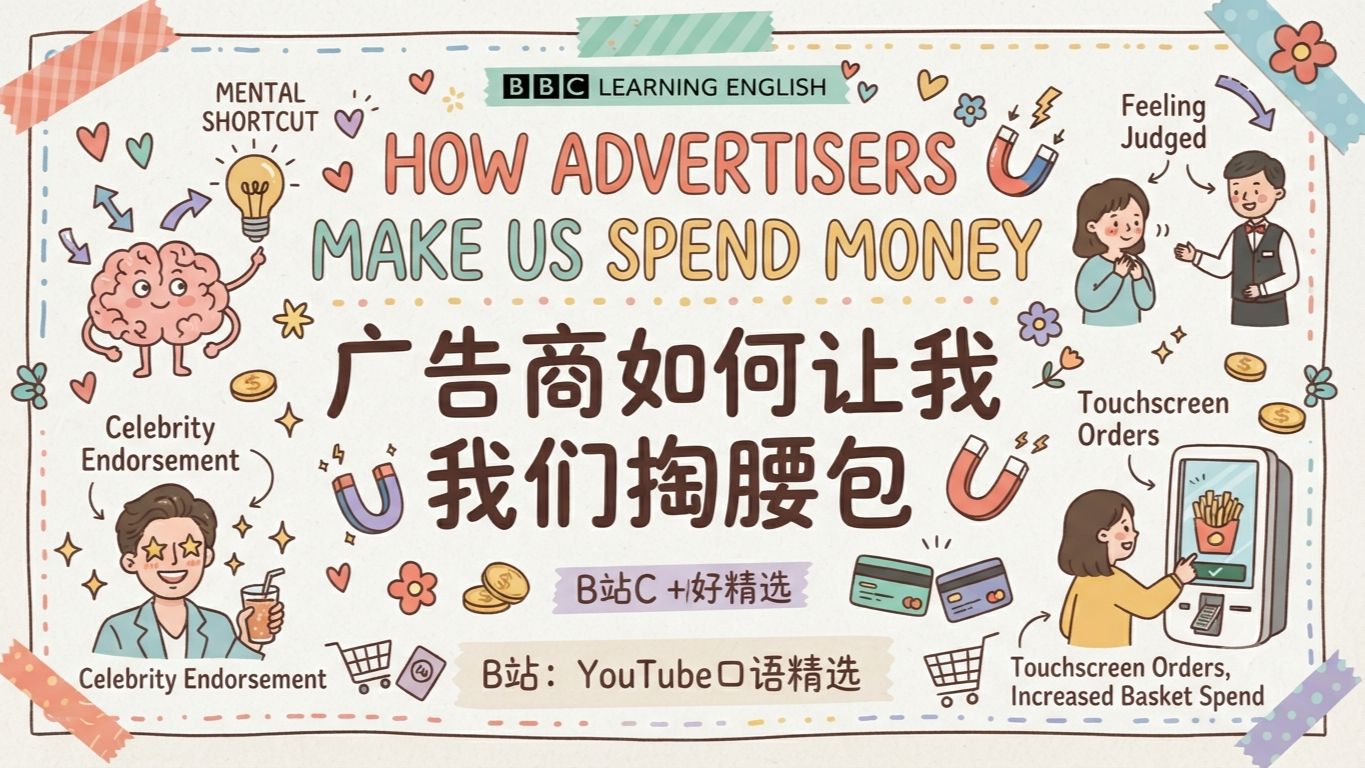
字幕摘录
| 时间 | 英文 | 中文 |
|---|---|---|
| 0:07 | Hello, this is 6 Minute English from BBC Learning English. | 你好,这是6分钟英语 从BBC学习英语。 |
| 0:11 | I'm Pippa. | 我叫皮帕,你好吗? |
| 0:12 | And I'm Phil. | 我是菲尔。 |
| 0:14 | What's the last thing you bought and why did you buy it? | 你最后买的是什么 为什么要买? |
| 0:18 | I bought a new pair of headphones recently because my old ones broke and I did lots of | 最近我买了一双耳机 因为我的旧手机坏了 我做了很多 |
| 0:24 | research to try and find a good pair. | 研究找对好夫妇 |
| 0:26 | How about you? | 你怎么样? |
| 0:28 | I bought a soft drink on the way to work this morning. | 我今早在上班的路上买了一杯软饮料 |
| 0:31 | It might be because I saw someone | 可能是因为我看到一个人 |
| 0:33 | I like promoting it in an advert. | 我喜欢在广告上宣传 |
展开字幕全文(116 条)
| 序号 | 英文 | 中文 |
|---|---|---|
| 1 | Hello, this is 6 Minute English from BBC Learning English. | 你好,这是6分钟英语 从BBC学习英语。 |
| 2 | I'm Pippa. | 我叫皮帕,你好吗? |
| 3 | And I'm Phil. | 我是菲尔。 |
| 4 | What's the last thing you bought and why did you buy it? | 你最后买的是什么 为什么要买? |
| 5 | I bought a new pair of headphones recently because my old ones broke and I did lots of | 最近我买了一双耳机 因为我的旧手机坏了 我做了很多 |
| 6 | research to try and find a good pair. | 研究找对好夫妇 |
| 7 | How about you? | 你怎么样? |
| 8 | I bought a soft drink on the way to work this morning. | 我今早在上班的路上买了一杯软饮料 |
| 9 | It might be because I saw someone | 可能是因为我看到一个人 |
| 10 | I like promoting it in an advert. | 我喜欢在广告上宣传 |
| 11 | We call this a celebrity endorsement, but why do they | 我们称之为名人认可, 但为什么他们 |
| 12 | work? | 工作吗? |
| 13 | Let's start by hearing from Ben Jones, a behavioural research expert speaking to | 我们先听听本·琼斯 行为研究专家 |
| 14 | BBC World Service programme Business Daily. | BBC世界服务节目"商业日报". |
| 15 | When we're unsure, we don't know what to do. | 当知无常无常. |
| 16 | It's kind of easy to follow the lead of those | 跟着他们走很容易 |
| 17 | who we think are credible or knowledgeable. | 我们认为他们可信或有知识。 |
| 18 | It's a mental shortcut. | 智捷径. |
| 19 | It's something that | 这是的东西 |
| 20 | helps us navigate uncertain times or make quick choices. | 帮助我们渡过不确定的时间或作出迅速的选择。 |
| 21 | We start doing that from an | 我们从一个开始做 |
| 22 | early age. | 幼儿期。 |
| 23 | Our parents, for some people, it's about our teachers. | 我们的父母,对有些人来说,这是关于我们的老师. |
| 24 | You know, these people | 你知道,这些人 |
| 25 | help us learn and make sense of the world. | 帮助我们学习和理解世界。 |
| 26 | And some businesses can draw on this through | 有些企业可以利用这个 |
| 27 | things like endorsements, you know, dentists recommending toothpaste, athletes endorsing | 比如赞成 牙医推荐牙膏 运动员推荐 |
| 28 | sportswear. | 运动服 |
| 29 | Ben says that endorsements work as a mental shortcut. | 本说背书是心理上的捷径 |
| 30 | This is something that helps us | 这对我们有帮助 |
| 31 | make a decision quickly. | 快做个决定 |
| 32 | If we trust the endorsement, then we don't need to think about it that | 如果我们相信支持,那么我们不需要考虑 |
| 33 | In this episode, we're going to look at the way that people can be convinced to do things. | 在本集中,我们将审视人们如何被说服去做事情. |
| 34 | And as usual, we'll learn some useful new words and phrases. | 并照常学习一些有用的新词和短语. |
| 35 | And remember, you'll find all the | 记住,你会找到所有 |
| 36 | bbclearningenglish.com. 请检查access-date=中的日期值 (帮助) 互联网档案馆的存檔,存档日期2011-09-02. | |
| 37 | OK, but first, I have a question for you, Pippa. | 好吧,但首先,我有一个问题给你,皮帕。 |
| 38 | Today, we're talking about behavioural | 今天,我们谈论的是行为 |
| 39 | science. | 科学。 |
| 40 | What's the name of the theory that says people respond to small prompts? | 论何名说众生应小因缘. |
| 41 | Is it | 是吗? |
| 42 | a. push theory, b. pull theory, or c. nudge theory? | a. 推力理论,b. 推力理论,或c. 推力理论? |
| 43 | Oh, I'm not sure. | 哦,我还不确定 |
| 44 | I'm going to say b. pull theory. | 我要说b. 拉理论。 |
| 45 | OK, well, we'll find out the answer at the end of the programme. | 好吧,我们会在节目结束时找到答案。 |
| 46 | In recent years, many fast food chains have installed touch screen machines for people | 近年来,许多快餐连锁店为人们安装了触摸屏机 |
| 47 | to order their food. | 以订购他们的食物。 |
| 48 | They've reported taking more money as a result. | 他们报称为此收了更多钱. |
| 49 | Could behavioural | 行为 |
| 50 | science tell us why this happens? | 科学告诉我们为什么会这样? |
| 51 | 这是产品设计师Dean Ward 和BBC说话 | |
| 52 | World Service's Business Daily. | 世界服务社商业日报. |
| 53 | Firstly, the psychology of speaking to someone and feeling judged, we think is a key factor. | 首先,与某人交谈和感觉被判断的心理学,我们认为是一个关键因素. |
| 54 | So would you like extra fried? | 要不要加点油? |
| 55 | Would you like to go large? | 你想去大吗? |
| 56 | Not all people, but I think there's | 并不是所有人, 但我认为有 |
| 57 | definitely a large proportion of people who may feel judged in those instances and may say no. | 肯定有相当一部分人 可能觉得被审判 并且可能说不。 |
| 58 | There's the fact that you've got more time to look. | 亦有汝等多时观察. |
| 59 | You can see the product, you can see what's | 你可以看到产品,你可以看到什么 |
| 60 | in it, you can see all the products linked to it as well. | 在其中,你可以看到所有的产品 与之相连。 |
| 61 | And also around upsell as well. | 上市时也有 |
| 62 | Would | 会 |
| 63 | you like to add this? | 你想加这个吗? |
| 64 | Would you like to do that? | 你想这样做吗? |
| 65 | Because you've got more time and you're not being | 因为你有更多的时间,你不是 |
| 66 | judged, you're very much more inclined to actually say yes to these things. | 判断,你更倾向于 实际答应这些事情。 |
| 67 | And that's typically what | 这通常就是 |
| 68 | we're seeing in increased basket spend of typically 25, 30 per cent. | 我们的篮子支出增加了25,30% |
| 69 | If people feel judged, then it means that they worry what other people will think of them. | 如果人们觉得有判断力,那意味着他们担心别人会怎么看待他们. |
| 70 | If we have to ask a human for extra fries, we might worry what they think of us, but no one feels | 如果我们要人多吃薯条 我们可能会担心他们对我们的看法 但没人觉得 |
| 71 | judged by a computer screen. | 由计算机屏幕判断。 |
| 72 | If you upsell something, then you get someone to spend more. | 如果你上市了,你就会有人花更多钱 |
| 73 | For example, waiters often try to get people to buy larger portions, more drinks or desserts. | 例如,服务员经常试图让人们购买更大的部分,更多的饮料或甜点. |
| 74 | Dean says that upselling can increase people's basket spend. | Dean说上市可以增加人们的篮子开支. |
| 75 | A basket spend is the total amount | 篮子是总金额 |
| 76 | that someone spends in one transaction on everything that's in their basket. | 某个人花在一个交易上 在他们篮子里的一切。 |
| 77 | Now, | 现在, |
| 78 | this is an example of a business using behavioural science to nudge people to do things. | 这是企业利用行为科学 说服人们做事的例子。 |
| 79 | But it's not just businesses that use behavioural science in this way. | 但使用行为科学的不仅仅是企业。 |
| 80 | In Tunisia, | 在突尼斯, |
| 81 | the United Nations World Food Programme wanted to encourage people to eat food together more often. | 联合国世界粮食计划署希望鼓励人们更经常地一起吃饭。 |
| 82 | They made a TV show set in a restaurant. | 他们做了一个电视节目 在一家餐厅。 |
| 83 | 让我们听听世界粮食公司的Takwa Khalifi | |
| 84 | Programme talking to BBC World Services Business Daily. | 节目与BBC世界服务商业日报对话. |
| 85 | So we needed something really creative | 所以我们需要创造力 |
| 86 | and really different to think outside of the box or to let people see themselves in those stories | 和真正不同的是思考 外的盒子 或者让人们看到自己在这些故事 |
| 87 | because people are learning and changing by imitating and modelling and observing others' | 因为人们正在学习和改变 通过模仿、建模和观察他人 |
| 88 | behaviours and others' actions and emotional reactions to things. | 行为与他人的行为和对事物的情感反应. |
| 89 | So this is why we tried | 所以这就是为什么我们尝试 |
| 90 | this project or tried this product or this TV series in order to impact people. | 为了影响人们, |
| 91 | Takwa says that they needed to think outside the box. | Takwa说他们得在盒子外思考 |
| 92 | This means to try and think in a different | 这意味着尝试和思考 在不同的 |
| 93 | way to come up with something creative. | 如何想出一些创意的东西。 |
| 94 | The TV programme leads to people modelling behaviour. | 电视节目引导人们建模行为. |
| 95 | If you model behaviour, then you behave in a way that other people can copy. | 如果你模仿行为, 那么你的行为方式 其他人可以复制。 |
| 96 | Now, Phil, I think it's time to hear the answer to your question. | 现在,菲尔,我想是时候 听到你的答案。 |
| 97 | Yes, it is. | 没错 |
| 98 | I asked what theory says that people respond to small prompts to change their behaviour. | 我问,什么理论说,人们响应小的提示来改变他们的行为。 |
| 99 | I thought it was pull theory. | 我以为是拉理论 |
| 100 | Which I'm afraid was the wrong answer. | 恐怕答案是错的 |
| 101 | Nudge | 前进 |
| 102 | theory says that people's behaviour can be changed by small prompts or nudges. | 理论说,人们的行为可以通过小提示或微调来改变. |
| 103 | OK, let's recap the vocabulary we've learned, starting with mental shortcut, | 好吧,让我们回顾一下我们学到的词汇, 从精神上的捷径开始, |
| 104 | which is something that helps us make a decision quickly, usually because we don't need to think | 这帮助我们迅速做出决定 通常因为我们不需要思考 |
| 105 | about it. | 关于它。 |
| 106 | If someone feels judged, then they're worried about what other people think about them. | 如果有人觉得受到评判,那么他们就会担心别人对他们的看法. |
| 107 | Upsell refers to persuading someone to buy something extra, like a dessert at a restaurant. | Upsell是指说服某人购买额外的东西,比如餐厅的甜点. |
| 108 | Basket spend is what you spend in one transaction, on the things in your shopping basket. | 篮子支出是你们在一个交易中 花在购物篮上的东西上 |
| 109 | If you think outside the box, then you think about something in a different way | 如果你想在盒子外面, 那你想的不一样 |
| 110 | to come up with a creative solution. | 提出一个创造性的解决办法。 |
| 111 | And finally, modelling is behaving | 最后,建模是行为 |
| 112 | in a way that others can copy. | 以别人能复制的方式 |
| 113 | Once again, our six minutes are up, but why not head over to our | 再说一遍,我们六分钟到了, 但为什么不过去我们 |
| 114 | bbclearningenglish.com网站 为本集试题问答和工作表. | |
| 115 | See you again soon. | 再会 |
| 116 | Bye. | 再见。 |
该视频共有字幕 116 条。解锁更多字幕为会员功能,请移动到 价格