TED演讲:如何有效地沟通?
字幕摘录
| 时间 | 英文 | 中文 |
|---|---|---|
| 0:05 | So I'm going to ask you to participate in an experiment, which is that when you leave | 所以我要请你参加一个实验 就是当你离开的时候 |
| 0:11 | this room, when you go out into the world today, tomorrow, whenever you feel like it, | 这个房间,当你走出去 在今天,明天, 当你喜欢它, |
| 0:16 | I'd like you to ask and answer one question of someone who's a stranger. | 请师问一问如何是陌生人. |
| 0:22 | You might meet them on the bus, you might meet them walking down the street, and I'm | 你可能会在巴士上遇到他们, 你可能会遇到他们走在街上,我 |
| 0:25 | going to show you the question that I'm going to ask you to ask and answer. | 让你看看我要问你的问题 问和回答 |
| 0:28 | The question is, when was the last time you cried in front of someone? | 问题是 你最后一次在别人面前哭是什么时候? |
| 0:34 | Now just out of curiosity, how many of you are really excited about this experiment? | 现在只是出于好奇, 你们有多少人真的对这个实验感到兴奋? |
| 0:39 | No hands went up whatsoever. | 手都不举 |
| 0:42 | And that makes sense, right, because there can be nothing that seems more intimidating | 这很合理,没错 因为没有什么比这更吓人的了 |
| 0:46 | or less fun than finding a stranger, asking them when they've cried in front of someone | 或者比找到陌生人更有趣 当他们在别人面前哭的时候问他们 |
展开字幕全文(214 条)
| 序号 | 英文 | 中文 |
|---|---|---|
| 1 | So I'm going to ask you to participate in an experiment, which is that when you leave | 所以我要请你参加一个实验 就是当你离开的时候 |
| 2 | this room, when you go out into the world today, tomorrow, whenever you feel like it, | 这个房间,当你走出去 在今天,明天, 当你喜欢它, |
| 3 | I'd like you to ask and answer one question of someone who's a stranger. | 请师问一问如何是陌生人. |
| 4 | You might meet them on the bus, you might meet them walking down the street, and I'm | 你可能会在巴士上遇到他们, 你可能会遇到他们走在街上,我 |
| 5 | going to show you the question that I'm going to ask you to ask and answer. | 让你看看我要问你的问题 问和回答 |
| 6 | The question is, when was the last time you cried in front of someone? | 问题是 你最后一次在别人面前哭是什么时候? |
| 7 | Now just out of curiosity, how many of you are really excited about this experiment? | 现在只是出于好奇, 你们有多少人真的对这个实验感到兴奋? |
| 8 | No hands went up whatsoever. | 手都不举 |
| 9 | And that makes sense, right, because there can be nothing that seems more intimidating | 这很合理,没错 因为没有什么比这更吓人的了 |
| 10 | or less fun than finding a stranger, asking them when they've cried in front of someone | 或者比找到陌生人更有趣 当他们在别人面前哭的时候问他们 |
| 11 | else, and then telling them about the time you cried in front of someone else. | 然后告诉他们你在别人面前哭的时候 |
| 12 | But I'm going to try and convince you over the next few minutes that this experiment | 但我会试着说服你 在接下来的几分钟 这个实验 |
| 13 | is not only worth doing, it's worth doing whenever you can, because it will make your | 不仅值得做,它值得做 只要可以,因为它会使你 |
| 14 | life better. | 生活会更好。 |
| 15 | And to explain how I got to this, I have to tell you a little bit of a story about me | 为了解释我是怎么做到的 我必须告诉你一些关于我的故事 |
| 16 | and my wife. | 还有我的妻子 |
| 17 | A few years ago, we got into this bad pattern. | 几年前,我们陷入了这种糟糕的模式。 |
| 18 | We've been married for 20 years, but I would come home from a long day at the office, I | 我们已经结婚20年了, 但我会从一个漫长的一天回家 在办公室,我 |
| 19 | was a reporter at the New York Times at that point, and I would start complaining about | 那时是纽约时报的记者 我开始抱怨 |
| 20 | my day, about how I'm not appreciated enough, and my wife very reasonably would offer me | 我一天,关于我如何不够感激, 我的妻子非常合理会给我 |
| 21 | some great advice. | 一些伟大的建议。 |
| 22 | She would say something like, why don't you take your boss out to lunch, and you guys | 她会说一些类似的东西, 你为什么不带你的老板出去 午餐,和你们 |
| 23 | can get to know each other a little bit better. | 可以更了解对方 |
| 24 | And instead of being able to hear her, I would get even more upset. | 而不是能听到她的声音 我会更难过 |
| 25 | And I would say things like, why aren't you supporting me? | 我会说一些事情,比如, 你为什么不支持我? |
| 26 | You should be outraged on my behalf. | 你应该为我感到愤慨 |
| 27 | And she would get upset because I was attacking her for giving me good advice. | 她会不高兴 因为我在攻击她 因为给了我好的建议 |
| 28 | This was not, anyone ever have an experience like this? | 没有,有人有过这样的经历吗? |
| 29 | It was not in a good situation. | 情况不妙 |
| 30 | And so I went and I started talking to researchers who were studying communication. | 于是我开始和研究交流的研究人员交谈。 |
| 31 | I asked them, why am I getting into this pattern? | 我问他们,我为什么要进入这种模式? |
| 32 | And they said, well, you're making a mistake. | 他们说 你犯了一个错误 |
| 33 | We're living through this golden age of understanding communication, really for the first time because | 我们生活在这个理解沟通的黄金时代, 真的第一次是因为 |
| 34 | of advances in neural imaging and data collection. | 神经成像和数据收集方面的进展。 |
| 35 | And they said, one of the big things that we've learned is that we tend to think of | 他们说,我们学到的一件大事 就是我们倾向于思考 |
| 36 | a discussion as being just one conversation, right? | 讨论只是一次谈话,对吧? |
| 37 | We're talking about one thing, my day, or the kid's grades, what to have for dinner. | 我们谈论一件事,我的一天, 或孩子的成绩, 吃什么晚餐。 |
| 38 | But what they said is that actually each discussion contains many different conversations. | 但他们说,实际上每次讨论都包含许多不同的对话。 |
| 39 | And in general, these conversations tend to fall into one of three buckets. | 而一般来说,这些对话往往会掉入三桶中的一桶. |
| 40 | There's these practical conversations, where we're talking about what's this all about? | 有这些实际的对话, 在那里我们谈论这是怎么回事? |
| 41 | What are we really discussing? | 我们到底在讨论什么? |
| 42 | But then there's emotional conversations, where we're talking about how do we feel? | 但接下来是情感对话, 在那里我们谈论 我们的感受? |
| 43 | And my goal is to share with you my feelings, and I don't want you to solve them. | 我的目标是与你分享我的感受, 我不想你解决它们。 |
| 44 | I want you to empathize. | 我要你同情我 |
| 45 | And then there's conversations that are social conversations about who we are, | 之后还有关于我们身份的社交对话 |
| 46 | the social identities that are important to us, | 对我们很重要的社会特性, |
| 47 | how we relate to each other, and how we relate to society. | 我们如何彼此联系,如何与社会联系。 |
| 48 | And what the researchers said is what we've learned is that if people are having | 研究人员说,我们学到的是 如果人们有 |
| 49 | different conversations at the same moment, they can't really hear each other. | 不同的对话在同一时刻, 他们不能真正听到对方。 |
| 50 | They can't really connect. | 他们不能真正连接。 |
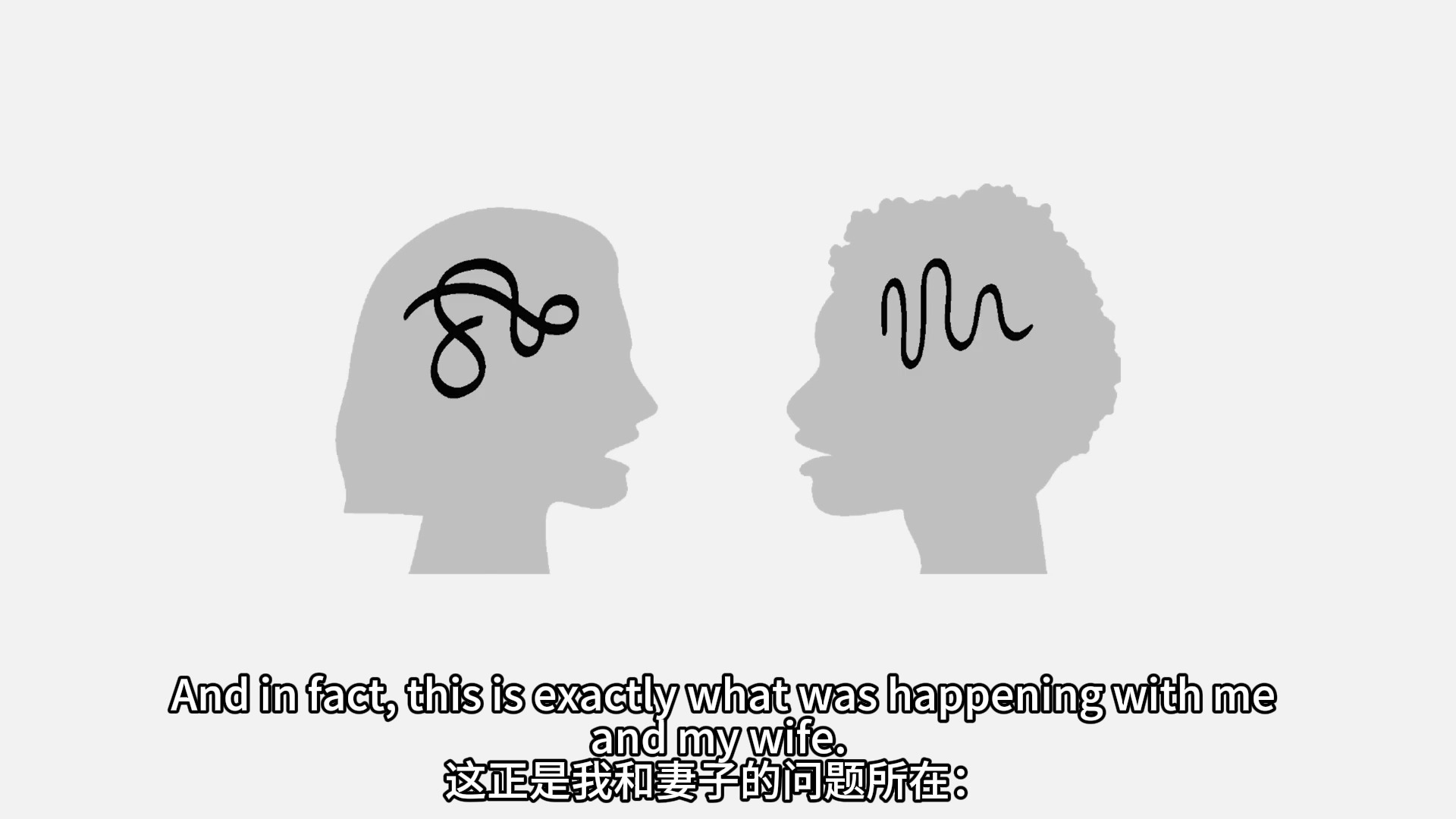
| 51 | And in fact, this is exactly what was happening with me and my wife, right? | 事实上,这就是我和我妻子发生的事,对吧? |
| 52 | I was coming home and having an emotional conversation. | 我回到家 并有一个情感谈话。 |
| 53 | My wife was responding with a practical conversation. | 我妻子在回答 一个实际的谈话。 |
| 54 | They are both legitimate conversations. | 他们都是合法的对话。 |
| 55 | But because we weren't having the same conversation at the same moment, | 但是,因为我们不是 在同一时刻, |
| 56 | we weren't really communicating with each other. | 我们没有真正沟通对方。 |
| 57 | And within neurology and psychology, this insight is known as the matching principle, | 在神经学和心理学中 这种洞察力被称为匹配原理 |
| 58 | which says that successful communication requires recognizing what kind of | 它说,成功的沟通需要认识到什么样的 |
| 59 | conversation is occurring and then matching each other. | 正在进行对话,然后相互匹配。 |
| 60 | But how do we do that? | 但是我们要怎么做呢? |
| 61 | Well, in schools, they've actually taught teachers to do this. | 嗯,在学校里,他们实际上教教师这样做。 |
| 62 | If you are a school teacher, and you'll probably learn at some point that if a | 如果你是学校的老师 你可能会在某个时候学会 |
| 63 | student comes up to you with a problem or they want something they want to talk | 学生找上你,或者他们想谈点什么 |
| 64 | about, you should ask them, do you want to be helped, which is a practical | 关于,你应该问他们, 你想得到帮助, 这是一个实用的 |
| 65 | conversation, do you want to be hugged, which is an emotional conversation, or | 谈话,你想被拥抱吗? |
| 66 | do you want to be heard, which is a social conversation? | 你想听吗? 社会对话? |
| 67 | And it seems to work. | 似乎还行 |
| 68 | It seems like if you ask students what they need, they'll tell you. | 似乎如果你问学生需要什么 他们会告诉你的 |
| 69 | But of course, that is hard to do in real life, right? | 当然,这在现实生活中是很难做到的,对吧? |
| 70 | If you go up and you ask someone at work if they want to hug, | 如果你上楼去问上班的人 想抱抱的话 |
| 71 | the HR might get involved, so you might not want to do that. | HR可能会介入, 所以你可能不想这样做。 |
| 72 | But luckily, there is another way of doing this for all of us normal people, | 但幸运的是,还有另一种方式 为我们所有正常人这样做, |
| 73 | which is to ask questions. | 就是问问题 |
| 74 | And in particular, to ask a certain type of question, | 尤其是,为了问一个问题, |
| 75 | a special question, what's known as a deep question. | 一个特别的问题,什么叫做深层问题。 |
| 76 | A deep question is something that invites us to talk about our values or | 一个很深的问题,就是让我们谈谈我们的价值观 |
| 77 | our beliefs or our experiences. | 我们的信仰或经验 |
| 78 | And that can sound a little intimidating, but | 这听起来有点吓人,但是... |
| 79 | it's actually much easier than it sounds. | 其实比听起来容易得多 |
| 80 | For instance, instead of asking someone, where do you work? | 比方说,与其问别人,你在哪里工作? |
| 81 | You could ask them, what do you love about your job? | 你可以问他们,你喜欢什么工作? |
| 82 | Instead of asking someone, where did you go to high school? | 而不是问别人,你在哪里上高中? |
| 83 | You could say, what was high school like? | 高中是怎样的? |
| 84 | Wait, what did you learn there? | 等等,你在那里学到了什么? |
| 85 | What changed you there? | 什么改变了你在那里? |
| 86 | Put differently, instead of asking about the facts of someone's life, | 换句话说 而不是问别人生活的事实 |
| 87 | we should ask them how they feel about their life. | 我们应该问他们对自己生活的感受 |
| 88 | Because when we do, they tend to reveal to us who they really are. | 因为当我们这样做, 他们倾向于向我们揭示他们的真实身份。 |
| 89 | They tend to tell us what they want not only out of this conversation, but | 他们往往告诉我们他们想要的 不仅仅是这次谈话,而是 |
| 90 | how they hope that we'll see them and how they want to see us. | 他们希望我们能见到他们 他们希望我们见到他们 |
| 91 | What matters to them most? | 他们最关心的是什么? |
| 92 | In fact, what studies show us is that this is so | 事实上,研究表明,这是如此 |
| 93 | powerful because these kinds of questions allow us to be vulnerable. | 因为这些问题让我们变得脆弱。 |
| 94 | And vulnerability and reciprocal vulnerability. | 以及脆弱性和相互脆弱性。 |
| 95 | When we hear vulnerability and we become vulnerable in return, | 当我们听到脆弱和 我们变得脆弱 作为回报, |
| 96 | is the key to allowing us to connect with other people. | 是让我们和别人联系的关键 |
| 97 | And explain how this works. | 并解释如何运作. |
| 98 | I want to tell you a story about this guy, Dr. Bifar Adai. | 我想告诉你关于这个家伙的故事 比法尔·阿代博士 |
| 99 | Dr. Adai is a cancer surgeon in New York City. | 阿黛医生是纽约市的癌症外科医生. |
| 100 | He specializes in prostate cancer, | 他专门研究前列腺癌, |
| 101 | removing prostate tumor, removing cancer tumors from prostates. | 移除前列腺肿瘤,去除前列腺的癌症肿瘤. |
| 102 | And he has this kind of interesting job, because every single day, | 他有这种有趣的工作, 因为每一天, |
| 103 | a patient will come into his office asking, he thinks, for medical advice. | 一个病人会来他的办公室 问,他认为, 寻求医疗建议。 |
| 104 | And what he will tell them is, you should not get surgery. | 他会告诉他们,你不应该做手术。 |
| 105 | The prostate is located so | 前列腺的位置是这样的 |
| 106 | close to the nerves that control urination and sexual function, | 接近控制排尿和性功能的神经, |
| 107 | that it's a relatively risky surgery. | 这是一个相对危险的手术。 |
| 108 | And what's more, most prostate tumors, they grow very, very slowly. | 还有,大多数前列腺肿瘤, 它们生长得非常,非常缓慢。 |
| 109 | It's actually one of the slowest growing forms of cancer in existence. | 它实际上是现存最慢的生长型癌症之一. |
| 110 | There's a saying among doctors that if you have an old patient with prostate | 医生们有句话说 如果你有一个前列腺老病人 |
| 111 | cancer, he's going to die of old age before the cancer kills him. | 癌症,他会在癌症杀死他之前 死于老年。 |
| 112 | And so Dr. Adai would have these patients come in and | 所以Adai医生会让这些病人进来 |
| 113 | he would tell them, look, I don't think you should do anything. | 他告诉他们,你看, 我不认为你应该做任何事情。 |
| 114 | In fact, I think you should do this thing called active surveillance. | 事实上,我觉得你应该 做这个叫做主动监视的东西。 |
| 115 | What we're going to do is we're going to take a blood sample every six months. | 我们要做的是 每六个月抽血一次 |
| 116 | We're going to do a biopsy every two years. | 我们每两年做一次活体检查 |
| 117 | And if the tumor seems to change, we'll do an MRI. | 如果肿瘤看起来变了 我们会做核磁共振 |
| 118 | And if we have to, we can do the surgery. | 如果有必要,我们可以做手术。 |
| 119 | But otherwise, no radiation, no surgery, it's going to be okay. | 但否则,没有辐射,没有手术,一切都会好起来的. |
| 120 | And these patients would listen to him, and then they would go home, and | 这些病人会听他的 然后他们就会回家 |
| 121 | they would discuss it with their spouse. | 他们会和他们的配偶讨论 |
| 122 | And then they would walk in the next day, and | 然后他们会在第二天走, |
| 123 | they would insist on having the surgery. | 他们坚持要手术 |
| 124 | They would say, I absolutely want you to cut me open, | 他们会说,我绝对希望你把我切开, |
| 125 | take the tumor out as fast as possible. | 尽快把肿瘤取出来 |
| 126 | And for Dr. Adai, this was bewildering, right? | 对Adai医生来说,这太不可思议了,对吧? |
| 127 | He thought these would be the easiest conversations of his life. | 他认为这是他一生中最简单的谈话. |
| 128 | He's telling people that they don't have to have surgery, and he's a surgeon. | 他告诉人们他们不需要手术,他是一个外科医生. |
| 129 | He told me that when this happens again, and again, and again, | 他告诉我,当这种情况再次发生, 一遍又一遍, |
| 130 | you start to realize this isn't a problem with my patients. | 你开始意识到这跟我的病人没有关系 |
| 131 | This is a problem with me, I'm doing something wrong. | 我有点问题,我做错了什么 |
| 132 | And so he goes to these folks, these professors at the Harvard Business School, | 所以他去找这些人 哈佛商学院的教授 |
| 133 | and he asks them for advice on what to do differently. | 他问他们 如何做不同的。 |
| 134 | And they said, well, look, the biggest mistake that you're making is you are | 他们说,你看,你最大的错误是 你是 |
| 135 | starting this conversation all wrong. | 开始这个对话都是错误的。 |
| 136 | You are starting by assuming that the patient walks into your room, | 你首先假设病人走进你的房间 |
| 137 | into your exam room, looking for advice and looking for medical solutions. | 进入你的检查室, 寻找建议和医疗解决方案。 |
| 138 | But you don't know if that's true, you're not asking them any questions. | 但你不知道这是否是真的, 你没有问他们任何问题。 |
| 139 | What you need to do is you need to start asking deep questions. | 你需要做的是,你需要开始问 深刻的问题。 |
| 140 | So two weeks later, after having this conversation, | 两周后,经过这次谈话 |
| 141 | a 62 year old man comes into Dr. Adai's office for the first time. | 一个62岁的老人第一次来到Adai医生的办公室 |
| 142 | He had just gotten his diagnosis of having prostate cancer. | 他刚刚被诊断患有前列腺癌 |
| 143 | And Dr. Adai, instead of giving him advice, | 还有阿黛博士 而不是给他建议 |
| 144 | instead of telling him what he ought to do, he asks the question. | 他没有告诉他应该做什么 而是问问题 |
| 145 | He asks the question, what does this cancer diagnosis mean to you? | 他问,这个癌症诊断对你意味着什么? |
| 146 | And the man starts talking, and he starts talking about how | 男人开始说话, 他开始谈论如何 |
| 147 | his father had died when he was 17 years old. | 他的父亲在17岁时就去世了。 |
| 148 | And this had just been so hard for him, and it had been so hard for his mom. | 这对他来说太难了 对他妈妈来说也太难了 |
| 149 | And then he starts talking about his grandchildren and | 然后他开始谈论他的孙子和 |
| 150 | his fears for the world they're inheriting, what with climate change and | 他对世界的恐惧 他们继承, 气候变化和 |
| 151 | everything else that's going on. | 一切众生. |
| 152 | Dr. Adai had expected this guy to at least bring up cancer, | Adai医生预计这家伙至少会患上癌症 |
| 153 | to at least mention mortality or pain, but it never came up. | 至少提到死亡或痛苦,但它从来没有出现。 |
| 154 | And at that moment, Dr. Adai realized, because he had asked this deep question, | 当时,阿代博士意识到 因为他问了这个很深的问题 |
| 155 | that this man wanted to have an emotional conversation. | 这个人想有一个情感对话。 |
| 156 | He wanted to talk about, how do we feel? | 他想谈谈 我们感觉如何? |
| 157 | He needed to be hugged. | 他需要被拥抱。 |
| 158 | And so Dr. Adai didn't actually hug him, right? | 所以Adai医生其实没有拥抱他 对吧? |
| 159 | But he did the verbal equivalent. | 但他做了相当于口头的。 |
| 160 | And then Dr. Adai says, look, do you mind? | 然后Adai医生说,你介意吗? |
| 161 | There's some medical options I'd like to talk over with you. | 有一些医学选择 我想和你谈谈。 |
| 162 | Is that okay? | 可以吗? |
| 163 | And they move into a practical conversation together, and | 他们一起开始实际对话, |
| 164 | within seven more minutes, the man decides to do active surveillance and | 在7分钟内,他决定进行主动监视 |
| 165 | never looks back. | 从不回头 |
| 166 | Dr. Adai's patients overwhelmingly now opt for active surveillance, | Adai医生的病人现在绝大多数选择主动监视 |
| 167 | his advice, because of this approach. | 他的建议,因为这个方法。 |
| 168 | And the thing is, we can do this in any conversation. | 问题是,我们可以在任何谈话中做到这一点。 |
| 169 | It doesn't have to be an important conversation. | 这不一定是一个重要的谈话 |
| 170 | It doesn't have to be life or death. | 不须生死. |
| 171 | We can always connect more and better, and | 我们总是可以连接 更多更好的, |
| 172 | in a really profound way with the person that we're speaking to, if we want to. | 以非常深刻的方式 与我们说话的人 如果我们想。 |
| 173 | Which brings me back to that experiment. | 这让我回到那个实验。 |
| 174 | So just to remind you what you're supposed to do, walk out of the room, | 所以为了提醒你 你该做什么 走出房间 |
| 175 | find a stranger, ask them, when was the last time you cried in front of someone? | 找到陌生人,问他们 你最后一次在别人面前哭是什么时候? |
| 176 | And then as soon as they answer, | 然后一旦他们回答, |
| 177 | you answer the question yourself and you tell them when you last cried. | 你自己回答问题 然后在上次哭的时候告诉他们 |
| 178 | Let me just say, this experiment has been done thousands and thousands of times, | 让我说,这个实验 已经做了上千次了, |
| 179 | most notably by a guy named Nick Epley at the University of Chicago. | 芝加哥大学的一个叫尼克·艾普利的家伙 |
| 180 | People hate this experiment. | 人们讨厌这个实验。 |
| 181 | Nobody who participates comes in and is like, I'm really looking, | 没有人参与进来,就像,我真的在看, |
| 182 | this is going to be a great time. | 这将是一个伟大的时间。 |
| 183 | Instead, what they say is, I do not want to do this. | 相反,他们说,我不想这样做。 |
| 184 | This sounds terrible. | 这听起来很可怕。 |
| 185 | But they're in an experiment, they basically have to do it, right? | 但他们在实验中, 他们基本上必须做到这一点,对不对? |
| 186 | They're in the room, they get paired with a partner. | 他们在房间里,他们和一个搭档配对。 |
| 187 | They go and they ask a question, ask an answer. | 他们去问一个问题,问一个答案。 |
| 188 | And then Nick Epley afterwards asks them, what was that like? | 然后Nick Epley问他们,那是什么感觉? |
| 189 | And what people say are things like, my gosh, I felt so connected to that person, | 人们说的就像,我的天啊, 我觉得和那个人有如此的关联, |
| 190 | more connected than to people in other conversations in a while. | 在一段时间里,比其他谈话中的人更能联系. |
| 191 | I felt more caring towards them and I felt like they were really caring about me. | 我觉得更关心他们 我觉得他们真的很关心我 |
| 192 | So why, why is this so powerful? | 那么,为什么,这是为什么如此强大? |
| 193 | Why is asking this question, why does it help us connect so well? | 为什么问这个问题,它为什么帮助我们如此连接? |
| 194 | Because it's a deep question. | 因甚深问. |
| 195 | It allows us to say something real. | 它允许我们说一些真实的话。 |
| 196 | And when we ask deep questions, | 当我们问到深刻的问题时, |
| 197 | we figure out which of the three conversations we're in. | 找出我们三个对话中的哪个 |
| 198 | What we're talking about, what everyone really wants out of this dialogue. | 我们所谈论的,每个人真正想要的,从这个对话中. |
| 199 | And that is how we connect with each other. | 这就是我们彼此联系的方式。 |
| 200 | We are living through a time of polarization and division. | 我们生活在两极分化和分裂的时代。 |
| 201 | We have forgotten how to have conversations. | 我们忘记了如何对话。 |
| 202 | But there's a science to it. | 但有学问. |
| 203 | There are these folks who are known as super communicators, | 这些人被称为超级通讯员 |
| 204 | who, they are not special, they're not more charismatic, or | 他们不是特别的 他们不是更有魅力的 |
| 205 | they're not, they're not more outgoing than anyone else. | 他们没有,他们没有比任何其他人 更多的离开。 |
| 206 | They've just learned skills that allow us to connect with others. | 他们刚刚学会了能让我们与其他人联系的技能. |
| 207 | And they're skills that all of us can learn. | 这些都是我们所有人都能学习的技能。 |
| 208 | And that feeling you get after a wonderful conversation, | 和那种感觉 你得到一个美妙的谈话, |
| 209 | that glow that you experience, our brains have evolved to give us that, | 你经历的光芒, 我们的大脑进化给我们, |
| 210 | to crave connection. | 想要连接。 |
| 211 | So I hope you go out, I hope you find a stranger, and | 所以我希望你出去, 我希望你找到一个陌生人, |
| 212 | I hope you tell them all about the last time you cried in front of another person. | 我希望你告诉他们 你最后一次在别人面前哭的时候 |
| 213 | And then tell me how it went. | 然后告诉我情况如何。 |
| 214 | Thanks. | 谢谢 |
该视频共有字幕 214 条。解锁更多字幕为会员功能,请移动到 价格