TED演讲:ai_生成的生物帮助我们拓宽想象的边界
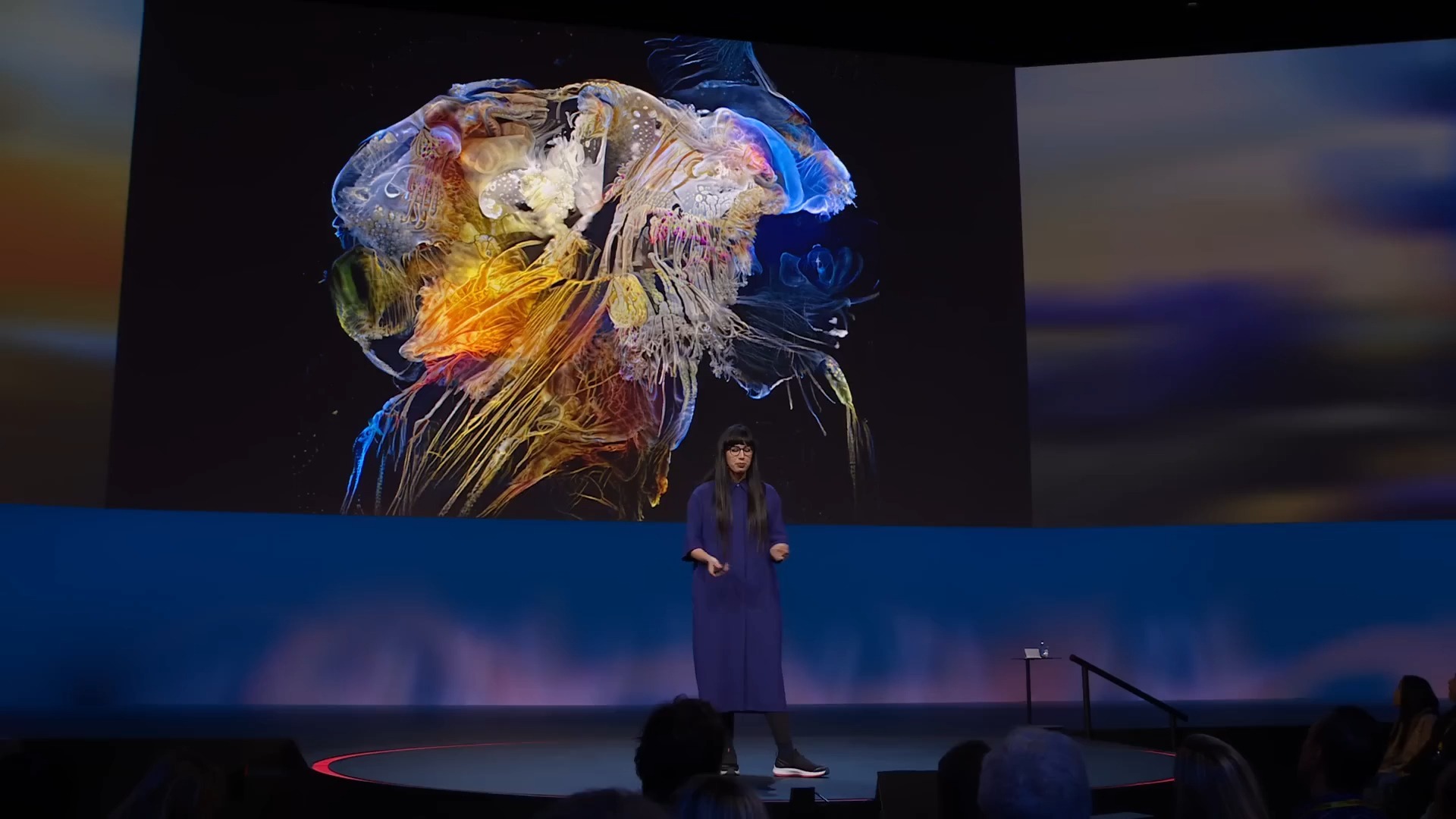
字幕摘录
| 时间 | 英文 | 中文 |
|---|---|---|
| 0:04 | I'd like to start by asking you to imagine a color | 我首先要请你想象一种颜色 |
| 0:09 | that you've never seen before. | 你从来没有见过。 |
| 0:12 | Just for a second, give this a try. | 就一会,试试看 |
| 0:15 | Can you actually visualize a color that you've never been able to perceive? | 你能想象出你从未察觉到的颜色吗? |
| 0:21 | I never seem to get tired of trying this, | 我从不厌倦尝试这个 |
| 0:23 | although I know it's not an easy challenge. | 虽然我知道这不是一个容易的挑战。 |
| 0:26 | And the thing is, we can imagine something | 问题是,我们可以想象一些东西 |
| 0:30 | without drawing upon our experiences. | 而不借鉴我们的经验。 |
| 0:33 | A color we haven't yet seen outside the spectrum we can perceive | 我们还没有见过的颜色 在光谱之外,我们可以看到 |
| 0:38 | is outside our ability to conjure up. | 是我们无法想象的 |
展开字幕全文(141 条)
| 序号 | 英文 | 中文 |
|---|---|---|
| 1 | I'd like to start by asking you to imagine a color | 我首先要请你想象一种颜色 |
| 2 | that you've never seen before. | 你从来没有见过。 |
| 3 | Just for a second, give this a try. | 就一会,试试看 |
| 4 | Can you actually visualize a color that you've never been able to perceive? | 你能想象出你从未察觉到的颜色吗? |
| 5 | I never seem to get tired of trying this, | 我从不厌倦尝试这个 |
| 6 | although I know it's not an easy challenge. | 虽然我知道这不是一个容易的挑战。 |
| 7 | And the thing is, we can imagine something | 问题是,我们可以想象一些东西 |
| 8 | without drawing upon our experiences. | 而不借鉴我们的经验。 |
| 9 | A color we haven't yet seen outside the spectrum we can perceive | 我们还没有见过的颜色 在光谱之外,我们可以看到 |
| 10 | is outside our ability to conjure up. | 是我们无法想象的 |
| 11 | It's almost like there's a boundary to our imagination, | 这几乎就像有一个界限 我们的想象, |
| 12 | where all the colors we can imagine | 在那里我们可以想象所有的颜色 |
| 13 | can only be various shades of other colors we have previously seen. | 只能是我们以前见过的其他颜色的 各种阴影 |
| 14 | Yet, we know for a fact | 然而,我们知道一个事实 |
| 15 | that those color frequencies outside our visible spectrum are there. | 我们可见光谱以外的颜色频率就在那里 |
| 16 | And scientists believe that there are species | 科学家相信有种 |
| 17 | that have many more photoreceptors | 拥有更多的光受体 |
| 18 | than just the three color ones we humans have, | 不只是我们人类的三种颜色 |
| 19 | which, by the way, not all humans see the world in the same way. | 顺便说一句,并不是所有人类都以同样的方式看待世界。 |
| 20 | Some of us are colorblind to various degrees, | 我们有些人是不同程度的色盲 |
| 21 | and very often, we don't even agree on small things, | 经常,我们甚至没有同意 小事情, |
| 22 | like if a dress on the internet is blue and black or white and gold. | 就像网上的裙子是蓝色、黑色、白色、金色 |
| 23 | But my favorite creature, one of my favorite creatures, | 但我最喜欢的生物, 我最喜欢的生物之一, |
| 24 | is the peacock mantis shrimp, | 是孔雀的蟑螂虾, |
| 25 | which is estimated to have 12 to 16 photoreceptors, | 估计有12至16个光受体, |
| 26 | and that indicates the world to them might look so much more colorful. | 这表明世界对他们来说可能看起来更多彩 |
| 27 | So what about artificial intelligence? | 那人工智能怎么办? |
| 28 | Can AI help us see beyond our human capabilities? | AI能帮助我们超越人的能力吗? |
| 29 | Well, I've been working with AI for the past five years, | 我和AI合作了五年了 |
| 30 | and in my experience, it can see within the data. | 根据我的经验,它可以看到数据。 |
| 31 | It gets fed. | 受供养. |
| 32 | But then you might be wondering, | 但你可能会想, |
| 33 | okay, if AI can't help imagine anything new, | 好吧,如果AI不能 帮助想象什么新的, |
| 34 | why would an artist see any point in using it? | 艺术家为什么要用它呢? |
| 35 | And my answer to that is because I think that it can help | 而我的答案是 因为我认为它能帮助 |
| 36 | as there's value in creating combinations of known elements | 因为创造已知元素的组合有价值 |
| 37 | to form new ones. | 组成新的。 |
| 38 | And this boundary of what we can imagine, | 而我们能够想象的边界 |
| 39 | based on what we have experienced, | 根据我们的经历, |
| 40 | is the place that I have been exploring. | 就是我一直在探索的地方 |
| 41 | For me, it started with jellyfish on a screen at an aquarium | 对我来说,它从水母开始 在水族馆的屏幕上 |
| 42 | and wearing those old 3D glasses, | 戴着那三维眼镜 |
| 43 | which I hope you remember, the ones with the blue and red lens. | 我希望你记得 那些蓝红镜头的 |
| 44 | And this experience made me want to recreate their textures. | 这种经历让我想重塑他们的纹理。 |
| 45 | But not just that, | 但不只是这样 |
| 46 | I also wanted to create new jellyfish that I hadn't seen before, | 我也想创造出以前没见过的新水母 |
| 47 | like these. | 像这样 |
| 48 | And we started with jellyfish very quickly, | 我们从水母开始 很快, |
| 49 | escalated to other sea creatures, | 升级为其他海洋生物, |
| 50 | like sea anemone, coral, and fish. | 像海葵、珊瑚和鱼一样 |
| 51 | And then from there came amphibians, birds, and insects. | 然后从那里出现了两栖动物,鸟类和昆虫. |
| 52 | And this became a series called Neural Zoo. | 这成为了一个叫做神经动物园的系列. |
| 53 | But when you look closely, what do you see? | 但是当你仔细观察, 你看到什么? |
| 54 | There's no single creature in these images. | 这些图像中没有单一的生物. |
| 55 | And AI augments my creative process | 人工智能能增强我的创造力 |
| 56 | by allowing me to distill and recombine textures. | 允许我蒸馏和重新压缩纹理 |
| 57 | And that's something that would otherwise take me months to draw by hand, | 如果那样的话,我需要几个月的时间 才能用手画出来, |
| 58 | plus I'm actually terrible at drawing. | 况且我画画不好 |
| 59 | So you could say, in a way, what I'm doing | 所以你可以说,在某种程度上,我在做什么 |
| 60 | is a contemporary version of something | 是当代版本的东西 |
| 61 | that humans have already been doing for a long time, | 人类已经做了很长时间, |
| 62 | even before cameras existed. | 甚至在摄像机存在之前 |
| 63 | In medieval times, people went on expeditions, | 在中世纪,人们去探险, |
| 64 | and when they came back, | 当他们回来的时候, |
| 65 | they would share about what they saw to an illustrator. | 他们会告诉一个插画家他们所看到的 |
| 66 | And the illustrator, having never seen what was being described, | 和插画家,从来没有见过什么 是描述, |
| 67 | would end up drawing based on the creatures that they had previously seen. | 最终会根据他们之前看到的生物来画画 |
| 68 | And in the process, creating a hybrid animal of some sort. | 在这个过程中,创造了某种杂交动物。 |
| 69 | So an explorer might describe a beaver, | 所以探险家可以描述海狸 |
| 70 | but having never seen one, the illustrator might give it the head of a rodent, | 但从未见过, 插画家可能会把它给一个啮齿动物的头, |
| 71 | the body of a dog, and a fish-like tail. | 狗的躯体和鱼的尾巴 |
| 72 | In this series, Artificial Natural History, | 在这个系列中,人工自然史, |
| 73 | I took thousands of illustrations from natural history archives, | 我从自然历史档案中提取了数千幅插图 |
| 74 | and I fed them to a neural network to generate new versions of them. | 我把它们喂进神经网络 以生成新版本 |
| 75 | But up until now, all my work was done in 2D. | 但直到现在,我所有的工作都在2D完成. |
| 76 | And with the help of my studio partner, Felicán McCormick, | 在我的摄影棚搭档费利坎·麦考密克的帮助下 |
| 77 | we decided to train a neural network on a dataset of 3D-scanned beetles. | 我们决定训练一个神经网络 在3D扫描甲虫的数据集。 |
| 78 | But I must warn you that our first results were extremely blurry, | 但我必须警告你 我们的最初结果非常模糊 |
| 79 | and they looked like the blobs you see here. | 他们看起来像你在这里看到的斑点。 |
| 80 | And this could be due to many reasons, | 这可能是由于很多原因, |
| 81 | but one of them being that there aren't really a lot of | 其中一个是,没有多少 |
| 82 | openly available datasets of 3D insects. | 3D昆虫的公开数据集. |
| 83 | And also, we were repurposing a neural network | 还有,我们重新使用神经网络 |
| 84 | that normally gets used to generate images to generate 3D. | 通常用于生成图像生成3D。 |
| 85 | So believe it or not, these are very exciting blobs to us. | 信不信由你 这些对我们来说非常刺激 |
| 86 | But with time and some very hacky solutions like data augmentation, | 但随着时间的流逝 和一些非常黑客化的解决方案 比如数据增强, |
| 87 | where we threw in ants and other beetle-like insects to enhance the dataset, | 我们扔进蚂蚁和其他类似甲虫的昆虫 来增强数据集, |
| 88 | we ended up getting this, | 我们最终得到了这个, |
| 89 | which we've been told they look like grilled chicken. | 我们被告知他们看起来像烤鸡 |
| 90 | Hungry for more, we pushed our technique, | 饿了,我们推了我们的技巧, |
| 91 | and eventually, they ended up looking like this. | 最后,他们最终 看起来像这样。 |
| 92 | We used something called 3D style transfer to map textures onto them, | 我们用一种叫做3D风格的调剂 将纹理映射到它们身上 |
| 93 | and we also trained a natural language model | 我们还训练了一个自然语言模型 |
| 94 | to generate scientific-like names and anatomical descriptions. | 生成类似科学的名称和解剖学描述。 |
| 95 | And eventually, we even found a network architecture | 最后,我们甚至找到了一个网络架构 |
| 96 | that could handle 3D meshes, so they ended up looking like this. | 它可以处理3D meshes, 所以他们最后看起来像这样。 |
| 97 | And for us, this became a way of creating kind of a speculative study. | 对我们来说,这成为了一种创造一种投机研究的方法。 |
| 98 | Thank you. | 谢谢 |
| 99 | A speculative study of creatures that never existed. | 对从未存在的生物进行投机性研究. |
| 100 | Kind of like a speculative biology. | 有点像一种推测生物学。 |
| 101 | But I didn't want to talk about AI and its potential, | 但我不想谈AI及其潜力 |
| 102 | unless it brought me closer to a real species. | 除非它让我更接近一个真正的物种 |
| 103 | Which of these do you think is easier to find data about online? | 你觉得哪一个比较容易在网上找到数据? |
| 104 | Yeah, well, as you guessed correctly, the red panda. | 是啊,你猜对了,红熊猫 |
| 105 | And this maybe could be due to many reasons, | 这可能是由于很多原因, |
| 106 | but one of them being how cute they are, | 但他们中的一个是多可爱, |
| 107 | which means we photograph and talk about them a lot, | 也就是说我们经常拍照和谈论他们 |
| 108 | unlike the boreal ful-like. | 不像北方的风味 |
| 109 | But both of them are classified as endangered. | 但两者都被归类为濒危. |
| 110 | So I wanted to bring visibility to other endangered species | 所以我想给其他濒危物种带来可见度 |
| 111 | that don't get the same amount of digital representation | 数字化代表不相同 |
| 112 | as the cute, fluffy red panda. | 作为可爱的,蓬松的红熊猫。 |
| 113 | And to do this, we trained an AI on millions of images of the natural world, | 为了做到这一点,我们训练了一个AI 关于数百万的自然世界的图像, |
| 114 | and then we prompted with text to generate some of these creatures. | 然后我们用文字催生了一些这些生物。 |
| 115 | So when prompted with a text, | 当一个文字被启示的时候, |
| 116 | an image of a critically endangered spider, | 一个濒临绝境的蜘蛛的形象, |
| 117 | the peacock tarantula and its scientific name, | 孔雀蛛及其科学名称, |
| 118 | our model generated this. | 我们的模型产生了这个。 |
| 119 | And here's an image of the real peacock tarantula, | 这是一只真正的孔雀蛛的影像 |
| 120 | which is a wonderful spider in the make-to-India. | 它是一个很棒的蜘蛛 在制作到印度。 |
| 121 | But when prompted with a text, | 但当一个文字被唤醒的时候, |
| 122 | an image of a critically endangered bird, | 一只濒危鸟的形象, |
| 123 | the mangrove finch, | 红树林的鳍, |
| 124 | our model generated this. | 我们的模型产生了这个。 |
| 125 | And here's a photo of the real mangrove finch. | 这是一张照片 真正的红树林。 |
| 126 | Both these creatures exist in the wild, | 这两种生物都存在于野外 |
| 127 | but the accuracy of each generated image | 但每个生成的图像的精确度 |
| 128 | is fully dependent on the data available. | 完全依赖现有数据。 |
| 129 | These chimeras of our everyday data, | 我们日常数据中的这些烟囱 |
| 130 | to me, are a different way of how the future could be. | 对我来说,是不同的方式 未来会如何。 |
| 131 | Not in a literal sense, perhaps, | 也许不是字面意义上的 |
| 132 | but in the sense that through practicing the expanding of our own imagination | 但从我们自己想象力的扩展来看 |
| 133 | about the ecosystems we are a part of, | 关于我们的生态系统的一部分, |
| 134 | we might just be better equipped to recognize new opportunities and potential. | 我们也许更有能力认识到新的机会和潜力。 |
| 135 | Knowing that there's a boundary to our imagination | 知道我们想象力的界限 |
| 136 | doesn't have to feel limiting. | 没必要觉得有限制 |
| 137 | On the contrary, | 相反, |
| 138 | it can help motivate us to expand that boundary further | 它有助于激励我们进一步扩大边界 |
| 139 | and to seek out colors and things we haven't yet seen, | 寻找我们还没有见过的颜色和事物, |
| 140 | and perhaps enrich our imagination as a result. | 从而丰富我们的想象力 |
| 141 | So, thank you. | 所以,谢谢你。 |
该视频共有字幕 142 条。解锁更多字幕为会员功能,请移动到 价格