索罗斯:人的不确定性原则
共 2 集
剧集目录
| 集 | 标题 | 时长 |
|---|---|---|
| P1 | 索罗斯:人的不确定性原则 索罗斯:人的不确定性原则 | 30:48 |
| P2 | 索罗斯:人的不确定性原则 IMG_0291 | 19:48 |
P1 · 索罗斯:人的不确定性原则 p01 索罗斯:人的不确定性原则 (P1)
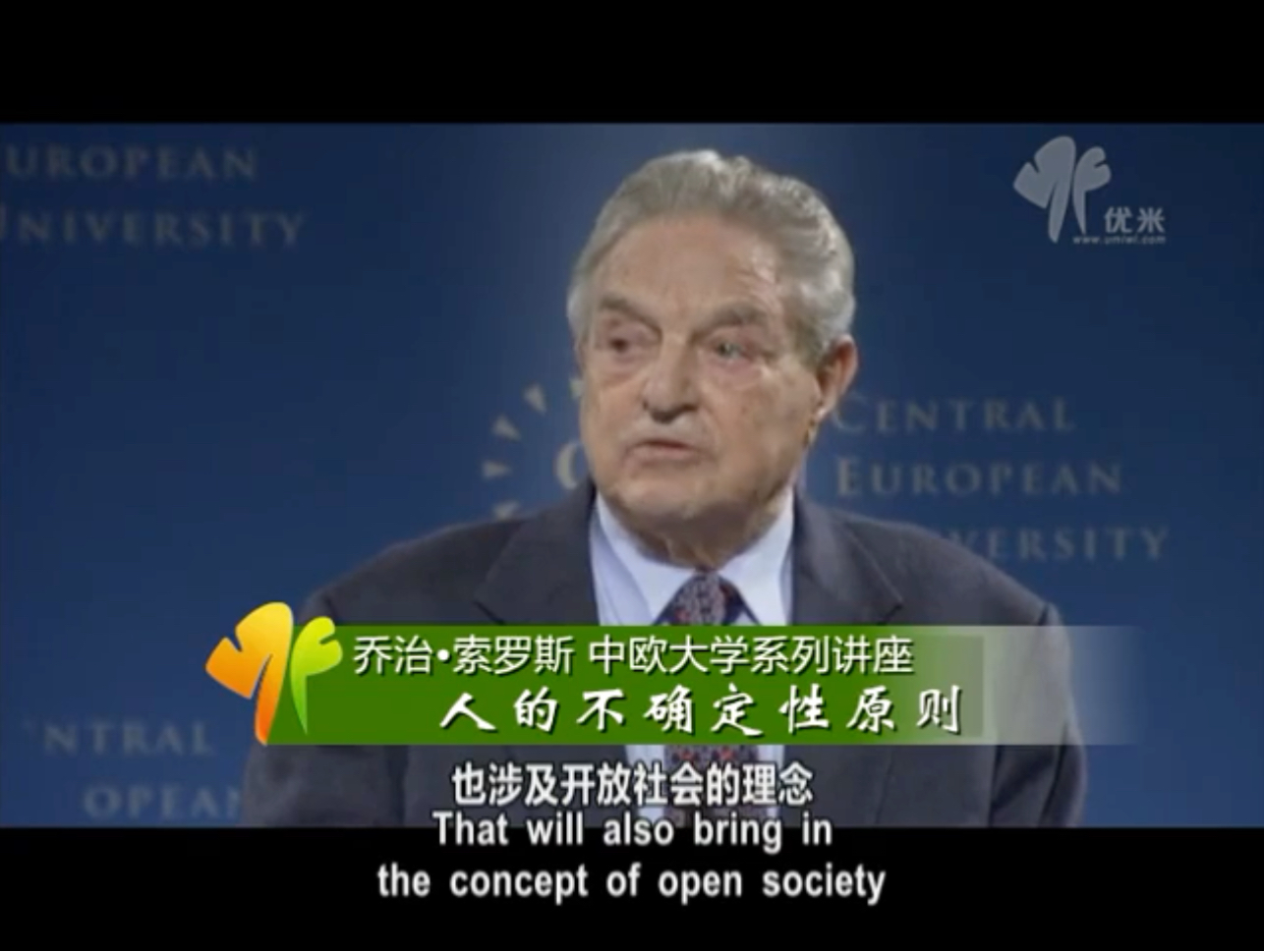
字幕摘录
| 时间 | 英文 | 中文 |
|---|---|---|
| 0:20 | Thank you very much, and thank you for all for coming, both here and in London. | 非常感谢大家的到来 无论是在这里还是在伦敦 |
| 0:29 | In the course of my life, I've developed a conceptual framework which has helped me | 在我的一生中,我开发了一个概念框架 帮助了我 |
| 0:37 | both in making money as a hedge fund manager and in spending it as a policy-oriented philanthropist. | 无论是作为对冲基金经理赚钱还是作为政策性慈善家花钱。 |
| 0:47 | But the framework itself is not about money. | 但框架本身与金钱无关。 |
| 0:51 | It's about the relationship between thinking | 而是思考之间的关系 |
| 0:54 | and reality, a subject that has extensively studied by philosophers from early on. | 和现实,一个哲学家从早期就广泛研究的课题. |
| 1:04 | I started developing my philosophy as a student at the London School of Economics in the late 1950s. | 1950年代后期开始作为伦敦经济学院的学生发展哲学. |
| 1:12 | I took my final exams one year early, and I had a year to fill before I was qualified to receive | 我提前一年参加期末考试 考满一年就有资格接受 |
| 1:19 | my degree. | 我的学位。 |
| 1:21 | I could choose my own tutor, and I chose Karl Popper, whose book The Open Society | 我选择了卡尔·波普,他的书《开放社会》 |
展开字幕全文(402 条)
| 序号 | 英文 | 中文 |
|---|---|---|
| 1 | Thank you very much, and thank you for all for coming, both here and in London. | 非常感谢大家的到来 无论是在这里还是在伦敦 |
| 2 | In the course of my life, I've developed a conceptual framework which has helped me | 在我的一生中,我开发了一个概念框架 帮助了我 |
| 3 | both in making money as a hedge fund manager and in spending it as a policy-oriented philanthropist. | 无论是作为对冲基金经理赚钱还是作为政策性慈善家花钱。 |
| 4 | But the framework itself is not about money. | 但框架本身与金钱无关。 |
| 5 | It's about the relationship between thinking | 而是思考之间的关系 |
| 6 | and reality, a subject that has extensively studied by philosophers from early on. | 和现实,一个哲学家从早期就广泛研究的课题. |
| 7 | I started developing my philosophy as a student at the London School of Economics in the late 1950s. | 1950年代后期开始作为伦敦经济学院的学生发展哲学. |
| 8 | I took my final exams one year early, and I had a year to fill before I was qualified to receive | 我提前一年参加期末考试 考满一年就有资格接受 |
| 9 | my degree. | 我的学位。 |
| 10 | I could choose my own tutor, and I chose Karl Popper, whose book The Open Society | 我选择了卡尔·波普,他的书《开放社会》 |
| 11 | and Its Enemies had made a profound impression on me. | 它的敌人给我留下了深刻的印象 |
| 12 | In his books, Popper argued that the | 在他的书中,波普认为 |
| 13 | empirical truth can't be known with absolute certainty. | 实证真理是绝对不能肯定的. |
| 14 | Even scientific laws can't be verified | 连科学法则都无法验证 |
| 15 | beyond the shadow of a doubt. | 远离怀疑的阴影 |
| 16 | They can only be falsified by testing. | 只能通过测试才能伪造 |
| 17 | One failed test is enough | 一个测试失败就够了 |
| 18 | to falsify, but no amount of confirming instances is sufficient to verify. | 伪造,但任何确认数量都不足以核实。 |
| 19 | Scientific laws are hypothetical in character, and their truth remains subject to testing. | 科学法则在性质上是假设性的,其真实性仍然受到考验. |
| 20 | Ideologies which claim to be in possession of the ultimate truth are making a false claim. | 自称掌握最终真相的意识形态正在作假。 |
| 21 | Therefore, they can be imposed on society only by force. | 因此,它们只能通过武力强加于社会。 |
| 22 | This applies to communism, | 这适用于共产主义, |
| 23 | fascism, and national socialism alike. | 法西斯主义 以及国家社会主义 |
| 24 | All these ideologies lead to repression. | 所有这些意识形态导致镇压。 |
| 25 | Popper proposed a more attractive form of social organization, an open society in which | 波普提出一种更有吸引力的社会组织形式,一种开放的社会,其中 |
| 26 | people are free to hold divergent opinions, and the rule of law allows people with different views | 人民可以自由地持有不同意见,法治允许持有不同意见的人 |
| 27 | and different interests to live together in peace. | 和不同的利益 在和平中共同生活。 |
| 28 | Having lived through both Nazi and | 经历了纳粹和 |
| 29 | communist occupation here in Hungary, I found the idea of an open society immensely attractive. | 在匈牙利这里的共产主义占领, 我发现开放社会的想法非常有吸引力。 |
| 30 | While I was reading Popper, I was also studying economic theory, and I was struck by the | 当我读波普的时候,我也在研究经济理论,我被 |
| 31 | contradiction between Popper's emphasis on imperfect understanding and the theory of perfect | 波普强调不完美的理解与完美理论之间的矛盾 |
| 32 | competition in economics which postulated perfect knowledge. | 经济学的竞争 假设完美的知识。 |
| 33 | This led me to start questioning the | 这让我开始质疑 |
| 34 | assumptions of economic theory. | 假设经济理论。 |
| 35 | These were the two major theoretical inspirations of my philosophy. | 这些是我哲学的两大理论灵感. |
| 36 | It's also deeply rooted in my personal history. | 这也深深扎根于我的个人历史. |
| 37 | The formative experience of my life was the German | 我的成长经历是德国人 |
| 38 | occupation of Hungary in 1944. | 1944年占领匈牙利。 |
| 39 | I was not yet 14 years old at the time, coming from a reasonably | 我当时还不到14岁 从一个合理的 |
| 40 | well-to-do middle-class background, suddenly confronted with the prospect of being deported | 中产阶级背景良好,突然面临被驱逐的前景 |
| 41 | and killed just because I was Jewish. | 就因为我是犹太人才被杀的 |
| 42 | Fortunately, my father was well prepared for this far from | 幸好我父亲已经做好了准备 |
| 43 | equilibrium experience. | 平衡经验. |
| 44 | He had lived through the Russian Revolution, and that was the formative | 他经历了俄国的革命,这就是成长 |
| 45 | experience of his life. | 他一生的经历 |
| 46 | Until then, he had been an ambitious young man. | 在这之前,他一直是一个雄心勃勃的年轻人。 |
| 47 | When the First World War | 第一次世界大战时 |
| 48 | broke out, he volunteered to serve in the Austro-Hungarian Army. | 爆发,他志愿在奥匈军队服役. |
| 49 | He was captured by the | 他被俘虏了 |
| 50 | Russians and taken as a prisoner of war to Siberia. | 俄罗斯人并被俘虏到西伯利亚. |
| 51 | Being ambitious, he became the editor of a newspaper | 他野心勃勃,成为报纸的编辑 |
| 52 | produced by the prisoners. | 由囚犯生产。 |
| 53 | It was handwritten and displayed on a plank, and it was called | 手写在木板上 被称作 |
| 54 | the plank. | 那块木板 |
| 55 | This made him so popular that he was elected the prisoner's representative. | 这让他非常受欢迎,以至于他当选为囚犯的代表. |
| 56 | Then some soldiers escaped from a neighboring camp, and their prisoner's representative was shot | 后来,一些士兵从一个邻近的营地逃跑,他们的囚犯代表被枪杀。 |
| 57 | in retaliation. | 为了报复 |
| 58 | My father, instead of waiting for the same thing to happen in his camp, | 我父亲 与其在营地等待同样的事情发生 |
| 59 | organized a breakout. | 组织突围. |
| 60 | His plan was to build a raft and sail down to the ocean, | 他的计划是造个木筏 航行到海里 |
| 61 | but his knowledge of geography was somewhat deficient. | 但他的地理知识有点不足 |
| 62 | He didn't realize that all the rivers | 他没有意识到所有的河流 |
| 63 | in Siberia flow into the Arctic. | 在西伯利亚流入北极 |
| 64 | They drifted for several weeks before they realized | 他们漂流了几个星期才意识到 |
| 65 | that they were heading for the Arctic, and it took them several more months to make their way | 他们驶向北极, 花了几个月的时间,他们走了 |
| 66 | back to civilization across the taiga. | 回到横跨泰加的文明 |
| 67 | In the meantime, the Russian Revolution broke out, | 在此期间,俄国革命爆发, |
| 68 | and they became caught up in it. | 他们被卷入其中。 |
| 69 | Only after a variety of adventures | 只有经过各种冒险 |
| 70 | did my father manage to find his way back to Hungary. | 我父亲有没有找到回匈牙利的路 |
| 71 | Had he remained in the camp, he would have | 如果他留在营地,他会 |
| 72 | arrived home much sooner. | 早点回家 |
| 73 | My father came home a changed man. | 我父亲回来了 一个变了的男人。 |
| 74 | His experiences during the Russian | 他的俄罗斯经历 |
| 75 | Revolution profoundly affected him. | 革命深深地影响了他。 |
| 76 | He lost his ambition and wanted nothing more from life than | 他失去了他的野心 并且对生命的渴望莫过于 |
| 77 | to enjoy it. | 来享受 |
| 78 | He imparted to his children values that were very different from those of the milieu | 他向孩子们传授了 与环境截然不同的价值观 |
| 79 | in which we lived. | 我们生活在其中。 |
| 80 | He had no desire to amass wealth or become socially prominent. | 他不想聚敛财富或成为社会知名人士。 |
| 81 | On the contrary, | 相反, |
| 82 | he worked only as much as was necessary to make ends meet. | 他只为维持生计而工作 |
| 83 | I remember being sent to his main client | 我还记得被送到他的主要客户那里 |
| 84 | to borrow some money before we went on a skiing holiday. | 在去滑雪节前借些钱 |
| 85 | My father was grouchy for months afterwards | 我父亲几个月后很不爽 |
| 86 | because he had to work to pay it back. | 因为他必须工作才能还钱 |
| 87 | Although we were reasonably prosperous, | 虽然我们相当繁荣 |
| 88 | we were not the typical bourgeois family, and we were proud of being different. | 我们不是典型的资产阶级家庭, 我们为不同而自豪。 |
| 89 | In 1944, when the Germans occupied Hungary, my father immediately realized that these were not | 1944年,当德国人占领匈牙利时,我父亲立即意识到这些不是 |
| 90 | normal times and the normal rules didn't apply. | 正常时间和正常规则都不适用. |
| 91 | He arranged false identities for his family | 他给家人安排了假身份 |
| 92 | and a number of other people. | 还有其他一些人 |
| 93 | Those who could, paid. | 有能力的人,付了钱。 |
| 94 | Others, he helped for free. | 其他人,他帮助免费。 |
| 95 | Most of them survived. | 他们大多幸存下来. |
| 96 | That was his finest hour. | 这是他最好的时间。 |
| 97 | Living with false identity turned out to be an | 活在假身份 证明是一个 |
| 98 | exhilarating experience for me too. | 我也很开心 |
| 99 | We were in mortal danger. | 我们身处险境 |
| 100 | People perished all around us, | 我们周围的人都死了 |
| 101 | but we managed not only to survive, but to help other people. | 但是我们不仅设法生存了下来 而且帮助了其他人 |
| 102 | We were on the side of the angels | 我们站在天使的一边 |
| 103 | and we triumphed against overwhelming odds. | 我们战胜了压倒性的机会 |
| 104 | This made me feel very special. | 这让我觉得很特别 |
| 105 | It was high adventure. | 这是高冒险。 |
| 106 | I had a reliable guide in my father and came through unscathed. | 我有一个可靠的 向导在我父亲, 并来到了无斑。 |
| 107 | What more | 还有什么 |
| 108 | could a 14 year old ask for? | 14岁的人能要求吗? |
| 109 | After the euphoric experience of escaping the Nazis, life in Hungary | 在逃离纳粹后,匈牙利的生活 |
| 110 | started to lose its luster during the Soviet occupation. | 在苏联占领期间 开始失去它的色欲 |
| 111 | I was looking for new challenges | 我在寻找新的挑战 |
| 112 | and with the help of my father, I found my way out of Hungary. | 在我父亲的帮助下 我找到了离开匈牙利的路 |
| 113 | When I was 17, I became a student in | 17岁时,我成为学生 |
| 114 | London. | 伦敦 |
| 115 | In my studies, my primary interest was to gain a better understanding of the strange world | 在我的研究中,我的主要兴趣是 更好地了解这个陌生的世界 |
| 116 | into which I had been born. | 我从小就出生 |
| 117 | But I have to confess, I also harbored some fantasies of becoming an | 但我必须承认,我也有些幻想成为... |
| 118 | important philosopher. | 重要的哲学家 |
| 119 | I believed that I had gained insights that set me apart from other people. | 我相信,我获得了深刻的见解,使我与其他人不同。 |
| 120 | Living in London was a big let down. | 住在伦敦是一个很大的失望。 |
| 121 | I was without money, alone, and people were not interested in | 我没有钱,一个人,人们对 |
| 122 | what I had to say. | 我不得不说 |
| 123 | But I didn't abandon my philosophical ambitions, even when circumstances | 但我并没有放弃我的哲学野心 即使当时的情况 |
| 124 | forced me to make a living in more mundane pursuits. | 强迫我靠更平庸的追求谋生 |
| 125 | After completing my studies, I had a | 完成学业后,我有一个 |
| 126 | number of false starts. | 错误开始数。 |
| 127 | Finally, I ended up as an arbitrage trader in New York. | 最后,我成了纽约的套利交易商 |
| 128 | But in my free time, | 但在我的空闲时间, |
| 129 | I continued to work on my philosophy. | 我继续研究我的哲学 |
| 130 | That's how I came to write my first major essay, | 所以我才来写我的第一篇主要论文 |
| 131 | entitled The Burden of Consciousness. | 题为“意识的包袱”。 |
| 132 | It was an attempt to model a purpose framework | 这是试图模拟一个目的框架 |
| 133 | of open and closed societies. | 开放和封闭的社会。 |
| 134 | It linked organic society with a traditional mode of thinking, | 它把有机社会与传统的思维方式联系起来, |
| 135 | closed society with a dogmatic mode, and open society with a critical mode. | 以教条模式封闭社会,以批评模式开放社会。 |
| 136 | What I could not properly resolve was the nature of the relationship between the mode of thinking | 我无法正确解决的是 思维方式之间的关系的性质 |
| 137 | and the actual state of affairs. | 和实际情况。 |
| 138 | That problem continued to preoccupy me, | 这个问题一直困扰着我 |
| 139 | and that's how I came to develop the concept of reflexivity, a concept I shall explore | 所以我才来发展反射力的概念 我会探索这个概念 |
| 140 | in greater detail a little later. | 稍后再详细介绍 |
| 141 | It so happened that the concept of reflexivity provided me with | 如此巧妙的,反射能力的概念给了我 |
| 142 | a new way of looking at financial markets, a better way than the prevailing theory. | 一种审视金融市场的新方式,一种比流行理论更好的方式. |
| 143 | This gave me an edge, first as a securities analyst and then as a hedge fund manager. | 这给了我一个优势,首先作为证券分析师,然后作为对冲基金经理. |
| 144 | I felt | 我觉得 |
| 145 | as if I were in possession of a major discovery that would enable me to fulfill my fantasy | 仿佛我有了一个重大发现 能让我实现我的幻想 |
| 146 | of becoming an important philosopher. | 成为重要的哲学家 |
| 147 | At a certain moment when my business career | 在某一时刻 当我的职业生涯 |
| 148 | ran into a roadblock, I shifted gears and devoted all my energies to developing my theory. | 撞上了路障,我换了齿轮,把精力都用在发展我的理论上. |
| 149 | But I treasured my discovery so much that I couldn't part with it. | 但我很珍惜我的发现 以至于我无法脱离它 |
| 150 | I felt that the concept | 我觉得这个概念 |
| 151 | of reflexivity needed to be explored in great depth. | 需要深入探讨反射性。 |
| 152 | As I delved deeper and deeper into the | 我越来越深入地探索 |
| 153 | subject, I got lost in the intricacies of my own constructions. | 话题,我迷路了 在复杂的我自己的建筑。 |
| 154 | One morning, I couldn't understand | 一天早上,我无法理解 |
| 155 | what I had written the night before. | 我前一晚写的 |
| 156 | At that point, I decided to abandon my philosophical | 那时,我决定放弃我的哲学 |
| 157 | explorations and to focus on making money. | 探索和专注于赚钱。 |
| 158 | It was only many years later, after a successful | 过了几年才成功 |
| 159 | run as a hedge fund manager, that I returned to my philosophy. | 以对冲基金经理的身份运行, 我回到了我的哲学。 |
| 160 | I published my first essay, | 我发表了我的第一篇论文, |
| 161 | The Alchemy of Finance, in 1987. | 1987年的"金融炼金术". |
| 162 | In that book, I tried to explain the philosophical underpinnings | 在这本书中,我试图解释哲学基础 |
| 163 | of my approach to financial markets. | 我对金融市场的态度。 |
| 164 | The book attracted a certain amount of attention. | 该书引起了一定的注意. |
| 165 | It has been read by most people in the hedge fund industry and it is taught in business schools. | 大部分对冲基金行业的人都读过,并在商学院教授。 |
| 166 | But the philosophical arguments didn't make much of an impression. | 但哲学论点并没有给人多少印象. |
| 167 | They were largely dismissed | 他们基本上被解雇了 |
| 168 | as the conceit of a man who has been successful in business and fancied himself as a philosopher. | 作为一个在商业上成功并幻想自己成为哲学家的人的自负. |
| 169 | I myself came to doubt whether I was in possession of a major new insight. | 我自己开始怀疑我是否掌握了一个重要的新见解。 |
| 170 | After all, | 毕竟. |
| 171 | I was dealing with a subject that has been explored by philosophers since time immemorial. | 我研究的是自古以来 哲学家们探讨过的一个课题 |
| 172 | What grounds did I have for thinking that I had made a new discovery, especially as nobody else | 我有什么理由认为我有了新的发现 特别是没有人 |
| 173 | seems to think so? | 看来是这样吗? |
| 174 | Undoubtedly, the conceptual framework was useful to me personally, | 毫无疑问,概念框架对我个人有用, |
| 175 | but it didn't seem to be considered equally valuable by others. | 但其他人似乎并不认为它具有同等价值。 |
| 176 | I had to accept that judgment. | 我必须接受这个判断 |
| 177 | I didn't give up my philosophical interests, but I came to regard them as a personal predilection. | 我没有放弃我的哲学兴趣,但我开始把它们看作是个人的偏执. |
| 178 | I continued to be guided by my conceptual framework, both in my business and in my | 我继续遵循我的概念框架,无论是在我的业务中,还是在我的业务中。 |
| 179 | philanthropic activities, which came to assume an increasingly important role in my life. | 慈善活动开始在我生命中扮演越来越重要的角色. |
| 180 | Each time I wrote a book, I faithfully recited my arguments. | 我每写一本书,都忠实地背诵我的论点。 |
| 181 | This helped me to develop my | 这帮助我发展了 |
| 182 | framework, but I continued to consider myself a failed philosopher. | 但我仍然认为自己是个失败的哲学家 |
| 183 | Once I even gave a lecture | 有一次我甚至讲课 |
| 184 | with the title, A Failed Philosopher Tries Again. | 与标题,一个失败的哲学家 特里斯再次。 |
| 185 | All this has changed as a result of | 这一切已经改变 因为 |
| 186 | the financial crisis of 2008. | 2008年金融危机。 |
| 187 | My conceptual framework enabled me both to anticipate the crisis | 我的概念框架使我得以预见危机 |
| 188 | and to deal with it when it finally struck. | 并处理它 当它最终打击。 |
| 189 | It has also enabled me to explain and predict events | 这也使我得以解释和预测事件 |
| 190 | better than most others. | 胜过大多数其他人。 |
| 191 | This has changed my own evaluation and that of many others. | 这改变了我本人和许多其他方面的评价。 |
| 192 | My philosophy is no longer a personal matter. | 我的哲学不再是个人问题了 |
| 193 | It deserves to be taken seriously as a possible | 应该认真对待 |
| 194 | contribution to our understanding of reality. | 帮助我们了解现实。 |
| 195 | And that is what has prompted me to give this | 这也是我给这个的原因 |
| 196 | series of lectures. | 一系列讲座。 |
| 197 | So here it goes. | 就这样 |
| 198 | Today, I shall explain the concept of fallibility | 今天,我将解释一个错误的概念 |
| 199 | and reflexivity in general terms. | 和一般的反射性。 |
| 200 | Tomorrow, I shall apply them to the financial markets | 明天,我将把它们应用于金融市场 |
| 201 | and after that to politics. | 之后是政治问题 |
| 202 | That will also bring in the concept of open society. | 这也将带来开放社会的概念。 |
| 203 | In the fourth lecture, I shall explore the difference between market values and moral | 在第四场演讲中,我将探讨市场价值与道德之间的区别。 |
| 204 | values. | 数值。 |
| 205 | And in the fifth, I shall give some predictions and prescriptions for the present | 而在第五,我会给出一些预言和处方 对于现在 |
| 206 | moment in history. | 历史时刻 |
| 207 | I can state the core idea in two relatively simple propositions. | 我可以用两个相对简单的提议来说明核心思想。 |
| 208 | One is | 一个是 |
| 209 | that the situation that has thinking participants, the participant's view of the world | 思考参与者的情况、参与者对世界的看法 |
| 210 | is always partial and distorted. | 总是片面扭曲 |
| 211 | That's the principle of fallibility. | 这是谬误的原则. |
| 212 | The other is that | 另一个是 |
| 213 | distorted views can influence the situation to which they relate because false views lead | 扭曲的观点会影响它们所涉及的情况,因为虚假的观点会导致 |
| 214 | to inappropriate actions. | 对不适当的行动。 |
| 215 | That's the principle of reflexivity. | 这就是反射原理. |
| 216 | For instance, treating drug addicts | 例如,治疗吸毒者 |
| 217 | as criminals creates criminal behavior. | 作为罪犯制造犯罪行为。 |
| 218 | It misconstrues the problem and interferes with | 它误解了问题,干扰了 |
| 219 | proper treatment of addicts. | 治疗瘾君子 |
| 220 | As another example, declaring that government is bad | 另一个例子是,宣布政府是坏的 |
| 221 | tends to make for bad government. | 往往让坏政府。 |
| 222 | Both fallibility and reflexivity are sheer common sense. | 谬误性和反射性都是完全常识. |
| 223 | So when | 所以什么时候 |
| 224 | my critics say that I am merely stating the obvious, they are right up to a point. | 我的批评者们说,我只是在说显而易见的,他们只是说到一点。 |
| 225 | What makes my propositions interesting is that their significance has not been generally | 令我感兴趣的是,它们的意义并不普遍 |
| 226 | appreciated. | 谢谢 |
| 227 | The concept of reflexivity in particular has been studiously avoided and even | 特别是反射性的概念被逐渐避免,甚至 |
| 228 | denied by economic theory. | 被经济理论否定. |
| 229 | So my conceptual framework deserves to be taken seriously, | 因此,我的概念框架值得认真对待, |
| 230 | not because it constitutes a new discovery, but because something as common sense as reflexivity | 并不是因为它构成一个新的发现 而是因为一些常识 |
| 231 | has been so studiously ignored. | 一直被冷落着 |
| 232 | Recognizing reflexivity has been sacrificed to the vain | 承认反射性是徒劳的 |
| 233 | pursuit of certainty in human affairs, most notably in economics. | 在人类事务中,特别是在经济学中,追求确定性。 |
| 234 | And yet, | 不过, |
| 235 | uncertainty is the key feature of human affairs. | 不确定性是人类事务的关键特征。 |
| 236 | Economic theory is built on the | 经济理论建立在 |
| 237 | concept of equilibrium, and that concept is in direct contradiction with the concept of | 平衡的概念,而这一概念直接抵触了 |
| 238 | reflexivity. | 反射性 |
| 239 | As I shall try to show in the next lecture, the two concepts yield to two | 正如我将尝试在下一次讲座中表明,这两个概念将变成两个 |
| 240 | entirely different interpretations of financial markets. | 对金融市场的解释完全不同。 |
| 241 | The concept of fallibility is far less | 错误的概念要少得多 |
| 242 | controversial. | 有争议。 |
| 243 | It's generally recognized that the complexity of the world in which we live | 人们普遍认为我们生活的世界的复杂性 |
| 244 | exceeds our capacity to comprehend it. | 超越了我们理解的能力 |
| 245 | I have no great new insights to offer. | 我没有什么新的见解可以提供。 |
| 246 | The main source of | 主要来源: |
| 247 | that participants are part of the situation they have to deal with. | 参与者是他们必须处理的情况的一部分。 |
| 248 | Confronted by a reality of | 面对现实 |
| 249 | extreme complexity, we are obliged to resort to various methods of simplification, generalizations, | 我们不得不采用各种简化和概括的方法, |
| 250 | dichotomies, metaphors, decision rules, moral precepts, to mention just a few. | dichotomies,比喻,决定规则,道德观念,仅举几个例子. |
| 251 | These mental | 这些精神 |
| 252 | constructs take on an existence of their own, further complicating the situation. | 建筑本身的存在使情况更加复杂。 |
| 253 | The structure of the brain is another source of distortions. | 大脑的结构是另一个扭曲的来源. |
| 254 | Recent advances in brain science | 大脑科学的最新进展 |
| 255 | have begun to provide some insight into how the brain functions, and they have substantiated | 已经开始提供一些洞察 大脑如何运作, 他们证明了 |
| 256 | contention that reason is the slave of passion. | 认为理性是激情的奴隶 |
| 257 | The idea of a disembodied intellect or reason | 失去理智或理性的想法 |
| 258 | is a figment of our imagination. | 是我们想象力的虚构 |
| 259 | The brain is bombarded by millions of sensory impulses, | 大脑受到数百万感官冲动的轰击 |
| 260 | but consciousness can only process only seven or eight subjects concurrently. | 但意识只能同时处理七八个课题. |
| 261 | The impulses need | 冲动需要 |
| 262 | to be condensed, ordered, and interpreted under immense time pressure, and mistakes and distortions | 在巨大的时间压力、错误和扭曲下进行凝聚、命令和解释 |
| 263 | cannot be avoided. | 无法避免。 |
| 264 | Brain science adds many new details to my original contention that our | 脑科学为我最初的论点增加了许多新的细节: |
| 265 | understanding of the world in which we live is inherently imperfect. | 对我们生活的世界的理解本来就是不完善的。 |
| 266 | The concept of reflexivity | 反射性概念 |
| 267 | needs a little more explanation. | 需要更多的解释 |
| 268 | It applies exclusively to situations that have thinking | 它只适用于有下列想法的情况: |
| 269 | participants. | 与会者。 |
| 270 | The participant's thinking serves two functions. | 参与者的思维有两个功能. |
| 271 | One is to understand the world in which | 一是了解这个世界 |
| 272 | we live. | 我们活着。 |
| 273 | I call this the cognitive function. | 我称之为认知功能。 |
| 274 | The other is to change the situation to our advantage. | 另一个是改变局势,以利我们。 |
| 275 | I call this the manipulating or participating function. | 我称之为操纵或参与功能。 |
| 276 | The two functions | 这两项职能 |
| 277 | connect thinking and reality in opposite directions. | 将思维和现实联系起来。 |
| 278 | In the cognitive function, | 在认知功能中, |
| 279 | reality is supposed to determine the participant's views. | 现实应该是确定参与者的观点。 |
| 280 | The direction of causation | 因果关系的方向 |
| 281 | is from the world to the mind. | 从世界到心灵 |
| 282 | By contrast, in the manipulative function, the direction of causation | 相比之下,在操纵功能中,因果关系的方向 |
| 283 | is from the mind to the world. | 从思想到世界 |
| 284 | That is to say, the intentions of the participants have an effect | 也就是说,参与者的意图是有效果的 |
| 285 | on the world. | 这世界。 |
| 286 | When both functions operate at the same time, they can interfere with each other. | 当两个功能同时运行时,它们可以互相干扰. |
| 287 | How? | 怎么会? |
| 288 | By depriving each function of the independent variable that would be to determine the value of | 剥夺每个函数的独立变量,以确定其价值 |
| 289 | the dependent variable. | 所依赖的变量。 |
| 290 | Because when the independent variable of one function is the dependent | 因为当一个函数的独立变量是依赖 |
| 291 | variable of the other, neither function has a genuinely independent variable. | 变量,两个函数都没有真正独立的变量。 |
| 292 | This means | 这意味着 |
| 293 | that the cognitive function can't produce enough knowledge to serve as the basis of the | 认知的功能不能产生足够的知识来作为 |
| 294 | participant's decisions. | 参与者的决定。 |
| 295 | Similarly, the manipulative function can have an effect on the outcome, | 同样,操纵功能可对结果产生影响, |
| 296 | but can't determine it. | 但无法确定 |
| 297 | In other words, the outcome is liable to diverge from the participant's | 换句话说,结果可能不同于参与者的 |
| 298 | intentions. | 意图。 |
| 299 | There is bound to be some slippage between intentions and actions, | 意图与行动之间必然会出现一些倒退, |
| 300 | and further slippage between actions and outcomes. | 以及行动和结果之间的进一步滞后。 |
| 301 | As a result, there is an element of uncertainty | 因此,存在着不确定因素。 |
| 302 | both in our understanding of reality and in the actual course of events. | 我们既了解现实,也了解实际情况。 |
| 303 | To understand the uncertainties associated with reflexivity, we need to probe a little further. | 为了了解与反射性有关的不确定性,我们需要进一步探索。 |
| 304 | If the cognitive function operated in isolation without any interference from the manipulative | 如果认知功能在不受操纵者干扰的情况下单独运作 |
| 305 | function, it could produce knowledge. | 它能产生知识。 |
| 306 | Knowledge is represented by true statements. | 知识以真实的言论为代表. |
| 307 | A statement | 声明 |
| 308 | is true if it corresponds to the facts. | 如果与事实相符,则属实。 |
| 309 | That's what the correspondence theory of truth tells us. | 这就是真理的对应理论告诉我们的. |
| 310 | But if there is interference from the manipulative function, the facts no longer serve as an | 但是,如果有干扰 从操纵功能, 事实不再作为一个 |
| 311 | independent criterion by which the truth of a statement can be judged. | 判断声明真相的独立标准。 |
| 312 | Because the correspondence | 因为信件 |
| 313 | may have been brought about by the statement changing the facts. | 可能是因为声明改变了事实。 |
| 314 | Consider the statement, | 考虑一下声明, |
| 315 | it's raining. | 下着雨 |
| 316 | That statement is true or false, depending on whether it is in fact raining. | 这一说法是真实的还是虚假的,这取决于事实上是否下雨。 |
| 317 | Now consider the statement, this is a revolutionary moment. | 现在考虑一下这个声明,这是一个革命的时刻. |
| 318 | That statement is reflexive, | 这一说法具有反射性, |
| 319 | and its truth value depends on the impact it makes. | 它的真理价值取决于它的影响。 |
| 320 | Reflexive statements have some affinity | 反射语句有些亲近性 |
| 321 | with the paradox of the liar, which is a self-referential statement. | 与骗子的悖论, 这是一种自我优惠的声明。 |
| 322 | But while self-reference | 但虽然自我参考 |
| 323 | has been extensively analyzed, reflexivity has received much less attention. | 反射率受到的关注要少得多。 |
| 324 | That's strange | 这很奇怪 |
| 325 | because reflexivity has an impact on the real world, while self-reference is purely a linguistic | 因为反射力对现实世界有影响 而自我参照纯粹是一种语言 |
| 326 | phenomenon. | 现象。 |
| 327 | In the real world, the participant's thinking finds expression not only in statements, | 在现实世界中,参与者的思维不仅体现在言论中, |
| 328 | but also in various forms of action and behavior. | 也表现在各种行动和行为上 |
| 329 | That makes reflexivity a very broad phenomenon | 这使反射性成为一个非常广泛的现象 |
| 330 | that typically takes the form of feedback loops. | 通常采取反馈循环的形式。 |
| 331 | The participant's views influence the | 参与者的观点影响 |
| 332 | course of events, and the course of events influences the participant's views. | 活动过程,以及活动过程影响参与者的观点. |
| 333 | The influence | 影响 |
| 334 | is continuous and circular. | 是连续的和循环的。 |
| 335 | That's what turns it into a feedback loop. | 这就是它变成反馈循环的原因. |
| 336 | Reflexive feedback loops | 折射反馈循环 |
| 337 | have not been rigorously analyzed, and when I originally encountered them and tried to analyze | 还没有经过严格的分析, 当我最初遇到他们,试图分析 |
| 338 | them, I ran into various complications. | 他们,我遇到了各种并发症。 |
| 339 | The feedback loop is supposed to be a two-way connection | 反馈循环应该是双向连接 |
| 340 | between the participant's views and the actual course of events. | 在参与者的观点和事件的实际过程之间。 |
| 341 | But what about a two-way connection | 但双向连接呢? |
| 342 | between the participant's views? | 在参与者的观点之间? |
| 343 | And what about a solitary individual asking himself who he is | 一个人问自己是谁 |
| 344 | and what he stands for, and changing his behavior as a result of his reflections? | 他所主张的,和他因自己的反省而改变的行为, |
| 345 | In trying to resolve these difficulties, I got so lost among the categories I created | 在试图解决这些困难时,我失去了我创造的类别 |
| 346 | that one morning I couldn't understand what I had written the night before. | 有一天早上 我无法理解我之前写了什么 |
| 347 | That's when I gave up | 那时我放弃了 |
| 348 | my philosophy and devoted my efforts to making money. | 我的哲学 并致力于赚钱。 |
| 349 | To avoid that trap, let me propose the | 为了避免这个陷阱,让我提议 |
| 350 | following terminology. | 采用术语。 |
| 351 | Let's distinguish between the objective and subjective aspects of reality. | 让我们区分现实的客观和主观方面. |
| 352 | Thinking constitutes the subjective aspect, events the objective. | 思考构成主观方面,事件是目标. |
| 353 | In other words, the subjective | 换言之,主观性 |
| 354 | aspect covers what takes place in the minds of the participants. | 内容包括参与者心中发生的事情。 |
| 355 | The objective aspect denotes | 目标方面意味着 |
| 356 | what takes place in the external reality. | 发生在外部现实中的事情。 |
| 357 | There's only one external reality, but many different | 只有一个外部现实,但很多不同 |
| 358 | subjective views. | 主观观点。 |
| 359 | Reflexivity can then connect any two or more aspects of reality, setting up | 弹性可以连接现实的任何两个或多个方面,设置 |
| 360 | two-way feedback loops. | 双向反馈循环. |
| 361 | Exceptionally, it may even occur within a single aspect of reality, | 在特殊情况下,它甚至可能发生在现实的一个方面, |
| 362 | as in the case of a solitary individual reflecting on his own identity. | 例如,个人单独反映其身份。 |
| 363 | This may be described as | 这可以说是: |
| 364 | self-reflexivity. | 自我反应。 |
| 365 | We may then distinguish between two broad categories. | 然后我们可以区分两大类。 |
| 366 | Reflexive relationships, | 折射关系, |
| 367 | which connect the subjective aspects, and reflexive events, which involve the objective aspect as | 将主观方面和反射事件联系起来,涉及客观方面: |
| 368 | well. | 不错 |
| 369 | Marriage is a reflexive relationship. | 婚姻是一种反射性的关系。 |
| 370 | The crash of 2008 was a reflexive event. | 2008年的空难是一个反射事件。 |
| 371 | When reality | 当现实 |
| 372 | has no subjective aspect, there can be no reflexivity. | 没有主观的方面, 没有反射力。 |
| 373 | Feedback loops can be either negative | 反馈循环可以是负的 |
| 374 | or positive. | 或正数。 |
| 375 | Negative feedback brings the participants' views and the actual situation | 负面反馈带来参与者的观点和实际情况 |
| 376 | closer together. | 更亲近。 |
| 377 | Positive feedback drives them further apart. | 积极的反馈促使它们进一步分裂。 |
| 378 | In other words, | 也就是说, |
| 379 | negative feedback is self-correcting. | 负面反馈是自我纠正。 |
| 380 | It can go on forever, and if there are no significant changes | 它可以永远继续下去,如果没有显著的变化 |
| 381 | in external reality, it may eventually lead to an equilibrium where the participants' views | 在外部现实中,它最终可能导致一种平衡,使参与者的观点 |
| 382 | come to correspond to the actual state of affairs. | 来与实际情况相符。 |
| 383 | That is what's supposed to happen in financial | 这是应该发生在财政上的事 |
| 384 | markets. | 市场。 |
| 385 | So equilibrium, which is the central case in economics, turns out to be a limiting case | 所以,平衡,这是经济学的核心案例, 证明是一个限制案例 |
| 386 | in my conceptual framework. | 我的概念框架。 |
| 387 | By contrast, a positive feedback process is self-reinforcing. | 相比之下,积极的反馈过程是自我强化的. |
| 388 | It can't go on forever because eventually the participants' views would become so far removed | 它不能永远继续下去 因为最终 参与者的观点会变得如此遥远 |
| 389 | from objective reality that the participants would have to recognize them as unrealistic. | 从客观现实出发,与会者必须承认它们不切实际。 |
| 390 | Nor can the iterative process occur without any change in the actual state of affairs | 迭代过程也不可能在不改变实际状况的情况下发生 |
| 391 | because it's in the nature of positive feedback that it reinforces whatever tendency prevails | 因为它具有正面反馈的性质 它强化了任何趋势 |
| 392 | in the real world. | 在现实世界。 |
| 393 | Instead of equilibrium, we are faced with a dynamic disequilibrium | 我们面对的不是平衡,而是动态的不平衡 |
| 394 | or what may be described as far-from-equilibrium conditions. | 或可以说是远离平衡条件。 |
| 395 | Usually, in far-from-equilibrium | 通常,在离平衡很远的地方 |
| 396 | situations, the divergence between perceptions and reality leads to a climax which sets in motion | 观念和现实之间的分歧导致一个开始发展的高潮 |
| 397 | a positive feedback process in the opposite direction. | 向相反方向的积极反馈进程。 |
| 398 | Such initially self-reinforcing, | 这种最初的自我强化, |
| 399 | but eventually self-defeating, boom-bust processes or bubbles are characteristic of | 但最终自负, 繁荣-bust 过程或气泡的特点是 |
| 400 | financial markets. | 金融市场。 |
| 401 | But they can also be observed in other spheres. | 但它们也可以在其他领域观察到. |
| 402 | There I called, I called it, | 我打过电话,我打过电话 |
该视频共有字幕 402 条。解锁更多字幕为会员功能,请移动到 价格
P2 · 索罗斯:人的不确定性原则 p02 IMG_0291 (P2)
字幕摘录
| 时间 | 英文 | 中文 |
|---|---|---|
| 0:00 | In far-from-equilibrium situations, the divergence between perceptions and reality leads to a | 在远离平衡的情况下,观念与现实之间的分歧导致 |
| 0:08 | climax which sets in motion a positive feedback process in the opposite direction. | 高潮将启动反方向的积极反馈进程。 |
| 0:15 | Such initially self-reinforcing but eventually self-defeating boom-bust processes or bubbles | 这种最初是自我强化,但最终是自我削弱的爆破过程或泡沫 |
| 0:24 | are characteristic of financial markets. | 是金融市场的特征。 |
| 0:29 | But they can also be observed in other spheres. | 但它们也可以在其他领域观察到. |
| 0:34 | There I call them fertile fallacies, interpretations of reality that are distorted yet produce | 我称之为肥沃的谬误 对现实的诠释 被歪曲却产生 |
| 0:43 | results which reinforce the distortion. | 结果加剧了扭曲。 |
| 0:49 | I realize that this is all very abstract and difficult to follow. | 我意识到,这一切都是非常抽象的,很难遵循。 |
| 0:54 | It would make it much easier if I gave some concrete examples. | 如果我举出一些具体的例子,这将更容易。 |
| 1:00 | But you will have to bear with me. | 但你必须忍受我 |
展开字幕全文(191 条)
| 序号 | 英文 | 中文 |
|---|---|---|
| 1 | In far-from-equilibrium situations, the divergence between perceptions and reality leads to a | 在远离平衡的情况下,观念与现实之间的分歧导致 |
| 2 | climax which sets in motion a positive feedback process in the opposite direction. | 高潮将启动反方向的积极反馈进程。 |
| 3 | Such initially self-reinforcing but eventually self-defeating boom-bust processes or bubbles | 这种最初是自我强化,但最终是自我削弱的爆破过程或泡沫 |
| 4 | are characteristic of financial markets. | 是金融市场的特征。 |
| 5 | But they can also be observed in other spheres. | 但它们也可以在其他领域观察到. |
| 6 | There I call them fertile fallacies, interpretations of reality that are distorted yet produce | 我称之为肥沃的谬误 对现实的诠释 被歪曲却产生 |
| 7 | results which reinforce the distortion. | 结果加剧了扭曲。 |
| 8 | I realize that this is all very abstract and difficult to follow. | 我意识到,这一切都是非常抽象的,很难遵循。 |
| 9 | It would make it much easier if I gave some concrete examples. | 如果我举出一些具体的例子,这将更容易。 |
| 10 | But you will have to bear with me. | 但你必须忍受我 |
| 11 | I want to make a different point. | 我想说点别的 |
| 12 | And the fact that it's so difficult to follow abstract arguments helps me to make it. | 和事实,这是如此困难 遵循抽象的论点 帮助我做到这一点。 |
| 13 | In dealing with subjects like reality or thinking or the relationship between thinking and reality, | 在处理诸如现实或思维等主题或思维与现实之间的关系时, |
| 14 | it's easy to get confused and formulate problems the wrong way. | 很容易搞混 并用错误的方式提出问题 |
| 15 | So, misinterpretations and misconceptions can play a very important role in human affairs. | 因此,误解和误解可以在人类事务中起到非常重要的作用. |
| 16 | The recent financial crisis can be attributed to a mistaken interpretation of how financial | 最近的金融危机可归因于对金融、金融、金融、金融、金融、金融、金融、金融、金融、金融、金融、金融、金融、金融、金融、金融、金融、金融、金融、金融、金融、金融、金融、金融、金融、金融、金融、金融、金融、金融、金融、金融、金融、金融、金融、金融、金融、金融、金融、金融、金融、金融、金融、金融、金融、金融、金融、金融、金融、金融、金融、金融、金融、金融、金融、金融、金融、金融、金融、金融、金融、金融、金融、金融、金融、金融、金融、金融、金融、金融、金融、金融、金融、金融、金融、金融、金融、金融、金融、金融、金融、 |
| 17 | markets work. | 市场发挥作用。 |
| 18 | I shall discuss that in the next lecture. | 我将在下一次讲座中讨论这一点。 |
| 19 | In the third lecture, I shall discuss two fertile fallacies, the Enlightenment fallacy | 在第三次演讲中,我将讨论两个肥沃的谬论,启蒙谬论 |
| 20 | and the postmodern fallacy. | 和后现代的谬论。 |
| 21 | These concrete examples will demonstrate how important misconceptions have been in the | 这些具体例子将表明,在国际法中,误解是多么重要。 |
| 22 | course of history. | 历史历程. |
| 23 | But for the rest of this lecture, I shall stay at the lofty heights of abstraction. | 但在这次演讲的其余部分,我将停留在抽象主义的崇高高度。 |
| 24 | I contend that situations that have thinking participants have a different structure from | 我认为,认为参与者的结构不同于 |
| 25 | natural phenomena. | 自然现象。 |
| 26 | The difference lies in the role of thinking. | 区别在于思维的作用. |
| 27 | In a natural phenomena, thinking plays no causal role and serves only a cognitive function. | 在自然现象中,思维不发挥因果作用,只服务于认知功能. |
| 28 | In human affairs, thinking is part of the subject matter and serves both a cognitive | 在人类事务中,思考是主题的一部分,对认知都有帮助 |
| 29 | and a manipulative function. | 和操纵功能。 |
| 30 | The two functions can interfere with each other. | 这两个功能可以互相干扰. |
| 31 | The interference doesn't occur all the time. | 干扰并不经常发生. |
| 32 | In everyday activities like driving a car or painting a house, the two functions actually | 在日常活动中,比如开车或画房子, 这两个功能实际上 |
| 33 | complement each other. | 互相补充。 |
| 34 | But when it occurs, it introduces an element of uncertainty which is absent from natural | 但当它发生时,它引入了一种不确定因素,而自然界并不存在这种因素。 |
| 35 | phenomena. | 现象。 |
| 36 | The uncertainty manifests itself in both functions. | 这种不确定性表现在这两种职能中。 |
| 37 | The participants act on the basis of imperfect understanding and the results of their actions | 参与者根据不完善的理解和行动结果行事。 |
| 38 | will not correspond to their expectations. | 将不符合他们的期望。 |
| 39 | I call that the human uncertainty principle and I consider it a key feature of human affairs. | 我称之为人类不确定性原则,我认为这是人类事务的一个关键特征。 |
| 40 | By contrast, in the case of natural phenomena, events unfold irrespective of the views held | 相反,就自然现象而言,不论持有何种观点,事件都会发生。 |
| 41 | by the observers. | 由观察者。 |
| 42 | The outside observer is engaged only in the cognitive function and the phenomena provide | 外界观察员只从事认知功能,现象提供 |
| 43 | a reliable criterion by which the truth of the observer's theories can be judged. | 一个可靠的标准,用来判断观察者理论的真相. |
| 44 | So the outside observer can obtain knowledge. | 故外观者能得知识. |
| 45 | Based on that knowledge, nature can be successfully manipulated. | 基于这种认识,自然可以被成功操纵. |
| 46 | There is a natural separation between the cognitive and manipulative function and due | 认知和操纵功能之间自然分离 |
| 47 | to that separation, both functions can serve their purpose better than in the human sphere. | 在这种分离中,这两种功能都比在人类领域更符合其目的。 |
| 48 | At this point, I need to emphasize that reflexivity is not the only source of uncertainty in human | 此时,我需要强调,反射性不是人类的不确定性的唯一来源。 |
| 49 | affairs. | 事务。 |
| 50 | Yes, reflexivity does introduce an element of uncertainty both into the participant's | 是的,反射性的确在参与者的 |
| 51 | views and the actual course of events, but other factors may also have the same effect. | 观点和事件的实际过程,但其他因素也可能产生同样的效果. |
| 52 | For instance, the fact that participants can't know what the other participants know is something | 例如,参与者不能知道 其他参与者知道什么是东西 |
| 53 | quite different from reflexivity, yet it's a source of uncertainty. | 与反射率有很大不同, 但它是一个不确定的来源。 |
| 54 | The fact that different participants have different interests, some of which may be | 不同的参与者具有不同的利益这一事实,其中一些可能是: |
| 55 | in conflict with each other, is another source of uncertainty. | 彼此冲突,是另一个不确定因素。 |
| 56 | Moreover, each individual participant may be guided by a multiplicity of values which | 此外,每个参与者都可能受到多种价值观的指导,这些价值观包括: |
| 57 | may not be self-consistent, as Isaiah Berlin has pointed out. | 正如以赛亚·柏林指出的,也许并非自成一体。 |
| 58 | The uncertainties created by these factors are likely to be even more extensive than | 这些因素造成的不确定性可能比 |
| 59 | those generated by reflexivity. | 由反射性产生的 |
| 60 | I have lumped them all together, and when I speak of the human uncertainty principle, | 我把它们拼凑在一起 当我谈到人类的不确定性原则时 |
| 61 | which is an even broader concept than reflexivity. | 这比反射性还广泛 |
| 62 | The human uncertainty principle I am talking about is much more specific and stringent | 我所说的人类不确定性原则,更具体,更严格 |
| 63 | than the subjective skepticism that pervades Cartesian philosophy. | 比在笛卡尔哲学中普遍存在的主观怀疑论. |
| 64 | It gives an objective reason to believe that our perceptions and expectations are, or at | 它提供了客观的理由,可以认为我们的看法和期望是,或者, |
| 65 | least may be, wrong. | 至少可能,错了。 |
| 66 | Although the primary impact of human uncertainty falls under participants, it has far-reaching | 虽然人类不确定性的主要影响属于参与者,但它具有深远的影响。 |
| 67 | implications for the social sciences. | 对社会科学的影响。 |
| 68 | I can explicate them best by invoking Karl Popper's theory of scientific method. | 我可以引用卡尔·波普的科学方法理论来解释它们。 |
| 69 | It's a beautifully simple and elegant scheme. | 这是一个美丽的简单而优雅的计划. |
| 70 | It consists of three elements and three operations. | 它包括三个要素和三个行动。 |
| 71 | The three elements are scientific laws and the initial and final conditions to which | 这三个要素是科学法以及初始和最终条件,这些条件是: |
| 72 | those laws apply. | 这些法律适用。 |
| 73 | The three operations are prediction, explanation, and testing. | 这三个操作是预测、解释和测试。 |
| 74 | When the scientific laws are combined with the initial conditions, they provide predictions. | 当科学定律与初始条件结合时,它们提供预测. |
| 75 | When they are combined with the final conditions, they provide explanations. | 当它们与最后条件相结合时,它们提供解释。 |
| 76 | In this sense, predictions and explanations are symmetrical and reversible. | 在这个意义上,预测和解释是对称的和可逆的. |
| 77 | That leaves testing, where predictions derived from scientific laws are compared with the | 这就留下了测试,从科学定律得出的预测与 |
| 78 | actual results. | 实际结果。 |
| 79 | According to Popper, scientific laws are hypothetical in character. | 根据波普尔的说法,科学法则在性格上是假设的. |
| 80 | They can't be verified. | 无法核实 |
| 81 | They can only be falsified by testing. | 只能通过测试才能伪造 |
| 82 | The key to the success of scientific method is that it can test generalizations of universal | 科学方法成功的关键在于它能够测试普适性 |
| 83 | validity with the help of singular observations. | 在单数观察的帮助下,有效性。 |
| 84 | One failed test is sufficient to falsify a theory, but no amount of confirming instances | 一个失败的测试足以伪造一个理论,但没有多少确认实例 |
| 85 | is sufficient to verify. | 足以核实。 |
| 86 | This is a brilliant solution to the otherwise intractable problem. | 这是解决本已棘手问题的绝妙办法。 |
| 87 | How can science be both empirical and rational? | 科学怎么能既经验又理性呢? |
| 88 | According to Popper, it's empirical because we test our theories by observing whether | 根据波普的说法,这是经验性的,因为我们通过观察是否 |
| 89 | the predictions we derive from them are true. | 我们从中得出的预测是真实的。 |
| 90 | And it's rational because we use deductive logic in doing so. | 这很合理,因为我们使用推理逻辑。 |
| 91 | Popper dispenses with inductive logic and relies instead on testing. | 波普可以摆脱诱导逻辑,而依靠测试. |
| 92 | Generalizations that can't be tested do not qualify as scientific. | 无法测试的概论不符合科学条件. |
| 93 | Popper's emphasis on the central role of testing plays a very important role in scientific | 波普强调测试的中心作用,在科学中起着非常重要的作用. |
| 94 | method and establishes a strong case for critical thinking by asserting that scientific laws | * 提出科学法则,为批判性思考确立强有力的依据 |
| 95 | are only provisionally valid and remain open to reexamination. | 仅具有暂时效力,并可重新审理。 |
| 96 | Thus, the three salient features of Popper's scheme are the symmetry between prediction | 因此,波普计划的三个显著特征是预测之间的对称性. |
| 97 | and explanation, the asymmetry between verification and falsification, and the central role of testing. | 核查和伪造之间的不对称,以及试验的中心作用。 |
| 98 | Testing allows science to grow, improve, and innovate. | 测试使科学能够成长、改进和创新。 |
| 99 | Popper's scheme works well for the study of natural phenomena, but the human uncertainty | 波普的计划对研究自然现象很有效 但人类的不确定性 |
| 100 | principle throws a monkey wrench into the supreme simplicity and elegance of Popper's scheme. | 原则将猴子扳手扔进波普尔计划的最高简洁和优雅之中。 |
| 101 | The symmetry between predictions and explanations is destroyed because of the element of uncertainty | 预测和解释之间的对称性由于不确定因素而被破坏. |
| 102 | in predictions. | 在预测中。 |
| 103 | And the central role of testing is endangered. | 而测试的中心作用也受到威胁. |
| 104 | Should the initial and final conditions include or exclude the participant's thinking? | 初始和最终条件是否包括或排除参与者的想法? |
| 105 | The question is important because testing requires replicating those conditions. | 这个问题很重要,因为测试需要复制这些条件。 |
| 106 | If the participant's thinking is included, it's difficult to observe what the initial | 如果参与者的想法被包含在内,很难观察什么是初始的. |
| 107 | and final conditions are because the participant's views can only be inferred from their statements | 并且最后的条件是因为参与者的观点只能从其发言中推断 |
| 108 | or actions. | 或行动。 |
| 109 | If it's excluded, the initial and final conclusions don't constitute singular observations because | 如果排除的话,最初的结论和最后的结论不构成单一的观察,因为 |
| 110 | the same objective conditions may be associated with very different views held by the participants. | 同样的客观条件可能与与会者持有的非常不同的意见有关。 |
| 111 | In either case, generalizations can't be properly tested. | 无论哪种情况,一般化都无法进行适当的测试. |
| 112 | These difficulties don't preclude social scientists from producing worthwhile generalizations, | 这些困难并不排除社会科学家 产生有价值的概括, |
| 113 | but they are unlikely to meet the requirements of Popper's scheme, nor can they match the | 但他们不可能满足波普计划的要求 也不可能符合 |
| 114 | predictive power of the laws of physics. | 物理定律的预测力. |
| 115 | Social scientists have found this conclusion hard to accept. | 社会科学家发现这个结论难以接受. |
| 116 | Economists in particular suffer from what Sigmund Freud might call physics envy. | 经济学家尤其会遭受西格蒙德·弗洛伊德所谓的物理学羡慕。 |
| 117 | There have been many attempts to eliminate the difficulties connected with the human | 已多次尝试消除与人类、人类、人类、人类、人类、人类、人类、人类、人类、人类、人类、人类、人类、人类、人类、人类、人类、人类、人类、人类、人类、人类、人类、人类、人类、人类、人类、人类、人类、人类、人类、人类、人类、人类、人类、人类、人类、人类、人类、人类、人类、人类、人类、人类、人类、人类、人类、人类、人类、人类、人类、人类、人类、人类、人类、人类、人类、人类、人类、人类、人类、人类、人类、人类、人类、人类、人类、人类、人类、人类、人类、人类、人类、人类、人类、人类、人类、人类、人类、人类、人类、人类、人 |
| 118 | uncertainty principle by inventing or postulating some kind of fixed relationship between the | 不确定性原则,即发明或假定在 |
| 119 | participant's thinking and the actual state of affairs. | 参与者的思想和实际情况. |
| 120 | Karl Marx asserted that the ideological superstructure was determined by the material conditions | 卡尔·马克思断言意识形态的上层结构是由物质条件决定的 |
| 121 | of production. | 生产。 |
| 122 | And Freud maintained that people's behavior was determined by drives and complexes of | 弗洛伊德坚称,人们的行为是由驱动器和复合器决定的 |
| 123 | which they were not even aware. | 他们不知道。 |
| 124 | Both gained scientific status for their theories, although, as Popper pointed out, they can't | 虽然如波普指出,他们不能 |
| 125 | be falsified by testing. | 通过测试伪造。 |
| 126 | But by far the most impressive attempt has been mounted by economic theory. | 但迄今为止,最令人印象深刻的尝试是经济理论提出的。 |
| 127 | It started out by assuming perfect knowledge, and when that assumption turned out to be | 它开始于假设 完美的知识, 当这个假设证明 |
| 128 | unsustainable, it went through an increasing contortion to maintain the fiction of rational | 不可持续,它经历了不断增长的曲折,以维持理性的虚构 |
| 129 | behavior. | 行为 |
| 130 | Economics ended up with the theory of rational actions which maintains that there is a single | 经济学最后提出了理性行动的理论,认为只有一种 |
| 131 | optimum view of the future, that which corresponds to it, and eventually all the market participants | 最佳展望未来,即与之相应的未来,最终是所有市场参与者 |
| 132 | {\fn黑体\fs22\bord1\shad0\3aHBE\4aH00\fscx67\fscy66\2cHFFFFFF\3cH808080}会合到这个观点周围 | |
| 133 | This postulate is absurd, but it is needed in order to allow economic theory to model | 这种假设是荒谬的,但为了让经济理论建模 |
| 134 | itself on Newtonian physics. | 自己在牛顿物理学上 |
| 135 | Interestingly, both Karl Popper and Friedrich Hayek recognized in their famous exchange | 有趣的是,卡尔·波普和弗里德里希·哈耶克都在其著名的交流中得到承认. |
| 136 | in the pages of Economica that the social sciences can't produce results comparable | 在《经济》中,社会科学不能产生可比较的结果 |
| 137 | to physics. | 对物理学。 |
| 138 | Hayek invades against the mechanical and uncritical application of the quantitative methods of | Hayek入侵了机械和非批判性地应用 |
| 139 | natural science. | 自然科学。 |
| 140 | He called it scientism, and Karl Popper wrote about the poverty of historicism, where he | 他称之为科学主义,卡尔·波普尔写下了历史主义的贫困,他在那里 |
| 141 | argued that history is not determined by universally valid scientific laws. | 认为历史不是由普遍有效的科学法律决定的。 |
| 142 | Nevertheless, Popper proclaimed what he called the doctrine of the unity of method, by which | 然而,波普宣布了他所说的方法统一理论,即: |
| 143 | that both natural and social sciences should be judged by the same criteria. | 自然科学和社会科学都应根据同样的标准来判断。 |
| 144 | And Hayek, of course, became the apostle of the Chicago School of Economics, where market | 哈耶克当然成为芝加哥经济学院的使徒 在那里市场 |
| 145 | fundamentalism was born. | 原教旨主义诞生了 |
| 146 | But as I see it, the implication of the human uncertainty principle is that the subject | 但在我看来 人类不确定性原则的意义在于 |
| 147 | the natural and social sciences is fundamentally different. | 自然科学和社会科学是根本不同的。 |
| 148 | Therefore, they need to develop different methods, and they have to be held to different | 因此,它们需要制定不同的方法,并且必须坚持不同的方法。 |
| 149 | standards. | 标准。 |
| 150 | Economic theory should not be expected to produce universally valid laws that can be | 不应期望经济理论产生普遍有效的、 |
| 151 | used reversely to explain and predict historic events. | 用来解释和预测历史事件。 |
| 152 | I contend that the slavish imitation of natural science inevitably leads to the distortion | 我主张 模仿自然科学 不可避免地导致扭曲 |
| 153 | of human and social phenomena. | 人类和社会现象。 |
| 154 | What is attainable in social science falls short of what is attainable in physics. | 在社会科学中可以实现的与在物理学中可以实现的相去甚远. |
| 155 | I am somewhat troubled, however, about drawing a sharp distinction between the naturals and | 不过,我有点担心 要对自然界和人类 |
| 156 | social sciences. | 社会科学。 |
| 157 | Such dichotomies are usually not found in reality. | 这种二恶英通常在现实中找不到. |
| 158 | They are introduced by us in our efforts to make some sense out of an otherwise confusing | 我们用这些话来说明我们的目的, |
| 159 | reality. | 现实 |
| 160 | Indeed, while a sharp distinction between physics and social sciences seems justified, | 事实上,虽然严格区分物理和社会科学似乎是有道理的, |
| 161 | there are other sciences, such as biology and the study of animal societies, that occupy | 还有其他一些科学,如生物学和动物学会的研究,它们占据着 |
| 162 | intermediate positions. | 中间位置。 |
| 163 | But I had to abandon my reservations and recognize a dichotomy because the social sciences encounter | 但我不得不放弃我的保留 并承认一个二分法 因为社会科学遇到 |
| 164 | a second difficulty from which the natural sciences are exempt, and that is that social | 自然科学的第二个困难是: |
| 165 | theories are reflexive. | 理论具有反射性. |
| 166 | Heisenberg's discovery of the uncertainty principle didn't alter the behavior of quantum | 海森堡对不确定性原理的发现并没有改变量子的行为 |
| 167 | particles, one iota, but social theories, whether Marxism, market fundamentalism, or | 粒子,一个iota, 但社会理论,无论是马克思主义,市场原教旨主义,或 |
| 168 | social theory of reflexivity, can affect the subject matter to which it refers. | 反射性的社会理论,可以影响它所指的主题. |
| 169 | Scientific method is supposed to be devoted to the pursuit of truth. | 科学方法应该专用于追求真理. |
| 170 | Heisenberg's uncertainty principle does not interfere with that postulate, but the reflexivity | 海森堡的不确定性原则并不妨碍这个假设,而是反射性 |
| 171 | of social theories does. | 社会理论是。 |
| 172 | Why should social science confine itself to passively studying social phenomena when it | 社会科学为什么应该局限于被动研究社会现象呢? |
| 173 | can be used to actively change the state of affairs? | 可以用来积极改变事态? |
| 174 | As I remarked in the Alchemy of Finance, the alchemists made a mistake in trying to change | 正如我在"金融炼金术"中所说 炼金术师们在试图改变时犯了错误 |
| 175 | the nature of base metals by incantation. | 通过咒语表达贱金属的性质。 |
| 176 | Instead, they should have focused their attention on the financial markets where they could | 相反,它们应当把注意力集中在它们能够利用的金融市场上。 |
| 177 | have succeeded. | 已经成功。 |
| 178 | How could social science be protected against this interference? | 如何保护社会科学免受这种干扰? |
| 179 | I propose a simple remedy. | 我建议一个简单的补救办法。 |
| 180 | Recognize a dichotomy between the natural and social sciences. | 承认自然科学与社会科学的二分法. |
| 181 | This will ensure that social theories will be judged on their merits and not by a false | 这将确保社会理论根据案情得到评判,而不是被错误地 |
| 182 | analogy with natural science. | 与自然科学类比。 |
| 183 | I propose this as a convention for the protection of scientific method, not as a demotion or | 我提议将此作为保护科学方法的公约,而不是降级或降级。 |
| 184 | devaluation of social science. | 社会科学贬值. |
| 185 | The convention sets no limits on what social science may be able to accomplish. | 公约没有限制社会科学能够取得什么成果。 |
| 186 | On the contrary, by liberating social science from the slavish imitation of natural science | 相反,通过解放社会科学 摆脱对自然科学的模仿 |
| 187 | and protecting it from being judged by the wrong standards, it should open up new vistas. | 并且保护它不被错误的标准判断 它应该打开新的前景 |
| 188 | It's in this spirit that I shall put forward my interpretation of financial markets tomorrow. | 本着这种精神,我明天要提出我对金融市场的解释. |
| 189 | I apologize for dwelling so long in the rarefied realm of abstractions. | 我为久居抽象世界而道歉 |
| 190 | I promise to come down to earth in my next lecture tomorrow. | 我答应明天的下一次演讲中 来到地球 |
| 191 | Thank you. | 谢谢 |
该视频共有字幕 191 条。解锁更多字幕为会员功能,请移动到 价格