【AI入门】你还没落后:17分钟学会AI · 30天掌握AI
共 2 集
剧集目录
| 集 | 标题 | 时长 |
|---|---|---|
| P1 | 【AI入门】你还没落后:17分钟学会AI · 30天掌握AI | 17:21 |
| P2 | 【AI入门】你还没落后:17分钟学会AI · 30天掌握AI | 17:21 |
P1 · 【AI入门】你还没落后:17分钟学会AI · 30天掌握AIM与MAAP框架 p01 中英字幕 (P1)
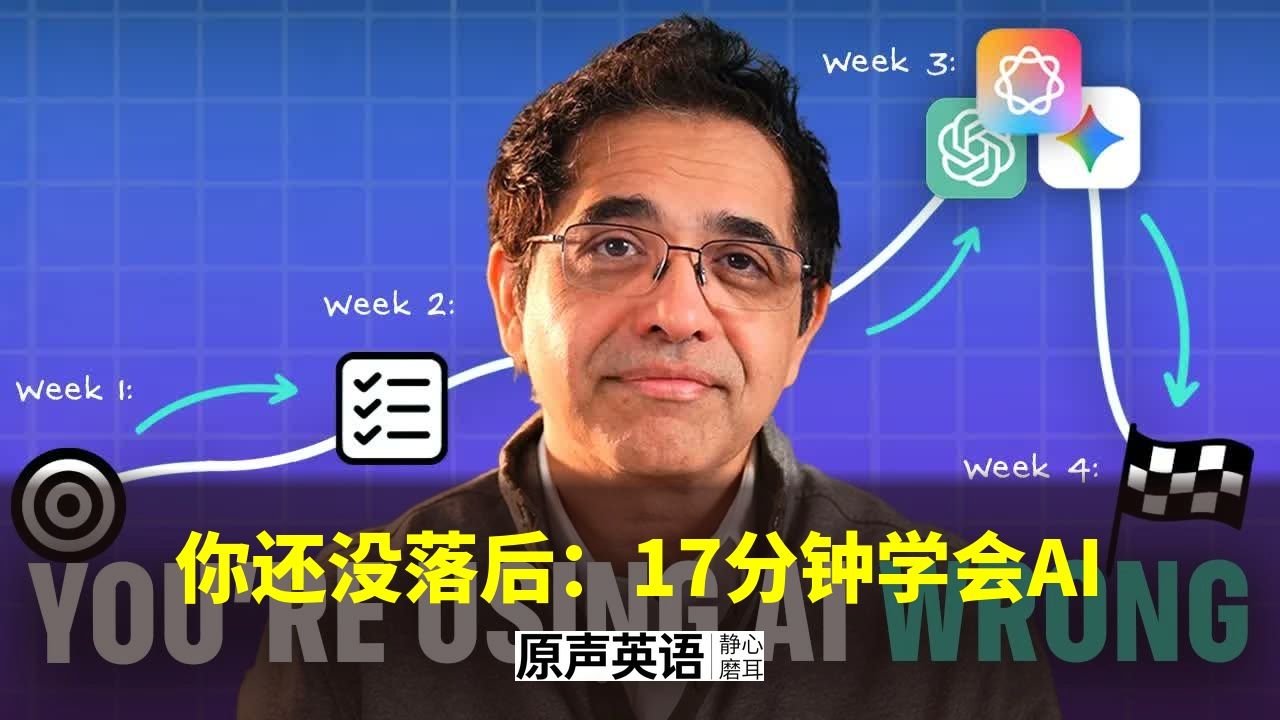
字幕摘录
| 时间 | 英文 | 中文 |
|---|---|---|
| 0:00 | Most people using AI are doing it wrong, | 大部分使用人工智能的人做错了 |
| 0:02 | which is why it's surprisingly easy | 这就是为什么它令人惊讶的容易 |
| 0:04 | to get ahead of 99% of them. | 领先他们99% |
| 0:06 | I have spent over 20 years in tech and AI | 我花了20多年的科技和人工智能 |
| 0:09 | as a CEO, board member, investor, | 作为首席执行官,董事会成员,投资人, |
| 0:12 | building billion dollar companies. | 建设亿元公司. |
| 0:14 | And here's what I'm seeing. | 且道所见. |
| 0:15 | The gap between people who understand AI | 理解AI的人之间的差距 |
| 0:18 | and those who don't is getting wider and faster. | 而那些不这样做的人 越来越宽和更快。 |
| 0:21 | In this video, I'll give you a clear seven step roadmap | 在这段视频里,我给你一个清晰的七步路线图 |
展开字幕全文(392 条)
| 序号 | 英文 | 中文 |
|---|---|---|
| 1 | Most people using AI are doing it wrong, | 大部分使用人工智能的人做错了 |
| 2 | which is why it's surprisingly easy | 这就是为什么它令人惊讶的容易 |
| 3 | to get ahead of 99% of them. | 领先他们99% |
| 4 | I have spent over 20 years in tech and AI | 我花了20多年的科技和人工智能 |
| 5 | as a CEO, board member, investor, | 作为首席执行官,董事会成员,投资人, |
| 6 | building billion dollar companies. | 建设亿元公司. |
| 7 | And here's what I'm seeing. | 且道所见. |
| 8 | The gap between people who understand AI | 理解AI的人之间的差距 |
| 9 | and those who don't is getting wider and faster. | 而那些不这样做的人 越来越宽和更快。 |
| 10 | In this video, I'll give you a clear seven step roadmap | 在这段视频里,我给你一个清晰的七步路线图 |
| 11 | to master AI like the top 1%. | 以像前1%一样掌握AI。 |
| 12 | And the best part is you can actually do it | 最好的部分是你可以做到这一点 |
| 13 | in just 30 days, even if you're a total beginner. | 30天内,即使你是一个全新的人。 |
| 14 | Let's dive in. | 让我们潜入。 |
| 15 | Week one starts with learning what I call machine English. | 一周开始学习我所说的机器英语。 |
| 16 | Most people talk to AI like it's a person, | 大部分人跟AI说话 就像一个人, |
| 17 | and that's a huge mistake. | 这是一个巨大的错误。 |
| 18 | Why? | 为什么? |
| 19 | Because the generated AI systems like chat GPT | 因为生成的AI系统如聊天GPT |
| 20 | don't actually understand our language. | 不真正理解我们的语言。 |
| 21 | They predict it. | 他们预测。 |
| 22 | And that's where most people get stuck. | 这就是大多数人被困的地方。 |
| 23 | If I said Humpty Dumpty sat on a, | 如果我说胖胖坐在一个, |
| 24 | your brain's gonna fire wall. | 你的大脑会发射墙壁。 |
| 25 | You knew what was coming. | 你知道会发生什么。 |
| 26 | Your brain predicted it. | 你的大脑预言的 |
| 27 | You could have said Humpty Dumpty sat on a roof. | 你可以说胖子坐在屋顶上 |
| 28 | Now it's accurate, but you knew wall was more likely | 不过你知道墙壁更可能 |
| 29 | based on what you've seen before. | 以你以前见过的为基础 |
| 30 | Think about Google search. | 考虑谷歌搜索. |
| 31 | It does autocomplete the same way. | 它的自动完成方式是一样的。 |
| 32 | Why? | 为什么? |
| 33 | Because it has seen so many search queries before, | 因为它以前见过这么多的搜索查询, |
| 34 | it has learned from it, | 它从中吸取了教训, |
| 35 | and now it's giving you the most likely option. | 现在它给了你最可能的选择。 |
| 36 | AI models like chat GPT or Gemini work in a similar fashion, | AI模型,如聊天GPT 或双子座工作类似的方式, |
| 37 | but they're different than search engines | 但和搜索引擎不一样 |
| 38 | because they don't store any pre-baked answers. | 因为他们不存储任何预烤的答案。 |
| 39 | They generate the answer on the fly. | 它们在苍蝇上产生答案 |
| 40 | How do they generate it? | 他们怎么生成的? |
| 41 | Like at a very high level, | 就像在非常高的水平, |
| 42 | AI breaks your text into smaller parts called tokens. | AI将您的文本分解为小部分,称为符号. |
| 43 | Each token is a word or sometimes a part of a word. | 每个符号都是单词,有时是单词的一部分. |
| 44 | Humpty is probably one token. | 胖子可能是个标志 |
| 45 | Dumpty could be another token. | 粪便可能是另一个标志。 |
| 46 | Sat, another token. | 萨特,另一个标志。 |
| 47 | Wall, another token. | 墙,另一个标志。 |
| 48 | Then AI converts each token into a list of numbers, | 然后AI将每个符号转换成数字列表, |
| 49 | also known as multi-dimensional vectors. | 也称为多维向量. |
| 50 | Those numbers are placed inside a massive mathematical space | 这些数字放在巨大的数学空间里 |
| 51 | called an embedding space. | 称为嵌入空间。 |
| 52 | And in that massive space, | 在那个巨大的空间里 |
| 53 | similar ideas tend to live closer together. | 类似的想法往往更紧密地共处. |
| 54 | The system has learned from previous experiences, | 该系统从以往的经验中吸取了教训, |
| 55 | so it knows that the word Humpty, egg, wall, and fall | 所以它知道"胖子"、"蛋"、"墙"、"摔" |
| 56 | will be closer, | 将更亲近, |
| 57 | but they're gonna be far from words | 但他们会远离文字 |
| 58 | like motorcycle or chocolate. | 像摩托车或者巧克力 |
| 59 | Now, when it's time to generate the answer, | 现在,当它的时间产生答案, |
| 60 | AI looks at the context | 大赦国际审视背景 |
| 61 | and predicts the most likely next token. | 并预测最有可能的下一个符号。 |
| 62 | So when it sees Humpty Dumpty had a great, | 所以当它看到胖子有一个伟大的, |
| 63 | it weighs all the options. | 它权衡了所有的选项。 |
| 64 | Humpty Dumpty had a great party. | 胖子有个很棒的派对 |
| 65 | Humpty Dumpty had a great day. | 胖子今天过得很愉快 |
| 66 | Humpty Dumpty had a great chocolate. | 矮胖子有一个伟大的巧克力。 |
| 67 | And it sees that the word fall is the most likely outcome. | 并且它看到这个词的掉落是最可能的结果. |
| 68 | So the line is generated and finished, | 因此,线是产生和完成的, |
| 69 | not from memory, not from stored facts, | 不从记忆, 不从存储的事实, |
| 70 | but from probability and proximity. | 但从概率和接近。 |
| 71 | That's why AI can feel so smart, but also so alien. | 所以AI能感觉如此聪明,但也如此异形. |
| 72 | Now, I'm skipping a lot of details here, | 现在,我跳过 很多细节在这里, |
| 73 | but the important takeaway here | 但重要的外卖 |
| 74 | is that when your prompt is vague, | 当你的警告是模糊的的时候, |
| 75 | this guessing machine called chat GPT or Gemini | 这个猜谜机叫做聊天GPT或双子座 |
| 76 | will produce guesses that are also vague. | 将产生同样模糊的猜测。 |
| 77 | And if your prompt is sharp and targeted, | 如果你的急速行动有目标 |
| 78 | AI will come back to you with sharp and targeted guesses. | AI会带着尖锐和有针对性的猜测回到你身边. |
| 79 | That's what I call machine English. | 这就是我所说的机器英语。 |
| 80 | It helps AI to compute your intent, | 它帮助AI计算你的意图, |
| 81 | not just try to comprehend it. | 不只是试图理解它。 |
| 82 | So what does a sharper prompt look like? | 更尖锐的提示是什么样子? |
| 83 | I call it AIM, A for actor. | 我叫它AIM,一个演员。 |
| 84 | Tell the model who it's acting as. | 告诉模特儿是谁 |
| 85 | I is for input. | 我是来输入的 |
| 86 | Give it the context and data it needs. | 给它所需的背景和数据. |
| 87 | An M for mission. | 一个M任务。 |
| 88 | What do you want it to do? | 你想怎样? |
| 89 | Instead of typing, let's say, fix my resume, | 而不是打字,让我们说, 修复我的简历, |
| 90 | try typing H at GPT. | 尝试在 GPT 输入 H 。 |
| 91 | You are the world's most sought after resume editor | 您是世界上在恢复编辑器之后 被寻找最多的 |
| 92 | and business writer. | 还有商业作家 |
| 93 | You've reviewed thousands of resumes | 你看过几千份简历 |
| 94 | that led to interviews at top tech companies. | 这导致采访 在顶级技术公司。 |
| 95 | You've told the AI what its persona is, | 你告诉了人工智能是什么人 |
| 96 | what it's acting as, A. | 它是什么行为,A。 |
| 97 | Second line, I'm attaching my resume | 第二行,我附上简历 |
| 98 | and the job description for a senior product manager role | 和高级产品经理职务说明 |
| 99 | at a fintech company. | 在一家金融科技公司。 |
| 100 | That's your input. | 这是你的投入。 |
| 101 | Third, mission. | 第三,任务。 |
| 102 | Review it and give me a bullet list of 10 specific ideas | 检查一下,给我十个具体的想法 |
| 103 | on how to improve clarity, measurable impact, | 如何提高清晰度和可衡量的影响, |
| 104 | align with the role. | 与角色一致。 |
| 105 | Your mission is to help me build the best resume | 你的任务是帮我建立最好的简历 |
| 106 | that gets me hired. | 这让我得到雇佣。 |
| 107 | That's how you take AIM. | 这就是你如何采取AIM。 |
| 108 | It turns a prompt into a structure | 它把一个提示变成一个结构 |
| 109 | the model can understand, compute, and reason with. | 模型可以理解,计算, 和理性。 |
| 110 | You can use this three-part structure in almost all prompts. | 你可以在几乎所有的提示中使用这个三段结构. |
| 111 | And from now on, you will start seeing the results | 从现在起,你将开始看到结果 |
| 112 | to be at least five or 10 times better than before. | 至少要比以前好五到十倍 |
| 113 | Only when you learn its language | 当你学会了它的语言 |
| 114 | does AI finally start working for you. | AI终于为你工作了 |
| 115 | Now that you understand how to speak to AI, | 现在你明白怎么跟AI说话了 |
| 116 | we're gonna pick your instrument. | 我们要选你的乐器 |
| 117 | Here's the thing. | 事情是这样的 |
| 118 | Most people start their AI journey the wrong way. | 大多数人开始他们的AI走错路了. |
| 119 | They Google top 50 AI tools, they pick 10, | 他们谷歌前50个AI工具, 他们选择10, |
| 120 | and they jump from one to the other. | 他们从一个跳到另一个 |
| 121 | They skim through all of them. | 他们滑过所有的。 |
| 122 | That's a recipe for failure | 这是失败的秘方 |
| 123 | because there's so much out there. | 因为外面有很多 |
| 124 | My recommendation, pick one, go deep. | 我的建议,选一个,深入。 |
| 125 | Think of learning AI | 想学人工智能 |
| 126 | the same way you would learn an instrument. | 就像你学乐器一样 |
| 127 | There's a study in Frontier Psychology | 边疆心理学研究 |
| 128 | that found that drummers pick up guitar | 发现鼓手拿起吉他 |
| 129 | faster than complete beginners. | 比完整的初学者更快 |
| 130 | Drumming is not even about melody, | 杜鲁明甚至不 关于旋律, |
| 131 | and it requires very different physical skills. | 它需要非常不同的体能 |
| 132 | But I personally had the same experience. | 但我个人也有同样的经历。 |
| 133 | I spent tens of thousands of hours as a drummer, | 我作为鼓手花了数万小时 |
| 134 | and when I picked up guitar, it wasn't easy, | 当我拿起吉他, 这不容易, |
| 135 | but it wasn't uncomfortable | 却不觉得不舒服 |
| 136 | because I already knew how to practice, | 因为我已经知道如何练习, |
| 137 | and my brain was trained to see structures and patterns. | 我的大脑被训练成能看见结构和规律 |
| 138 | The deeper you dig into one foundational model, | 你越深入地挖掘一个基础模型, |
| 139 | the faster you will find the rhythm of all the others. | 越快,你就会找到 所有其他的节奏。 |
| 140 | So which one do you pick? | 你选哪一个? |
| 141 | If you want the most mature one, pick Chad GPT. | 如果你想要最成熟的,请选择Chad GPT. |
| 142 | If you're deep into Google Stack and Google's ecosystem, | 如果你深入谷歌 Stack和谷歌的生态系统 |
| 143 | try Gemini. | 试试双子座 |
| 144 | If you want more business and project-based AI, | 如果你想要更多的商业和基于项目的AI, |
| 145 | go with Claude. | 和克劳德一起去 |
| 146 | But really, it doesn't matter what you pick. | 但真的,你选什么不重要 |
| 147 | In the first week, spend time with one of them | 第一个星期,和他们中的一个在一起 |
| 148 | and learn its personality, its cadences, | 并学习它的个性,它的节奏, |
| 149 | limits, its strengths. | 限制,它的长处。 |
| 150 | The goal is to start feeling the rhythm. | 目标是开始感受节奏. |
| 151 | Once you get comfortable, | 一旦你变得舒适, |
| 152 | try using the AIM framework that we talked about. | 尝试使用我们讨论过的AIM框架. |
| 153 | By the end of week one, | 到第一周结束时 |
| 154 | you should be able to write a structured prompt | 您应该可以写一个结构化的提示 |
| 155 | without thinking. | 没有思考。 |
| 156 | All right, so we have started using AI. | 好吧,所以我们已经开始使用AI。 |
| 157 | Now let's talk about what actually makes your outputs smart, | 现在让我们来谈谈 是什么让你的输出聪明, |
| 158 | and that's context. | 这是背景。 |
| 159 | The world's smartest AI will sound clueless | 全世界最聪明的人工智能 听起来毫无头绪 |
| 160 | unless you feed it context. | 除非你给它上下文。 |
| 161 | Every answer AI gives | AI的每个回答 |
| 162 | depends on how it understands the question. | 取决于它如何理解问题。 |
| 163 | If you don't give it context, it has no grounding. | 如果你不讲上下文,它就没有立足点。 |
| 164 | Remember that inside these AI models, | 记住,在这些AI模型中, |
| 165 | there is nothing but a crazy mathematical space | 只有一个疯狂的数学空间 |
| 166 | filled with billions of numbers. | 充满了数十亿的数字。 |
| 167 | Context is the map that helps you navigate that space | 上下文是帮助您导航空间的地图 |
| 168 | to tell AI where to look and what matters. | 告诉AI在哪里寻找,什么才是重要。 |
| 169 | And the best way to build that map is with an acronym | 而建造地图的最好方法是用缩写 |
| 170 | I call MAP. | 我打电话给MAP。 |
| 171 | M is for memory, | M是为了记忆 |
| 172 | the conversation history or the notes that carry over | 对话历史或记录 |
| 173 | from previous chat sessions that you've had with the AI. | 之前你和AI的谈话 |
| 174 | Now you can repaste the thread | 现在你可以重新调整线程 |
| 175 | or ask the model to summarize before starting again. | 或者请模型在重新开始之前进行总结。 |
| 176 | That's how you'll start building continuity | 这就是你开始建立连续性的方式 |
| 177 | in your conversations. | 在你的谈话。 |
| 178 | A is for assets, the files, data, | A是资产、文件、数据 |
| 179 | the resources that you attach or copy paste in your prompt. | 您在提示中附加或复制粘贴的资源。 |
| 180 | These assets help you ground the model in reality. | 这些资产可以帮助你建立模型 |
| 181 | Second A is for actions. | 第二A是行动。 |
| 182 | Now these are the tools that the model can call to do work. | 现在这些是模型可以称为工作的工具。 |
| 183 | The action could be search the web or scan your drive | 动作可以是搜索网页或扫描您的驱动器 |
| 184 | 或写此代码或创建Notion Doc。 | |
| 185 | And P is the prompt. | 而P是及时。 |
| 186 | And the prompt is the instruction itself. | 提示是指示本身。 |
| 187 | So the better you get with memory, assets | 所以,你得到越好 与记忆,资产 |
| 188 | and external actions, | 和外部行动, |
| 189 | the better context you'll give AI in the prompt. | 你马上会给AI更好的环境 |
| 190 | And the richer the context, | 环境越丰富 |
| 191 | the better the AI reasoning and response. | AI的推理和反应越好。 |
| 192 | Once you start using these frameworks like AIM and MAP, | 一旦你开始使用这些框架 比如AIM和MAP, |
| 193 | you have joined the top 10% of AI users. | 您已经加入了 AI 用户的前10% 。 |
| 194 | But if you want to hit that absolute expert level, | 但如果你想达到绝对的专家水平 |
| 195 | there's one more thing that you really need. | 还有一件事你真的很需要。 |
| 196 | Debug your thinking, which is step four. | 调试你的思维,这是第四步。 |
| 197 | When you're not getting the right answer, | 当你没有得到正确的答案, |
| 198 | the problem is not the AI, it's your thinking. | 问题不在于人工智能 而是你的思维 |
| 199 | I remember the first time I ever prompted an AI. | 我记得我第一次发动AI |
| 200 | It was one of those earliest models from OpenAI. | 它是OpenAI最早的模型之一. |
| 201 | And I spent an entire day trying to make sense of it. | 我花了整整一天的时间来解释 |
| 202 | And by the end of it, I was super frustrated | 到最后,我很沮丧 |
| 203 | because it was random, it was unpredictable. | 因为它是随机的, 它是无法预测的。 |
| 204 | But back then, no one understood. | 但那时 没人懂 |
| 205 | The phrase prompt engineering hadn't even existed yet | 即时工程这个短语还没有存在 |
| 206 | because prompting isn't typing, it's iterating. | 因为提示不是打字,而是累赘 |
| 207 | When the output is weak, I assume the fault is mine | 当输出疲软时,我猜是我的错 |
| 208 | because it is. | 因为它是。 |
| 209 | Did I get it the right persona? | 我找到对的人了吗? |
| 210 | Did I provide the right context? | 我提供了正确的环境吗? |
| 211 | Did I give it the right goal? | 我给了它正确的目标吗? |
| 212 | And sometimes I even ask the model itself, | 有时我甚至问模型本身, |
| 213 | what did you do and why did you choose that answer? | 你做了什么 为什么选择这个答案? |
| 214 | It will explain its logic, it will explain its chain, | 它会解释它的逻辑, 它会解释它的链, |
| 215 | and that's when the magic starts. | 魔力从此开始 |
| 216 | You're not just using AI, you're learning how it thinks. | 你不只是使用AI,你正在学习它的想法。 |
| 217 | There are three cheat codes I use for that. | 我用了三个欺骗代码 |
| 218 | The first is the chain of thought pattern. | 第一个是思想模式的链条。 |
| 219 | When the answer seems off, I would say, | 当答案似乎关闭,我会说, |
| 220 | think step by step, show your reasoning. | 一步一步思考,展示你的推理。 |
| 221 | Then give me the final concise answer. | 然后给我最后的简明答案。 |
| 222 | The second is the verifier pattern. | 第二个是验证器图案. |
| 223 | I would say to the AI, ask me three questions | 我会对AI说,问我三个问题 |
| 224 | that would clarify my intent to you. | 这会澄清我的意图 |
| 225 | Ask them one at a time and then combine | 一次问一次,然后结合 |
| 226 | what you've learned and try again. | 你学到了什么,再试一次 |
| 227 | And the third is the refinement pattern | 第三个是完善模式 |
| 228 | where you're refining your input itself. | 在那里,你正在完善你的输入本身。 |
| 229 | Before answering, propose two sharper versions | 在回答之前, 提出两个更清晰的版本 |
| 230 | of my question, ask which one I prefer. | 我的问题,问我喜欢哪一个。 |
| 231 | So AI will tell me how to ask the right way | 所以,AI会告诉我如何 问正确的方式 |
| 232 | and then we continue. | 然后我们继续 |
| 233 | And you have to keep iterating with these patterns | 你一定要跟这些图案一起走 |
| 234 | because these loops can teach the model | 因为这些循环可以教模型 |
| 235 | how to understand you and teach you | 如何理解你并教你 |
| 236 | how to understand the model. | 如何理解模型。 |
| 237 | Test, tweak, tune up, push until you can tell | 测试、调整、调头、推到知道为止 |
| 238 | why something is working and why something is off. | 为什么有些东西在工作 为什么有些东西在关闭。 |
| 239 | That's when it clicks. | 这时它点击。 |
| 240 | You're not talking at AI anymore. | 你不再在AI说话了 |
| 241 | You're having an ongoing conversation. | 你正在不断交谈 |
| 242 | You and AI are learning together from each other. | 你和AI在互相学习 |
| 243 | But here's the thing, it's not enough | 但问题是,这还不够 |
| 244 | to just debug your mind. | 只是调试你的思想。 |
| 245 | If your post sounds like every other LinkedIn post I see | 如果你的帖子听起来像其他的链接 我看见了 |
| 246 | that's pasted from ChatGPT, you still have a problem. | 你还有问题 |
| 247 | And that's why step five is to steer to experts. | 这也是为什么第五步要向专家们引导。 |
| 248 | 当你问ChatGPT一个问题, | |
| 249 | you're not searching a database of answers. | 您不会搜索一个答案数据库。 |
| 250 | You're sampling from millions of probable ideas | 你从无数可能的想法中取样 |
| 251 | that AI has learned over time | 随着时间的推移,大赦国际了解到: |
| 252 | and is storing as billions of numbers. | 并储存了数十亿个数字。 |
| 253 | Some are brilliant, some are average, | 有些很聪明,有些很普通 |
| 254 | some are completely made up and some are flat out wrong. | 有些是完全编造的,有些是完全错的。 |
| 255 | If you prompt vaguely, like explain how to make | 如果你模糊的提示,比如解释如何做 |
| 256 | a team more innovative, the model will give you | 一个团队更创新,模型会给你 |
| 257 | a superficial generic blah answer full of buzzwords | 一个肤浅的泛泛的回答 充满了响亮的词 |
| 258 | and you read it and think, yeah, I already knew that. | 你读它,然后想, 是的,我已经知道这一点。 |
| 259 | So how do you fix that? | 那么,你如何解决这个问题? |
| 260 | You direct the model away from the middle | 你让模特远离中间 |
| 261 | and toward the sharper edges of its brain. | 并朝着它的大脑的尖端。 |
| 262 | So instead of that vague prompt, you can say this, | 所以,与其说模糊的提示,你可以说, |
| 263 | explain how to make a team more innovative | 解释如何让团队更创新 |
| 264 | using ideas from Pixar's brain trust, | 利用皮克斯的大脑信任的想法 |
| 265 | Satya Nadella's strategy and Harvard's research. | 萨特亚·纳德拉的策略和哈佛的研究. |
| 266 | Now you pull the model from mediocrity into mastery | 现在你把模特儿从平庸中拉到掌握 |
| 267 | by navigating it toward experts, frameworks, depth. | 把它引向专家 框架 深度 |
| 268 | What if you want to learn about black holes | 如果你想学黑洞 |
| 269 | and you don't know who the experts are? | 你不知道专家是谁? |
| 270 | No problem, ask AI first. | 没问题,先问AI |
| 271 | List the top experts, researchers and research papers | 列出顶级专家、研究人员和研究论文 |
| 272 | and current thinking on black holes. | 和黑洞上的思维 |
| 273 | Then feed the same thing back to the model | 然后把同样的东西反馈给模型 |
| 274 | and prompt using these experts and sources, | 并迅速利用这些专家和来源, |
| 275 | synthesize the original framework that fills | 合成填充的原始框架 |
| 276 | a current gap on the science of black holes | 目前黑洞科学的空白 |
| 277 | or whatever it is that you're after. | 或者你想要的东西 |
| 278 | That's the way you make sure AI | 这就是你确保AI的方式 |
| 279 | is not an echo chamber anymore. | 不再是回声室了 |
| 280 | But remember, you're gonna need to verify what you get. | 但记住,你需要 核实你得到了什么。 |
| 281 | That's our step six. | 这是我们的第六步。 |
| 282 | Sometimes AI will tell you things like 68% of Americans | 有时AI会告诉你68%的美国人 |
| 283 | are getting divorced. | 即将离婚。 |
| 284 | I mean, you know it's not true. | 我的意思是,你知道 这不是真的。 |
| 285 | But the scary part is AI will sound just as confident | 但可怕的部分是AI 听起来同样自信 |
| 286 | when it's wrong as when it's right. | 当错如是时. |
| 287 | So you can tell AI a hundred times, stop making stuff up. | 所以你可以告诉AI100次, 停止编造的东西。 |
| 288 | But all models are essentially generative by design. | 但是所有的模型本质上都是通过设计而遗传的. |
| 289 | Making things up is why they exist. | 编造事物是它们存在的原因。 |
| 290 | So what do you do about that? | 那你怎么办? |
| 291 | You simply verify, don't just consume, critique. | 你只是核实, 不要只是消费,批评。 |
| 292 | There are five ways to separate intelligence from illusion. | 有五法能分别智慧与幻. |
| 293 | Assumptions, sources, counter evidence, auditing | 假设、来源、反证据、审计 |
| 294 | and cross model verification. | 和跨模型验证。 |
| 295 | Let's take one at a time. | 以一乘为一. |
| 296 | Assumptions, ask, list every assumption you made | 假设,问,列出你所做的每一个假设 |
| 297 | and rank them each by confidence. | 并依信义而加以排列。 |
| 298 | Second is sources. | 第二是来源。 |
| 299 | Ask, cite two independent sources | 问,引用两个独立来源 |
| 300 | for each major claim that you just made. | 你刚刚提出的每一项要求 |
| 301 | Include title, URL and a one line quote. | 包含标题、 URL 和一个行引用 。 |
| 302 | Now you can check it yourself. | 现在你可以自己检查了 |
| 303 | That's the scaffolding behind the answer. | 答后即是脚手脚. |
| 304 | Counter evidence, push it. | 反证,推之. |
| 305 | Find one credible source that disagrees with your answer. | 找到一个不认同你答案的可靠来源 |
| 306 | Explain the dependencies. | 解释依依. |
| 307 | That's where real reasoning lives. | 真实推理所住之处. |
| 308 | Auditing is the fourth one. | 审计是第四个。 |
| 309 | Ask, recompute every figure, show your math or code. | 问,重算每个数字,显示你的数学或代码. |
| 310 | You'll be shocked how often the numbers change | 你会震惊 数字经常变 |
| 311 | once you make it slow down and start auditing. | 一旦你让它慢下来并开始审计。 |
| 312 | And finally, cross model verification. | 最后,跨模型验证。 |
| 313 | This one's my favorite. | 这个是我最喜欢的 |
| 314 | I run the same prompt in ChatGPT and Gemini and Claude. | 我在ChatGPT和双子座和克劳德也跑过同样的快车 |
| 315 | I take the output from one model | 我从一个模型中提取输出 |
| 316 | and ask another to critique it. | 并请求别人批评它。 |
| 317 | Or I feed the claims of one model into the other | 或者我把一个模型的主张 输入另一个模型 |
| 318 | and say, verify this. | 并说,证实这一点。 |
| 319 | That's how you separate noise from knowledge. | 这就是你把噪音和知识分开的方法。 |
| 320 | By the end of your third week, | 到第三个星期结束时, |
| 321 | you'll start feeling more in control of your output. | 你会开始感觉更多的控制你的输出。 |
| 322 | But here's the problem. | 但问题是... |
| 323 | The best AI output aren't the ones | 最好的AI输出不是那些 |
| 324 | that sound the most original. | 这听起来最原创。 |
| 325 | They're the ones that sound like you. | 他们是那些听起来像你。 |
| 326 | That's why step seven is about developing tastes. | 因此第七步是发展口味. |
| 327 | Most people use AI like a vending machine. | 大多数人像自动售货机一样使用AI. |
| 328 | They push a button, | 他们按了一个按钮, |
| 329 | grab the same junk food output everyone else gets | 抢走同样的垃圾食品输出 其他人得到 |
| 330 | and call it a day. | 并告终. |
| 331 | If you did that, most people will know | 如果你这样做,大多数人会知道 |
| 332 | you just copy pasted it. | 你只是抄袭了它。 |
| 333 | But you are past that now, right? | 但你已经过去了 对吧? |
| 334 | It's your fourth week. | 尔时第四周. |
| 335 | It's time to step into the ring. | 时步入戒中. |
| 336 | Treat AI like your sparring partner. | 把AI当成你的搭档 |
| 337 | Argue with it. | 说吧 |
| 338 | Push back. | 推还. |
| 339 | Sharpen your thinking. | 更敏锐的思考。 |
| 340 | Sharpen its thinking. | 理其思虑. |
| 341 | That's where the ocean framework comes in, | 海洋框架就是从那里来的 |
| 342 | is how you turn generic answers into tasteful insights. | 就是如何把一般答案变成有品味的见解。 |
| 343 | Something that sounds like you. | 听起来像你 |
| 344 | Oh, original. | 哦,原创。 |
| 345 | Look at the response. | 看看反应 |
| 346 | Is there a non-obvious idea in it? | 里面有不明显的主意吗? |
| 347 | If not, push it. | 若无,推之. |
| 348 | Ask, give me three angles no one else has thought about. | 问,给我三个角度 没有人想到。 |
| 349 | Label one as risky | 标签一是危险的 |
| 350 | and recommend the one that you like the most. | 并推荐你最喜欢的。 |
| 351 | See, concrete. | 看见了 混凝土 |
| 352 | Are there names, examples, and numbers that make sense? | 名字、例子和数字是否合理? |
| 353 | If not, ask. | 若无则问. |
| 354 | Back every claim with one real example. | 以一个真正的例子回覆所有的权利要求。 |
| 355 | E is evident. | E很明显 |
| 356 | Is the reasoning visible? | 推理明显吗? |
| 357 | Is there enough evidence? | 有足够的证据吗? |
| 358 | If not, ask. | 若无则问. |
| 359 | Show your logic in three bullets. | 以三颗子弹显示你的逻辑. |
| 360 | Provide evidence before you provide final answer. | 在提供最后答复之前提供证据。 |
| 361 | A, assertive. | A,固执。 |
| 362 | Does it take a stance you could agree or disagree with? | 你同意还是不同意? |
| 363 | If not, push it again. | 若无,则再推. |
| 364 | Don't tell me what I wanna hear. | 别告诉我我想听什么 |
| 365 | Pick a side. | 选一旁. |
| 366 | State your thesis, defend it, | 陈述你的论文,捍卫它, |
| 367 | and then address the best counterpoint. | 然后处理最佳的反点。 |
| 368 | N, narrative. | N,叙事. |
| 369 | What's the story? | 什么情况? |
| 370 | Does it flow? | 它会流吗? |
| 371 | Is it tight? | 紧吗? |
| 372 | Guide it. | 引导它。 |
| 373 | Write it like a story. | 写作如是说法. |
| 374 | Hook problem insight proof actions, | 虎克问题洞察力证明行动, |
| 375 | whatever you want in that story. | 随你怎么说 |
| 376 | So that's the ocean framework. | 这就是海洋框架。 |
| 377 | To add taste to your output. | 在输出中添加味道. |
| 378 | Now, as you apply this over 30 days, | 现在,当你用这个30天, |
| 379 | you will start noticing something deeper. | 你会开始注意到更深层的东西。 |
| 380 | Every prompt you write, every revision you push, | 你每写一个提示,每个修改, |
| 381 | every judgment you make, | 你所做的一切判断, |
| 382 | you're not just training the model. | 你不只是训练模型。 |
| 383 | You are training you. | 你在训练你 |
| 384 | AI is coming, whether we like it or not. | 不管我们喜不喜欢,AI都会来 |
| 385 | To some, it might be triggering lots of deep fears, | 对有些人来说,这可能会引发许多深层的恐惧, |
| 386 | but I remain a perpetual optimist. | 但我永远是乐观主义者 |
| 387 | I think AI is not here to replace human work. | 我认为AI不是来代替人类工作的. |
| 388 | It's here to restore human worth. | 是来恢复人类价值的 |
| 389 | If you like this video, | 如果你喜欢这个视频, |
| 390 | don't forget to subscribe | 别忘了认购 |
| 391 | and check out my most recent video here. | 看看我最新的录像 |
| 392 | Thank you, and I love you. | 谢谢,我爱你 |
该视频共有字幕 392 条。解锁更多字幕为会员功能,请移动到 价格
P2 · 【AI入门】你还没落后:17分钟学会AI · 30天掌握AIM与MAAP框架 p02 无字幕 (P2)
字幕摘录
| 时间 | 英文 | 中文 |
|---|---|---|
| 0:00 | Most people using AI are doing it wrong, | 大部分使用人工智能的人做错了 |
| 0:02 | which is why it's surprisingly easy | 这就是为什么它令人惊讶的容易 |
| 0:04 | to get ahead of 99% of them. | 领先他们99% |
| 0:06 | I have spent over 20 years in tech and AI | 我花了20多年的科技和人工智能 |
| 0:09 | as a CEO, board member, investor, | 作为首席执行官,董事会成员,投资人, |
| 0:12 | building billion dollar companies. | 建设亿元公司. |
| 0:14 | And here's what I'm seeing. | 且道所见. |
| 0:15 | The gap between people who understand AI | 理解AI的人之间的差距 |
| 0:18 | and those who don't is getting wider and faster. | 而那些不这样做的人 越来越宽和更快。 |
| 0:21 | In this video, I'll give you a clear seven step roadmap | 在这段视频里,我给你一个清晰的七步路线图 |
展开字幕全文(388 条)
| 序号 | 英文 | 中文 |
|---|---|---|
| 1 | Most people using AI are doing it wrong, | 大部分使用人工智能的人做错了 |
| 2 | which is why it's surprisingly easy | 这就是为什么它令人惊讶的容易 |
| 3 | to get ahead of 99% of them. | 领先他们99% |
| 4 | I have spent over 20 years in tech and AI | 我花了20多年的科技和人工智能 |
| 5 | as a CEO, board member, investor, | 作为首席执行官,董事会成员,投资人, |
| 6 | building billion dollar companies. | 建设亿元公司. |
| 7 | And here's what I'm seeing. | 且道所见. |
| 8 | The gap between people who understand AI | 理解AI的人之间的差距 |
| 9 | and those who don't is getting wider and faster. | 而那些不这样做的人 越来越宽和更快。 |
| 10 | In this video, I'll give you a clear seven step roadmap | 在这段视频里,我给你一个清晰的七步路线图 |
| 11 | to master AI like the top 1%. | 以像前1%一样掌握AI。 |
| 12 | And the best part is you can actually do it | 最好的部分是你可以做到这一点 |
| 13 | in just 30 days, even if you're a total beginner. | 30天内,即使你是一个全新的人。 |
| 14 | Let's dive in. | 让我们潜入。 |
| 15 | Week one starts with learning what I call machine English. | 一周开始学习我所说的机器英语。 |
| 16 | Most people talk to AI like it's a person, | 大部分人跟AI说话 就像一个人, |
| 17 | and that's a huge mistake. | 这是一个巨大的错误。 |
| 18 | Why? | 为什么? |
| 19 | Because the generated AI systems like chat GPT | 因为生成的AI系统如聊天GPT |
| 20 | don't actually understand our language. | 不真正理解我们的语言。 |
| 21 | They predict it. | 他们预测。 |
| 22 | And that's where most people get stuck. | 这就是大多数人被困的地方。 |
| 23 | If I said Humpty Dumpty sat on a, | 如果我说胖胖坐在一个, |
| 24 | your brain's gonna fire wall. | 你的大脑会发射墙壁。 |
| 25 | You knew what was coming. | 你知道会发生什么。 |
| 26 | Your brain predicted it. | 你的大脑预言的 |
| 27 | You could have said Humpty Dumpty sat on a roof. | 你可以说胖子坐在屋顶上 |
| 28 | Now it's accurate, but you knew wall was more likely | 不过你知道墙壁更可能 |
| 29 | based on what you've seen before. | 以你以前见过的为基础 |
| 30 | Think about Google search. | 考虑谷歌搜索. |
| 31 | It does auto-complete the same way. | 一样的自动完成 |
| 32 | Why? | 为什么? |
| 33 | Because it has seen so many search queries before, | 因为它以前见过这么多的搜索查询, |
| 34 | it has learned from it, | 它从中吸取了教训, |
| 35 | and now it's giving you the most likely option. | 现在它给了你最可能的选择。 |
| 36 | AI models like chat GPT or Gemini work in a similar fashion, | AI模型,如聊天GPT 或双子座工作类似的方式, |
| 37 | but they're different than search engines | 但和搜索引擎不一样 |
| 38 | because they don't store any pre-baked answers. | 因为他们不存储任何预烤的答案。 |
| 39 | They generate the answer on the fly. | 它们在苍蝇上产生答案 |
| 40 | How do they generate it? | 他们怎么生成的? |
| 41 | Like at a very high level, | 就像在非常高的水平, |
| 42 | AI breaks your text into smaller parts called tokens. | AI将您的文本分解为小部分,称为符号. |
| 43 | Each token is a word or sometimes a part of a word. | 每个符号都是单词,有时是单词的一部分. |
| 44 | Humpty is probably one token. | 胖子可能是个标志 |
| 45 | Dumpty could be another token. | 粪便可能是另一个标志。 |
| 46 | Sat, another token. | 萨特,另一个标志。 |
| 47 | Wall, another token. | 墙,另一个标志。 |
| 48 | Then AI converts each token into a list of numbers, | 然后AI将每个符号转换成数字列表, |
| 49 | also known as multi-dimensional vectors. | 也称为多维向量. |
| 50 | Those numbers are placed inside a massive mathematical space | 这些数字放在巨大的数学空间里 |
| 51 | called an embedding space. | 称为嵌入空间。 |
| 52 | And in that massive space, | 在那个巨大的空间里 |
| 53 | similar ideas tend to live closer together. | 类似的想法往往更紧密地共处. |
| 54 | The system has learned from previous experiences, | 该系统从以往的经验中吸取了教训, |
| 55 | so it knows that the word Humpty, egg, wall, and fall | 所以它知道"胖子"、"蛋"、"墙"、"摔" |
| 56 | will be closer, | 将更亲近, |
| 57 | but they're gonna be far from words | 但他们会远离文字 |
| 58 | like motorcycle or chocolate. | 像摩托车或者巧克力 |
| 59 | Now, when it's time to generate the answer, | 现在,当它的时间产生答案, |
| 60 | AI looks at the context | 大赦国际审视背景 |
| 61 | and predicts the most likely next token. | 并预测最有可能的下一个符号。 |
| 62 | So when it sees Humpty Dumpty had a great, | 所以当它看到胖子有一个伟大的, |
| 63 | it weighs all the options. | 它权衡了所有的选项。 |
| 64 | Humpty Dumpty had a great party. | 胖子有个很棒的派对 |
| 65 | Humpty Dumpty had a great day. | 胖子今天过得很愉快 |
| 66 | Humpty Dumpty had a great chocolate. | 矮胖子有一个伟大的巧克力。 |
| 67 | And it sees that the word fall is the most likely outcome. | 并且它看到这个词的掉落是最可能的结果. |
| 68 | So the line is generated and finished, | 因此,线是产生和完成的, |
| 69 | not from memory, not from stored facts, | 不从记忆, 不从存储的事实, |
| 70 | but from probability and proximity. | 但从概率和接近。 |
| 71 | That's why AI can feel so smart, but also so alien. | 所以AI能感觉如此聪明,但也如此异形. |
| 72 | Now, I'm skipping a lot of details here, | 现在,我跳过 很多细节在这里, |
| 73 | but the important takeaway here | 但重要的外卖 |
| 74 | is that when your prompt is vague, | 当你的警告是模糊的的时候, |
| 75 | this guessing machine called ChatGPT or Gemini | 这个猜谜机叫做ChatGPT或双子座 |
| 76 | will produce guesses that are also vague. | 将产生同样模糊的猜测。 |
| 77 | And if your prompt is sharp and targeted, | 如果你的急速行动有目标 |
| 78 | AI will come back to you with sharp and targeted guesses. | AI会带着尖锐和有针对性的猜测回到你身边. |
| 79 | That's what I call machine English. | 这就是我所说的机器英语。 |
| 80 | It helps AI to compute your intent, | 它帮助AI计算你的意图, |
| 81 | not just try to comprehend it. | 不只是试图理解它。 |
| 82 | So what does a sharper prompt look like? | 更尖锐的提示是什么样子? |
| 83 | I call it AIM, A for actor. | 我叫它AIM,一个演员。 |
| 84 | Tell the model who it's acting as. | 告诉模特儿是谁 |
| 85 | I is for input. | 我是来输入的 |
| 86 | Give it the context and data it needs. | 给它所需的背景和数据. |
| 87 | An M for mission. | 一个M任务。 |
| 88 | What do you want it to do? | 你想怎样? |
| 89 | Instead of typing, let's say, fix my resume, | 而不是打字,让我们说, 修复我的简历, |
| 90 | try typing, H at GPT. | 尝试打字, H 在 GPT 。 |
| 91 | You are the world's most sought after resume editor | 您是世界上在恢复编辑器之后 被寻找最多的 |
| 92 | and business writer. | 还有商业作家 |
| 93 | You've reviewed thousands of resumes | 你看过几千份简历 |
| 94 | that led to interviews at top tech companies. | 这导致采访 在顶级技术公司。 |
| 95 | You've told the AI what its persona is, | 你告诉了人工智能是什么人 |
| 96 | what it's acting as, A. | 它是什么行为,A。 |
| 97 | Second line, I'm attaching my resume | 第二行,我附上简历 |
| 98 | and the job description for a senior product manager role | 和高级产品经理职务说明 |
| 99 | at a fintech company. | 在一家金融科技公司。 |
| 100 | That's your input. | 这是你的投入。 |
| 101 | Third, mission. | 第三,任务。 |
| 102 | Review it and give me a bullet list of 10 specific ideas | 检查一下,给我十个具体的想法 |
| 103 | on how to improve clarity, measurable impact, | 如何提高清晰度和可衡量的影响, |
| 104 | align with the role. | 与角色一致。 |
| 105 | Your mission is to help me build the best resume | 你的任务是帮我建立最好的简历 |
| 106 | that gets me hired. | 这让我得到雇佣。 |
| 107 | That's how you take AIM. | 这就是你如何采取AIM。 |
| 108 | It turns a prompt into a structure | 它把一个提示变成一个结构 |
| 109 | the model can understand, compute, and reason with. | 模型可以理解,计算, 和理性。 |
| 110 | You can use this three-part structure in almost all prompts. | 你可以在几乎所有的提示中使用这个三段结构. |
| 111 | And from now on, you will start seeing the results | 从现在起,你将开始看到结果 |
| 112 | to be at least five or 10 times better than before. | 至少要比以前好五到十倍 |
| 113 | Only when you learn its language | 当你学会了它的语言 |
| 114 | does AI finally start working for you. | AI终于为你工作了 |
| 115 | Now that you understand how to speak to AI, | 现在你明白怎么跟AI说话了 |
| 116 | we're gonna pick your instrument. | 我们要选你的乐器 |
| 117 | Here's the thing. | 事情是这样的 |
| 118 | Most people start their AI journey the wrong way. | 大多数人开始他们的AI走错路了. |
| 119 | They Google top 50 AI tools, they pick 10, | 他们谷歌前50个AI工具, 他们选择10, |
| 120 | and they jump from one to the other. | 他们从一个跳到另一个 |
| 121 | They skim through all of them. | 他们滑过所有的。 |
| 122 | That's a recipe for failure | 这是失败的秘方 |
| 123 | because there's so much out there. | 因为外面有很多 |
| 124 | My recommendation, pick one, go deep. | 我的建议,选一个,深入。 |
| 125 | Think of learning AI | 想学人工智能 |
| 126 | the same way you would learn an instrument. | 就像你学乐器一样 |
| 127 | There is a study in Frontier Psychology | 边疆心理学研究 |
| 128 | that found that drummers pick up guitar | 发现鼓手拿起吉他 |
| 129 | faster than complete beginners. | 比完整的初学者更快 |
| 130 | Drumming is not even about melody, | 杜鲁明甚至不 关于旋律, |
| 131 | and it requires very different physical skills. | 它需要非常不同的体能 |
| 132 | But I personally had the same experience. | 但我个人也有同样的经历。 |
| 133 | I spent tens of thousands of hours as a drummer. | 我作为鼓手花了数万小时 |
| 134 | And when I picked up guitar, it wasn't easy, | 当我拿起吉他时 并不容易 |
| 135 | but it wasn't uncomfortable | 却不觉得不舒服 |
| 136 | because I already knew how to practice, | 因为我已经知道如何练习, |
| 137 | and my brain was trained to see structures and patterns. | 我的大脑被训练成能看见结构和规律 |
| 138 | The deeper you dig into one foundational model, | 你越深入地挖掘一个基础模型, |
| 139 | the faster you will find the rhythm of all the others. | 越快,你就会找到 所有其他的节奏。 |
| 140 | So which one do you pick? | 你选哪一个? |
| 141 | If you want the most mature one, pick Chad GPT. | 如果你想要最成熟的,请选择Chad GPT. |
| 142 | If you're deep into Google Stack and Google's ecosystem, | 如果你深入谷歌 Stack和谷歌的生态系统 |
| 143 | try Gemini. | 试试双子座 |
| 144 | If you want more business and project-based AI, | 如果你想要更多的商业和基于项目的AI, |
| 145 | go with Claude. | 和克劳德一起去 |
| 146 | But really, it doesn't matter what you pick. | 但真的,你选什么不重要 |
| 147 | In the first week, spend time with one of them | 第一个星期,和他们中的一个在一起 |
| 148 | and learn its personality, its cadences, | 并学习它的个性,它的节奏, |
| 149 | limits, its strengths. | 限制,它的长处。 |
| 150 | The goal is to start feeling the rhythm. | 目标是开始感受节奏. |
| 151 | Once you get comfortable, | 一旦你变得舒适, |
| 152 | try using the AIM framework that we talked about. | 尝试使用我们讨论过的AIM框架. |
| 153 | By the end of week one, | 到第一周结束时 |
| 154 | you should be able to write a structured prompt | 您应该可以写一个结构化的提示 |
| 155 | without thinking. | 没有思考。 |
| 156 | All right, so we have started using AI. | 好吧,所以我们已经开始使用AI。 |
| 157 | Now let's talk about what actually makes your outputs smart, | 现在让我们来谈谈 是什么让你的输出聪明, |
| 158 | and that's context. | 这是背景。 |
| 159 | The world's smartest AI will sound clueless | 全世界最聪明的人工智能 听起来毫无头绪 |
| 160 | unless you feed it context. | 除非你给它上下文。 |
| 161 | Every answer AI gives | AI的每个回答 |
| 162 | depends on how it understands the question. | 取决于它如何理解问题。 |
| 163 | If you don't give it context, it has no grounding. | 如果你不讲上下文,它就没有立足点。 |
| 164 | Remember that inside these AI models, | 记住,在这些AI模型中, |
| 165 | there is nothing but a crazy mathematical space | 只有一个疯狂的数学空间 |
| 166 | filled with billions of numbers. | 充满了数十亿的数字。 |
| 167 | Context is the map that helps you navigate that space | 上下文是帮助您导航空间的地图 |
| 168 | to tell AI where to look and what matters. | 告诉AI在哪里寻找,什么才是重要。 |
| 169 | And the best way to build that map is with an acronym. | 建造地图的最好方法是用缩写。 |
| 170 | I call MAP. | 我打电话给MAP。 |
| 171 | M is for memory, | M是为了记忆 |
| 172 | the conversation history or the notes that carry over | 对话历史或记录 |
| 173 | from previous chat sessions that you've had with the AI. | 之前你和AI的谈话 |
| 174 | Now you can repaste the thread | 现在你可以重新调整线程 |
| 175 | or ask the model to summarize before starting again. | 或者请模型在重新开始之前进行总结。 |
| 176 | That's how you'll start building continuity | 这就是你开始建立连续性的方式 |
| 177 | in your conversations. | 在你的谈话。 |
| 178 | A is for assets, the files, data, | A是资产、文件、数据 |
| 179 | the resources that you attach or copy paste in your prompt. | 您在提示中附加或复制粘贴的资源。 |
| 180 | These assets help you ground the model in reality. | 这些资产可以帮助你建立模型 |
| 181 | Second A is for actions. | 第二A是行动。 |
| 182 | Now these are the tools that the model can call to do work. | 现在这些是模型可以称为工作的工具。 |
| 183 | The action could be search the web or scan your drive | 动作可以是搜索网页或扫描您的驱动器 |
| 184 | or write this code or create an ocean dock. | 或写此代码或创建海洋码头。 |
| 185 | And P is the prompt. | 而P是及时。 |
| 186 | And the prompt is the instruction itself. | 提示是指示本身。 |
| 187 | So the better you get with memory assets | 所以,你得到更好的 内存资产 |
| 188 | and external actions, | 和外部行动, |
| 189 | the better context you'll give AI in the prompt. | 你马上会给AI更好的环境 |
| 190 | And the richer the context, | 环境越丰富 |
| 191 | the better the AI reasoning and response. | AI的推理和反应越好。 |
| 192 | Once you start using these frameworks like AIM and MAP, | 一旦你开始使用这些框架 比如AIM和MAP, |
| 193 | you have joined the top 10% of AI users. | 您已经加入了 AI 用户的前10% 。 |
| 194 | But if you want to hit that absolute expert level, | 但如果你想达到绝对的专家水平 |
| 195 | there's one more thing that you really need. | 还有一件事你真的很需要。 |
| 196 | Debug your thinking, which is step four. | 调试你的思维,这是第四步。 |
| 197 | When you're not getting the right answer, | 当你没有得到正确的答案, |
| 198 | the problem is not the AI, it's your thinking. | 问题不在于人工智能 而是你的思维 |
| 199 | I remember the first time I ever prompted an AI. | 我记得我第一次发动AI |
| 200 | It was one of those earliest models from open AI. | 它是那些最早的模型之一 从开放AI。 |
| 201 | And I spent an entire day trying to make sense of it. | 我花了整整一天的时间来解释 |
| 202 | And by the end of it, I was super frustrated | 到最后,我很沮丧 |
| 203 | because it was random, it was unpredictable. | 因为它是随机的, 它是无法预测的。 |
| 204 | But back then, no one understood. | 但那时 没人懂 |
| 205 | The phrase prompt engineering hadn't even existed yet | 即时工程这个短语还没有存在 |
| 206 | because prompting isn't typing, it's iterating. | 因为提示不是打字,而是累赘 |
| 207 | When the output is weak, I assume the fault is mine | 当输出疲软时,我猜是我的错 |
| 208 | because it is. | 因为它是。 |
| 209 | Did I get it the right persona? | 我找到对的人了吗? |
| 210 | Did I provide the right context? | 我提供了正确的环境吗? |
| 211 | Did I give it the right goal? | 我给了它正确的目标吗? |
| 212 | And sometimes I even ask the model itself, | 有时我甚至问模型本身, |
| 213 | what did you do and why did you choose that answer? | 你做了什么 为什么选择这个答案? |
| 214 | It will explain its logic, it will explain its chain, | 它会解释它的逻辑, 它会解释它的链, |
| 215 | and that's when the magic starts. | 魔力从此开始 |
| 216 | You're not just using AI, you're learning how it thinks. | 你不只是使用AI,你正在学习它的想法。 |
| 217 | There are three cheat codes I use for that. | 我用了三个欺骗代码 |
| 218 | The first is the chain of thought pattern. | 第一个是思想模式的链条。 |
| 219 | When the answer seems off, I would say, | 当答案似乎关闭,我会说, |
| 220 | think step by step, show your reasoning. | 一步一步思考,展示你的推理。 |
| 221 | Then give me the final concise answer. | 然后给我最后的简明答案。 |
| 222 | The second is the verifier pattern. | 第二个是验证器图案. |
| 223 | I would say to the AI, ask me three questions | 我会对AI说,问我三个问题 |
| 224 | that would clarify my intent to you. | 这会澄清我的意图 |
| 225 | Ask them one at a time and then combine | 一次问一次,然后结合 |
| 226 | what you've learned and try again. | 你学到了什么,再试一次 |
| 227 | And the third is the refinement pattern | 第三个是完善模式 |
| 228 | where you're refining your input itself. | 在那里,你正在完善你的输入本身。 |
| 229 | Before answering, propose two sharper versions | 在回答之前, 提出两个更清晰的版本 |
| 230 | of my question, ask which one I prefer. | 我的问题,问我喜欢哪一个。 |
| 231 | So AI will tell me how to ask the right way | 所以,AI会告诉我如何 问正确的方式 |
| 232 | and then we continue. | 然后我们继续 |
| 233 | And you have to keep iterating with these patterns | 你一定要跟这些图案一起走 |
| 234 | because these loops can teach the model | 因为这些循环可以教模型 |
| 235 | how to understand you and teach you | 如何理解你并教你 |
| 236 | how to understand the model. | 如何理解模型。 |
| 237 | Test, tweak, tune up, push until you can tell | 测试、调整、调头、推到知道为止 |
| 238 | why something is working and why something is off. | 为什么有些东西在工作 为什么有些东西在关闭。 |
| 239 | That's when it clicks. | 这时它点击。 |
| 240 | You're not talking at AI anymore. | 你不再在AI说话了 |
| 241 | You're having an ongoing conversation. | 你正在不断交谈 |
| 242 | You and AI are learning together from each other. | 你和AI在互相学习 |
| 243 | But here's the thing, it's not enough | 但问题是,这还不够 |
| 244 | to just debug your mind. | 只是调试你的思想。 |
| 245 | If your post sounds like every other LinkedIn post I see | 如果你的帖子听起来像其他的链接 我看见了 |
| 246 | that's pasted from ChatGPT, you still have a problem. | 你还有问题 |
| 247 | And that's why step five is to steer to experts. | 这也是为什么第五步要向专家们引导。 |
| 248 | 当你问ChatGPT一个问题, | |
| 249 | you're not searching a database of answers. | 您不会搜索一个答案数据库。 |
| 250 | You're sampling from millions of probable ideas | 你从无数可能的想法中取样 |
| 251 | that AI has learned over time | 随着时间的推移,大赦国际了解到: |
| 252 | and is storing as billions of numbers. | 并储存了数十亿个数字。 |
| 253 | Some are brilliant, some are average, | 有些很聪明,有些很普通 |
| 254 | some are completely made up and some are flat out wrong. | 有些是完全编造的,有些是完全错的。 |
| 255 | If you prompt vaguely, | 如果你一动不动 |
| 256 | like explain how to make a team more innovative, | 比如解释如何让团队更创新, |
| 257 | the model will give you a superficial, | 模型会给你一个肤浅, |
| 258 | generic blah answer full of buzzwords. | 通俗的回答充满了语气 |
| 259 | And you read it and think, yeah, I already knew that. | 你读它并想, 是的,我已经知道这一点。 |
| 260 | So how do you fix that? | 那么,你如何解决这个问题? |
| 261 | You direct the model away from the middle | 你让模特远离中间 |
| 262 | and toward the sharper edges of its brain. | 并朝着它的大脑的尖端。 |
| 263 | So instead of that vague prompt, you can say this, | 所以,与其说模糊的提示,你可以说, |
| 264 | explain how to make a team more innovative | 解释如何让团队更创新 |
| 265 | using ideas from Pixar's brain trust, | 利用皮克斯的大脑信任的想法 |
| 266 | Satya Nadella's strategy and Harvard's research. | 萨特亚·纳德拉的策略和哈佛的研究. |
| 267 | Now you pull the model from mediocrity into mastery | 现在你把模特儿从平庸中拉到掌握 |
| 268 | by navigating it toward experts, frameworks, depth. | 把它引向专家 框架 深度 |
| 269 | What if you want to learn about black holes | 如果你想学黑洞 |
| 270 | and you don't know who the experts are, no problem. | 你不知道专家是谁 没问题 |
| 271 | Ask AI first, list the top experts, researchers | 先问AI,列出顶尖专家,研究人员 |
| 272 | and research papers and current thinking on black holes. | 研究论文和黑洞的思考 |
| 273 | Then feed the same thing back to the model | 然后把同样的东西反馈给模型 |
| 274 | and prompt using these experts and sources, | 并迅速利用这些专家和来源, |
| 275 | synthesize the original framework | 合成原始框架 |
| 276 | that fills a current gap on the science of black holes | 填补当前黑洞科学空白 |
| 277 | or whatever it is that you're after. | 或者你想要的东西 |
| 278 | That's the way you make sure AI | 这就是你确保AI的方式 |
| 279 | is not an echo chamber anymore. | 不再是回声室了 |
| 280 | But remember, you're gonna need to verify what you get. | 但记住,你需要 核实你得到了什么。 |
| 281 | That's our step six. | 这是我们的第六步。 |
| 282 | Sometimes AI will tell you things like, | 有时AI会告诉你一些事情, |
| 283 | 68% of Americans are getting divorced. | 68%的美国人离婚. |
| 284 | I mean, you know it's not true. | 我的意思是,你知道 这不是真的。 |
| 285 | But the scary part is AI will sound just as confident | 但可怕的部分是AI 听起来同样自信 |
| 286 | when it's wrong as when it's right. | 当错如是时. |
| 287 | So you can tell AI a hundred times, stop making stuff up. | 所以你可以告诉AI100次, 停止编造的东西。 |
| 288 | But all models are essentially generative by design. | 但是所有的模型本质上都是通过设计而遗传的. |
| 289 | Making things up is why they exist. | 编造事物是它们存在的原因。 |
| 290 | So what do you do about that? | 那你怎么办? |
| 291 | You simply verify, don't just consume, critique. | 你只是核实, 不要只是消费,批评。 |
| 292 | There are five ways to separate intelligence from illusion. | 有五法能分别智慧与幻. |
| 293 | Assumptions, sources, counter evidence, auditing | 假设、来源、反证据、审计 |
| 294 | and cross model verification. | 和跨模型验证。 |
| 295 | Let's take one at a time. | 以一乘为一. |
| 296 | Assumptions, ask, list every assumption you made | 假设,问,列出你所做的每一个假设 |
| 297 | and rank them each by confidence. | 并依信义而加以排列。 |
| 298 | Second is sources. | 第二是来源。 |
| 299 | Ask, cite two independent sources | 问,引用两个独立来源 |
| 300 | for each major claim that you just made. | 你刚刚提出的每一项要求 |
| 301 | Include title, URL and a one line quote. | 包含标题、 URL 和一个行引用 。 |
| 302 | Now you can check it yourself. | 现在你可以自己检查了 |
| 303 | That's the scaffolding behind the answer. | 答后即是脚手脚. |
| 304 | Counter evidence, push it. | 反证,推之. |
| 305 | Find one credible source that disagrees with your answer. | 找到一个不认同你答案的可靠来源 |
| 306 | Explain the dependencies. | 解释依依. |
| 307 | That's where real reasoning lives. | 真实推理所住之处. |
| 308 | Auditing is the fourth one. | 审计是第四个。 |
| 309 | Ask, recompute every figure, show your math or code. | 问,重算每个数字,显示你的数学或代码. |
| 310 | You'll be shocked how often the numbers change | 你会震惊 数字经常变 |
| 311 | once you make it slow down and start auditing. | 一旦你让它慢下来并开始审计。 |
| 312 | And finally, cross model verification. | 最后,跨模型验证。 |
| 313 | This one's my favorite. | 这个是我最喜欢的 |
| 314 | I run the same prompt in ChatGPT and Gemini and Claude. | 我在ChatGPT和双子座和克劳德也跑过同样的快车 |
| 315 | I take the output from one model | 我从一个模型中提取输出 |
| 316 | and ask another to critique it. | 并请求别人批评它。 |
| 317 | Or I feed the claims of one model | 或者我供养一个模型的主张 |
| 318 | into the other and say, verify this. | 进入另一个,并说, 核实这一点。 |
| 319 | That's how you separate noise from knowledge. | 这就是你把噪音和知识分开的方法。 |
| 320 | By the end of your third week, | 到第三个星期结束时, |
| 321 | you'll start feeling more in control of your output. | 你会开始感觉更多的控制你的输出。 |
| 322 | But here's the problem. | 但问题是... |
| 323 | The best AI output aren't the ones | 最好的AI输出不是那些 |
| 324 | that sound the most original. | 这听起来最原创。 |
| 325 | They're the ones that sound like you. | 他们是那些听起来像你。 |
| 326 | That's why step seven is about developing tastes. | 因此第七步是发展口味. |
| 327 | Most people use AI like a vending machine. | 大多数人像自动售货机一样使用AI. |
| 328 | They push a button, | 他们按了一个按钮, |
| 329 | grab the same junk food output everyone else gets | 抢走同样的垃圾食品输出 其他人得到 |
| 330 | and call it a day. | 并告终. |
| 331 | If you did that, most people will know | 如果你这样做,大多数人会知道 |
| 332 | you just copy pasted it. | 你只是抄袭了它。 |
| 333 | But you are past that now, right? | 但你已经过去了 对吧? |
| 334 | It's your fourth week. | 尔时第四周. |
| 335 | It's time to step into the ring. | 时步入戒中. |
| 336 | Treat AI like your sparring partner, | 把AI当成你的搭档 |
| 337 | argue with it, push back, | 与它争论,推回, |
| 338 | sharpen your thinking, sharpen its thinking. | 仔细想想,仔细想想 |
| 339 | That's where the ocean framework comes in, | 海洋框架就是从那里来的 |
| 340 | is how you turn generic answers into tasteful insights, | 你是如何把一般的答案变成有品味的见解, |
| 341 | something that sounds like you. | 听起来像你 |
| 342 | O, original. | O,原创。 |
| 343 | Look at the response. | 看看反应 |
| 344 | Is there a non-obvious idea in it? | 里面有不明显的主意吗? |
| 345 | If not, push it. | 若无,推之. |
| 346 | Ask, give me three angles no one else has thought about. | 问,给我三个角度 没有人想到。 |
| 347 | Label one as risky | 标签一是危险的 |
| 348 | and recommend the one that you like the most. | 并推荐你最喜欢的。 |
| 349 | C, concrete. | C 混凝土 |
| 350 | Are there names, examples and numbers that make sense? | 有名字、例子和数字有道理吗? |
| 351 | If not, ask. | 若无则问. |
| 352 | Back every claim with one real example. | 以一个真正的例子回覆所有的权利要求。 |
| 353 | E is evident. | E很明显 |
| 354 | Is the reasoning visible? | 推理明显吗? |
| 355 | Is there enough evidence? | 有足够的证据吗? |
| 356 | If not, ask. | 若无则问. |
| 357 | Show your logic in three bullets. | 以三颗子弹显示你的逻辑. |
| 358 | Provide evidence before you provide final answer. | 在提供最后答复之前提供证据。 |
| 359 | A, assertive. | A,固执。 |
| 360 | Does it take a stance you could agree or disagree with? | 你同意还是不同意? |
| 361 | If not, push it again. | 若无,则再推. |
| 362 | Don't tell me what I wanna hear. | 别告诉我我想听什么 |
| 363 | Pick a side. | 选一旁. |
| 364 | State your thesis, defend it | 说出你的论文,为它辩护 |
| 365 | and then address the best counterpoint. | 然后处理最佳的反点。 |
| 366 | N, narrative. | N,叙事. |
| 367 | What's the story? | 什么情况? |
| 368 | Does it flow? | 它会流吗? |
| 369 | Is it tight? | 紧吗? |
| 370 | Guide it. | 引导它。 |
| 371 | Write it like a story. | 写作如是说法. |
| 372 | Hook problem inside proof actions, | 虎克问题 内部证明动作, |
| 373 | whatever you want in that story. | 随你怎么说 |
| 374 | So that's the ocean framework to add taste to your output. | 这就是海洋框架 增加你的品味。 |
| 375 | Now, as you apply this over 30 days, | 现在,当你用这个30天, |
| 376 | you will start noticing something deeper. | 你会开始注意到更深层的东西。 |
| 377 | Every prompt you write, every revision you push, | 你每写一个提示,每个修改, |
| 378 | every judgment you make, | 你所做的一切判断, |
| 379 | you're not just training the model. | 你不只是训练模型。 |
| 380 | You are training you. | 你在训练你 |
| 381 | AI is coming, whether we like it or not. | 不管我们喜不喜欢,AI都会来 |
| 382 | To some, it might be triggering lots of deep fears, | 对有些人来说,这可能会引发许多深层的恐惧, |
| 383 | but I remain a perpetual optimist. | 但我永远是乐观主义者 |
| 384 | I think AI is not here to replace human work. | 我认为AI不是来代替人类工作的. |
| 385 | It's here to restore human worth. | 是来恢复人类价值的 |
| 386 | If you like this video, don't forget to subscribe | 如果你喜欢这个视频,别忘了订阅 |
| 387 | and check out my most recent video here. | 看看我最新的录像 |
| 388 | Thank you and I love you. | 谢谢你,我爱你。 |
该视频共有字幕 388 条。解锁更多字幕为会员功能,请移动到 价格