普林斯顿-耶鲁“相约周末”品读汇第八场:新一轮技术扩散将如何
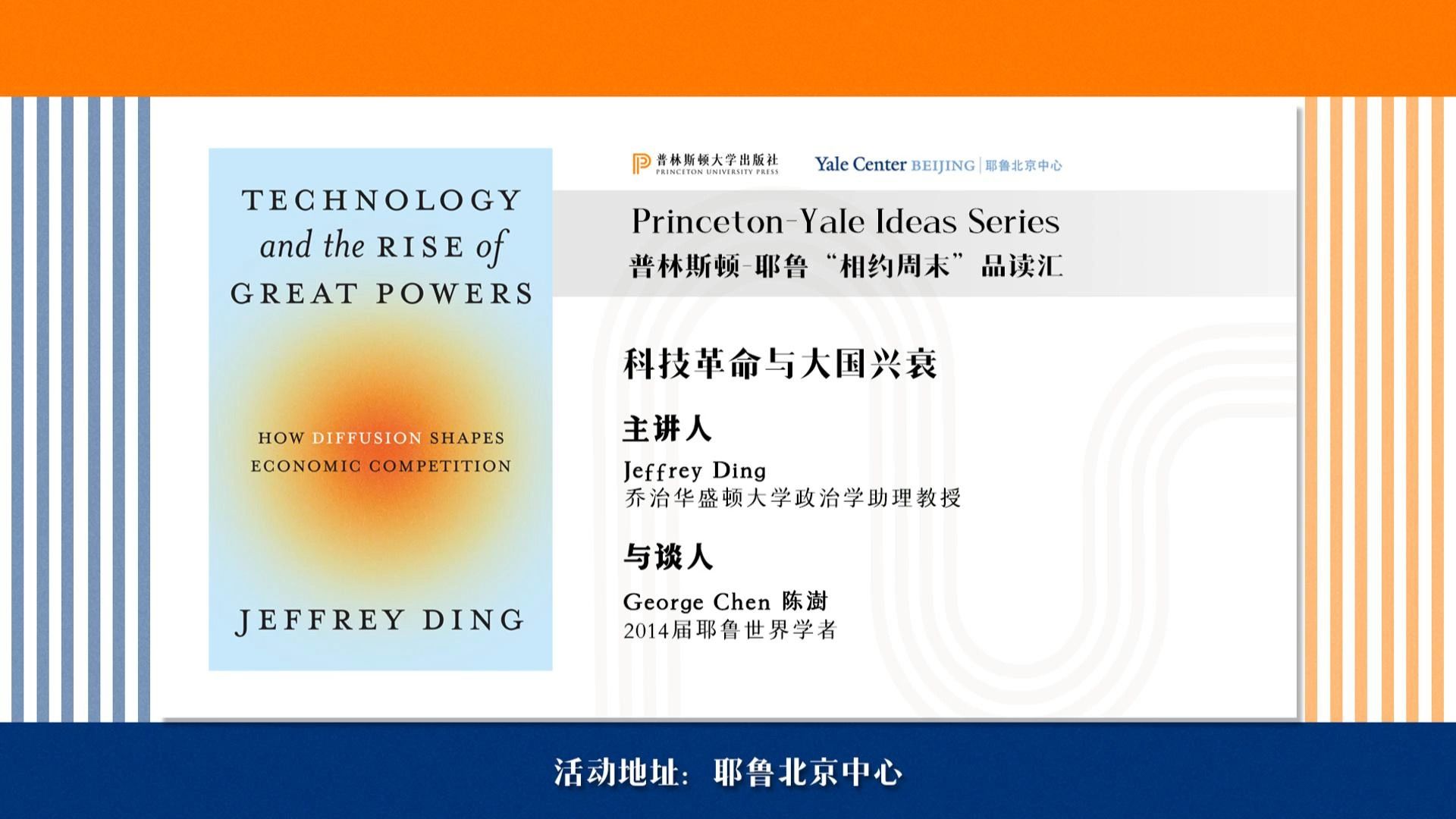
字幕摘录
| 时间 | 英文 | 中文 |
|---|---|---|
| 0:05 | Good day, everyone. | 大家好,再见 |
| 0:06 | And especially to our presenter and commentator, | 尤其是对我们的演讲人和评论员来说 |
| 0:09 | Professor Jeffrey Ding and Yale World Fellow, George Chen. | 杰弗里·丁教授和耶鲁世界研究员乔治·陈. |
| 0:14 | I'm Carol Lee Rafferty, a Yale College graduate | 我是卡罗尔·李·拉费蒂 耶鲁大学毕业生 |
| 0:17 | and also executive director of Yale Center Beijing, | 并兼任耶鲁中心北京执行董事, |
| 0:21 | Yale University's home here in China. | 耶鲁大学在中国的故乡. |
| 0:24 | For the past 10 years, since our founding in 2014, | 自2014年成立以来的10年中, |
| 0:27 | we've been hosting these types of activities | 我们一直在主持这些活动 |
| 0:30 | where we convene thought leaders from all over the world | 我们聚集了来自世界各地的思想领袖 |
| 0:33 | to discuss the most cutting edge issues facing humanity. | 讨论人类面临的最尖端问题。 |
展开字幕全文(1034 条)
| 序号 | 英文 | 中文 |
|---|---|---|
| 1 | Good day, everyone. | 大家好,再见 |
| 2 | And especially to our presenter and commentator, | 尤其是对我们的演讲人和评论员来说 |
| 3 | Professor Jeffrey Ding and Yale World Fellow, George Chen. | 杰弗里·丁教授和耶鲁世界研究员乔治·陈. |
| 4 | I'm Carol Lee Rafferty, a Yale College graduate | 我是卡罗尔·李·拉费蒂 耶鲁大学毕业生 |
| 5 | and also executive director of Yale Center Beijing, | 并兼任耶鲁中心北京执行董事, |
| 6 | Yale University's home here in China. | 耶鲁大学在中国的故乡. |
| 7 | For the past 10 years, since our founding in 2014, | 自2014年成立以来的10年中, |
| 8 | we've been hosting these types of activities | 我们一直在主持这些活动 |
| 9 | where we convene thought leaders from all over the world | 我们聚集了来自世界各地的思想领袖 |
| 10 | to discuss the most cutting edge issues facing humanity. | 讨论人类面临的最尖端问题。 |
| 11 | Today, we're so delighted to be co-hosting this book talk | 今天,我们很高兴能共同主持这个书评会 |
| 12 | together with the Princeton University Press Beijing Office. | 与普林斯顿大学出版社北京办事处合作。 |
| 13 | This talk is part of the Princeton Yale Ideas Series | 这个演讲是普林斯顿耶鲁思想系列的一部分 |
| 14 | where we connect the Chinese audience and readers | 我们连接中国观众和读者 |
| 15 | with authors on the most relevant topics. | 与作者讨论最相关的专题。 |
| 16 | So what drives the rise and fall of great powers? | 那么什么能推动大国的兴衰? |
| 17 | On this very important question, Professor Jeffrey Ding | 关于这个非常重要的问题,杰弗里·丁教授 |
| 18 | will discuss his new book with the Princeton University Press, | 将讨论他的新书 普林斯顿大学出版社, |
| 19 | Technology and the Rise of Great Powers, | 技术和大国的崛起, |
| 20 | How Diffusion Shapes Economic Competition, | 如何传播分裂经济竞争, |
| 21 | together with Yale World Fellow, George Chen. | 与耶鲁大学世界研究员,乔治·陈。 |
| 22 | They will discuss the mechanisms of technological diffusion | 他们将讨论技术传播的机制。 |
| 23 | and how they are shaping the pattern of economic competition | 以及它们如何塑造经济竞争模式 |
| 24 | among great powers. | 在大国之间 |
| 25 | Some of you may remember that George recently | 你们有些人可能记得乔治最近 |
| 26 | gave a talk at the Center on AI Governance. | 在AI治理中心演讲。 |
| 27 | So their insights are going to be especially topical | 所以他们的洞察力将特别热门 |
| 28 | to emerging technologies, such as AI, | 研究新兴技术,如大赦国际, |
| 29 | and their potential impact on the US-China power dynamic. | 以及它们对美中电力动力的潜在影响。 |
| 30 | Let me briefly introduce our presenter and commentator | 让我简单介绍一下我们的主持人和评论员 |
| 31 | today. | 今时. |
| 32 | Jeffrey Ding is an assistant professor | 杰弗里・丁是助理教授 |
| 33 | of political science at George Washington University | 乔治·华盛顿大学政治学系 |
| 34 | and serves as a reviewer for important academic journals, | 并担任重要学术期刊的评论员, |
| 35 | such as the American Political Science Review. | 例如美国政治科学评论。 |
| 36 | Previously, he was a postdoctoral fellow | 以前,他是博士后研究员 |
| 37 | at Stanford's Center for International Security | 斯坦福国际安全中心 |
| 38 | and Cooperation. | 7月12日至18日,日内瓦 |
| 39 | George Chen is a practitioner and scholar | 陈乔治是行家和学者 |
| 40 | with over a few decades of expertise | 拥有数十年的专门知识 |
| 41 | across media, technology, and public policy. | 包括媒体、技术和公共政策。 |
| 42 | Currently, he's managing director and co-chair | 目前,他是总经理兼联席主席 |
| 43 | of digital practice for the policy consultancy, | 为政策咨询、 |
| 44 | the Asia Group, which is headquartered in Washington, DC. | 亚洲集团,总部设在华盛顿特区。 |
| 45 | He is also currently a senior fellow | 他目前也是高年级同学 |
| 46 | at the Center of Civil Society and Governance | 民间社会和治理中心 |
| 47 | of the University of Hong Kong, where | 香港大学 |
| 48 | he teaches digital society and governance to master students. | 他教数字社会和治理 掌握学生。 |
| 49 | Prior to these roles, he was META, or Facebook's first ever | 在这些角色之前,他是META, 或Facebook的第一个 |
| 50 | and most senior policy leader for Greater China, Mongolia, | 以及大中国、蒙古、 |
| 51 | and Central Asia for almost a decade. | 和中亚近十年。 |
| 52 | And earlier in his career, George held various editorial | 在他职业生涯的早些时候,乔治 举行了各种社论 |
| 53 | and management roles at leading media organizations, | 以及主要媒体组织的管理作用, |
| 54 | such as the South China Morning Post and Reuters. | 例如南华早报和路透社. |
| 55 | And actually, just when the center was founded in 2014, | 事实上,就在2014年中心成立的时候, |
| 56 | George was elected as a Yale World Fellow. | 乔治被选为耶鲁大学世界研究员. |
| 57 | So we're very, very honored and happy to have the two of them | 所以,我们非常,非常荣幸和高兴 有他们两人 |
| 58 | at this event today. | 今天的这个活动。 |
| 59 | The event will happen and proceed as follows. | 活动将进行如下。 |
| 60 | Professor Ding will first give a talk on his book, | 丁教授首先要谈谈他的书 |
| 61 | and then George will provide his comments. | 然后乔治会提供他的评论。 |
| 62 | And then after that, the Q&A will begin. | 之后,QQA将开始. |
| 63 | So before we dive in, I would like | 所以在我们潜入之前 我想 |
| 64 | to extend a special thanks also to the Princeton University | 还特别感谢普林斯顿大学 |
| 65 | Press and Yale Center teams for making today's event | 新闻和耶鲁中心的团队 制作今天的活动 |
| 66 | and the event series possible. | 和可能的活动系列。 |
| 67 | Professor Ding's book will be available for sale | 丁教授的书可以出售 |
| 68 | after the event. | 事发后。 |
| 69 | So without further ado, let's welcome Professor Jeffrey Ding. | 所以,不用多说了,让我们欢迎杰弗里·丁教授。 |
| 70 | Thank you very much. | 谢谢 |
| 71 | Thank you so much. | 非常感谢 |
| 72 | Thank you so much, Carol. | 谢谢你,卡罗尔。 |
| 73 | And thank you as well, George, for taking the time | 也谢谢你 乔治 慢慢来 |
| 74 | to join us today. | 今天加入我们 |
| 75 | I'm really looking forward to your comments | 我很期待你的评论 |
| 76 | and the questions from the audience. | 还有观众的提问 |
| 77 | I think when we look at this hot topic of US-China competition | 我想,当我们看 这个热门话题 美中竞争 |
| 78 | in AI, this image is helpful. | 在AI中,这个形象很有帮助. |
| 79 | It's helpful for two reasons. | 有二义故. |
| 80 | The first is oftentimes this competition | 第一次经常是这场比赛 |
| 81 | is seen as this geopolitical chessboard | 被视为地缘政治棋盘 |
| 82 | on which the different countries are trying | 不同国家正在尝试的 |
| 83 | to implement their own strategies. | 执行自己的战略。 |
| 84 | But the second reason it's helpful | 但第二个原因 是有帮助的 |
| 85 | is anybody who plays chess or is following | 是谁在下棋 或正在跟踪 |
| 86 | Ding Liren in the World Chess Championship | 世界国际象棋锦标赛丁立仁 |
| 87 | knows that this position is not possible. | 也知道这个立场是不可能的。 |
| 88 | The kings can't touch each other on a chessboard. | 诸王在棋盘上不能相触. |
| 89 | And so I think this image is helpful | 所以我觉得这个形象很有帮助 |
| 90 | because it shows that our understanding of what | 因为它表明我们理解什么 |
| 91 | great power competition in emerging technologies | 新兴技术的强大力量竞争 |
| 92 | looks like is very confused and muddled. | 看起来像很困惑和泥巴。 |
| 93 | Maybe one starting point we can use | 也许我们可以用一个起点 |
| 94 | is Chinese leader Xi Jinping's speech to the BRICS | 是中国领导人习近平对金砖国家的讲话 |
| 95 | summit in 2018. | 2018年峰会. |
| 96 | This summit of BRICS nations, Brazil, Russia, India, China, | 本届金砖国家峰会 巴西,俄罗斯,印度,中国 |
| 97 | South Africa, all emerging economies | 南非,所有新兴经济体 |
| 98 | that are making up an increasingly large portion | 占比越来越大 |
| 99 | of world population and GDP. | 人口与国内生产总值。 |
| 100 | At this BRICS summit, Chinese leader Xi | 在金砖国家峰会上,中国领导人习近平 |
| 101 | talked about the Fourth Industrial Revolution. | 谈了第四次工业革命. |
| 102 | And the whole summit was organized | 整个峰会都是组织起来的 |
| 103 | around the theme of the Fourth Industrial Revolution. | 围绕第四次工业革命主题. |
| 104 | In the speech, some of the most important parts | 在演讲中,一些最重要的部分 |
| 105 | are he references these past three industrial revolutions | 他提到过去三次工业革命 |
| 106 | and specifically calls out specific technologies | 并具体提到具体技术 |
| 107 | in each of these industrial revolutions. | 在每一个工业革命中。 |
| 108 | What often happens in the Chinese system | 中国制度经常发生的事情 |
| 109 | is leaders give speeches and then analysts and commentators | 领导人发表演讲,然后分析家和评论家 |
| 110 | will try to interpret those speeches | 将尝试解释这些演讲 |
| 111 | a couple months later. | 几个月后 |
| 112 | So here's a publication from the Study Times, | 这是研究时报的一篇文章 |
| 113 | the Xuexi Shi Bao, a relatively authoritative publication | 薛世保,相对权威的出版物 |
| 114 | from the Chinese Communist Party, | 从中国共产党, |
| 115 | where two months later they analyze this speech | 两个月后 他们分析这个演讲 |
| 116 | and they highlight that when countries take advantage | 它们强调,当国家利用 |
| 117 | of industrial revolutions, the main impact | 工业革命的主要影响 |
| 118 | on the rise and fall of great powers | 大国的兴衰 |
| 119 | comes through the country that achieves | 穿过国家实现 |
| 120 | a world-leading productivity advantage. | 世界领先的生产力优势。 |
| 121 | Who gains leadership in advanced productivity | 在先进生产力中获得领导的人 |
| 122 | and becomes the most productive economy? | 成为最具生产力的经济? |
| 123 | Those of you familiar with international relations | 你们熟悉国际关系的人 |
| 124 | or history know this seminal work | 或历史知道这个开创性的作品 |
| 125 | by historian Paul Kennedy, | 历史学家保罗·肯尼迪, |
| 126 | where he describes a similar process. | 在那里他描述了类似的过程。 |
| 127 | The rise and fall of great powers | 大国的兴衰 |
| 128 | is a process that involves first, | 是一个首先涉及的过程, |
| 129 | differentials in technological change, | 技术变化的差异, |
| 130 | technological change leading to differentials | 导致差异的技术变革 |
| 131 | in economic growth rates, | 经济增长率, |
| 132 | and then that eventually shapes shifts | 然后最终会形成变化 |
| 133 | in geopolitical and military leadership. | 在地缘政治和军事领导中。 |
| 134 | And so today, and for the purposes of my book, | 所以今天 为了我的书 |
| 135 | I focus on the first step of that causal chain. | 我着重谈谈这一因果关系的第一步。 |
| 136 | How do these new technologies actually result | 这些新技术的实际结果如何? |
| 137 | in a shift in the global economic balances? | 全球经济平衡的转变? |
| 138 | Which country, which great power is able to take advantage | 哪个强国能占上风 |
| 139 | of these new technologies and sustain economic growth | 利用这些新技术并维持经济增长 |
| 140 | at higher rates than its rivals? | 以高于对手的比率? |
| 141 | Standard story that we hear a lot today | 标准的故事,我们今天听到很多 |
| 142 | is what I call the leading sector theory. | 这就是我所说的主要部门理论。 |
| 143 | Yeah, leading sector theory could work. | 是啊,领先部门理论可以工作。 |
| 144 | Another way to translate that would be | 另一种翻译方式是 |
| 145 | leading sector theory. | 领先的部门理论。 |
| 146 | So leading sector theory, under leading sector theory, | 因此,领先部门理论, 在领先部门理论, |
| 147 | one country dominates technological advances | 一个国家主导着技术进步 |
| 148 | in new fast-growing industries. | 在新的快速增长的工业。 |
| 149 | They get to control all the monopoly profits | 他们可以控制所有的垄断利润 |
| 150 | from being the innovation leader, | 成为创新的领导者 |
| 151 | and then they reinvest those, | 然后他们再投资, |
| 152 | take the gains that they get from exports, | 从出口中获得收益, |
| 153 | reinvest those into their economy, | 重新投资于他们的经济, |
| 154 | and achieve world-leading productivity. | 并实现世界领先的生产力。 |
| 155 | Daniel Dresner, a scholar from Tufts University, | 丹尼尔·德雷斯纳 来自塔夫茨大学的学者 |
| 156 | summarizes it well. | 总结一下 |
| 157 | A great power becomes a hegemon through a near monopoly | 强权通过接近垄断成为霸主 |
| 158 | on innovation in leading sectors. | 关于领导部门创新问题。 |
| 159 | And this might sound pretty familiar to you. | 这听起来很熟悉 |
| 160 | We all live and work in Beijing or Washington, DC, | 我们都住在北京或华盛顿 |
| 161 | and in policy-making circles, | 在决策界, |
| 162 | policy-making circles are very much influenced | 决策层受到很大影响 |
| 163 | by this perspective. | 从这个角度看。 |
| 164 | What are leading sectors? | 主要部门是什么? |
| 165 | Development economist Walt Rostow | 发展经济学家沃尔特·罗斯托 |
| 166 | gives this classic sequence of great leading sectors | 给这些优秀的领军部门 |
| 167 | that includes cotton textile industry | 包括纺织业 |
| 168 | in the first Industrial Revolution, | 在第一次工业革命中, |
| 169 | the steel and chemical industries | 钢铁和化学工业 |
| 170 | in the second Industrial Revolution, | 在第二次工业革命中 |
| 171 | automobile industry in US-Japan competition | 美日竞争中的汽车工业 |
| 172 | in the third Industrial Revolution. | 在第三次工业革命中 |
| 173 | They oftentimes are very fast-growing single sectors | 它们经常是快速增长的单一部门 |
| 174 | that sometimes become one of the largest industries | 有时成为最大的产业之一 |
| 175 | in an economy. | 在经济中。 |
| 176 | Today, I'm going to argue that | 今天,我要说 |
| 177 | there's a different explanation | 有一个不同的解释 |
| 178 | for how technological revolutions | 技术革命 |
| 179 | lead to the rise and fall of great powers. | 导致大国的兴衰. |
| 180 | And I want to focus on general purpose technologies, | 我想专注于通用技术, |
| 181 | 通用技術. | |
| 182 | And my argument here is that general purpose technologies | 我的观点是通用技术 |
| 183 | or GPTs are going to shape economic competition | 或GPT将形成经济竞争 |
| 184 | between great powers in a pathway that's very different | 大国之间 在一个截然不同的道路上 |
| 185 | from what I just started this talk with | 我刚刚开始的谈话 |
| 186 | as it relates to leading sectors. | 因为它涉及主要部门。 |
| 187 | And once we have a different sense | 一旦我们有了不同的感觉 |
| 188 | of the technology trajectory, | 技术轨迹, |
| 189 | that's gonna shape what institutional factors | 那会决定什么是制度因素 |
| 190 | that different countries are going to have to adapt | 不同国家将不得不适应 |
| 191 | to be successful in technological revolutions. | 在技术革命中取得成功。 |
| 192 | My book focuses on the education and training systems | 我的书主要讲述教育和培训系统 |
| 193 | that widen the base of engineering skills | 扩大工程技能基础 |
| 194 | associated with the general purpose technology. | 与一般用途技术有关。 |
| 195 | So that was the two-minute overview of the argument. | 因此,这是两分钟的概述。 |
| 196 | Next, I'm going to fill out the theory in more detail. | 接下来,我将更详细地填写这个理论. |
| 197 | Then I'm going to present some evidence | 那么我要提出一些证据 |
| 198 | primarily from the second Industrial Revolution. | 主要来自第二次工业革命. |
| 199 | And then finally, we'll return back to the beginning | 最后,我们回到开始 |
| 200 | and answer this question of | 并回答这个问题: |
| 201 | what are the US and China actually competing for in AI? | 美国和中国在AI里竞争什么? |
| 202 | The basis for this argument is | 这一论点的依据是: |
| 203 | new technologies present demands for countries. | 新技术对各国提出了需求。 |
| 204 | And so whichever country is gonna be most successful | 所以无论哪个国家都会最成功 |
| 205 | in adapting to a new technology | 适应新技术 |
| 206 | has to develop the institutions to meet those demands. | 必须发展机构来满足这些要求。 |
| 207 | And those institutions can range | 这些机构可以涵盖范围 |
| 208 | from a country's political system, | 从一个国家的政治制度, |
| 209 | the level of centralization or decentralization | 集中或权力下放的程度 |
| 210 | in terms of how it approaches science and technology policy. | 在如何对待科学和技术政策方面。 |
| 211 | It could be the system by which countries | 它可以是各国据以 |
| 212 | organize their businesses. | 组织企业。 |
| 213 | Do they support big business alliances | 他们支持大企业联盟吗? |
| 214 | like Japan's Koretsu system? | 就像日本的科雷苏系统? |
| 215 | Or do they support a more competitive industrial landscape? | 还是他们支持更具竞争力的工业景观? |
| 216 | My book focuses on the institutions of skill formation, | 我的书主要讲述了技能的形成 |
| 217 | talent cultivation. | 培养人才。 |
| 218 | The existing literature, that leading sector theory, | 现有的文献, 领先的部门理论, |
| 219 | they want to focus on the demands of new technologies | 他们想专注于新技术的需求 |
| 220 | from the perspective of innovation, | 从创新的角度出发, |
| 221 | 創新. | |
| 222 | Technological change can be mapped out | 技术变革可以规划出来 |
| 223 | into three different phases. | 分为三个不同的阶段。 |
| 224 | Invention is the first time a new discovery | 发明是第一次新的发现 |
| 225 | comes out in the world. | 出来的世界。 |
| 226 | Innovation is the first time that a company | 创新是公司第一次 |
| 227 | pioneers and commercializes that new invention. | 开拓者和商业化 新的发明。 |
| 228 | Diffusion is that phase by which a new technology | 传播是一个新技术的阶段 |
| 229 | spreads across a population of users. | 分布于用户群中. |
| 230 | So leading sector is all about that invention | 所以领导阶层都是关于这个发明的 |
| 231 | and innovation stage, that eureka moment. | 和革新阶段, eureka的时刻。 |
| 232 | And so they focus on a country's ability | 所以他们专注于一个国家的能力 |
| 233 | to adapt its institutional factors | 适应其体制因素 |
| 234 | for monopolizing innovation in leading sectors. | 垄断主导部门的创新。 |
| 235 | So they care a lot about how much is your country | 所以他们很关心你的国家多少钱 |
| 236 | spending on cutting edge R&D? | 用于前沿研发? |
| 237 | Does your country have the systems to prevent | 贵国是否有防止 |
| 238 | these cutting edge innovations | 这些前沿创新 |
| 239 | from leaking out to other countries? | 从泄露到其他国家? |
| 240 | This is based on something called | 这是基于一个叫做 |
| 241 | the leading sector product cycle. | 主导部门产品周期。 |
| 242 | Or the leading sector theory is based on something called | 或者主要部门理论是基于所谓的 |
| 243 | the product cycle theory. | 产品循环理论。 |
| 244 | And essentially this treats the nation like a firm | 基本上这把国家当做企业 |
| 245 | that has a new product innovation. | 有了新的产品创新。 |
| 246 | So your country comes out with a new smartphone innovation. | 因此,你的国家有了一个新的智能手机创新。 |
| 247 | They invested all this R&D. | 他们投资了所有这些研发。 |
| 248 | They came out with this fancy, shiny new product. | 他们用这个闪闪发光的新产品出来了 |
| 249 | And so there's a window of time where you are the only player | 所以有一个时间之窗 你是唯一的玩家 |
| 250 | and you get to control monopoly profits. | 你就能控制垄断利润 |
| 251 | But shortly after, other competitors, other countries | 但不久,其他竞争者,其他国家 |
| 252 | gonna develop their own smartphones. | 将开发自己的智能手机。 |
| 253 | And once that competition increases, your profits decline | 一旦竞争加剧 你的利润就会下降 |
| 254 | and you lose that window where you had monopoly profits. | 你失去了那扇窗户 在那里你拥有垄断利润。 |
| 255 | So these are just a few quotes from international relations | 所以这些只是一些国际关系的引言 |
| 256 | and political science scholars | 政治学学者 |
| 257 | that are using that product cycle as a template. | 将产品周期作为模板。 |
| 258 | I think the last quote is what I want to emphasize | 我想最后一句话是我想强调的 |
| 259 | to you here, which is the leading sector account says | 给这里的你, 这是主要部门帐户说 |
| 260 | the country that is the pioneer in all these new innovations, | 国家是所有这些新发明的先驱, |
| 261 | they get the benefits of monopoly profits | 他们从垄断利润中获益 |
| 262 | until the diffusion stage, right? | 直到传播阶段,对不对? |
| 263 | That's where their story ends. | 这就是他们的故事结束的地方。 |
| 264 | They don't care about the diffusion stage | 他们不在乎传播阶段 |
| 265 | because that's when they think the advantages | 因为那是他们认为优点的时候 |
| 266 | to the leader go away. | 对领导者走开。 |
| 267 | For my alternative theory, that's where my story starts, | 对于我的另一种理论, 这就是我的故事开始, |
| 268 | the diffusion stage. | 传播阶段。 |
| 269 | And so GPT diffusion theory focuses on general purpose | 因此,GPT扩散理论侧重于一般目的 |
| 270 | technologies, not leading sectors. | 技术,而不是主导部门。 |
| 271 | I think what I wanna emphasize here is that we really need | 我想在这里强调的是 我们真的需要 |
| 272 | to understand the characteristics of GPTs | 了解普通教育的特点 |
| 273 | and how they are different from leading sectors. | 以及它们与主要部门有何不同。 |
| 274 | Sometimes when I read articles or blogs | 有时我读文章或博客 |
| 275 | on emerging technology policy, | 关于新兴技术政策, |
| 276 | it feels like everything sounds the same | 感觉一切听起来都一样 |
| 277 | regardless of what technology they're talking about. | 不管他们在说什么技术 |
| 278 | If you saw a paper on quantum computing, | 如果你看到一篇关于量子计算的文章 |
| 279 | you could just find and replace quantum with blockchain | 你可以找到量子 用块链替换 |
| 280 | or AI, it's all just boilerplate copied and pasted. | 或AI,这一切都只是锅炉板 复制和粘贴。 |
| 281 | We need to take seriously the differences | 我们要认真对待分歧 |
| 282 | between technologies. | 技术之间。 |
| 283 | So let me just give a simple example. | 因此,让我举一个简单的例子。 |
| 284 | Everybody is really interested in China's advances | 大家都对中国的进步很感兴趣 |
| 285 | in electric vehicles. | 在电动车辆。 |
| 286 | EVs are a leading sector, not a GPT. | EVs是一个领先的部门,而不是GPT. |
| 287 | Let's compare EVs to something like AI, | 让我们比较EVs和AI之类的东西, |
| 288 | which I think has that potential to be a GPT. | 我认为它有可能是GPT。 |
| 289 | EVs have one single use case, transportation, | EVs有一个单一的使用案例,运输, |
| 290 | getting from point A to B. | 从A点到B点 |
| 291 | AI has countless, I couldn't even list | AI有无数,我甚至不能列举 |
| 292 | all the different use cases of AI | 所有不同的使用案例 |
| 293 | in terms of how it is affecting the ability to write, | 如何影响写作能力, |
| 294 | the ability to code, the ability to generate images, | 编码能力,生成图像的能力, |
| 295 | the ability to perceive landscapes | 能够感知风景 |
| 296 | in terms of applications in autonomous vehicles. | 在自动车辆中的应用。 |
| 297 | One way to really test this is think about | 测试的方法之一是思考 |
| 298 | are advances in electric vehicles | 电动车辆的垫款 |
| 299 | fundamentally transforming what's happening | 根本改变正在发生的事情 |
| 300 | in the AI industry? | 在AI行业? |
| 301 | No, but think about the other direction. | 不,但想想另一个方向。 |
| 302 | Are advances in AI fundamentally transforming | AI的进步是根本的转变 |
| 303 | what's happening in the electric vehicle industry? | 电动车辆行业发生了什么? |
| 304 | Answers are resounding yes. | 答案是强烈的是的。 |
| 305 | One technology is more enabling than the other. | 一种技术比另一种技术更有利。 |
| 306 | One technology is more general purpose than the other. | 一种技术比另一种技术更普遍。 |
| 307 | So if we care about GPTs, the key point here, | 所以,如果我们关心GPT,这里的关键点, |
| 308 | this is Stanford historian Paul David, | 这是斯坦福历史学家保罗·戴维 |
| 309 | he says that GPTs make their mark on the economy | 他说GPT对经济有影响 |
| 310 | through a regular pattern. | 通过常规模式。 |
| 311 | And this pattern is an extended trajectory | 这种模式是延伸的轨迹 |
| 312 | of incremental technical improvements over time, | 随着时间的推移逐步进行的技术改进, |
| 313 | which results in a gradual and protracted process | 导致一个渐进和旷日持久的进程 |
| 314 | of diffusion into widespread use across the entire economy. | 传播到整个经济的广泛使用。 |
| 315 | Now, if we care about GPTs, | 现在,如果我们关心GPT, |
| 316 | then that diffusion stage really matters | 那么传播阶段真的很重要 |
| 317 | because the potential population of users | 因为用户的潜在数量 |
| 318 | or adopters of a GPT is essentially the entire economy. | 或收养人基本上是整个经济。 |
| 319 | And so, of course, maybe if your country | 所以,当然,也许 如果你的国家 |
| 320 | is the first to pioneer new technologies, | 是率先开拓新技术, |
| 321 | that might help you with widespread adoption, | 可以帮助你被广泛收养, |
| 322 | but it's not the only factor. | 但这不是唯一的因素 |
| 323 | And actually, when you think about competition | 其实,当你想到竞争 |
| 324 | between the most advanced economies, | 在最发达经济体之间, |
| 325 | for a field as broad as AI or electricity or the computer, | 对于像AI或电或计算机一样宽的领域, |
| 326 | they're all gonna have frontier firms | 他们都会有边境公司 |
| 327 | and universities who are close | 大学和大学 |
| 328 | to the technological frontier in a GPT, right? | 在GPT技术前沿,对不对? |
| 329 | Think about the US and China today when it comes to AI. | 想想今天的美国和中国, |
| 330 | No one country is monopolizing innovation in this space. | 在这个空间里,没有一个国家垄断创新。 |
| 331 | China's top universities, the Tsinghua's of the world, | 中国顶尖大学 清华世界大学 ,. |
| 332 | China's top firms, the Zhipu AIs of the world, | 中国顶级企业,世界志普AI, |
| 333 | the Baidu's of the world are very close | 贝都因人的世界很近 |
| 334 | to that technological frontier. | 在技术前沿。 |
| 335 | And so, it might be the divergences, | 所以,这可能是 分歧, |
| 336 | the differences in long-term economic growth | 长期经济增长的差异 |
| 337 | might be more about which country can take those innovations | 可能更多关于哪个国家可以接受这些创新 |
| 338 | from their frontier firms | 从他们的边境公司 |
| 339 | and spread them throughout the entire economy. | 并把它们传播到整个经济中。 |
| 340 | Okay, last part of the argument. | 好吧,最后一部分的争论。 |
| 341 | I've shown you how GPTs make their economic impact | 我给你们演示过GPT如何产生经济影响 |
| 342 | in a way that's different from leading sectors. | 以一种不同于主要部门的方式 |
| 343 | Now, that means there needs to be different institutions | 现在,这意味着需要不同的机构 |
| 344 | that meet the demands of GPT diffusion. | 满足GPT传播需求. |
| 345 | And so, I highlight the institutions | 因此,我强调机构 |
| 346 | that widen the pool of engineering talent linked to GPTs. | 这拓宽了与GPT相关的工程人才库. |
| 347 | That's gonna address a couple of problems. | 这会解决几个问题。 |
| 348 | That's necessary to address a couple of problems. | 这对解决几个问题是必要的. |
| 349 | One is pretty obvious, technology always races ahead | 很明显,科技总是领先 |
| 350 | and skills have to keep up. | 和技能必须跟上。 |
| 351 | But I think number two is especially important. | 但我认为二号特别重要。 |
| 352 | For a GPT to spread, you need to have coordination | 要传播GPT,需要协调 |
| 353 | and information flows between the GPT sector | GPT部门之间的信息流动 |
| 354 | and all the different application sectors | 以及所有不同的应用部门 |
| 355 | that could use the GPT. | 这可以用GPT。 |
| 356 | You don't need that for leading sectors. | 你不需要这个 领导部门。 |
| 357 | For electric vehicles, | 电动车辆 |
| 358 | you don't need the electric vehicle industry | 你不需要电动车辆行业 |
| 359 | to coordinate with the construction industry | 与建筑业协调 |
| 360 | or the education industry for electric vehicles | 或电动车辆教育行业 |
| 361 | to make an economic impact. | 产生经济影响。 |
| 362 | But for AI, the construction industry | 但对于AI,建筑业 |
| 363 | needs to know what's happening in the AI industry, | 需要知道AI产业发生了什么 |
| 364 | for AI to spread across sectors. | 使大赦国际能够跨越各部门。 |
| 365 | The education industry needs to know, | 教育行业需要知道, |
| 366 | okay, what are the latest large language models? | 好吧,什么是最新的 大语言模型? |
| 367 | How do I benchmark whether this LLM is more efficient | 我如何衡量LLM是否更有效率 |
| 368 | or more effective than another LLM? | 还是比其他LLM更有效? |
| 369 | Where is the AI sector going? | AI部门要去哪里? |
| 370 | Because then, in order for me | 因为为了我 |
| 371 | to develop complementary innovations, | 发展互补创新, |
| 372 | I need to know what's happening in the GPT sector. | 我需要知道GPT部门发生了什么 |
| 373 | And so, engineering knowledge helps systematize | 因此,工程知识有助于系统化 |
| 374 | and standardize the best practices in a GPT | 将最佳做法标准化 |
| 375 | and facilitates those information flows | 并促进信息流动 |
| 376 | GPT 区间 | |
| 377 | and all the different application sectors | 以及所有不同的应用部门 |
| 378 | with their own unique demands. | 他们自己独特的要求。 |
| 379 | That's why, historically, | 这就是为什么,历史上, |
| 380 | when we see the emergence of a new GPT, | 当我们看到一个新的GPT的出现, |
| 381 | we often see a completely new engineering discipline follow. | 我们经常看到一个全新的工程学科 |
| 382 | So think electricity and electrical engineering | 想想电机工程 |
| 383 | or the computer and computer science. | 或者计算机和计算机科学。 |
| 384 | It doesn't have the word engineering in it, | 里面没有工程这个词 |
| 385 | but computer science is very much | 但计算机科学非常 |
| 386 | an engineering-oriented discipline. | 一个面向工程的学科。 |
| 387 | Okay, to sum up, | 好吧,总结一下, |
| 388 | what we're trying to do here is asking | 我们想做的是问 |
| 389 | a very simple question. | 一个很简单的问题。 |
| 390 | How do technological revolutions affect | 技术革命如何影响 |
| 391 | and shape an economic power transition? | 并形成经济实力的转变? |
| 392 | One great power sustains economic growth | 一个大国维持经济增长 |
| 393 | at higher rates than its rivals over the long run | 从长远来看,比对手高 |
| 394 | because of a productivity advantage. | 因为生产力优势。 |
| 395 | I've given you the conventional wisdom, leading sector, | 我给了你传统的智慧,领导阶层, |
| 396 | and then I've given you my alternative theory, GPT diffusion. | 然后我给你我的另类理论,GPT传播。 |
| 397 | Now I'm mapping out that the technological trajectories | 现在我正在绘制技术轨迹 |
| 398 | differ on three dimensions. | 三个维度不同。 |
| 399 | When do the technological changes make their greatest impact? | 技术变革何时产生最大影响? |
| 400 | Does it come very early | 来得真早 |
| 401 | in that brief window of monopoly profits? | 在短暂的垄断利润窗口? |
| 402 | Or does it come in a very delayed and protracted process | 或者是在一个非常拖延和漫长的过程中 |
| 403 | like it is for GPTs? | 就像是GPT吗? |
| 404 | Second dimension, what is the phase of technological change | 第二方面,技术变革的阶段是什么 |
| 405 | that is the most important for deciding | 这对决定 |
| 406 | which country gets ahead or not? | 哪个国家领先呢? |
| 407 | Is it about innovation, monopolizing innovation, | 是关于创新,垄断创新, |
| 408 | or is it about having that edge in diffusion, | 或者说,那是关于传播的优势, |
| 409 | spreading that GPT across the most users | 将GPT传播到大多数用户 |
| 410 | within your country? | 在你的国家? |
| 411 | Third, is technological change and economic growth | 第三,技术变革和经济增长 |
| 412 | concentrated in just a few leading sectors | 集中在少数主要部门 |
| 413 | or is it dispersed and broad-based | 或它是分散和广泛的 |
| 414 | like we would expect with a GPT? | 就像我们期待的GPT? |
| 415 | Now lastly, that's going to affect | 最后,这将会影响 |
| 416 | the institutional adaptations that countries have to make. | (c) 各国必须作出体制上的调整。 |
| 417 | If you care more about leading sectors, | 如果你更关心领导阶层 |
| 418 | you might care more about deepening the skill base, | 你可能更关心 深化技能基础, |
| 419 | training the best and the brightest in these new industries. | 培训这些新产业中最优秀和最聪明的人。 |
| 420 | If you care more about GPTs, | 如果你更关心GPT, |
| 421 | you emphasize what I call GPT skill infrastructure | 你强调我所说的GPT技能基础设施 |
| 422 | and widening the engineering skill base | 扩大工程技术基础 |
| 423 | in these technologies. | 这些技术。 |
| 424 | Okay, enough theory. | 好了,够了理论。 |
| 425 | Let's move into actual evidence. | 移入实证. |
| 426 | We're gonna rewind to the second industrial revolution. | 我们要倒向第二次工业革命. |
| 427 | Note how the book covers the same three | 注意本书如何涵盖同样的三个 |
| 428 | industrial revolutions that the speech | 工业革命的演讲 |
| 429 | by Chinese leader Xi Jinping gave at the BRICS Summit. | 由中国领导人习近平在金砖国家峰会上给出. |
| 430 | And so second industrial revolution, 1870 to 1914. | 于是第二次工业革命,1870年至1914年. |
| 431 | Here we have all these different innovations. | 在这里,我们有所有这些不同的创新。 |
| 432 | Scholars see it as one of the densest periods | 学者认为这是最密集的时期之一 |
| 433 | of scientific advance. | 科学进步。 |
| 434 | And crucially, we see a shift | 最重要的是,我们看到一个转变 |
| 435 | in the economic balance of power. | 在经济实力平衡中。 |
| 436 | This is the decline of Great Britain | 这是英国的衰落 |
| 437 | and the rise of Germany and the US. | 以及德国和美国的崛起 |
| 438 | What I want to emphasize here is that | 我想强调的是 |
| 439 | when you look at the data on economic efficiency | 当你看经济效率数据时 |
| 440 | and economic productivity, | 经济生产力, |
| 441 | the US becomes the preeminent economic power before 1914. | 美国在1914年之前就成为主要的经济强国。 |
| 442 | US is the blue line, Britain is the green, | 美国是蓝线 英国是绿线 |
| 443 | Germany is the red. | 德国是红色。 |
| 444 | Germany never surpasses the UK | 德国从未超越过英国 |
| 445 | in terms of economic productivity. | 在经济生产力方面。 |
| 446 | So what we're doing in this exercise | 所以,我们在做什么 在这个练习中 |
| 447 | is we are trying to ask how did the US | 我们想问一下美国怎么样 |
| 448 | benefit from the technological advances | 从技术进步中受益 |
| 449 | in the second industrial revolution | 在第二次工业革命中 |
| 450 | to become the preeminent economic power | 成为强大的经济力量 |
| 451 | before World War I? | 在第一次世界大战之前? |
| 452 | Did it follow the GPT diffusion path | 它是否遵循了 GPT 传播路径 |
| 453 | or did it follow the leading sector theory? | 还是遵循了主要部门理论? |
| 454 | And I'm just gonna go through all of those dimensions | 我只是要通过所有这些维度 |
| 455 | on this table step by step. | 在这张桌子上一步一步。 |
| 456 | So let's start with impact timeframe. | 因此,让我们从撞击时间段开始。 |
| 457 | I think all of the evidence in this era suggests, | 我认为所有的证据 在这个时代, |
| 458 | at least for the US, | 至少对美国来说, |
| 459 | we don't see the near immediate impact | 我们没有看到 接近即时撞击 |
| 460 | of some of these new technologies like chemicals. | 包括化学等新技术。 |
| 461 | Electrification does not have a significant impact | 电气化没有重大影响 |
| 462 | on US economic productivity until after 1914. | 直到1914年之后, |
| 463 | So we get the advent of the electric dynamo in 1870, | 所以我们在1870年 有了电动堤坝 |
| 464 | but it takes all of those decades for electricity | 但是这需要几十年的电力 |
| 465 | to diffuse throughout the US economy. | 分散在美国经济中 |
| 466 | Rather, the key technology in this era, | 相反,这个时代的关键技术, |
| 467 | in my view, is this general purpose technology | 我认为,这是通用技术 |
| 468 | of interchangeable parts manufacture. | 可互换部件的制造。 |
| 469 | Essentially, we had these earlier innovations | 基本上,我们有 这些早期的创新 |
| 470 | in the 1840s, 1850s with machine tools | 1840年代,1850年代 机器工具 |
| 471 | like the turret lathe and the universal milling machine. | 就像炮塔和通用的磨坊机 |
| 472 | This is a Jichuang. | 这是吉川号 |
| 473 | And so these machine tools allow you to shape | 所以这些机器工具可以让你塑造 |
| 474 | and cut metal and wood in more precise ways | 以更精确的方式切割金属和木材 |
| 475 | so that you can have standardized parts. | 这样就可以有标准化部件。 |
| 476 | So when a bicycle breaks down, | 所以当自行车坏了, |
| 477 | you don't have to get a whole new bicycle. | 你不必买全新自行车 |
| 478 | You can just replace that part | 你可以换掉那部分 |
| 479 | because you can cut the material | 因为你可以剪掉材料 |
| 480 | in more precise and standardized ways. | 以更精确和标准化的方式。 |
| 481 | And so these practices, | 因此,这些做法, |
| 482 | these interchangeable parts manufacturing processes | 这些可互换的零件制造工艺 |
| 483 | are general purpose in that they can be used | 属于一般目的,因为可以使用 |
| 484 | to make not just bicycles, not just sewing machines, | 不只是自行车, 不只是缝纫机, |
| 485 | but also other machine tools and firearms, | 还有其他机器工具和火器, |
| 486 | and they affect all these different | 并影响所有这些不同的 |
| 487 | manufacturing industries. | 制造业。 |
| 488 | And so by the time the US is completing its economic rise, | 所以到了美国完成经济崛起的时候 |
| 489 | that's when these machine tools are spreading | 这时这些机器工具正在扩散 |
| 490 | throughout American industry. | 整个美国工业。 |
| 491 | Second question, is the US's advantage | 第二个问题是美国的优势 |
| 492 | based on innovation leadership or diffusion leadership? | * 以创新领导或传播领导为基础? |
| 493 | Actually, the US is not the definitive leader | 事实上,美国不是最后的领袖 |
| 494 | in innovation in leading sectors. | 在领先部门创新。 |
| 495 | When it came to electricity, for example, | 比如说,在用电的时候, |
| 496 | the British Institute of Electrical Engineers | 英国电气工程师学会 |
| 497 | assesses that when it comes to inventive genius, | 评估说,当它涉及到发明天才, |
| 498 | the UK is not that far behind. | 英国没有落后那么远。 |
| 499 | But when it comes to practical application, | 但对于实际应用, |
| 500 | that's where the UK has fallen behind the US. | 那是英国落后于美国的地方 |
| 501 | In terms of interchangeable parts manufacturing, | 在可互换零件制造方面, |
| 502 | a few indicators show that the US is outpacing | 一些指标显示,美国的速度超过了美国。 |
| 503 | Britain and Germany by more than double the rate | 英国和德国比这高一倍多 |
| 504 | by this time period. | 截止这一时期。 |
| 505 | And so Great Britain sends all these study teams | 大不列颠派遣了这些研究小组 |
| 506 | to the US to try to figure out what's happening here. | 试着找出这里发生了什么 |
| 507 | Why are we falling so far behind? | 为什么我们落后这么远? |
| 508 | They report back that it's about this eagerness of diffusion | 他们回报说 是这种急切的传播 |
| 509 | in the United States, spreading machinery | 在美国,传播机器 |
| 510 | across all different industries. | 跨越所有不同的行业。 |
| 511 | Third, the breadth of economic growth | 第三,经济增长的广度 |
| 512 | and technological change. | 和技术变革。 |
| 513 | It's not concentrated in just a few industries. | 不只集中在少数行业. |
| 514 | The US has broad-based productivity growth in this period. | 在此期间,美国生产力有广泛的增长。 |
| 515 | Lastly, what accounts for the US's advantage? | 最后,美国有何优势? |
| 516 | What accounts for the US's success | 美国成功的原因 |
| 517 | in the second industrial revolution? | 在第二次工业革命中? |
| 518 | If my theory is right, we should expect that the US | 如果我的理论是正确的, 我们应该期待美国 |
| 519 | is able to widen the base of engineering talent. | 能够拓宽工程人才基础. |
| 520 | It has the institutions that are better equipped | 它拥有更好的机构 |
| 521 | to widen the base of mechanical engineering talent | 扩大机械工程人才基础; |
| 522 | for spreading this interchangeable parts | 用于扩展此可互换部件 |
| 523 | manufacturing method. | 制造方法。 |
| 524 | And that is the case. | 这就是事实。 |
| 525 | Britain did not produce enough mechanical engineers, | 英国没有生产足够的机械工程师, |
| 526 | and Germany did produce enough, | 而德国的产量是足够的, |
| 527 | but that mechanical engineering education | 但机械工程教育 |
| 528 | was not connected to industrial and commercial applications. | 与工业和商业应用无关。 |
| 529 | It wasn't standardized and systematized in that way. | 它没有标准化和系统化的方式。 |
| 530 | So here's one piece of evidence on that. | 因此这里有一个证据。 |
| 531 | This is from the US Bureau of Education report | 这是美国教育局的报告 |
| 532 | from around that time period, | 从那个时期开始, |
| 533 | and they're translating | 他们正在翻译 |
| 534 | a German engineering professor's assessment. | a 德国工程教授的评估。 |
| 535 | And the top three rows | 还有前三行 |
| 536 | are mechanical engineering schools | 机械工程学校 |
| 537 | represented of the German model. | 代表德国模式。 |
| 538 | The bottom two rows are engineering schools | 下两排是工程学校 |
| 539 | represented of the US model at that time. | 当时代表美国模式。 |
| 540 | The dark shaded lines, the black lines, | 黑暗的阴影线,黑线, |
| 541 | are the amount of time in the curriculum | 课程中的时间 |
| 542 | dedicated to practical exercises in the lab and shop. | 专门从事实验室和商店的实际练习。 |
| 543 | The gray lines are dedicated | 灰色线路是专用的 |
| 544 | to oral and theoretical instruction. | 接受口头和理论教育。 |
| 545 | So you see how the US has a significant advantage | 所以,你可以看到,美国 如何有重大优势 |
| 546 | in terms of the time devoted | 时间方面 |
| 547 | to mechanical engineering education | 机械工程教育 |
| 548 | that is based in practical exercises in the lab and shop. | 这是在实验室和商店的实际练习。 |
| 549 | I'm gonna skip the stuff on chemicals. | 我会跳过化学物质。 |
| 550 | Okay, that's a lot of words on that slide. | 幻灯片上有很多字 |
| 551 | I'm not gonna go through all of them. | 我不会去通过所有他们。 |
| 552 | What I wanna show in these other historical cases | 我想在其他历史案件中展示什么 |
| 553 | that are each their own chapter in the book, | 各有自己的一章, |
| 554 | I just wanna show you that I'm doing the same exercise | 我只是想告诉你,我做同样的练习 |
| 555 | for all of them, | 对于他们所有人, |
| 556 | going through these four dimensions | 经历这四个维度 |
| 557 | that we just went through | 我们刚刚经历了 |
| 558 | with the second Industrial Revolution case. | 与第二件工业革命案. |
| 559 | Third Industrial Revolution, US-Japan competition | 第三次工业革命,美日竞争 |
| 560 | in the 1980s, 1990s. | (原始内容存档于20世纪80年代,90年代). |
| 561 | What's interesting here is that everyone expects | 这里有趣的是,每个人都期望 |
| 562 | that Japan will become the number one technological power, | 日本将成为第一技术强国, |
| 563 | but it doesn't come to be. | 但它不会来。 |
| 564 | The leading sector mechanism can't really explain this | 主导部门机制无法真正解释 |
| 565 | because Japan dominates in all these new industries | 因为日本在所有这些新兴产业中占主导地位 |
| 566 | like consumer electronics, semiconductor components. | 比如消费电子,半导体组件. |
| 567 | My theory can explain it. | 我的理论可以解释 |
| 568 | Japan does not lead the US when it comes to the adoption | 在领养问题上,日本并不领导美国 |
| 569 | of general purpose technologies, most notably the computer. | 通用技术,尤其是计算机。 |
| 570 | Okay, now let's circle back all the way to the beginning. | 好吧,现在让我们回转 一路回到开始。 |
| 571 | What does this mean for US-China competition in AI? | 这对AI的中美竞争意味着什么?. |
| 572 | I'm going to do the same exercise | 我也会做同样的练习 |
| 573 | where I look at the shape | 在那里我看着形状 |
| 574 | of the technological trajectory across three dimensions | 三维技术轨迹 |
| 575 | and then examine which country will be best prepared | 然后再检查哪个国家能做好最好的准备 |
| 576 | to adapt to the demands of AI. | 适应大赦国际的要求。 |
| 577 | And when most people discuss US-China AI competition, | 当大多数人讨论美中AI竞争时 |
| 578 | they're largely relying on the leading sector model. | 他们主要依靠领先的部门模式. |
| 579 | My argument here is that on all these dimensions, | 我的论点是 在所有这些方面, |
| 580 | if you take my GPT diffusion model as a basis, | 如果你把我的GPT扩散模型作为基础 |
| 581 | you're going to have very, very different conclusions. | 你会有非常,非常不同的结论。 |
| 582 | So let's start. | 所以,让我们开始。 |
| 583 | Number one, impact timeframe. | 第一,影响时限。 |
| 584 | This is, in the leading sector model, | 在主要部门模式中, |
| 585 | this is the National Security Commission | 这是国家安全委员会 |
| 586 | on AI's final report, a very influential body | 关于大赦国际的最后报告,一个很有影响力的机构 |
| 587 | set up in the US. | 在美国设立。 |
| 588 | I'm also citing Graham Allison, Harvard professor, | 我还引用了哈佛教授格雷厄姆·艾利森的话 |
| 589 | Eric Schmidt, former Google CEO, Lee Kaifu. | 埃里克·施密特(英語:Eric Schmidt),曾任谷歌CEO,李启福. |
| 590 | I think most people here know him. | 我想这里大多数人都认识他 |
| 591 | He wrote this book on AI superpowers. | 他写了这本书 关于AI超能力。 |
| 592 | They're very much rooted in the leading sector model | 他们非常植根于领先的部门模式 |
| 593 | and their timeframe for when AI could lead China | 以及AI何时可以领导中国的时间范围 |
| 594 | to surpass the US in technological leadership, | 超越美国的技术领导, |
| 595 | their timeframe is very early. | 他们的时间很早 |
| 596 | It matches this expectation that leading sectors | 它符合领先部门的预期 |
| 597 | will have disproportionate impacts | 将产生不成比例的影响 |
| 598 | early after the sector's development, | 在该部门发展初期, |
| 599 | all within this decade. | 都在这十年里 |
| 600 | For me, if you take GPT diffusion theory seriously, | 对我来说,如果你认真对待GPT传播理论 |
| 601 | and we know from past GPTs they take multiple decades | 我们从过去的GPT中知道 他们花了几十年的时间 |
| 602 | to diffuse and make their mark throughout the entire economy, | 在整个经济中传播并留下印记, |
| 603 | then let's set 2012 as the date | 那我们把2012年定为日期 |
| 604 | when this new deep learning paradigm was incubated | 当这个新的深层学习范式被孵化 |
| 605 | 与 AlexNet 提交 | |
| 606 | (原始内容存档于2017-10-09). to Stanford's ImageNet competition. | |
| 607 | If it's going to take multiple decades to diffuse, | 如果要花几十年时间扩散 |
| 608 | and remember, electricity took more than four decades | 记住,电耗了40多年 |
| 609 | to diffuse, then we shouldn't see major productivity payoffs | 我们不应该看到生产力的回报 |
| 610 | from AI until after 2030, okay? | 从AI到2030年后,好吗? |
| 611 | Next, is it going to be about innovation leadership | 接下来,这是关于创新领导 |
| 612 | or diffusion leadership? | 还是传播领导力? |
| 613 | So a lot of the analysis about whether China can catch up | 所以很多关于中国能否赶上的分析 |
| 614 | or overtake the US in AI focuses | 或超过AI焦点中的美国 |
| 615 | on China's innovation capacity. | 中国的创新能力。 |
| 616 | What is China doing when it comes to investments | 中国在投资方面在做什么? |
| 617 | and cutting edge AI research and development? | 和前沿AI研发? |
| 618 | What are the most valuable big firms and startups? | 什么是最有价值的大公司和初创企业? |
| 619 | For me, I have an alternative perspective | 对我来说,我有另一个观点 |
| 620 | because I care more about is China competitive with the US | 因为我更关心的是中国与美国的竞争 |
| 621 | when it comes to the diffusion of AI | 当涉及到AI的传播时 |
| 622 | and some preliminary evidence comes | 还有一些初步证据 |
| 623 | from China actually ranks pretty middling | 从中国来的,其实是名列前茅 |
| 624 | when it comes to the diffusion of other information | 在传播其他信息方面 |
| 625 | and communications technologies. | 和通信技术。 |
| 626 | I'm citing some indexes collected | 我引用一些指数 |
| 627 | by the International Telecommunications Union. | 由国际电信联盟提供。 |
| 628 | China also lags the US significantly | 中国也大大落后于美国 |
| 629 | in terms of the diffusion of key digital technologies | 关键数字技术的传播 |
| 630 | like cloud computing, smart sensors and industrial software. | 比如云计算,智能传感器和工业软件. |
| 631 | I'll point you to one of my other articles | 我指给你看 我的另一篇文章 |
| 632 | where I argue that China faces a diffusion deficit. | 我主张中国面临扩散赤字。 |
| 633 | On the left, you have all these different indicators | 在左边,你有所有这些不同的指标 |
| 634 | of innovation capacity. | 创新能力。 |
| 635 | How much is your country spending on R&D? | 贵国在研发方面的开支是多少? |
| 636 | What's the average R&D spending of your top three firms? | 你们这三家公司的平均研发开支是多少? |
| 637 | Your Huawei's, your Alibaba's. | 你的华威,你的阿里巴巴。 |
| 638 | What's the average global ranking | 全球平均排名是多少? |
| 639 | of your top three research universities? | 你最好的三所研究型大学? |
| 640 | On all those metrics, China ranks very, very high. | 在所有这些衡量标准上,中国排名非常,非常高。 |
| 641 | Average ranking of 11. | 平均排名为11位. |
| 642 | When it comes to diffusion capacity, | 关于传播能力, |
| 643 | how intensive have information communications technologies | 信息和通信技术的密集程度 |
| 644 | permeated across businesses | 渗透到企业中 |
| 645 | and small size and medium size businesses? | 小型和中型企业? |
| 646 | How well do the different parts of your science | 你科学的不同部分有多好 |
| 647 | and technology ecosystem talk to each other? | 和科技生态系统谈话? |
| 648 | Is there strong linkages and connective tissue | 是否有紧密的联系和连接组织 |
| 649 | between your universities and your industry? | 在你的大学和你的行业之间? |
| 650 | China's average ranking is more middling. | 中国平均排名比较偏差. |
| 651 | Third point, is your technology policy directed | 第三点,你的技术政策 |
| 652 | at just a few leading sectors? | 在几个主要部门? |
| 653 | Or are you recognizing that technological change | 还是你意识到技术变革 |
| 654 | and economic growth under the GPT model | GPT模式下的经济增长 |
| 655 | is dispersed throughout all these different industries? | 是否分散在所有这些不同的行业? |
| 656 | Here's actually a think tank affiliate | 这其实是智囊团的附属机构 |
| 657 | with the State Council, Guo Wuyuan here, | 与国务院,郭武远在此, |
| 658 | where it's saying, hey, maybe China should reconsider | 也许中国应该重新考虑一下 |
| 659 | picking winners in terms of developing | 在发展中挑选赢家 |
| 660 | a few new technologies and move towards more | 新的技术,并走向更多 |
| 661 | of this horizontal economy-wide effort. | 在全经济范围内开展的横向努力。 |
| 662 | Last point, who's better positioned | 最后一点,谁的位置更好 |
| 663 | to compete in the age of AI? | 在AI时代竞争? |
| 664 | The question here is, which country has the institutions | 这里的问题是,哪个国家有机构 |
| 665 | that are equipped to widen the base | * 具备扩大基地的装备 |
| 666 | of engineering skills in AI? | 在AI的工程技能? |
| 667 | Again, I think there's a preliminary case | 再说一遍,我想还有个案子 |
| 668 | for a US advantage. | 为了美国的利益 |
| 669 | One indicator from the book in the last chapter | 上一章书中的一项指标 |
| 670 | is I try to count up the number of universities | 我试图计算大学的数量 |
| 671 | in both countries that meet a very low quality baseline | 达到非常低质量基线的两个国家 |
| 672 | for training average AI engineers. | 用于培训普通AI工程师. |
| 673 | So all you have to do is have, your university | 你只要有你的大学 |
| 674 | has to have at least one faculty, just one, | 至少有一个系,只有一个 |
| 675 | that has published in an established AI conference. | 在一次既定的大赦国际会议上发表。 |
| 676 | China, by that metric, has 29 universities. | 中国有29所大学。 |
| 677 | The US has 159. | 美国有159个 |
| 678 | So once you get past the Beidas, the Tsinghua, | 所以一旦你穿过贝达人 清华人 |
| 679 | the Nanjing universities of the world, | 世界南京大学, |
| 680 | by comparison, the US has a broader bench | 相比之下,美国有更大的长椅 |
| 681 | of institutions that can train average AI engineers. | 能够培训普通AI工程师的机构。 |
| 682 | When it comes to industry academic linkages, | 关于工业学术联系, |
| 683 | remember, diffusion is all about getting different parts | 记住 传播就是要获得不同的部分 |
| 684 | of the science and technology ecosystem | 科学和技术生态系统 |
| 685 | to talk to each other and have common standards | 彼此交谈并有共同的标准 |
| 686 | and protocols. | 和协议。 |
| 687 | One indicator of that is which country | 其中一个指标是哪个国家 |
| 688 | has more hybrid AI publications? | 有没有更多的混合人工智能出版物? |
| 689 | So your AI publications that have at least one co-author | 所以,你的AI出版物 至少有一个合著者 |
| 690 | from industry and one co-author from academia. | 和一位来自学术界的作者 |
| 691 | US leads the world in that metric, | 美国在这个衡量标准上领先世界, |
| 692 | according to Stanford, HAI's AI index. | 根据斯坦福,HAI的AI指数。 |
| 693 | China faces significant challenges in this space. | 中国在这方面面临重大挑战。 |
| 694 | I'll leave you with some of my policy recommendations, | 我给你留一些政策建议 |
| 695 | which are mostly focused at the US government. | 他们大多集中在美国政府。 |
| 696 | This is a foreign affairs op-ed that I published | 这是我出版的外事专栏 |
| 697 | based on the book that says, currently, | 根据这本书,目前, |
| 698 | the US's approach to competing with China | 美国与中国竞争的方法 |
| 699 | is very much based in the leading sector model. | 以主导部门模式为主要基础。 |
| 700 | We think that we can monopolize innovations in AI | 我们认为我们可以垄断AI的创新 |
| 701 | and prevent these cutting-edge technologies from leaking out. | 防止这些尖端技术泄露出去。 |
| 702 | This is the Fortress America approach. | 这是美国要塞 |
| 703 | I'm saying, instead, if we adopt a diffusion-centric model, | 换句话说 如果我们采用以扩散为中心的模式 |
| 704 | it shouldn't be about Fortress America. | 不应该是美国要塞的事 |
| 705 | It should be about running faster than competitors | 应该是跑得比竞争对手快 |
| 706 | and prioritizing how to improve and sustain | 并优先考虑如何改进和持续 |
| 707 | the rate at which AI becomes adopted | 采用AI的比率 |
| 708 | in a wide range of productive processes. | 在广泛的生产过程中。 |
| 709 | And in this op-ed, I lay out a few specific proposals, | 我在这篇署名文章中提出了一些具体的建议, |
| 710 | such as providing more support for community colleges | 例如,为社区学院提供更多的支持。 |
| 711 | to widen different pathways to training average AI engineers. | 扩大培训普通AI工程师的不同途径。 |
| 712 | Let me leave it there. | 让我留在那里。 |
| 713 | The holidays are coming up, | 假期即将到来, |
| 714 | so if you want a good gift for a friend or yourself, | 所以,如果你想要一个好礼物 一个朋友或你自己, |
| 715 | please consider getting a copy | 请考虑得到一份副本 |
| 716 | and helping to diffuse the ideas in this book. | 帮助传播这本书中的思想。 |
| 717 | Thanks for your attention | 谢谢你的注意 |
| 718 | and looking forward to George's comments | 并期待着乔治的评论 |
| 719 | and the questions to follow. | 和接下来的问题。 |
| 720 | Can you hear me? | 你能听到我吗? |
| 721 | All good? | 没事吧? |
| 722 | Yes, we can hear you, George. | 是的,我们可以听到你,乔治。 |
| 723 | That's quite a lot. | 这是相当多。 |
| 724 | Actually, I'm impressed how you can | 其实,我很佩服你能 |
| 725 | pack the four industry revolutions | 收拾四大工业革命 |
| 726 | into 30 minutes, 40 minutes talk, | 进入30分钟,40分钟的谈话, |
| 727 | helping us to go through the history, | 帮助我们通过历史, |
| 728 | the ups and downs and everything. | 升降和一切。 |
| 729 | I'll just quickly give a key takeaways | 我马上给钥匙外卖 |
| 730 | as you were doing the presentation. | 你当时在做演示 |
| 731 | I took some notes. | 我做了一些笔记。 |
| 732 | I think the importance of the book is, | 我认为这本书的重要性是, |
| 733 | it came at a very interesting time, | 在一个非常有趣的时刻, |
| 734 | as you introduced it at the very beginning, | 当你一开始介绍它时, |
| 735 | everybody talk about the US-China competition. | 大家都在谈论中美竞争 |
| 736 | And people know how important technology is, | 人们知道技术有多重要, |
| 737 | but I think that this is very timely | 但我认为这很及时 |
| 738 | for not just politicians and policymakers | 不只是政客和决策者 |
| 739 | and also for the students and scholars | 以及学生和学者 |
| 740 | to look into how the US-China tensions | 调查美中紧张局势 |
| 741 | started to emerge and get worse | 开始浮现 变得更糟 |
| 742 | and how that is related to the competition for technology. | 以及这与技术竞争的关系。 |
| 743 | So I think that in that aspect, | 因此,我认为在这方面, |
| 744 | the book gives a very fresh perspective | 书给出了一个非常新鲜的视角 |
| 745 | to understand the politics around the two big powers. | 了解两个大国的政治 |
| 746 | We perhaps talk too much about the trade war. | 我们也许谈论太多关于贸易战争的问题。 |
| 747 | I think it's obvious as Biden talk over the White House, | 拜登谈论白宫的事时 很明显 |
| 748 | the trade war quickly shifted to more like a technology war | 贸易战争迅速转向更像是科技战争 |
| 749 | and then all kind of like a mixture | 然后像混合物一样 |
| 750 | of trade war plus tech war. | 贸易战和科技战 |
| 751 | Even if you look at the trade war nowadays, | 即使你看看现在的贸易战 |
| 752 | people talking about the export bands, chips and AI, | 人们谈论出口带,芯片和AI, |
| 753 | this is still very much related to technology. | 这仍然与技术密切相关。 |
| 754 | So that's point one. | 这就是第一点 |
| 755 | Secondly, I think you viewed your research | 第二,我觉得你看过你的研究 |
| 756 | also based on some previous scholars research | 也基于以前一些学者的研究 |
| 757 | Paul Kennedy is a great scholar. | 保罗·肯尼迪是一位伟大的学者. |
| 758 | I think he was the first to sort of looking | 我觉得他是第一个看 |
| 759 | to how great a country could be | 国家是多么伟大 |
| 760 | and how a country could fall | 以及一个国家如何崩溃 |
| 761 | in terms of its contribution to the world economy. | 在对世界经济的贡献方面。 |
| 762 | Before Paul Kennedy, people talk more about like gun power. | 在保罗·肯尼迪之前,人们更多地谈论枪权. |
| 763 | As Chairman Mao said, you have guns, you have the regime. | 正如毛主席所说,你们有枪,你们有政权. |
| 764 | People talk about how many nuclear missiles you have. | 人们谈论你有多少核导弹。 |
| 765 | I think Paul very much looking | 我觉得保罗非常看 |
| 766 | to the economic power perspective. | 从经济实力的角度 |
| 767 | By the way, I think he's still teaching | 对了,我想他还在教书 |
| 768 | at the Yale University, | 在耶鲁大学, |
| 769 | just three and a half years of advertisement for Yale. | 只有三年半的广告为耶鲁。 |
| 770 | He's getting older, | 他变老了 |
| 771 | but I think he's still doing some lectures. | 但我觉得他还在做一些讲座 |
| 772 | The other finding, and it's just to me, | 另一个发现, 它只是对我来说, |
| 773 | even I worked in the tech industry for a long time, | 甚至我在技术行业工作了很久 |
| 774 | which was quite inspiring, | 这是相当鼓舞人心的, |
| 775 | is you talking about the difference between, | 你说的是 区别, |
| 776 | of course, people understand the invention and innovation, | 当然,人们理解发明和创新 |
| 777 | but I think the third dimension is actually more interesting. | 但我觉得第三个维度更有趣 |
| 778 | The diffusion, I think I really like the example | 传播,我觉得我真的很喜欢这个例子 |
| 779 | you used why Chinese EVs are so popular. | 你用过为什么中国EV这么流行 |
| 780 | And then you are in Beijing, | 然后你们就在北京 |
| 781 | our audience in Beijing, | 我们在北京的观众, |
| 782 | if you go out and then look at public policy | 如果你出去看看公共政策 |
| 783 | in the Beijing Straits, you will be very impressed. | 在北京海峡,你会印象深刻。 |
| 784 | So how quickly a technology can be applied for general use, | 因此,技术如何能迅速应用于一般用途, |
| 785 | that also affects a lot. | 这也影响很大。 |
| 786 | And then in comparison, I think the US is still hugely | 相比之下,我认为美国仍然是巨大的 |
| 787 | left behind in terms of the EVs for the public, | 留下的EV给公众, |
| 788 | like for ordinary people to get on it. | 喜欢普通人得到它。 |
| 789 | It's getting there, but the penetration ratio is still | 已经到了,但是渗透率还是 |
| 790 | far lower even than those Nordic countries. | 远低于那些北欧国家。 |
| 791 | So that's very interesting. | 这很有趣 |
| 792 | I think perhaps we should hear more from you, | 我想我们该多听听你的话 |
| 793 | if we look from diffusion perspective, | 如果我们从扩散的角度来看, |
| 794 | why some countries sort of have the first mover advantage | 为何某些国家拥有第一个推动者优势 |
| 795 | like Japan, right? | 像日本,对不对? |
| 796 | But how in the end that they didn't really | 但最后他们怎么没有 |
| 797 | became the champion while other countries, | 成为冠军 而其他国家, |
| 798 | and I think now China has sort of the potential, | 我想现在中国有潜力了 |
| 799 | maybe in some ways, China was still behind the US | 也许在某些方面,中国仍然落后于美国 |
| 800 | in terms of AI developments, | 关于大赦国际的发展情况, |
| 801 | but in terms of how fast the AI adoption could be | 但从人工智能的通过速度来看 |
| 802 | for the society and business, | 为社会和企业, |
| 803 | China could take a very good lead against the US | 中国可以对美国采取很好的领先 |
| 804 | in the next five to 10 years. | 在接下来的五到十年。 |
| 805 | I think this is also why the US is a bit worried. | 我想这也是美国担心的原因。 |
| 806 | And I also read some literature recently, | 我最近还读了一些文献 |
| 807 | people say the AI adoption in Japan, for example, | 比如说日本的人工智能收养 |
| 808 | is pretty low, like around 10%. | 相当低, 大约10%。 |
| 809 | While in China, the AI adoption in business | 在中国,AI在商业上的收养 |
| 810 | is already around 40%. | 已经约40%。 |
| 811 | It's arguable Japan also has great AI scientists | 日本也有伟大的AI科学家 |
| 812 | and researchers, but how come Japan is a little bit slow | 和研究人员,但为什么日本 有点慢 |
| 813 | when it comes to AI adoption for business and society? | 当涉及到AI的收养企业和社会? |
| 814 | That's also an interesting question, | 这也是一个有趣的问题, |
| 815 | especially when we think from the diffusion perspective. | 特别是当我们从传播的角度思考的时候。 |
| 816 | I think related to that, | 我觉得和那个有关 |
| 817 | your argument about the leading sector model, | 您关于领先部门模式的争论, |
| 818 | the so-called the to yang you shi, | 所谓的"向阳你什, |
| 819 | whether a country should just focus on several sectors, | 一国是否应当仅仅侧重于若干部门, |
| 820 | like China has also those national champions, | 就像中国也有那些全国冠军 |
| 821 | like BAT and Huawei, that's one aspect. | 像BAT和华威, 这是一个方面。 |
| 822 | The other aspect is still the adoption. | 另一个方面仍然是通过。 |
| 823 | So I think this is also an interesting argument. | 所以我认为这也是个有趣的论点。 |
| 824 | The car industry in the US is actually a quite sad story. | 美国的汽车工业实际上是一个相当悲哀的故事. |
| 825 | I will argue they used to have very good advantage, | 我会说他们以前很有优势 |
| 826 | the first mover advantage, the leading sector advantage, | 领先的行业优势 |
| 827 | but how come it just completely left behind | 但为什么它只是 完全留下 |
| 828 | in the whole competition, | 在整个比赛中, |
| 829 | when EV emerging as a new technology, right? | 当EV作为一种新技术出现,对不对? |
| 830 | So that's also an interesting angle. | 这也是一个有趣的角度。 |
| 831 | So I have a couple of questions, | 我有几个问题 |
| 832 | but I don't want to occupy the whole time. | 但我不想 占用整个时间。 |
| 833 | I'm pretty sure that the audience will also have | 我敢肯定,观众也会有 |
| 834 | a lot of sorts of questions to share. | 有很多问题要问 |
| 835 | So maybe I start there with one question. | 所以也许我先问一个问题 |
| 836 | I don't know if perhaps less relevant to the book, | 我不知道是否与这本书无关 |
| 837 | but I was also always a bit puzzled. | 但我总是有点困惑 |
| 838 | So you didn't have time to touch on sort of the way | 所以,你没有时间 接触某种方式 |
| 839 | how internet and the cyberspace is regulated and governed | 因特网和网络空间是如何管理和管理的 |
| 840 | in different countries. | 在不同国家。 |
| 841 | I think that also matters in terms of innovation. | 我认为,就创新而言,这一点也很重要。 |
| 842 | But one question people always ask is, | 但人们总是问一个问题: |
| 843 | okay, so if the conventional wisdom will say, | 好吧,所以如果传统 智慧会说, |
| 844 | okay, so innovation will happen | 好吧,所以创新会发生 |
| 845 | when you have a more free environment | 当你有一个更自由的环境 |
| 846 | for research, academic research or scientific research | 研究、学术研究或科学研究 |
| 847 | and this and that, but how can we argue, | 和这个,和那个, 但我们如何辩论, |
| 848 | like everybody knows like China's internet | 就像大家知道中国的互联网 |
| 849 | is very restrictive, perhaps the most restrictive | 限制性很强,也许是最严格的 |
| 850 | among the major policy in the world, | 在世界上的主要政策之一, |
| 851 | but how can we argue like even given such high censorship | 但是,我们怎么可以争论 像即使如此高的审查 |
| 852 | and tight control of the internet | 严格控制互联网 |
| 853 | and in a way that also affect the innovation, | 并以同样影响创新的方式, |
| 854 | but we still have quite successful internet companies, | 但我们仍然有相当成功的互联网公司, |
| 855 | naming the BAT, right? | 命名BAT,对不对? |
| 856 | Does that mean Silicon Valley, | 这是否意味着硅谷, |
| 857 | yes, they have the free environment, | 是的,他们有自由的环境, |
| 858 | but the freedom in governance is not necessary | 但管理自由并不必要 |
| 859 | a key element to push for more innovation. | 推动更多创新的关键因素。 |
| 860 | I'll just leave the question there. | 我就把问题留在那里 |
| 861 | So maybe you can have some thoughts. | 所以,也许你可以有一些想法。 |
| 862 | And then the second question is more about | 然后第二个问题 更多关于 |
| 863 | the US-China competition. | 中美竞争 |
| 864 | So crystal ball, but you focus very much | 如此的结晶球,但你非常集中 |
| 865 | on the argument about the diffusion. | 关于传播的争论。 |
| 866 | So I don't know if the US government can get it. | 我不知道美国政府能不能拿到 |
| 867 | If the current attention continues to rise, | 如果目前的注意力继续增加, |
| 868 | it's going to be lose-lose for both US and China | 美国和中国都会输 |
| 869 | in terms of basically we talk about | 基本上,我们谈论 |
| 870 | how to make the cake bigger, right? | 如何使蛋糕更大,对不对? |
| 871 | Rather than everyone just try to grab one slice. | 而不是每个人都想抓一块 |
| 872 | I don't have a good answer to that, | 我对此没有很好的答案 |
| 873 | but I'm also curious to hear your thought. | 但我也很想知道 你的想法。 |
| 874 | Is there a solution for both sides to see, | 有没有一个解决方案让双方看到, |
| 875 | this is not a zero-sum game in the, | 这不是零和游戏, |
| 876 | currently we are in the fourth industrial revolution, right? | 我们正处于第四次工业革命中,对吧? |
| 877 | Or is this just the fate of the world? | 还是这仅仅是世界的命运? |
| 878 | Because if you look back into the history, | 因为如果你回顾历史 |
| 879 | every industrial revolution so far | 至今为止的每一个工业革命 |
| 880 | can only have one strong lead like to survive, | 只有一个很强的线索能活下来, |
| 881 | rather than two countries can share the power | 而不是两个国家可以分享权力 |
| 882 | in some key innovation technology. | 在一些关键创新技术中。 |
| 883 | This might be also a deep concern | 这可能也是一个令人深为关切的问题 |
| 884 | inside the many American politicians' mind. | 在很多美国政客的思想中 |
| 885 | There's no like a number two. | 何等为二. |
| 886 | The world only recognize number one | 全世界只认得第一 |
| 887 | when it comes to key technologies. | 在关键技术方面。 |
| 888 | So I'll just leave the two questions there. | 所以我把两个问题留在这儿 |
| 889 | I'm pretty sure that the audience | 我敢肯定,观众 |
| 890 | will have their own questions too. | 他们也会有自己的问题 |
| 891 | Thanks a lot. | 非常感谢 |
| 892 | Great book, great presentation. | 很棒的书 很棒的介绍 |
| 893 | I think this is very timely a bit | 我觉得这很及时 |
| 894 | because the whole world is so crazy, | 因为整个世界都这么疯狂, |
| 895 | like people are just confused. | 就像人们只是困惑。 |
| 896 | I think when we're confused, | 我想当我们感到困惑时, |
| 897 | it's always useful to look into history, | 研究历史总是有用的 |
| 898 | to show some lessons from what happened | 给大家一些教训 |
| 899 | and to see what could happen next. | 看看接下来会发生什么 |
| 900 | Thanks. | 谢谢 |
| 901 | Yeah, thank you so much, George. | 是的,非常感谢,乔治。 |
| 902 | Really appreciate you taking the time to dig into this | 非常感谢你花时间去调查 |
| 903 | and give your own thoughts based on your experience | 并根据你的经验表达你的想法 |
| 904 | and your unique vantage point | 和您独特的优势点 |
| 905 | and also raising some really thought-provoking questions. | 也提出了一些令人深思的问题。 |
| 906 | Let me go through some of your comments | 让我听听你的意见 |
| 907 | and then we'll get into the broader Q&A. | 然后我们进入更宽的QQA. |
| 908 | So first, before I address the two questions, | 所以首先 在我回答这两个问题之前 |
| 909 | I think it's important to go in depth on this EV example. | 我认为必须深入探讨EV的例子。 |
| 910 | EVs are not a general purpose technology. | EV不是通用技术. |
| 911 | So yes, China might be ahead in terms of EV adoption, | 是的,中国在EV收养方面可能领先 |
| 912 | but I don't see that as being connected | 但我不认为这是连接 |
| 913 | to widespread productivity growth | 实现生产力普遍增长 |
| 914 | as much as the potential of AI. | 就像AI的潜力一样 |
| 915 | So I do think China has shown | 所以,我认为中国已经显示 |
| 916 | that it can be a strong diffusion leader | 它可以是一个强大的传播领导者 |
| 917 | in two types of settings. | 在两种类型的设置中。 |
| 918 | One is when it's about scaling up infrastructure, | 一是扩大基础设施规模 |
| 919 | which can be done with a top-down | 用自上而下的方法完成 |
| 920 | coordinated approach from the government. | 政府的协调方针。 |
| 921 | So example there is high-speed rail. | 因此,有高速铁路。 |
| 922 | Two is, and maybe EVs fall under this category, | 二是,也许EV属于这个类别, |
| 923 | when adoption by consumers is relatively cheap | 当消费者的收养相对便宜时 |
| 924 | and doesn't have too many barriers to entry. | 并且没有太多的进入障碍。 |
| 925 | And so think mobile payment systems | 所以想想移动支付系统 |
| 926 | or food delivery systems. | 或食物输送系统。 |
| 927 | Diffusion of GPTs is much more difficult | GPT的传播要困难得多 |
| 928 | because you need businesses to adopt it | 因为你需要企业收养 |
| 929 | and embed it into productive processes | 并把它嵌入生产过程 |
| 930 | to improve productivity. | 提高生产率。 |
| 931 | It can't be coordinated from the top down. | 从上而下无法协调. |
| 932 | See example A of the Soviet Union. | 参见苏联的例子A. |
| 933 | And it's much more difficult to do | 更难做到 |
| 934 | than just consumer-facing adoption. | 不只是消费者的收养。 |
| 935 | With EVs, the consumer doesn't need, | 用EVs,消费者不需要, |
| 936 | the user doesn't need to have an engineer | 用户不需要工程师 |
| 937 | to help them implement the technology. | 帮助他们实施技术。 |
| 938 | For AI, if you're a small-sized, | 对于AI,如果你是一个小尺寸, |
| 939 | medium-sized firm in Hunan province, | 湖南省中型企业, |
| 940 | you're gonna need at least one AI engineer | 你至少需要一位人工智能工程师 |
| 941 | in your firm to be able to implement AI. | 在你的公司里 能够执行AI。 |
| 942 | And you have to make the profit case. | 且须作利物案. |
| 943 | There has to be sort of a fast-acting | 一定有快动作 |
| 944 | natural diffusion mechanism. | 自然扩散机制。 |
| 945 | So that's one thing I just, | 所以,这是一件事,我只是, |
| 946 | I think we need to get to that level of detail | 我想我们得说清楚 |
| 947 | rather than just China scales up everything | 不只是中国把一切都放大 |
| 948 | means it's gonna diffuse faster. | 意味着它会扩散更快。 |
| 949 | Okay, on your two really important questions. | 好吧,关于你的两个非常重要的问题。 |
| 950 | First is what is the role of governance and regulation? | 第一,治理和监管的作用是什么? |
| 951 | And how do we think about concerns | 我们如何看待关注 |
| 952 | that China's need to control and regulate information flows | 中国需要控制和管制信息流动 |
| 953 | and censor information means | 和审查信息意味着 |
| 954 | that it won't be able to innovate in this space? | 无法在这个空间创新? |
| 955 | I think you drew a really good example | 我想你画了一个很好的例子 |
| 956 | that we've seen in the internet space | 我们在互联网上看到的 |
| 957 | that China can still be very, very innovative | 中国仍然可以非常,非常创新 |
| 958 | despite strict censorship controls. | 尽管严格的审查控制。 |
| 959 | And we're starting to see that with AI as well. | 我们开始看到AI。 |
| 960 | I was just talking to someone who has talked with Alibaba | 我刚刚和阿里巴巴谈过 |
| 961 | and how they're controlling their large language models. | 他们如何控制他们的大语言模型。 |
| 962 | And essentially, it's just daily calls | 基本上,这只是每天的电话 |
| 963 | with the censorship authorities | 与审查当局的合作 |
| 964 | using the same practices that they do for other censorship | 使用与其他审查相同的做法 |
| 965 | such as on like Taobao forums. | 像陶宝论坛一样 |
| 966 | And so China seems to have developed a way | 所以中国似乎发展了一种方式 |
| 967 | to still innovate in the context of these censorship demands. | 仍在这些审查要求的背景下进行创新。 |
| 968 | Let me give one example that touches on all the points | 让我举一个涉及所有问题的例子。 |
| 969 | you raised on that first thread | 你在第一线上长大了 |
| 970 | because I think it unpacks the complicated picture. | 因为我觉得它能解开复杂的画面 |
| 971 | So let's go back to April, 2023, | 那么我们回2023年4月吧 |
| 972 | China with the Cyberspace Administration, CAC, | 中国与网络空间管理局,CAC, |
| 973 | releases the draft new generative AI regulations. | 发布新基因AI条例草案. |
| 974 | And this draft imposes some really, really strict regulations | 这份草案规定了一些非常严格的规定 |
| 975 | and requirements on generative AI service providers | 对基因AI服务供应商的要求 |
| 976 | that have public opinion properties | 拥有公共舆论财产的人 |
| 977 | for social mobilization capacity. | 社会动员能力。 |
| 978 | One of the requirements at the time in that draft in April | 4月草案中当时的一项要求 |
| 979 | was generative AI service providers need to verify | 人工智能服务提供商需要验证 |
| 980 | the objectivity and accuracy of their training data. | 培训数据的客观性和准确性。 |
| 981 | Now, these LLMs are essentially training | 现在,这些LLMS基本上是训练 |
| 982 | on all of the available Chinese language texts | 关于所有中文文本 |
| 983 | on the internet or essentially like the equivalent | 在互联网上或基本上类似 |
| 984 | of Wikipedia. | 维基百科中的相关条目。 |
| 985 | It would be like trying to verify the accuracy | 就像试图验证准确性 |
| 986 | and objectivity of the Wikipedia corpus | 以及维基百科的客观性 |
| 987 | or the Baidu Baika corpus. | 或贝都贝卡人 |
| 988 | Over the course of that summer, | 在那个夏天, |
| 989 | then we have the revised version that comes out in August | 然后我们有了8月推出的修订版 |
| 990 | and relaxes a lot of those overly stringent restrictions. | 并且放松了这些过于严格的限制。 |
| 991 | And so you start to see the push and pull | 所以你开始看到推力和拉力 |
| 992 | between how much can we control these models | 我们能控制多少这些模型 |
| 993 | to prevent sensitive political outputs | 防止敏感政治产出 |
| 994 | and how much do we need to balance that | 以及我们需要多少平衡 |
| 995 | with ensuring we can still compete in this space. | 保证我们仍能在这个空间里竞争 |
| 996 | As for your second question, | 至于你的第二个问题 |
| 997 | in terms of where do I see this space going | 从我所看到的空间的走向来看 |
| 998 | and what is the potential for getting away | 和什么是 潜逃的潜力 |
| 999 | from zero-sum competition? | 从零和竞争? |
| 1000 | So I think what I would say to that is | 所以我想我要说的是 |
| 1001 | if both countries adopt a GPT-diffusion-focused approach, | 如果两国都采用以全球预防扩散为重点的方法, |
| 1002 | then it's not necessarily about controlling the other side | 那不一定要控制对方 |
| 1003 | from being able to run the race at all. | 从能够运行 比赛的完全。 |
| 1004 | It's about let's see who runs faster | 看看谁跑得更快 |
| 1005 | based off of our institutions. | 从我们的机构。 |
| 1006 | I'm not gonna try to control you | 我不会试图控制你 |
| 1007 | and prevent you from running the race at all | 并阻止你运行比赛 完全 |
| 1008 | because doing that would actually hurt my ability to run. | 因为这样做会伤害我的跑步能力 |
| 1009 | So let me give a specific example for that. | 因此,让我举一个具体的例子。 |
| 1010 | In the US right now, there's a debate over | 在美国,现在有一个争论 |
| 1011 | whether the US should try to expand | 美国是否应该扩大 |
| 1012 | the export control regime to AI open source models, | * 出口管制制度对AI的开放源码模型, |
| 1013 | open source AI models. | 开源AI模型. |
| 1014 | So think the meta-Lama series | 所以,想想元拉玛系列 |
| 1015 | or the best Chinese open source large language model | 或最优秀的中文开源大语言模型 |
| 1016 | is Alibaba's Q1 or DeepSeq's version. | 是阿里巴巴的Q1或DeepSeq的版本. |
| 1017 | And so I think if the US were to do that, | 所以我想如果美国这样做, |
| 1018 | that's an example where you become more closed | 举例来说,你变得更加封闭 |
| 1019 | and when you hurt your own open source ecosystem, | 当你伤害了自己的开源生态系统 |
| 1020 | that's gonna hinder the US's diffusion capacity in AI. | 这会妨碍美国在AI的传播能力. |
| 1021 | So efforts to become more closed might actually trade off | 所以,努力关闭 可能实际上交换 |
| 1022 | with your own country's ability to run faster. | 拥有自己国家更快运行的能力. |
| 1023 | And so there, it's not like this magical world | 所以,那里,它不是 像这个神奇的世界 |
| 1024 | of win-win where everything's in harmony, | 在一切和谐的双赢中 |
| 1025 | but maybe there is a world where the US and China | 但也许有一个世界 美国和中国 |
| 1026 | are just trying to compete on even terms | 只是想在公平的条件下竞争 |
| 1027 | to see who can run faster on GPT diffusion. | 看看谁能在GPT扩散上跑得更快。 |
| 1028 | Let me leave it there. | 让我留在那里。 |
| 1029 | And George, feel free to chime in | George 随便打个电话吧 |
| 1030 | when we get to the Q&A session as well, | 当我们到达QQA会议, |
| 1031 | but let's open it up to the folks in the room | 但是让我们打开它 在房间里的人 |
| 1032 | and really looking forward to seeing | 并真正期待着看到 |
| 1033 | what you all have to say. | 你们都得说些什么 |
| 1034 | I have to say. | 我必须说。 |
该视频共有字幕 1034 条。解锁更多字幕为会员功能,请移动到 价格