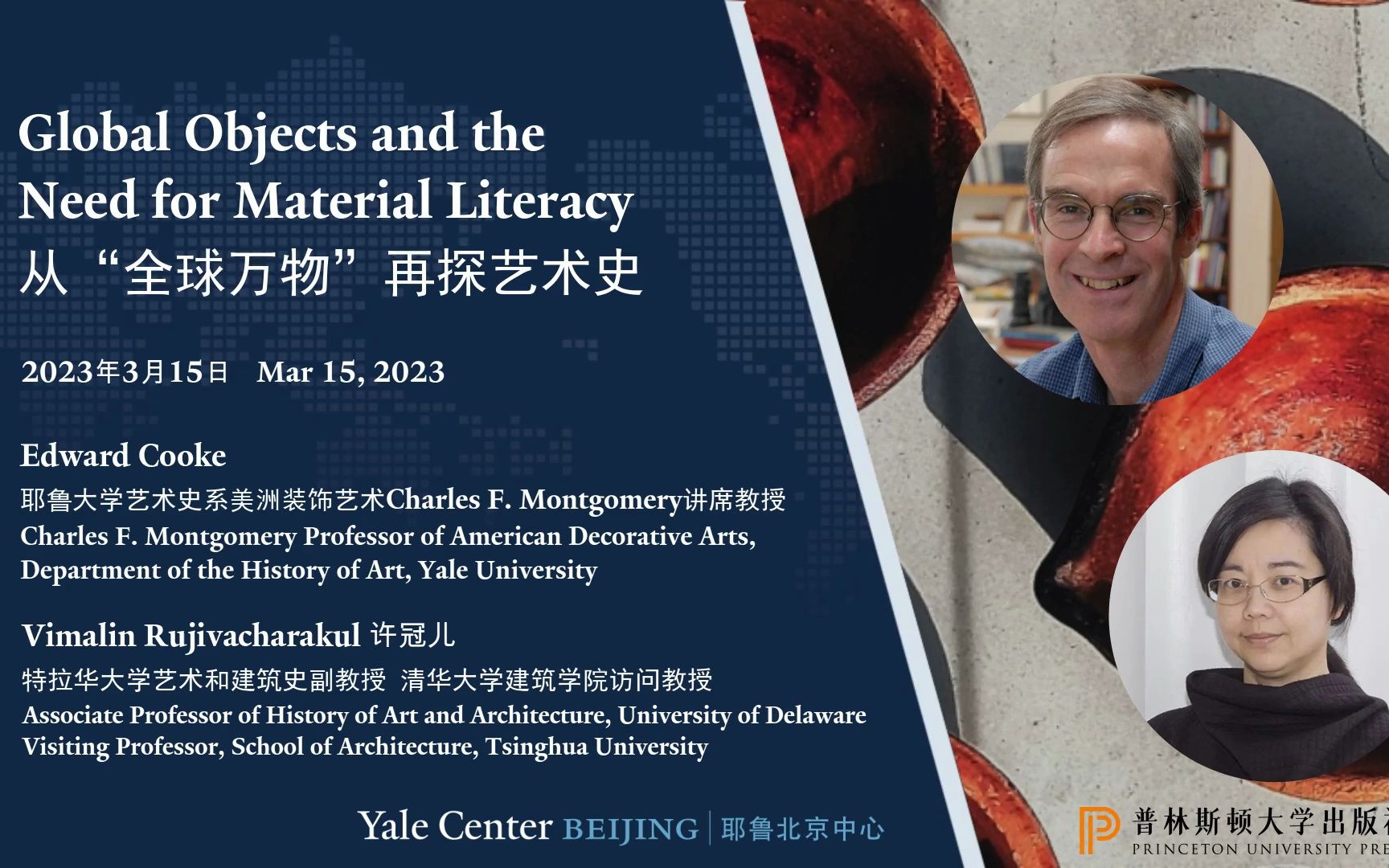
互联网时代,小心成为“物质文盲”!耶鲁教授用一本颠覆艺术史的
字幕摘录
| 时间 | 英文 | 中文 |
|---|---|---|
| 0:05 | Good day, everyone. | 大家好,再见 |
| 0:06 | And especially to our distinguished speakers, Professor Ned Cook from Yale University, | 特别是我们尊敬的演讲者 耶鲁大学的奈德·库克教授 |
| 0:13 | as well as Professor Vimalin Rajivacharkul of the University of Delaware. | 以及特拉华大学的维马林·拉吉瓦查库尔教授. |
| 0:20 | She also has a Chinese name Xu Guan'er. | 她也有中文名徐关尔. |
| 0:24 | Welcome, everyone, to the Zoom webinar on Global Objects and the Need for Material Literacy, | 欢迎各位收看《全球物体的放大器》和《素养的需要》 |
| 0:31 | co-hosted by Princeton University Press, China Office, and the Yale Center Beijing. | 由普林斯顿大学出版社,中国办事处,耶鲁中心北京联合主办. |
| 0:38 | I'm Carolee Rafferty, Executive Director of Yale Center Beijing and a Yale College alumna. | 我是Carolee Rafferty,耶鲁北京中心执行董事 和耶鲁大学的校友。 |
| 0:44 | For those of you who may be new to Yale Center Beijing events, the center is Yale University's | 对于你们中那些刚来耶鲁中心的人来说 北京活动中心是耶鲁大学的 |
| 0:51 | only university-wide center outside of the U.S. | 只有美国以外的全大学中心 |
| 0:55 | Throughout the year, we host events such as these, whether over Zoom or in person, | 全年,我们主办诸如此类的活动, 无论是超度还是亲自, |
展开字幕全文(993 条)
| 序号 | 英文 | 中文 |
|---|---|---|
| 1 | Good day, everyone. | 大家好,再见 |
| 2 | And especially to our distinguished speakers, Professor Ned Cook from Yale University, | 特别是我们尊敬的演讲者 耶鲁大学的奈德·库克教授 |
| 3 | as well as Professor Vimalin Rajivacharkul of the University of Delaware. | 以及特拉华大学的维马林·拉吉瓦查库尔教授. |
| 4 | She also has a Chinese name Xu Guan'er. | 她也有中文名徐关尔. |
| 5 | Welcome, everyone, to the Zoom webinar on Global Objects and the Need for Material Literacy, | 欢迎各位收看《全球物体的放大器》和《素养的需要》 |
| 6 | co-hosted by Princeton University Press, China Office, and the Yale Center Beijing. | 由普林斯顿大学出版社,中国办事处,耶鲁中心北京联合主办. |
| 7 | I'm Carolee Rafferty, Executive Director of Yale Center Beijing and a Yale College alumna. | 我是Carolee Rafferty,耶鲁北京中心执行董事 和耶鲁大学的校友。 |
| 8 | For those of you who may be new to Yale Center Beijing events, the center is Yale University's | 对于你们中那些刚来耶鲁中心的人来说 北京活动中心是耶鲁大学的 |
| 9 | only university-wide center outside of the U.S. | 只有美国以外的全大学中心 |
| 10 | Throughout the year, we host events such as these, whether over Zoom or in person, | 全年,我们主办诸如此类的活动, 无论是超度还是亲自, |
| 11 | where we convene thought leaders from all sectors to discuss the most interesting, cutting edge, | 我们召集各部门的思想领袖 讨论最有趣的尖端 |
| 12 | and critical topics facing humanity. | 人类面临的重要议题。 |
| 13 | Today, we're delighted to be able to invite Yale Professor Edward Cook to give a presentation | 今天,我们很高兴能邀请耶鲁教授 Edward Cook做演讲 |
| 14 | about his book, new book, Global Objects Toward a Connected Art History, | 关于他的书,新书,"全球物体走向连接的艺术史, |
| 15 | which is published by the Princeton University Press. | 由普林斯顿大学出版社出版。 |
| 16 | We're also delighted to have Professor Vimalin Rajivacharkul from the University of Delaware | 我们也很高兴有特拉华大学的维马林·拉吉瓦查库尔教授 |
| 17 | to have a discussion with him on this topic. | 与他讨论这个问题。 |
| 18 | And we're so grateful to both of you for your time and preparation. | 我们非常感激你们两位的时间和准备。 |
| 19 | We're very glad to be collaborating with the Princeton University Press, | 我们很高兴和普林斯顿大学出版社合作 |
| 20 | China Office to co-host this important webinar for the Chinese audience. | 中信办为中国观众共同主持这次重要的网吧. |
| 21 | The Princeton University Press is one of the world's leading academic publishers, | 普林斯顿大学出版社是世界领先的学术出版社之一, |
| 22 | which brings scholarly ideas to the world by publishing peer-reviewed books that connect | 通过出版同行评审的书籍,将学术思想带给世界 |
| 23 | authors and readers across spheres of knowledge to advance and enrich the global conversation. | 作者和读者跨越知识领域,推动和丰富全球对话。 |
| 24 | And the Princeton University Press, China Office, with whom Yale Center Beijing has worked closely | 和普林斯顿大学出版社,中国办事处,耶鲁中心北京公司密切合作 |
| 25 | to prepare for this event, is committed to fostering cross-cultural exchanges and further | 致力于促进跨文化交流和进一步开展文化交流,并致力于为这一活动做好准备。 |
| 26 | advancing the international dialogues of scholars. | 推动学者的国际对话。 |
| 27 | So throughout the talk, we'll see Professor Cook's presentation. | 因此在整个谈话中,我们会看到库克教授的介绍. |
| 28 | He'll have some slides. | 他会有一些幻灯片。 |
| 29 | And Professor Vimalin Rajivacharkul will also be kind of engaging in a discussion | 维马林·拉吉瓦查库尔教授也将参与讨论 |
| 30 | on this topic. | 关于这一主题。 |
| 31 | Now, let me introduce our two distinguished speakers. | 现在,请允许我介绍我们两位尊敬的发言者。 |
| 32 | Professor Ned Cook is a Yale College alumnus and the Charles F. Montgomery Professor of | 奈德·库克教授是耶鲁大学的校友 查尔斯·蒙哥马利教授 |
| 33 | American Decorative Arts in the Department of History of Art at Yale University. | 耶鲁大学艺术史系的美国装饰艺术. |
| 34 | His work focuses upon material culture and decorative arts with an emphasis on the | 他的工作重点是物质文化和装饰艺术,重点是: |
| 35 | relationship between production and consumption. | 生产与消费之间的关系。 |
| 36 | At Yale, Professor Cook teaches lecture courses on American material culture, | 在耶鲁大学,库克教授教授讲授关于美国物质文化的课程, |
| 37 | an introductory course on global decorative arts, and offers seminars on a variety of topics, | 开设全球装饰艺术入门课程,并举办各种专题研讨会; |
| 38 | including craft and design in India and in Australia. | 包括印度和澳大利亚的工艺和设计。 |
| 39 | He has written extensively on modern craft as an author, a founding co-editor of the | 他作为作家、创始人兼编辑,广泛撰写现代工艺著作。 |
| 40 | Journal of Modern Craft, guest editor of a special issue of American art focusing on craft, | 《现代工艺学报》,美国艺术专刊的特刊编辑 |
| 41 | as well as his work as co-curator and publication author of multiple exhibitions, | 以及他作为多个展览的协办者和出版者所做的工作, |
| 42 | including Inspired by China, Contemporary Furniture Makers Explore Chinese Traditions | 包括受中国启发,当代家具制造商探索中国传统 |
| 43 | at the Peabody Essex Museum in 2006. | 2006年在皮博迪·埃塞克斯博物馆举行. |
| 44 | He's the author of several books on material culture and decorative arts, | 他是几本关于物质文化和装饰艺术的著作的作者, |
| 45 | including the book of today's talk, Global Objects Toward a Connected Art History, | 包括今天演讲的书 《走向连结艺术史的全球目标》 |
| 46 | published by the Princeton University Press. | 普林斯顿大学出版社出版。 |
| 47 | In this groundbreaking book, Professor Cook breaks down traditional hierarchies in the | 在这部开创性的著作中,库克教授打破了传统的等级制度。 |
| 48 | field of art history by bridging the divide between fine art, paintings, architecture, | 通过弥合美术、绘画、建筑之间的鸿沟, |
| 49 | and sculpture, and material culture through an examination of these more functional objects | 通过对这些功能性较强的物体的检查, |
| 50 | around the world. | 环绕世界. |
| 51 | In doing so, he's charting exciting new directions in art history by presenting a more inclusive | 他以此为艺术史绘制了令人振奋的新方向 通过呈现一个更具包容性 |
| 52 | and expansive perspective on made objects and their uses, meaning and cultural value | 及其用途、意义和文化价值 |
| 53 | through time. | 穿越时间 |
| 54 | Professor Cook's work in expanding the field of decorative arts has led to many awards, | 库克教授在扩大装饰艺术领域的工作 导致许多奖项, |
| 55 | including election as an honorary fellow of the American Craft Council and College Arts | 包括当选美国工艺委员会和学院艺术荣誉研究员 |
| 56 | Association Distinguished Teacher of Art History Award. | 艺术史杰出教师协会奖. |
| 57 | We're very grateful for his generosity in making time for this talk for the Chinese | 我们非常感谢他慷慨地为中国人安排了这次谈话 |
| 58 | audience. | 观众。 |
| 59 | Vimalin Rujavacharkul教授在大学教授艺术和建筑史 | |
| 60 | of Delaware. | 特拉华州 |
| 61 | She also concurrently holds the 2021 to 2024 Visiting Professorship at the School of | 她还同时担任2021年到2024年法国大学的客座教授职务。 |
| 62 | Architecture at Tsinghua University and is a lifetime fellow of Clare Hall at Cambridge | 清华大学建筑系,是剑桥市克莱尔堂的终身同学. |
| 63 | University. | 大学. |
| 64 | She researches and publishes on architectural history and historiography, material culture, | 她研究并出版关于建筑历史和历史学,材料文化, |
| 65 | and object studies, history of cartography, and history of global collecting. | 和对象研究、制图史以及全球收集史。 |
| 66 | 她的著作中包括"建筑化亚洲"(Architecturalized Asia),它是经选择选择成为"建筑化亚洲"(Asian). | |
| 67 | outstanding book in 2014, Liang Sicheng, and The Temple of Buddha's Light, which was | 2014年的杰出著作,梁思诚,和佛光寺,当时是 |
| 68 | included in the China Classic series by China's Ministry of Education, and Collecting | 由中国教育部列入中国经典丛书,并收藏 |
| 69 | China, the World, China, and a Short History of Collecting, which became the ground for | 中国,世界,中国,以及一部短篇的收集史,成为了 |
| 70 | the 2017 workshop that she co-directed at the Winter Thur Museum for the National Museum | 她为国家博物馆在温特瑟博物馆共同执导的2017年研讨会 |
| 71 | of Asian Arts Chinese Object Study. | 亚洲艺术中国对象研究. |
| 72 | At Tsinghua University, she works with colleagues in the history of architecture with | 在清华大学,她与建筑史上的同事合作 |
| 73 | on preserving village and vernacular architecture in China. | 保护中国乡村和方言建筑。 |
| 74 | We're also very, very delighted to have her to be in conversation with Professor Ned Cook | 很高兴她能和奈德·库克教授谈话 |
| 75 | today. | 今时. |
| 76 | Now, throughout this webinar, please feel free to type your questions in the Zoom chat | 现在,在整个网络中,请随意在缩放聊天中输入您的问题 |
| 77 | box. | 页:1 |
| 78 | And the first person to pose a question to our speakers, who's not a Yale Center Beijing | 第一个向我们的演讲者提问的人 他不是耶鲁中心北京 |
| 79 | staff member and not a Princeton University Press staff member, will get a complimentary | 工作人员,而不是普林斯顿大学出版社的工作人员,将获得一个辅助人员 |
| 80 | copy of Professor Cook's new book, thanks to the Princeton University Press' generosity. | 由于普林斯顿大学出版社的慷慨,库克教授的新书的复制本. |
| 81 | I'd also like to encourage all of you to purchase a copy of Global Objects towards an | 我还想鼓励你们所有人 购买一份全球物体的复制品 |
| 82 | interconnected art history, as the professors who joined these Yale Center Beijing lectures | 作为参加耶鲁中心北京讲座的教授 |
| 83 | do so out of their kindness and generosity to the Yale community. | 这样做是出于他们对耶鲁社区的善意和慷慨。 |
| 84 | And it is very important that we support their work and encourage them to continue | 我们必须支持他们的工作并鼓励他们继续 |
| 85 | engaging with the Yale community in China. | 与中国的耶鲁社区合作。 |
| 86 | So without further ado, let's welcome Professor Ned Cook. | 所以不用多说了,欢迎奈德·库克教授 |
| 87 | And Ned, please queue up your share your screen so we can get it going. | 奈德,请排队 分享你的屏幕 这样我们就可以让它去。 |
| 88 | Thank you. | 谢谢 |
| 89 | All right. | 好吧,我们走。 |
| 90 | Carol, is that on now? | 卡罗尔,是现在吗? |
| 91 | Yes, it's on. | 是的,开始了。 |
| 92 | Well, thanks to Carol and Devin for organizing this, as well as for Vimalan willing to be a | 感谢卡罗尔和德文组织这次活动 还有维玛兰愿意成为 |
| 93 | partner early in the morning here on the eastern seaboard of the US. | 早上在东岸的美国 |
| 94 | And it's a real delight to be able to speak to a broader international audience about this | 能跟广大国际观众谈论这件事真是令人高兴 |
| 95 | kind of project, because it really does get at the heart of the way we are connected as | 某种项目,因为它确实 得到的核心 我们连接的方式 |
| 96 | human beings. | 人类 |
| 97 | For many of us, the accepted notion of art is one that privileges a certain kind of | 对我们许多人来说,公认的艺术概念是特权于某种 |
| 98 | creative activity and creative product. | 创造性活动和创造性产品。 |
| 99 | We tend to think about monumental public architecture. | 我们倾向于考虑具有重大意义的公共建筑。 |
| 100 | We tend to think about framed paintings. | 我们往往会考虑绘画 |
| 101 | And what we do is we honor them in some respects because they have a certain fixity. | 我们所做的就是在某些方面尊重他们, 因为他们有某种固定性。 |
| 102 | They're fixed in place. | 他们已经固定好了 |
| 103 | They're usually stable. | 它们通常稳定. |
| 104 | Yes, there's some variations in architecture. | 是的,建筑上有些变化。 |
| 105 | Paintings get reframed or might be cleaned. | 涂料被重新刻画或可能被清洗. |
| 106 | But they oftentimes are very well documented. | 但是,它们常常有很好的记录。 |
| 107 | They've existed in some sort of a public dimension for quite some time. | 它们在某种公共层面存在了相当长一段时间。 |
| 108 | And I just want to use this portrait by Arthur Devis, painted of Mr. and Mrs. Hill, upper | 我只想用Arthur Devis的肖像画 上面是希尔夫妇的画 |
| 109 | middle-class British couple, hanging in the Yale Center for British Art currently, but certainly | 中产阶级英国夫妇, 挂在耶鲁大学英国艺术中心 目前,但当然 |
| 110 | earlier was in the Hills and their descendants' homes. | 之前在山上和他们的后代家 |
| 111 | And I think that it sort of represents so well the way in which we really focus in on what are | 我觉得它代表了我们真正关注 |
| 112 | known, quote, works of art. | 已知,引文,艺术品。 |
| 113 | That it is something that is an obvious medium that we're comfortable elevating to that status. | 这是一种显而易见的媒介,我们自在地提升到这种地位。 |
| 114 | It's oil painting on canvas. | 画布上的油画 |
| 115 | It indicates sort of a certain degree of self-fashioning by the couple who are really | 这表明夫妇们 在某种程度上的自我时尚 |
| 116 | presenting themselves to people who came and visited the house, oftentimes an exclusive | 向前来拜访房子的人展示自己 经常是独家 |
| 117 | audience. | 观众。 |
| 118 | But it's a way in which they are presenting themselves to that limited world. | 但这是他们向有限世界展示自己的方式。 |
| 119 | It's commemorative in that it really celebrates who they are for either their friends or | 这是纪念 因为它真的 庆祝他们是谁 他们的朋友或 |
| 120 | subsequent generations. | 之后几代人。 |
| 121 | And there's a known artist. | 还有一位知名艺术家. |
| 122 | The artist signs it. | 艺人签名. |
| 123 | So all these things that sort of really start to create to the value of this kind of work of art | 所以所有这些东西 真正开始 创造这种艺术作品的价值 |
| 124 | over time. | 随着时间的推移。 |
| 125 | And yet in the background, sitting on top of a mahogany table, the couple are obscuring | 而在背景中,坐在一个毛糯米的桌子上, 夫妇们在迷惑 |
| 126 | mahogany chairs, there's a tea service. | 毛腿椅,有茶服务。 |
| 127 | And sort of thinking about a teapot as a minor kind of player pushed to the background. | 某种程度上认为一个茶壶是一个小种类的玩家推向背景。 |
| 128 | And using kind of the theatrical metaphor of someone like Irving Goffman in the presentation | 并用戏剧的比喻 某人像欧文・戈夫曼在演讲中 |
| 129 | of Everyday Life, it's merely a prop that the real focus is on the actors, the couple, | 在日常生活中,它只是一个道具 真正的焦点是演员,夫妇, |
| 130 | and the stage set, which is the interior of their home. | 和舞台,即他们家的内部。 |
| 131 | Props exist really sort of only in a very supplementary way that are not really key | 道具真的存在 那种只有非常补充的方式 而不是真正关键 |
| 132 | players in the value of this particular object. | 此特定对象值中的玩家。 |
| 133 | They are merely affirming. | 他们只是申明。 |
| 134 | But what I'm intrigued with is flipping the script. | 但我感兴趣的是翻转剧本 |
| 135 | What happens if we make the painting, the one that we value now, in service of | 如果我们把画做成我们现在珍视的一幅 |
| 136 | larger object? | 更大的物体吗? |
| 137 | All of a sudden making that teapot larger in scale to dominate this kind of value system. | 突然使茶壶规模变大 来支配这种价值体系 |
| 138 | And to think about what about a skillfully made functional object? | 想想一个巧妙的功能性物体怎么样? |
| 139 | And it's not quite as stable as the painting might be. | 画可能不够稳定 |
| 140 | Because objects tend to be messy. | 因为物体往往很乱 |
| 141 | They draw from ideas and materials from throughout the world. | 它们来自世界各地的思想和材料。 |
| 142 | They move. | 他们移动。 |
| 143 | They don't hang on the wall and stay there. | 他们不挂在墙上 并停留在那里。 |
| 144 | They get used in different ways. | 他们被不同的方式使用。 |
| 145 | They might get repurposed. | 他们可能会被重新使用。 |
| 146 | Something like a teapot could be used as a padboat for somebody elderly or infirm | 像茶壶一样的东西 可以用来做老人或病人的垫船 |
| 147 | who needs to have basically an adult Tommy tippy cup to be able to drink fluids from. | 他们需要 一个成人汤米尖杯 才能喝液体。 |
| 148 | It could get worn out. | 可能会磨损的 |
| 149 | It might actually become pieces, sherds, rather than actually a whole object. | 它可能会变成碎片, 壳,而不是整个物体。 |
| 150 | And it's not simply to think about this object as functional or aesthetic alone. | 而将这个物体仅仅视为功能性或美学,并不是简单的考虑. |
| 151 | It's not even innocent. | 这甚至不是无辜的。 |
| 152 | It actually has a very complicated history of engagement, of entanglement with the world. | 它实际上有着非常复杂的 接触历史, 与世界的纠缠。 |
| 153 | If we were to think of this teapot, it really represents the conflation of lots | 如果我们想到这个茶壶, 它真的代表了众多的混杂 |
| 154 | of different ideas, materials, and value systems. | 不同的思想、材料和价值体系。 |
| 155 | It's based on smaller Chinese stoneware vessels. | 以较小的中国石器皿为主. |
| 156 | But it's elevated in typical fashion to a venti size. | 但它以典型的方式提升到通风大小. |
| 157 | To think about a Starbucks metaphor here. | 想想星巴克的隐喻 |
| 158 | It's supersized kind of consumption of tea, which is also at this point in time | 这是超大种类的茶, 也是在这个时候 |
| 159 | in the 17th and 18th century, a Chinese product. | 在17和18世纪,是中国的产品. |
| 160 | So you have a form that's based on China for a material that's Chinese in origin. | 所以,你有一个基于中国的形式 对于一个材料的中文起源。 |
| 161 | But yet it's mixed with sugar, which is grown in the Caribbean with enslaved labor on plantations. | 但是它却与糖混合,糖在加勒比地区种植,在种植园有奴役劳工. |
| 162 | So that the sugar gets mixed in with the tea itself and becomes a much more charged kind of object. | 使糖与茶叶本身混合,成为更充电的物体。 |
| 163 | Then there's the body that is the material itself. | 然后是身体就是物质本身 |
| 164 | Unlike using purplish stoneware in China or even porcelain later on, it's refined earthenware. | 与中国使用纯净石器件甚至后来的瓷器不同,它是精制土器件. |
| 165 | It's something that Josiah Wedgwood in Staffordshire really developed of mixing | 这是乔西亚韦奇伍德在斯塔福德郡 真正发展出来的混合 |
| 166 | lighter colored clays, making them much purer in some respects. | 颜色较浅的粘土,在某些方面使其更加纯洁. |
| 167 | Then mixing in a white clay called kaolin, which actually was brought in from Cherokee | 然后混合在白色粘土中 叫做Kaolin 这其实是从切罗基带来的 |
| 168 | country in North Carolina, where it was really called Unicar. | 北卡罗来纳州, 在那里它被真正叫做Unicar。 |
| 169 | Wedgwood has this exclusive contract to extract white clay from the Cherokee country to bring | Wedgwood有这个独家合同 从切罗基国家提取白粘土 |
| 170 | to England to mix in with his local earthenwares to create this refined earthenware that simulates | 去英国和他本地的土器皿混合 来制造这个精细的土器皿 模拟 |
| 171 | the look of porcelain. | 瓷器的外观。 |
| 172 | In that pursuit of whiteness, he's again sort of looking throughout the world | 在追求白色时,他又在寻找全世界 |
| 173 | to bring together materials. | 将材料汇集在一起。 |
| 174 | Then on top of that, you have the decoration of this, which is not hand painted, | 最重要的是,你有装饰 这个不是手画的, |
| 175 | but it's actually a printing technology. | 但它实际上是一种印刷技术。 |
| 176 | It's a transfer of print off of a copper plate that they could produce the same image | 这是从铜板上打印出来的一种转录 他们可以产生同样的图像 |
| 177 | time and time over and over again on a series of teapots. | 时间和时间 反复在一系列茶壶上。 |
| 178 | And in it, what they do is they really sort of become very prescriptive about | 而在其中,他们所做的是 他们真的有点变得非常规范 |
| 179 | what's the proper use for an aspiring middle class to use this teapot to show you that | 一个有抱负的中产阶级用这个茶壶来告诉你有什么用? |
| 180 | you should have a table. | 你应该有一个桌子。 |
| 181 | You should have the kinds of accoutrements. | 汝等应具种种戒具. |
| 182 | You should have some sort of servant. | 你应该有个仆人 |
| 183 | And oftentimes you even see enslaved servants behind pouring, doing the actual physical | 你经常看到被奴役的仆人倒在水里, 做真正的身体 |
| 184 | labor while the couple in front are merely at leisure. | 工作,而前面的夫妇 只是休闲。 |
| 185 | In some respects, this is a different kind of portrait, a portrait that | 在某些方面,这是另一种 肖像,一个肖像 |
| 186 | moves through time and through space. | 穿越时空 |
| 187 | And so for me, it's really thinking about elevating an object like this to a more | 因此,对我来说,它真的考虑 将这样的物体提升到更多的 |
| 188 | sustained kind of analysis, to really contextualize it and to unpack it in as | 持续的分析, 真正地将它的背景化, 并把它包装成 |
| 189 | many different ways as possible to give it that sense of impact that maybe something | 许多不同的方法 给予它 影响感,也许东西 |
| 190 | like the diva's portrait of the hills is more of a one trick pony in some respects. | 喜欢女神的山丘画像 更是一个诡计小马在某些方面。 |
| 191 | And so that's why I ended up really working on this book, which is based on a course | 这就是为什么我最终真的 写这本书, 这是基于一个课程 |
| 192 | I've been teaching for eight years now that is designed as an alternative to the | 我已经教了八年了 被设计成替代 |
| 193 | usual kind of introduction to art history. | 艺术史的介绍 |
| 194 | And by looking at functional, aesthetically kind of charged objects of really trying | 通过观察功能性,美学上 那种电荷物体 真正尝试 |
| 195 | to make a human history of art as opposed to one that is distant or removed from a | 创造人类艺术史,而不是远离或脱离 |
| 196 | great number of people and thinking about the ways in which we really need to put | 很多人,思考我们真正需要 如何使 |
| 197 | together the concept of realization that is making something and then also the kind | 实现的概念 正在创造一些东西 然后是那种 |
| 198 | of circulation, what happens when it moves from the shop out into the world. | 流通,当它从商店 移动到世界。 |
| 199 | And that can be both movement as well as meaning. | 这既可以是运动,也可以是意义。 |
| 200 | And so the book is really set up to sort of move from the raw material throughout the | 所以这本书真的被设定为 从原材料中走出来 |
| 201 | world into production, into movement, circulation, and then ultimately sort of the | 进入生产、移动、流通, 并最终排序 |
| 202 | afterlife as the object continues to move through time and space and perhaps get repurposed, | 当物体在时间和空间中继续移动 并且可能重新定位 |
| 203 | perhaps get maintained, perhaps reworked in some respects. | 也许得到维持,也许在某些方面重新工作。 |
| 204 | And I thought I would just sort of walk you through the content of these three different | 我想我会只是 走你 通过这三种不同的内容 |
| 205 | kinds of sections. | 几节 |
| 206 | That one is to think about making and the importance of materials and understand the | 一个是思考制作和材料的重要性,并理解 |
| 207 | logic of materials and the logic of making. | 材料逻辑与制作逻辑. |
| 208 | And I thought two good examples of this might be the raffia cushion cover on the left and | 我想两个很好的例子 可能是左边的拉菲亚衬垫盖 |
| 209 | then this textile fragment from Gujarat from the 15th century. | 然后是15世纪古吉拉特岛的纺织碎片 |
| 210 | The raffia cover is, you know, the raffia palm in Western Africa was used as a | 西非的拉菲亚棕榈被当做 |
| 211 | source of thread of splitting up the frond, twisting it together, keeping it moist during | 绳子的源头 将叶子分开 扭在一起 保持湿润 |
| 212 | this, and then weaving it on a tension loom. | 这个,然后把它编织在紧张状态上 |
| 213 | But weaving with such incredible kind of technical expertise, you could also make it plush. | 但编织这种令人难以置信的技术专长, 你也可以把它加起来。 |
| 214 | That is, you could have some of the wefts be supplementary and cut them so you have a | 也就是说,你可以有 一些编织是补充 并剪掉,所以你有 |
| 215 | pile to these sorts of fabrics. | 堆到这些布料上 |
| 216 | You could create different kinds of weave patterns to create diamonds, shapes that you | 你可以创造不同种类的编织图案 来创造钻石,形状你 |
| 217 | see in the example on the left. | 参见左边的例子。 |
| 218 | Highly sophisticated work in which these cloths were oftentimes used and exchanged among the | 这些布料经常被人们使用和交换的非常复杂的工作。 |
| 219 | different kingdoms in West Africa as sort of tribute cloth, status cloth. | 西非不同的王国 作为一种贡品布,地位布。 |
| 220 | This was a way of affirming connections with one another. | 这是确认彼此关系的一种方式。 |
| 221 | So there was a real value of these and oftentimes as woven as cloaks. | 因此,这些和经常编织成斗篷的作品具有真正的价值。 |
| 222 | When the Portuguese started to come down the African coast trading in the 16th century, | 当16世纪葡萄牙人开始在非洲海岸贸易时 |
| 223 | they looked at this cloth and their reference point was thinking about cut velvet being | 他们看着这布 他们的参考点 是想切丝绒是 |
| 224 | produced in Europe at this point. | 此时在欧洲生产。 |
| 225 | They saw this as incredibly sophisticated and the local African kings also saw the | 当地非洲国王们也看到 |
| 226 | ways the Portuguese looked at this. | 葡萄牙人看这个时的样子 |
| 227 | The Portuguese described it as fine as the best linen coming from the low countries. | 葡萄牙人形容它是来自低地国家的最好的亚麻布. |
| 228 | The African kings started to give these cloths as a form of diplomatic gifts, thinking that | 非洲国王们开始将这些布作为外交礼物赠送,认为 |
| 229 | would create them as equals to the Portuguese explorers, merchants and missionaries. | 他们和葡萄牙的探险家、商人和传教士一样 |
| 230 | Many of these objects were then taken back and you see examples in which the Congo are | 许多这些物体后来被收回,你可以看到刚果的例子。 |
| 231 | trying to use this as a way of building up alliances with European powers, even to the | 试图以此为手段与欧洲列强建立联盟,甚至与欧洲的欧洲列强建立联盟。 |
| 232 | But how quickly they start to become disengaged from a sense of localness. | 但是,他们是如何迅速脱离 一种地方感。 |
| 233 | This is a piece that is really extraordinary because it's a European form, a pillow cover, | 这是一个非常特别的作品,因为它是一个欧洲形式, 一个枕头封面, |
| 234 | that has been stitched, seamed on the inside, that they've basically stitched this inside out, | 被缝合 缝合到里面 他们基本上把这个缝在里面 |
| 235 | put it back together, back right side out to create this cushion cover, | 把它组装起来, 右后方出来 来创造这个垫盖, |
| 236 | something that was very not made in the Congo, but it quickly lost its African heritage | 刚果的产物非常不成熟, |
| 237 | when it was inventoried in the Swedish royal collection. | 当它被清点 在瑞典皇家收藏。 |
| 238 | There was a lot of exchange among different royal courts in 1670. | 1670年各王室法院之间进行了大量的交流. |
| 239 | It was described as being Portuguese, which suggests its route from Africa to Portugal. | 它被描述为葡萄牙人,这表明它从非洲到葡萄牙的路线. |
| 240 | Then in the 18th century, it was thought to be from Southeast Asia. | 后于18世纪被认为来自东南亚. |
| 241 | To me, it's fascinating how no one thought it could possibly be from the Congo, | 对我来说,令人着迷的是,没有人认为这可能是来自刚果, |
| 242 | that it was of such fine quality. | 质量这么好 |
| 243 | The Gujarat cloth is also a really interesting case study in that it was made for | 古吉拉特布也是一个非常有趣的案例研究,因为它是为了 |
| 244 | the Egyptian market. | 埃及市场。 |
| 245 | You can see in the lower right corner that pseudo Islamic script | 在右下角可以看到伪伊斯兰文字 |
| 246 | that shows an awareness, and the Gujaratis, who have, because of the climate, have wonderful | 古吉拉特人,由于气候的原因, 拥有美妙的 |
| 247 | cotton, but they also have a plant, a che root, that is really ideal for | 棉花,但他们也有植物,切根, 这是真正理想的 |
| 248 | reds, really colourfast reds. | 红色的 红色的 |
| 249 | In their dye stuffs, they have ideal water for setting | 在他们的染料中,他们有 理想的水设置 |
| 250 | these kinds of dyes, the indigo for the blue. | 这些染料 蓝色的印地安人 |
| 251 | And we tend to think about Egyptian cotton today, but actually in the 15th century, | 我们今天往往想埃及的棉花 但实际上在15世纪 |
| 252 | Egypt was still very much of a linen culture, which dates back into ancient Egypt. | 埃及仍然非常具有亚麻文化,这种文化可以追溯到古埃及. |
| 253 | Their cotton industry is actually much more recent. | 他们的棉花工业实际上更近一些。 |
| 254 | And Gujarat was engaged in a lot of Indian trade across the Indian Ocean to the Arab | 古吉拉特参与了许多印度贸易 跨越印度洋到阿拉伯 |
| 255 | Peninsula and to East Africa, and was producing cloth for that export market as early as the 10th | 半岛和东非 早在10号就为那个出口市场生产布料 |
| 256 | century. | 一个世纪 |
| 257 | Again, making good use of their supply of materials, cotton, their dye stuffs, like indigo | 再说一次,好好利用他们的物资 棉花 染料,像Indigo |
| 258 | or che root, also known as matter, and also the technology that they had for knowing how | 或切根,又称物质, 和他们掌握的技术如何 |
| 259 | to do block printing, cutting wooden blocks and being able to register this sort of decoration | 进行块印刷,切割木块,并能够注册这种装饰 |
| 260 | on large swaths of cloth. | 在大片的布上, |
| 261 | A second example in which we sort of talk about the ways in which | 第二个例子,我们谈论了如何 |
| 262 | local materials and conventions might have different impact on similar kinds of forms | 地方材料和公约可能对类似形式产生不同的影响。 |
| 263 | would be these two cabinets. | 这将是这两个内阁。 |
| 264 | On the left, one from the Netherlands, again, these are from the same | 在左边,一个来自荷兰, 再一次,这些来自相同的 |
| 265 | period in which the overall effect of this, what is called oyster veneering, that is taking the | 其总体影响,即所谓的牡蛎捕食作用,即 |
| 266 | olive wood and cutting cross sections of it. | 橄榄木和切断它的交叉部分。 |
| 267 | So you have a whole series of circles that are all | 所以你有一系列的圆圈 |
| 268 | veneered over the surface. | 阴气过于表面. |
| 269 | And it really sort of emphasizes this idea of a very thin veneer surface, | 它真的有点强调这个想法 一个非常薄的表面, |
| 270 | that it's surface decoration. | 这是表面装饰。 |
| 271 | And in many ways you could say it embodies that Dutch aesthetic of | 在许多方面,你可以说它体现了 荷兰的美学 |
| 272 | outing, which wants order depth, which is really conveyed within these cross sections of legible | 输出,它需要命令的深度, 真正传递在这些可辨认的交叉部分 |
| 273 | spatial relations, luscious color harmony. | 空间关系,优雅的色彩和谐. |
| 274 | If you think about a lot of Dutch still life paintings | 如果你想到很多荷兰的活画 |
| 275 | at this time period, this is it replicated in another natural material. | 在这个时候,这是在另一种自然材料中复制的。 |
| 276 | And it's a cabinet | 是个柜子 |
| 277 | that you would open up the doors and you'd have drawers behind in which you could put your | 你会打开门,你会有抽屉 后面你可以把你的 |
| 278 | collectible items. | 可收藏物品。 |
| 279 | In Pulakat in the Kormemba coast in East India, what you've got is the same | 在东印度的科门巴海岸的普拉卡特, 你得到的是一样的 |
| 280 | form of a doored cabinet with drawers behind it, a drawer underneath that's set up on legs with that | 门面的柜子 后面有抽屉 下面有抽屉 放在腿上 |
| 281 | same sort of barbell stretcher connecting the legs that you see in the Dutch example. | 在荷兰的例子中, 连接腿部的同样的巴铃担架。 |
| 282 | But in this case, | 但在这种情况下, |
| 283 | it's totally different kind of material approach. | 这是完全不同的物质方法。 |
| 284 | They are using ebony, a wood that comes from | 他们用的是Ebony,一种来自 |
| 285 | that lower, from Tamil Nadu, the lower Kormemba coast in Sri Lanka. | 从泰米尔纳德邦到斯里兰卡的科曼巴海岸 |
| 286 | The wood is carved. | 木为雕刻. |
| 287 | Almost every part of the surface is carved. | 几乎地表的每一部分都是雕刻的. |
| 288 | It has this kind of sheen to it. | 它有这种花纹。 |
| 289 | Ebony是绝妙的 | |
| 290 | wood, tight-grained, very dense and heavy that takes this kind of vegetal kind of motif, | 木头,紧紧的,非常密集和沉重, 需要这种植物种类的摩托, |
| 291 | which actually is very similar to the jolly screens in mosques throughout different parts | 和清真寺的欢乐屏幕非常相似 |
| 292 | of the Mughal Empire. | 在莫卧儿帝国。 |
| 293 | And here, what you might say is rather than expressing this idea of howding, | 在这里,你可能会说, 而不是表达 这种想法的嚎叫, |
| 294 | they're taking a Dutch form. | 他们正采取荷兰的形式。 |
| 295 | And Pulakat is a Dutch factory, that is a Dutch trading post | Pulakat是荷兰的工厂,是荷兰的贸易站 |
| 296 | on the Kormemba coast. | 在科门巴海岸 |
| 297 | But they are having the local makers work with their own traditions | 但是,他们让本地的制造者 用他们自己的传统工作 |
| 298 | to embody these Sanskrit notions of boga, which is this idea of a really rich, sensuous | 来体现这些梵语的博加概念, 这就是一个真正丰富,感性的想法 |
| 299 | kind of handling of materials, which is that densely carved ebony. | 一种材料的处理, 即密集雕刻的骨骼。 |
| 300 | And then also marga, | 还有玛嘉 |
| 301 | an intent to blend different regional aesthetics. | 打算融合不同的区域美学。 |
| 302 | In this case, blending the Dutch with the local | 在这种情况下,荷兰人和当地人混杂在一起 |
| 303 | kind of perspective. | 那种视角。 |
| 304 | So I just use those two pairings to sort of show the richness, | 所以我就用这两个配对 来显示丰富的, |
| 305 | if you pay attention to materials and processes of seeing these kinds of equivalences or | 如果你注意看到这些等同物的材料和过程,或者 |
| 306 | ways in which people can respond at the same time using local traditions and local materials. | 利用当地传统和地方材料同时作出反应的方式。 |
| 307 | Many times people are looking at these objects and trying to sort of freeze them in place. | 很多时候人们在看着这些物体 并试图将其固定下来。 |
| 308 | If | 若为 |
| 309 | you go to museums, it seems like oftentimes if you put a piece of decorative art on view, | 你去博物馆,它似乎 经常,如果你把一块装饰艺术 在视图, |
| 310 | you oftentimes have something literally trying to recreate what it looked like as it left the shop, | 你经常有东西 字面上试图重现 它的样子,当它离开商店, |
| 311 | just as it was born in essence. | 就像它从本质上诞生一样 |
| 312 | But yet objects moved. | 但物体移动了 |
| 313 | And this becomes a really important part | 这成为很重要的一部分 |
| 314 | of the story of why they are hard to track in some respects, how you can sort of find them | 故事,为什么他们 难以追踪一些方面, 你如何可以找到他们 |
| 315 | stable at certain moments in time. | 稳定在一定的时间点。 |
| 316 | And I think that the whole story of blue and white | 我认为整个故事的蓝白 |
| 317 | ceramic is one of these fascinating stories. | 陶瓷是其中之一 迷人的故事。 |
| 318 | And many times people think about its relationship | 人们常常会考虑它的关系 |
| 319 | to Chinese porcelain. | 至中华瓷. |
| 320 | That's always been the blue and white story. | 这一直是蓝白故事 |
| 321 | But yet blue and white actually | 但其实蓝白 |
| 322 | has a complicated story right from the beginning in the 9th century, where you've got the different | 从9世纪开始就有了一个复杂的故事, 你得到了不同的 |
| 323 | kinds of opposite technology in ceramics that is covering an orangey kind of earthenware with a | 陶瓷中的相反技术 覆盖一种橙色的土器皿 |
| 324 | white tin oxide and then using cobalt, which was found in greater Iran at this time, to paint | 白锡氧化物,然后用此时在大伊朗发现的钴来涂料 |
| 325 | blue decoration on that white tin glazed oxide. | 蓝色装饰的白色锡 玻璃氧化物。 |
| 326 | And how trade of the aromatics of incense, | 香气的买卖, |
| 327 | myrrh, et cetera, from the Arab Peninsula to China in the 9th century and then bringing ceramics back | 在9世纪从阿拉伯半岛到中国 然后把陶瓷带回来 |
| 328 | had introduced white stoneware to the Arab Peninsula. | 在阿拉伯半岛引入了白色石器 |
| 329 | And then that blue and white technique | 然后蓝白技术 |
| 330 | that emerges in places like Basra then starts to impact what's going on in Chinese stoneware | 在巴士拉等地出现 然后开始影响中国的石器 |
| 331 | in the north of China, such as you see on the right, where most of the time stoneware in China | 在中国北部,例如右边, 中国大部分的石器 |
| 332 | had really been white, celadon, did not have cobalt blue. | 原本是白色的, celadon, 没有钴蓝色。 |
| 333 | And cobalt becomes another one of these | 钴又成为其中之一 |
| 334 | export items. | 出口项目。 |
| 335 | And in fact, in Qingdechen, they oftentimes referred to the blue paint as Muslim | 事实上,在清代,他们经常把蓝漆称为穆斯林 |
| 336 | blue because it came from Iran early on until they started developing some of their own blues. | 蓝色是因为它早年从伊朗传来,直到他们开始开发一些自己的蓝调. |
| 337 | This really sets up this, you know, in greater Iran, they moved from even tin | 在大伊朗,他们从锡中搬走了 |
| 338 | glazed earthenware to using fritware, which is sort of ground quartz and white clay | 光滑的土器械 用来使用火化器械 这是一种地面石英和白色粘土 |
| 339 | and glass frit to create this even more brilliant white body. | 和玻璃颤抖 创造这个更辉煌的白色身体。 |
| 340 | And one has to think about fritware | 也得考虑一下面包 |
| 341 | coming from greater Iran and porcelain coming from Qingdechen initially as the two centers | 来自大伊朗的瓷器和青德琴的瓷器 最初是两个中心 |
| 342 | of blue and white porcelains in the 13th century. | 13世纪的青白瓷 |
| 343 | And the fact that they are both | 他们俩都是 |
| 344 | really strong traditions, it's not like one preceded the other, but they almost sort of | 真正的强传统, 不像一个前, 但几乎是那种 |
| 345 | grew out simultaneously out of some of the same impulses that had been going on for several | 由一些同样的冲动 同时发展出来 一直持续到几个 |
| 346 | hundred years. | 百年.. |
| 347 | And you can see even in some of this early work being produced in Qingdechen, | 即使在清代的早期作品中 |
| 348 | that they were very much aware of the Islamic market of having this pseudo script as a decorative | 他们非常清楚 伊斯兰市场 拥有这个假字作为装饰 |
| 349 | device. | 设备。 |
| 350 | And in fact, you can see this back and forth, as it were, the movement of ideas | 事实上,你可以看到 思想的传承 |
| 351 | through objects. | 穿过物体。 |
| 352 | The bunch of grapes pattern gets produced in both porcelain as well as in fritware | 葡萄图案既用瓷器也用佛瑞特器皿制作 |
| 353 | and all the great collections either in the imperial collections in China or | 和所有伟大的收藏 无论是在中国的帝国收藏或 |
| 354 | in the Ardabil Shrine in Isfahan or in Topkapi Palace in Istanbul. | 在伊斯法罕的阿尔达比勒圣殿或伊斯坦布尔的托普卡皮宫。 |
| 355 | It's always a mix of both | 总是兼而有之 |
| 356 | fritware and Chinese porcelain. | 花纹和中国瓷器 |
| 357 | They were considered equivalent at this moment in time. | 在这个时候,它们被认为是相等的。 |
| 358 | And how that idea of blue and white being sort of the top of the ceramic pyramid at this point | 蓝色和白色是陶瓷金字塔顶部的这个想法 |
| 359 | influences a number of other people to continue to produce knockoffs, as it were. | 影响着其他一些人 继续产生连锁反应 |
| 360 | So the Portuguese | 所以说葡萄牙人 |
| 361 | sort of working in that Mediterranean tradition from the early Arab world starts to work with | 在早期阿拉伯世界的地中海传统中, |
| 362 | tin-glazed earthenware and producing plates and dishes that really mimic the export ware that was | 生产盘子和盘子 真正模仿出口器皿 |
| 363 | how the Dutch also got in on this of producing tin-glazed earthenware sort of at a different | 荷兰人是如何参与 生产锡-玻璃土器械的? |
| 364 | price point than the imported kind of Qingdechen pottery. | 价格点比进口的清代陶器种类. |
| 365 | But it's not simply trickled down from | 但它并不只是从 |
| 366 | sort of a China to the European producers. | 一种中国对欧洲生产商。 |
| 367 | There's oftentimes a back and forth. | 时常有前后. |
| 368 | And | 还有 |
| 369 | this series I think really shows the ways in which this is captivating different producers' | 这一系列,我认为 真正显示的方式 这是吸引 不同的制作人。 |
| 370 | imagination. | 想象力。 |
| 371 | On the left you have a plate in the so-called willow pattern which was transfer | 在左边,你有一个盘子 在所谓的柳图案,这是转移 |
| 372 | decorated. | 装饰. |
| 373 | That again is copper plate engraving. | 这又是铜板雕刻 |
| 374 | You ink it up, you put tissue on it, then you | 你把它涂上,你涂上组织,然后你 |
| 375 | take that tissue and apply it to the plate. | 把纸巾放到盘子上 |
| 376 | So every part of that image, both the scene and the | 画面的每一个部分 无论是现场还是现场 |
| 377 | border, is done through print technology and you can produce sets of these plates. | 边框,通过打印技术完成 你可以生产这些盘子的套件。 |
| 378 | So it's using | 所以这是用 |
| 379 | British kind of technology on the British refined earthenware body. | 英国的精制土器体技术 |
| 380 | And then in the middle what you | 然后在中间的你 |
| 381 | see is the way that the potteries in Qingdechen respond to that willow pattern but using porcelain | 清代的陶器是用青柳图案 来反应的 |
| 382 | and they're hand painting all this. | 他们用手画这一切。 |
| 383 | So this is not transfer decorated. | 故此不为转移装饰. |
| 384 | There are going to be | 会有的 |
| 385 | slight variations in all of them. | 它们都略有变化。 |
| 386 | But it's a Chinese response to a British idea that's based | 但这是中国对英国思想的回应 |
| 387 | on an imagined China. | 在一个想象中的中国。 |
| 388 | And then you get to the plate on the right which is from Qingdechen. | 然后,你得到的盘子 在右边是清德琴。 |
| 389 | And what you see here is it's hand painted underglaze in blue but it's painted to simulate | 你在这里看到的是 手被涂成蓝色的底镜 但被涂成模拟 |
| 390 | the look of a transfer decorated object in and of its own. | 外观显示一个在内部和自身装饰的转让对象。 |
| 391 | It's not a typical kind of intertwined | 这不是典型的交织 |
| 392 | fluid pattern that you would find in terms of a hand painted Chinese kind of | 流体图案,用手画的中国画 |
| 393 | inspiration motif but actually it's this isolated printed looking kind of object | 灵感是主动的,但其实是这个孤立的印刷物 |
| 394 | but it's done in a hand painted tradition. | 但这是用手画的传统 |
| 395 | So to me this gets this really complicated thing. | 对我来说这很复杂 |
| 396 | Is | 已经 |
| 397 | this Chinese? | 这个中国人? |
| 398 | Is this British? | 这是英国人吗? |
| 399 | Is it Anglo-Chinese? | 是英裔华人吗? |
| 400 | It's everything. | 谓一切法. |
| 401 | And it really is the circulation | 这真的是流通 |
| 402 | of these objects and the awareness of markets as staffers competing with Qingdechen for | 以及市场作为工作人员与清德钦竞争 |
| 403 | different parts of the ceramic market. | 陶瓷市场的不同部分。 |
| 404 | Lacquer presents this other example of the movement of | Lacquer 呈现了另一个运动的例子: |
| 405 | ideas and technologies. | 想法和技术。 |
| 406 | The great galleon trade coming from Manila to the west coast of the | 从马尼拉到西海岸的大加仑贸易 |
| 407 | Americas, to Al Capulco, amongst those cargoes being collected in Manila from throughout East | 美洲到卡普尔科,在马尼拉从整个东部收集的货物中 |
| 408 | Asia was Japanese lacquer work, Chinese silks, and many of these objects were coffers, screens, | 亚洲是日本的彩绘作品,中国的丝绸, 并且很多这些物品是国库,银幕, |
| 409 | etc., the lacquered objects. | 等,被粉饰的物体。 |
| 410 | This is an example that was made for a European market, particularly | 这是一个欧洲市场的例子,特别是: |
| 411 | a Portuguese market initially but then shipped across the Pacific that's very dense in terms | 最初是葡萄牙的市场,但后来又在太平洋各地发货,其密度非常高 |
| 412 | of its use of gold and silver powders as well as very thin pieces of mother of pearl, | 以金银粉和珍珠的薄壳盟誓, |
| 413 | a kind of lacquer tradition called macier that was shipped. | 一种叫macier的彩绘传统被运走 |
| 414 | It had a layover, if you will, | 如果你愿意的话,它有停留 |
| 415 | for a hundred years or so in Central America, South America, at which point it gets some of | 在中美洲,南美,一百年左右的时间里,它得到了一些 |
| 416 | silver kind of mounts, the corner pieces, the hasp for the lock, those get added in silver. | 银色的山,角片, 散列为锁, 这些被加入银。 |
| 417 | Originally in Japan, they would oftentimes be made out of copper, so they've been upgraded | 最初在日本,它们常常用铜制成,所以已经升级 |
| 418 | with the use of American silver coming either from Mexico or from Potosi in Bolivia and then | 使用美国白银 要么来自墨西哥 要么来自玻利维亚的波托西 |
| 419 | eventually work their way across the Atlantic and oftentimes are found in churches back in northern | 最终穿越大西洋 经常在北部的教堂里出现 |
| 420 | Spain where a lot of the Spanish colonial officials came from, so that this is an object | 许多西班牙殖民官员来自西班牙 所以这是个目标 |
| 421 | that sort of speaks to lacquer being brought across the Pacific, incorporated within the | 那种言语是把彩绘带过太平洋 并融入其中 |
| 422 | Central and South American New Spain world, and then ultimately back to Spain. | 中南美新西班牙世界,然后最终回到西班牙. |
| 423 | But at the same time, | 但与此同时, |
| 424 | there's a local tradition in South America that is using another kind of material | 南美洲有种地方传统 使用另一种材料 |
| 425 | that the Indigenous people refer to as Mopa Mopa, which was a small little bud right at the base of | 土著人民称为Mopa Mopa, 是一个小小萌芽 就在基部 |
| 426 | a leaf of a certain tree in the upper Amazon, sort of on the east side of the Andes, in which | 亚马逊河上游某棵树的叶子 大约位于安第斯山脉东侧 |
| 427 | this was chewed, it's masticated, and then stretched into something that is like Saran wrap | 这被嚼了,它被塑胶, 然后伸到像撒兰包装的东西 |
| 428 | and was typically used by the Indigenous people to cover gourds, natural sorts of vessels. | 通常被土著人民用来覆盖瓜子和自然种类的船只。 |
| 429 | You could add colors from different natural ingredients while you're chewing and create all | 你可以从不同的天然成分中添加颜色 当你咀嚼和创造所有 |
| 430 | sorts of different colors, which then could be assembled like a jigsaw puzzle to create a | 不同的颜色,然后可以组装成拼图来创建 |
| 431 | pictorial kind of composition, and then sort of you could pen in certain things, or maybe to think | 画像的成分, 然后排序你可以 笔在某些事情, 或者也许思考 |
| 432 | of it as a form of marquetry and that technique used for wood, but in this case done with a very | 一种木制工艺 但在这种情况下 |
| 433 | thin sheathing, but it does the same thing that lacquer does, it provides a protoplastic kind of | 薄薄的薄薄薄薄薄薄薄薄薄薄薄薄薄薄薄薄薄薄薄薄薄薄薄薄薄薄薄薄薄薄薄薄薄薄薄薄薄薄薄薄薄薄薄薄薄薄薄薄薄薄薄薄薄薄薄薄薄薄薄薄薄薄薄薄薄薄薄薄薄薄薄薄薄薄薄薄薄薄薄薄薄薄薄薄薄薄薄薄薄薄薄薄薄薄薄薄薄薄薄薄薄薄薄薄薄薄薄薄薄薄薄薄薄薄薄薄薄薄薄薄薄薄薄薄薄薄薄薄薄薄薄薄薄薄薄薄薄薄薄薄薄薄薄薄薄薄薄薄薄薄薄薄薄薄薄薄薄薄薄薄薄薄薄薄薄薄薄薄薄薄薄薄薄薄薄薄薄薄薄薄薄薄薄薄薄薄薄薄薄薄薄薄薄薄薄薄薄薄薄薄薄薄薄薄薄薄薄薄薄薄薄薄薄薄薄薄薄薄薄薄薄薄薄薄薄薄薄薄薄薄薄薄薄薄薄薄薄薄薄薄薄薄薄薄薄薄薄薄薄薄薄薄 |
| 434 | sealant to the base structure. | 密封于基结构. |
| 435 | And these artisans who worked with Mopa Mopa were then | 那些和莫帕合作的工匠当时 |
| 436 | encouraged by the Spanish officials to start applying them to Spanish forms, whether they be | 受到西班牙官员的鼓励,他们开始将其应用于西班牙表格,无论这些表格是 |
| 437 | caskets or writing cabinets, and you see here sort of a way in which, and when some people would say | 棺材或书写柜子,你在这里看到 一种方式,当一些人会说 |
| 438 | oh this is pseudo lacquer work, you know they're imitating the kind of work that you see on the | 哦,这是假漆的作品, 你知道他们正在模仿你看到的作品 |
| 439 | left, but actually it's a very different tradition. | 左,但实际上 这是一个非常不同的传统。 |
| 440 | It is coming from the Indigenous know-how | 这是来自土著的诀窍 |
| 441 | who are then applying it for an expanded market for the Spanish officials, and the Spanish even | 然后申请扩大西班牙官员的市场 甚至是西班牙官员 |
| 442 | start to refer to it as something else from their own point of reference. | 开始从他们自己的角度把它称为别的东西. |
| 443 | They call it barniz de | 他们称之为谷仓 |
| 444 | pasto, barniz being Spanish for varnish, pasto being the capital of that part of the viceroyalty | 面条,谷仓是西班牙语的清漆, 面条是那部分总督府的首府 |
| 445 | Peru. | 秘鲁。 |
| 446 | Basically, as I said, in Colombia now, in the upper Amazon on the east slope of the Andes. | 基本上,正如我所说,现在哥伦比亚, 在安第斯山脉东坡的亚马逊上游。 |
| 447 | So this needs to be seen on its own again as sort of a parallel world in the same way that we might | 因此,这需要再次被单独地 视为一种平行的世界 与我们可能一样 |
| 448 | think of brickware and blue and white porcelain. | 想想砖瓦和青白瓷 |
| 449 | These are coexisting, and they started airing | 这些是共存的,它们开始播放 |
| 450 | but they're not, one's not derivative of the other. | 但他们不是,一个不是另一个的衍生物。 |
| 451 | One is not influenced per se by the other. | 一种不受另一种影响。 |
| 452 | You might even sort of thinking about ways in which objects and ideas come together in the | 你甚至可以考虑一下 物体和想法如何在 |
| 453 | work of William Kick, who's a Dutch ornamental painter of the early 17th century, who sees | William Kick的作品,他是17世纪早期的荷兰装饰画家,他看到了 |
| 454 | lacquer work coming from Japan that is this sort of deep black with gold powders. | 彩绘作品来自日本, 是这种深黑色的金粉。 |
| 455 | He starts to imitate sort of the crockware of those plates that are being exported, | 他开始模仿那些被出口的板块的硬盘 |
| 456 | but he translates it into a form of lacquers that you see on the left, or even starts to incorporate | 但是他把它译为一种你左边看到的彩绘, 甚至开始融入 |
| 457 | some of the actual porcelain as the inset pieces of a set of plates that he's produced, | 一些实际的瓷器作为他制作的一组板块的内嵌件, |
| 458 | all of which are sort of evoking crock porcelain both in terms of the motifs around the border, | 在边界周围的地盘上, 都出现了瓷器 |
| 459 | using actual crock porcelain in the interior medallion, but using European materials of | 使用内部装饰中的实际青瓷,但使用欧洲材料: |
| 460 | varnish of gold leaf polychrome glazes to produce this kind of hybrid type of object. | 粉刷金叶多色玻璃,以产生这种混合型物体. |
| 461 | Then we might think about ways in which an object could actually stimulate different kinds of | 然后,我们可能会思考 如何使物体 真正刺激不同的类型 |
| 462 | responses and not from Europe down to the far reaches of the empire, but sometimes it works | 而不是从欧洲到帝国的远处 但有时还是有效的 |
| 463 | in a variety of different ways. | 以各种不同的方式。 |
| 464 | Here's an example on the left of a silk ground textile that has silk | 左边有个有丝绸的纺织厂的例子 |
| 465 | embroidery done in China in the 17th century that we know were sent as export items. | 17世纪在中国完成的刺绣,已知是作为出口物品送来的. |
| 466 | There's a temple in Kyoto has one of these. | 京都有一座寺庙有此经之一. |
| 467 | There are several other examples that | 还有其他几个例子: |
| 468 | sort of are dispersed and not used only in China, but what was really significant about them is they | 一种是分散的,不仅在中国使用, 真正有意义的是它们 |
| 469 | had a peony in the middle flanked by phoenixes with these rectangular borders with mythical | 中侧有一匹小马 被凤凰围住 长方形的边界和神话 |
| 470 | creatures all around the side, but again it's embroidery silk on silk. | 周围的生物,但又是丝绸上的绣线丝. |
| 471 | But then what emerges in | 但后来的出现 |
| 472 | the viceroyalty of Peru is something that's got the same conventions of a peony in the middle, | 秘魯的總管權權是一樣的 中間有一只小马的傳統, |
| 473 | phoenixes on either side, mythical animals both Chinese in origin as well as | 凤凰在两边,神话中的动物 无论是起源于中国还是起源于中国 |
| 474 | other local animals, alpacas, but this is not embroidered. | 其他的当地动物,美洲狮, 但这不是刺绣。 |
| 475 | This is woven. | 这是编织的。 |
| 476 | This is tapestry | 这是挂毯 |
| 477 | woven with camelid wool that is from the llamas, with cotton from the Peruvian coast, | 由山羊毛和秘鲁海岸的棉花组成 |
| 478 | and it's dyed red with cochineal, which is that insect that is affixed to cacti in Central and | 它的染色是红色的 科奇纳 就是那个在中央和中央 |
| 479 | South America. | 南美洲. |
| 480 | So this is something that's motif-wise and compositionally it's very much | 所以,这是一些 动机和组成 它非常 |
| 481 | drawn from the Chinese example, but it's done all with local techniques and local materials. | 从中国的例子中抽取,但都是用当地技术和当地材料完成的. |
| 482 | Late 17th century, it's only in the 18th century that Portugal starts to copy some of the same | 17世纪后期,葡萄牙直到18世纪才开始抄袭部分同文. |
| 483 | thing in terms of again using embroidery, using silk thread embroidery, but it's on a linen ground, | 重新使用刺绣 使用丝线刺绣 但在亚麻地上 |
| 484 | which is again sort of a common form of a ground for textiles, but again you start to see the same | 这也是纺织业的一种常见形式 但还是开始看到 |
| 485 | sort of images. | 某种图像。 |
| 486 | So it almost reverses the usual kind of from the center out to the periphery, | 所以它几乎颠倒了通常那种 从中央到外围, |
| 487 | and again sort of relocates us in our geographies. | 并再次将我们重新定位在我们的地理上。 |
| 488 | Finally, thinking about meaning, | 最后,想想意义, |
| 489 | sort of things are circulating, ideas are getting transmitted, materials are moving around, | 一些东西在流传 思想在传播 材料在移动 |
| 490 | ideas are being translated into local materials. | 想法正在被翻译成当地材料。 |
| 491 | We might think about a couple different ways that | 我们可能会考虑几种不同的方式 |
| 492 | meaning is accrued over time. | 意义是逐渐累积的。 |
| 493 | So one might be the idea of gift. | 所以也许有种天赋 |
| 494 | A gift could be something as | 礼物可以像 |
| 495 | simple and as sort of personal as a tobacco box, such as you see here on the left. | 简单和像烟草盒一样的个性 就像你左边看到的 |
| 496 | Done | 写好了 |
| 497 | with brass. | 与青铜。 |
| 498 | It's a gift from one person to another. | 一人赠之. |
| 499 | It's so well appreciated. | 非常感谢 |
| 500 | The engraving | 雕刻 |
| 501 | has worn because this has been handled and touched so many times because it's handheld. | 因为它是手持的 所以它被处理和触摸过很多次 |
| 502 | This is something that's a small snuff box, and sometimes this is the equivalent of a calling card | 这是一种小的口袋, 有时这相当于一个呼叫卡 |
| 503 | in the early modern period that someone like Elihu Yale actually had 300 snuff boxes when he died. | 在早期的现代时期,像伊利胡·耶鲁这样的人实际上有300个闷闷不乐的盒子,在他死的时候. |
| 504 | Obviously, it's not like he's going to have a snuff box in every room of his house or | 显然 他家的每个房间 都不会装一个闷闷不乐的盒子 |
| 505 | all over. | 到处都是 |
| 506 | He's giving them away as tokens of memory, of remember my friendship. | 他把它们当作纪念物 用来纪念我的友谊 |
| 507 | So I think it's really important to think about that idea of the personal gift that you have here, | 所以我认为考虑一下你在这里的个人天赋 是非常重要的 |
| 508 | but you also can have another kind of gift that's built off of plunder, | 但你也可以有另一种 以掠夺为生的天赋 |
| 509 | which is what you've got on the right side, which is the original tent owned by Tipu Sultan, | 这是你右侧的原始帐篷 由提普苏丹拥有 |
| 510 | the person who the British really thought he was the last person to defeat the British army | 英国人认为他是最后打败英国军队的人 |
| 511 | after the American Revolution. | 美国革命后 |
| 512 | But the British so hated Tipu Sultan. | 但英国人如此讨厌提普苏丹 |
| 513 | In fact, | 事实上, |
| 514 | were worried that he was going to have an alliance with the French to drive the | 担心他会和法国人结盟 |
| 515 | East India Company out of India at the end of the 18th century that they went all out to defeat | 东印度公司在18世纪末从印度出来 他们都出去打败了 |
| 516 | and killed Tipu Sultan down in Mysore. | 在密索尔杀了提普苏丹 |
| 517 | His palace was ransacked by East India Company soldiers, | 他的宫殿被东印度公司的士兵洗劫一空 |
| 518 | and so it was seized as plunder by Richard Wellesley, who presented it to Edward Clive, | 于是被理查德·韦尔斯利作为掠夺品没收, 他把它交给爱德华·克莱夫, |
| 519 | the governor of Madras at that point, and a member of the East India Company of sort of | 他当时是马德拉斯的州长 也是东印度公司的成员 |
| 520 | tribute and now hangs in Palace Castle in Wales as sort of part of the Clive Memorial | 现在在威尔士的宫殿城堡里作为克莱夫纪念馆的一部分 |
| 521 | for their destiny. | 他们的命运。 |
| 522 | We might think about meaning of appearance of thinking about ways of art and | 我们也许能考虑一下 艺术方式的外观 |
| 523 | science being combined together. | 科学是结合在一起的。 |
| 524 | A chest on the left from Boston with this burl veneer that is | 波士顿左侧的一个胸口 上面有这个毛毯,就是 |
| 525 | the diseased part of the tree that has this interlocking grain that creates this really | 这棵树的病态部分 有这种相互交错的谷物 产生这种真正的 |
| 526 | vibrant kind of surface. | 充满活力的表面 |
| 527 | This is not a time at which veneer is used because there's a shortage | 现在不是因为缺钱而使用阴间 |
| 528 | of wood. | 木头 |
| 529 | There's so much wood in New England at this point that it's important to understand | 此时新英格兰有这么多木头 需要了解 |
| 530 | what's the value of veneer. | 阴阳的值多少. |
| 531 | And if you look at the ways in which the veneer is laid over those | 如果你看看 阴道的铺设方式 这些 |
| 532 | fronts, and then there's a little thinner line around each of them outlining the burl | 前面,然后周围有条比较细的线 每一个都勾勒出布球 |
| 533 | done in just sort of a plain herringbone walnut. | 做在一个普通的草莓骨核桃。 |
| 534 | Well, one only has to look at the work of Robert | 只要看看罗伯特的作品 |
| 535 | Hooke, who wrote a book about sort of the idea of the microscope in the 1660s and 1670s, | 胡克在1660年代和1670年代写了一本关于显微镜想法的书, |
| 536 | to realize that there's this great interest in the microscopic world at this point. | 以意识到现在对微观世界的极大兴趣 |
| 537 | He does | 没错 |
| 538 | cross-sections of palms, palm trees, and various other things to sort of look at the world of | 棕榈树,棕榈树, 和各种其他东西的交叉部分 来观察世界 |
| 539 | vessels for trees and things like that. | 树和类似的东西的容器。 |
| 540 | So burl, if you think about this, this is like an illustration | 所以,如果你想这个,这就像一个插图 |
| 541 | from Robert Hooke that you've got this close-up microscopic detail of wood that's framed not by | 从罗伯特 钩子,你得到了这个特写 细微细节的木头 不是由 |
| 542 | a black line at the engraving in Hooke's book, but in this case by the herringbone veneer. | 在胡克的书中刻着一条黑线, 但在这种情况下,由草本植物。 |
| 543 | To think of this as microfilia, writ three-dimensionally as opposed to being | 把这当成是微小的, 以三维的字写着而不是作为 |
| 544 | in a book, or to think about Sheffield plate of silver plating that we oftentimes tend to think | 在一本书中,或者想 谢菲尔德的盘子 镀银,我们经常认为 |
| 545 | about silver plating on a base metal as being cheap, tawdry. | 说在底金属上镀银很便宜 |
| 546 | But again, in the late 18th, | 但是在18岁晚期 |
| 547 | early 19th century, this was considered the ultimate in the convergence of art and science. | 19世纪初,这被认为是艺术与科学交汇的终极. |
| 548 | The ability to roll with heavy rollers, to roll sheet silver over a body and to then put it into | 能够用重的滚筒滚动 将银板滚过一具尸体 然后放进去 |
| 549 | a neoclassical form, which isn't really have relief carving or anything like that. | 新古典主义的形式, 它没有真正的解脱雕刻或类似的东西。 |
| 550 | It's really | 这是真的 |
| 551 | sort of the tautness of the façade really lent itself. | 外表的细腻 真的很适合自己 |
| 552 | So you've got this way in which | 所以你有这样的方式 |
| 553 | the science of rolling a silver plate and the aesthetics of neoclassicism come together to make | 新古典主义的美学 |
| 554 | this a desirable object, even amongst those who could afford solid silver at the same time. | 即使是那些能同时买得起坚固的银子的人 也希望如此 |
| 555 | And then final thing about meaning is touch. | 最后一点就是触摸 |
| 556 | To me, it really is the language of material | 对我来说,这真的是物质的语言 |
| 557 | literacy. | 识字。 |
| 558 | You can see it within the connoisseurs of Chinese literature, that all these points of | 在中国文学界的学者中,你可以看到这些观点 |
| 559 | connoisseurship and collecting in the literati is about touch of feel of bronzes and various | 博物学和收集在Litrati 的触觉 铜和各种感觉 |
| 560 | other objects. | 其他物体。 |
| 561 | That it's not simply an ocular centric kind of exercise, but it's full embodied | 这不仅仅是一种以视觉为中心的运动,而是完全体现 |
| 562 | engagement. | 订婚。 |
| 563 | And it can be both the scholar that you have on the left, but it could also be the | 也可以是左边的学者 |
| 564 | language of the marketplace when people don't speak the same language with kind of cultural | 市场的语言,当人们不说 相同的语言与某种文化 |
| 565 | referrism of the 19th century, in which you've got these proper European ladies in the copper | 在19世纪的教程中, 青铜器里有这些欧洲女人 |
| 566 | souk in Egypt who are looking at these kinds of copper alloy vessels. | 埃及的苏克人 正在寻找这些铜合金船 |
| 567 | Language, it's not, | 语言,它不是, |
| 568 | it's bits and pieces, but it's primarily through touch that people are understanding | 这是零碎的, 但主要是通过触摸 人们理解 |
| 569 | something about the workmanship. | 有关工作技巧的东西。 |
| 570 | And I just want to leave you with a sense of why a connected art | 我只想给你一个感知 为什么一个连接的艺术 |
| 571 | history focused on functional objects is important. | 注重功能对象的历史很重要。 |
| 572 | For one, it provides an alternative to this idea | 首先,它提供了一个替代这个想法的方法 |
| 573 | of chronological progressive stories that automatically assume a rise, a golden age, | 时间顺序进步的故事 自动假设一个上升, 一个黄金时代, |
| 574 | and a decline. | 和下降。 |
| 575 | It gets away from this idea of kind of a national narrative that everybody's | 它远离了这种想法 一种民族的叙述 每个人都 |
| 576 | by country of origin, and you don't see the connections between, say, | 而你们却看不到彼此之间的联系 比如说 |
| 577 | greater Iran and China in terms of ceramics. | 在陶瓷方面,大伊朗和中国。 |
| 578 | To think about the world's been much more connected | 想想这个世界的联系要大得多 |
| 579 | than we think over time. | 比我们想的时间。 |
| 580 | I think that the principles of sustained rigorous visual analysis, | 我认为持续严格的视觉分析的原则 |
| 581 | which is the basis of any history of art class, but what happens when you get embodied analysis | 这是任何艺术课历史的基础 但当你得到体现的分析时会发生什么 |
| 582 | in there as well? | 里面还有吗? |
| 583 | And this is where touch comes in. | 这就是触摸的地方 |
| 584 | This is where can you understand how these | 这是哪里你能理解这些 |
| 585 | objects, how we as human beings interact with these objects? | 我们人类如何与这些物体互动? |
| 586 | How do we wrap ourselves in these | 我们如何在这些 |
| 587 | textiles or put our faces on the textiles? | 还是把我们的脸放在纺织品上? |
| 588 | How do we pick up a copper alloy vessel? | 如何取铜合金船. |
| 589 | Is it cold? | 冷吗? |
| 590 | Is | 已经 |
| 591 | it warm? | 暖和吗? |
| 592 | How does it feel? | 感觉怎么样? |
| 593 | And so to me, it's really about material literacy rather than this | 对我来说,这是真正的 物质知识而不是这个 |
| 594 | idea of taxonomical appreciation, to be able to put something into a stylistic little pigeonhole. | 能够把东西放进结构化的小鸽子洞里 |
| 595 | Oftentimes people are very, what I call, object-centered in which they have a series | 经常有人非常,我所说的, 以物体为中心 他们有一个系列 |
| 596 | of diagnostic features that leads to attribution, that freezes an object in time. | 诊断特征导致归属 及时冻结物体 |
| 597 | But I'm interested | 但我有兴趣 |
| 598 | in this kind of what I call object-driven inquiry, that the object is merely a beginning point | 在这种我称之为对象驱动的询问中,对象仅仅是一个起点 |
| 599 | rather than an end point. | 而不是终点。 |
| 600 | That you can look at these features, but it can lead to an understanding | 你可以看这些特征, 但它可以导致理解 |
| 601 | of choice from many possibilities, acceptance of change over time, the attention to the social life | 从许多可能性中作出选择、接受随时间而变化、关注社会生活 |
| 602 | of an object, how it gets repurposed, where it maintained. | 对象,它如何被重新使用,它在哪里维持。 |
| 603 | And this really allows us to think | 这真的让我们思考 |
| 604 | about objects as evidence, as historical evidence that helps offset the bias of written imperial | 关于物体作为证据,作为有助于抵消书面帝国主义偏见的历史证据 |
| 605 | records, that gives voice to anonymous makers, anonymous owners, anonymous circulators. | 给匿名的制作者、匿名的拥有者、匿名的循环器 |
| 606 | And I | 还有我 |
| 607 | think ultimately the big takeaway when I'm teaching this course, or with the hope of this book, is that | 想想当我教这门课时 或带着这本书的希望 |
| 608 | really stimulates both curiosity and tolerance about the material world around us, which | 真正激发我们周围物质世界的好奇心和容忍度 |
| 609 | ultimately leads to curiosity, tolerance, and engagement on a human person-to-person level. | 最终导致好奇心、宽容和人与人之间的接触。 |
| 610 | So that's, I've gone on longer than I thought, but I hope that sort of gives you an overview | 也就是说,我比我想的要长, 但我希望这能给你一个概览 |
| 611 | of the book and its value. | 及其价值。 |
| 612 | Thank you. | 谢谢 |
| 613 | What a fascinating presentation with the juxtaposition | 多么迷人的演示 与并排 |
| 614 | of the objects. | 对象。 |
| 615 | I want to invite Marlon. | 我想邀请马龙。 |
| 616 | Yes, please. | 是的,谢谢。 |
| 617 | Thank you so much, Ned. | 谢谢你,奈德 |
| 618 | It's so interesting, | 这太有趣了, |
| 619 | and you know, I've got a chance to see many, many beautiful objects for this early morning | 你知道,我有一个机会 看到很多,许多美丽的物品 为这个早晨 |
| 620 | after the power outage out last night. | 昨晚断电后 |
| 621 | This is a real treat. | 这真是大餐 |
| 622 | But those of you who are in other | 但你们中那些在别处的人 |
| 623 | parts of the world, you know, we had power outage on the Eastern Seaboard last night, which is | 我们昨晚在东海板上停电了 |
| 624 | quite interesting that we actually were able to pull together this event, you know, smoothly. | 非常有意思的是,我们实际上 能够把这个活动,你知道,顺利。 |
| 625 | So I want to tell everyone that Professor Cook and I had a very lively phone conversation earlier | 所以我想告诉大家 库克教授和我之前的电话交谈很活跃 |
| 626 | two days ago, you know, to discuss how we can pursue this. | 两天前,我们讨论如何继续 |
| 627 | And now that I actually have been, | 现在,我其实已经, |
| 628 | you know, going through all the questions that everyone put in, I think the first set of questions | 你知道,通过所有的问题 每个人都提出, 我认为第一组问题 |
| 629 | that we thought, Ned, it actually might fit very well. | 我们认为,内德, 它实际上可能非常适合。 |
| 630 | And we're going to begin with the things on | 我们从头开始 |
| 631 | the cover of the book itself, you know, and that talks about a connected art history. | 书的封面,你知道的, 并谈论一个连接的艺术历史。 |
| 632 | Most of you | 你们大多数 |
| 633 | might have known already, but let's do some recap to know why this word is quite unique for art | 可能已经知道,但让我们回顾一下 为什么这个词对艺术来说是独一无二的 |
| 634 | historians, as well as cultural historians, the word connected history, connected art history. | 历史学家,以及文化史学家,连通历史的词,连通艺术史. |
| 635 | It has a long historiography dating back to the very ginormous debate between Godfrey Semper | 它有很长的编年史可以追溯到 戈弗雷·森普尔之间的激烈争论 |
| 636 | and Alorigo in the 19th century. | 和19世纪的阿洛里戈 |
| 637 | And to sum the two thick books written in German into three | 把用德语写的两本厚厚的书合并成三本 |
| 638 | sentences, that would be Semper argued that there could be analogous origins of objects, | Semper认为可能存在类似的物体起源, |
| 639 | because the players know that the materials were created. | 因为玩家知道材料是创造出来的. |
| 640 | Rigo, on the other hand, said, well, | 而里戈则说 |
| 641 | you know, you by saying that you actually discounted what we call the wills of the artists | 你知道,你说你实际上 低估了我们所谓的 艺术家的遗嘱 |
| 642 | and the many, many, many, many translation of Kunstwahl, and you can look it up, you know, | 和许多,许多,许多,许多翻译 昆斯瓦赫,你可以查一下,你知道, |
| 643 | on that end. | 在那个方面。 |
| 644 | So then it leads us here, you know, and there were a number of art historians who | 因此,它引导我们在这里,你知道, 有一些艺术历史学家谁 |
| 645 | tried to reinterpret a connected art history, you know, we named many of them in our phone | 试图重新解释一个相联的艺术史, 你知道,我们命名了很多 在我们的电话中 |
| 646 | conversation, you know, and many of you might have known already, but in particular, David Summers, | 谈话,你知道, 和你们许多人可能已经知道, 但特别,大卫·萨默斯, |
| 647 | who also what they had described earlier, you know, in a sense, in terms of trying to connect | 以及他们之前所描述的, 从某种意义上说,在试图连接 |
| 648 | between art, architecture, space and time. | 在艺术、建筑、空间和时间之间 |
| 649 | So now we move forward to 2023. | 因此,我们现在向前迈进到2023年。 |
| 650 | So how would you like | 那你想怎么样? |
| 651 | to explain, you know, and redefine these connected art history that you have seen in the book? | 来解释,你知道, 并重新定义这些相关的艺术历史 你见过的书? |
| 652 | And thank you, by the way, for the bullet points that you actually put in as the last slide. | 顺便说一下,谢谢你 将子弹点数作为最后一张幻灯片。 |
| 653 | Yeah, I mean, it's, to me, it's, it's fascinating, because you can think about | 是的,我的意思是,它,对我来说,它是, 它的迷人,因为你可以考虑 |
| 654 | Rigo with this whole idea of Kunstwahlen, and sort of the will of the artist. | 和艺术家的意志 |
| 655 | And what that really | 那到底是什么东西? |
| 656 | does is it really puts the primary power in the intellect of the artists, that, you know, they're | 真正赋予艺术家智慧的力量 |
| 657 | going to overcome materials, it's the individual genius, it's the, it's an update to Vasari, in | 要克服材料, 它是个人的天才, 它是,这是一个更新 瓦萨里,在 |
| 658 | some respects, that we need to really think about this as a real endeavor of personal creativity, | 有些方面,我们需要真正地 考虑这一点 作为个人创造力的真正努力, |
| 659 | in some respects, as if it's sort of this genius idea that comes out of nowhere, | 在某些方面,仿佛是这种天才的想法 突然冒出来, |
| 660 | and sort of like overcoming materials, even, right, you know, you impose your will power, | 而且有点像克服物质, 即使,对,你知道, 你强制你的意志力, |
| 661 | which is such a modern concept that, you know, we can, we can overcome any kind of thing that | 这是一个现代的概念,你知道, 我们可以,我们可以克服 任何种类的东西, |
| 662 | through persistence and determination, and, in this case, creative genius. | 通过坚持不懈的决心, 以及,在这种情况下,创造天才。 |
| 663 | What that does is it discounts, it puts everything within the kind of creative side of a brain, | 它的用处是折扣, 它把所有的东西 都放在大脑的创造性方面, |
| 664 | as opposed to thinking about creativity comes in a variety of different ways. | 而不是思考创造力 以不同的方式出现。 |
| 665 | I oftentimes | 我经常这样 |
| 666 | think about the economics of this kind of process, that a really skilled artisan | 想想这种过程的经济学 一个真正熟练的工匠 |
| 667 | can see something, can pick up ideas, and then be creative in terms of transforming it to their | 能够看到一些东西, 能够收集一些想法, 然后创造性地把它转化为他们 |
| 668 | own kinds of systems or their own market. | 拥有各种系统或自己的市场。 |
| 669 | I once talked to a contemporary furniture maker | 我曾经跟当代家具制造商谈过 |
| 670 | who summarized his whole approach to making a living through making things. | 他总结了整个方法 通过制造东西谋生。 |
| 671 | He says, | 他说, |
| 672 | I do what people want my way. | 我做人们想要我的方式。 |
| 673 | And it's, you know, there's a very simple kind of message there is | 有个很简单的信息 |
| 674 | that with my skills, I can do a lot of different things. | 用我的能力,我可以做很多不同的事情。 |
| 675 | And if someone comes to me and says, | 如果有人来找我说 |
| 676 | can you do this? | 你能做到这一点吗? |
| 677 | I'm going to adapt what they want, doing it my own way. | 我要适应他们的愿望,用我自己的方式 |
| 678 | It's not as if they're | 又不是他们 |
| 679 | going to do exactly what that person thought. | 照那个人的想法去做 |
| 680 | You know, it might look very similar, but actually | 你知道,它可能看起来非常相似,但实际上 |
| 681 | structurally, it's going to be different, or it might be a variation thereof. | 结构上,它将会是不同的, 也可能是其中的一种变化。 |
| 682 | And I think that | 我觉得 |
| 683 | that sort of gets at this notion about the will of the artist and talking about the skill of the | 那种得到这个概念 关于艺术家的意志 和谈论技巧 |
| 684 | artist, in some respects, to be able to adapt to different markets, possibilities, opportunities, | 在某些方面,艺术家能够适应不同的市场、可能性和机会, |
| 685 | because ultimately, they have to make a living, they have to survive, and the way that one can | 因为归根结底, 他们必须谋生, 他们必须生存, |
| 686 | survive. | 幸存下来 |
| 687 | And this is where that idea of semper was very much interested in materials and thinking | 这正是那个 铸币局的想法 对材料和思考非常感兴趣的地方 |
| 688 | about simultaneous kind of action. | 关于同时行动 |
| 689 | And I don't, you know, sometimes things bubble up simultaneously, | 我不,你知道, 有时事情同时浮出水面, |
| 690 | yes, but oftentimes there's a dialogue, there's a connection that breeds that kind of almost | 是的,但经常有对话, 有一种联系 产生这种几乎 |
| 691 | simultaneous kind of quality. | 一样的质量。 |
| 692 | And to me, it is trying to understand this idea of connectedness | 对我来说,它正在试图理解 这种连接的想法 |
| 693 | that really allows you to put the agency back into a variety of artisans and artists, | 这真的让你把代理 回到各种工匠和艺术家, |
| 694 | rather than thinking only a certain type qualify for that. | 而不是认为只有某种类型 才有资格做到这一点。 |
| 695 | And to think about strategies, | 想想战略 |
| 696 | in some respects, the agency of the maker, rather than the agency of some sort of abstract idea. | 在某些方面,制造者的代理,而不是某种抽象思想的代理. |
| 697 | I think the phrase of the agency of the makers really sums up, you know, pretty much the book | 我想制造商的词句 真正概括了,你知道,几乎是这本书 |
| 698 | itself, because certainly you put the voice back into the maker's mouth, you know, because | 因为你把声音放回制造者的嘴里 因为 |
| 699 | otherwise, we tend not to think about it as much as we do, you know, especially in | 否则,我们往往不会像我们那样去思考, 你知道,特别是... |
| 700 | the so-called traditional art history. | 所谓的传统艺术史。 |
| 701 | With that, you know, I would like to, I noticed a | 有了这个,你知道,我想,我注意到 |
| 702 | number of questions, you know, ongoing, you know, on the side that they asked some specific details, | 问题的数量,你知道, 持续,你知道, 在一边 他们问了一些具体的细节, |
| 703 | which I think I'm going to let them do that on their own, but all the questions that somehow, | 我想我会让他们自己做 但所有的问题 不知何故 |
| 704 | I'm sorry, main post out there, underlying one particular notion about what exactly is the most | 对不起,主帖子在那里, 基于一个特定的概念 关于什么才是最 |
| 705 | typical beginning of us when we look at the object. | 典型的开始,当我们看着物体。 |
| 706 | So all the questions is about clothes, | 所以所有的问题都是关于衣服的 |
| 707 | you know, paper, ceramics, you know, when you have an object, where you begin? | 你知道,纸,陶瓷, 你知道,当你有一个物体, 你在哪里开始? |
| 708 | 你既不是Semperian,你也不是Regalian。 | |
| 709 | So where do we begin? | 我们从哪里开始? |
| 710 | I actually talk about, I begin on the inside. | 我从内心开始说起 |
| 711 | What I'm, you know, many times, | 我是什么,你知道, 很多次, |
| 712 | I think we're trained, a lot of art historians are trained, you know, as museum goers in some | 我认为我们受过训练 很多艺术史学家都受过训练 你知道,作为博物馆的走者 |
| 713 | respects, that you start from the outside and work in. | 尊重,你从外面开始工作 |
| 714 | You start, you know, you do your visual take | 你开始,你知道, 你做你的视觉拍摄 |
| 715 | of something, and then sort of work through a systematic way of looking. | 然后通过系统的观察来工作 |
| 716 | I actually oftentimes | 我经常这样 |
| 717 | find myself with my head on the inside, thinking what's behind the facade, and then working my way | 发现自己与我的头 在内,思考是什么 背后的外表,然后工作我的方式 |
| 718 | to the outside, and oftentimes sort of then going back in, and so it's often described sort of | 外表,而且常常是 那种然后返回, 所以它经常被描述 那种 |
| 719 | an in and out process. | 进退两难 |
| 720 | And even as I'm on the inside, I'm thinking, what are some of the questions | 我内心深处都在想 问题是什么 |
| 721 | that I want to begin with about this time period, this place, etc. | 我想从这个时间段开始 这个地方等等 |
| 722 | So, so | 原来如此 |
| 723 | I look at objects inside out, I guess, | 我看着里面的东西,我想, |
| 724 | almost like that Congo cushion cover. | 就像那个刚果的衬垫盖 |
| 725 | I'm sewn on with the reverse | 我缝在反面 |
| 726 | and then I'm put back together again. | 然后,我又重归于好。 |
| 727 | So then that moves us from the cover | 这样我们就能摆脱封面 |
| 728 | and now we are making progress. | 现在我们正在取得进展。 |
| 729 | We've going to table contents. | 我们准备讨论内容了 |
| 730 | For the table contents, we noticed that | 关于表格内容,我们注意到: |
| 731 | Professor Cook has the M themes. | 库克教授有M主题. |
| 732 | I'm not sure why the M letter is so fascinating here, | 我不知道为什么M字母在这里如此迷人, |
| 733 | but the M themes here. | 但这里的M主题。 |
| 734 | So basically- | 所以基本上... |
| 735 | It's a good alliteration. | 善能调伏. |
| 736 | What can I say? | 我能说什么? |
| 737 | Like it could be the A theme, you know? | 就像它可能是A的主题,你知道吗? |
| 738 | So making movement and meaning. | 因此,使运动和意义。 |
| 739 | And in our conversation, you know, | 在我们的谈话中,你知道, |
| 740 | on the phone conversation we had, | 在我们的电话交谈中, |
| 741 | we had a very lively understanding | 我们有一个非常活泼的理解 |
| 742 | that that's actually the hidden fourth M theme. | 这其实是隐藏的第四个M主题。 |
| 743 | That M is actually money, monetary, you know, or economics. | M其实是金钱,金钱,你知道的,或者经济学。 |
| 744 | So because of these are all functional objects, you know, | 因为这些都是功能性物体,你知道, |
| 745 | somehow it requires demand and supply | 不知何故它需要供求 |
| 746 | in order to make it happen. | 以成其义. |
| 747 | But that, you know, that you actually led me | 但是,你知道, 你实际上领导了我 |
| 748 | to the hidden fifth M theme that actually I missed | 到隐藏的第五M主题,其实我错过了 |
| 749 | at the beginning when we spoke on the phone | 一开始我们打电话的时候 |
| 750 | and that is Marxism. | 这就是马克思主义。 |
| 751 | So could you elaborate on this? | 你能解释一下吗? |
| 752 | So the rest of us can actually, you know, | 这样我们其他人就可以,你知道, |
| 753 | come to that agreement too. | 也来达成协议 |
| 754 | Yeah, I mean, money is sort of there a little bit | 是啊,我的意思是, 钱是有点 |
| 755 | 说到其他的M's as it was, | |
| 756 | in terms of access to materials, | 在获取材料方面, |
| 757 | certainly in terms of circulation, you know, | 当然,在流通方面,你知道, |
| 758 | and even the objects themselves are a form of money | 即使是物品本身也是金钱的一种形式 |
| 759 | that the Gujarati textiles or Coromandel Coast textiles, | 古吉拉特邦的纺织品或科罗曼德尔海岸的纺织品, |
| 760 | the painted cottons from the Coromandel Coast | 科罗曼德尔海岸的棉布 |
| 761 | serve as currency for the spice trade in Indonesia | 作为印度尼西亚香料贸易的货币 |
| 762 | that oftentimes people coming from Europe stop by, | 经常有人从欧洲来, |
| 763 | Gujarat or Madras pick up cloth | 古吉拉特语或马德拉斯语 |
| 764 | and then take cloth to get nutmeg and ginger | 然后拿布拿肉豆蔻和姜 |
| 765 | and things like that, and then bring that back to Europe. | 和类似的事情, 然后带回欧洲。 |
| 766 | So there are ways in which some of these objects | 所以,有些东西有方法 |
| 767 | facilitate that kind of exchange medium. | 方便这种交换媒介。 |
| 768 | And so thinking about money exchange, | 所以想着换钱 |
| 769 | I think money is such an interesting, you know, | 我觉得钱很有趣,你知道的 |
| 770 | it's a more modern concept because I think that, | 这是一个更现代的概念 因为我认为, |
| 771 | you know, here we are with Vimo | 我们跟维莫在一起 |
| 772 | and various other kinds of ways | 以及各种其他方式 |
| 773 | of electronic transfer of money. | 电子转账。 |
| 774 | You know, there wasn't even a standard currency | 你知道,甚至没有标准货币 |
| 775 | for much of the period we're engaged with. | 大部分时间我们接触。 |
| 776 | But I was interested in sort of when you raised | 但我对你长大后感兴趣 |
| 777 | the question about what's the fourth M in this | 关于这里面的第四个M是什么的问题 |
| 778 | that I was thinking about Marxism just because | 我在想马克思主义 只是因为 |
| 779 | in my attempt to try to think about the ways | 我试图思考的方式 |
| 780 | in which production and consumption | 生产和消费 |
| 781 | aren't viewed separately, | 没有分开看 |
| 782 | how do you start to understand | 你怎么开始明白 |
| 783 | the kind of synergetic relationship between production? | 生产之间的协同关系? |
| 784 | You know, it's chicken and egg, | 你知道,这是鸡和鸡蛋, |
| 785 | which comes first, supply, demand. | 首先是供应和需求 |
| 786 | And, you know, how to think about both of them together. | 而且,你知道,如何思考 他们两个在一起。 |
| 787 | And thinking of Marx, you know, | 想想马克思,你知道, |
| 788 | who has both an interest in labor | 他们都对劳动感兴趣 |
| 789 | as well as an interest in consumption. | 还有对消费的兴趣。 |
| 790 | You know, he's interested in the alienation of labor, | 他对劳动力的疏远很感兴趣 |
| 791 | under industrial capitalism. | 在工业资本主义之下。 |
| 792 | He's worried about the fetishization of the commodity. | 他担心商品的迷恋. |
| 793 | But in some respects, what he's dealing with | 但在某些方面,他面对的是什么 |
| 794 | is a kind of early quantified economic history. | 是一种早期量化的经济历史。 |
| 795 | You know, he's trying to generalize. | 你知道,他试图概括。 |
| 796 | And when he talks about commodity culture, | 当他谈论商品文化时 |
| 797 | and this is the way a lot of people from Apodura | 阿波都拉的很多人都是这样 |
| 798 | and others really talk about it, | 其他人真的谈论它, |
| 799 | it's almost like he's dealing in widgets, | 他好像在做部件 |
| 800 | to use a classic economics term, | 使用经典经济学术语, |
| 801 | that these are commodities that are sort of abstracted | 这些商品有点抽象 |
| 802 | in some respects, or they'll just say something like | 在某些方面,否则他们会说一些 |
| 803 | cotton or iron, or, you know, sort of this bigger category. | 棉花或铁,或者,你知道, 某种更大的类别。 |
| 804 | And I think what I'm interested in | 我觉得我感兴趣的是 |
| 805 | is trying to drill down a little bit | 正在试图钻进一点点 |
| 806 | and trying to get away from these aggregate kinds | 并试图摆脱这些集合种类 |
| 807 | of elements and trying to think about, | 和试图思考, |
| 808 | well, there's a whole range of cottons | 有一大堆棉条 |
| 809 | that could be available. | 这可以提供。 |
| 810 | Let's think about what kind of commodities | 想想哪一种商品 |
| 811 | are we talking about, or on the part of labor, | 我们谈论的, 或者在劳动方面, |
| 812 | thinking about what does alienation mean? | 想着异化意味着什么? |
| 813 | Is it only your relationship | 只是你的关系 |
| 814 | to the means of production, to tools? | 生产工具,工具? |
| 815 | What happens when you start thinking about | 当你开始思考时会发生什么 |
| 816 | other forms of engagement with labor | 其他形式的劳动 |
| 817 | as opposed to alienation? | 而不是异化? |
| 818 | What happens if you start thinking about | 如果你开始思考会怎样 |
| 819 | making as problem solving? | 作为解决问题的方法? |
| 820 | Not to romanticize in a Mauritian like William Morris, | 而不是像威廉·莫里斯那样在毛里求斯浪漫 |
| 821 | but is there a way in which people | 但人有一条路, |
| 822 | like the ways of problem solving, making objects, | 就像解决问题、制造物品的方法 |
| 823 | that it's better than sitting at your desk | 总比坐在你桌上好 |
| 824 | on a Zoom screen day after day after day after day? | 日复一日地在缩放屏幕上? |
| 825 | So that's, I mean, to me, that's trying to say | 所以,我的意思是,对我来说, 这是试图说, |
| 826 | you have to be careful and evaluative | 你一定要小心,评价 |
| 827 | with specificity without being romantic, I guess. | 我猜是没有浪漫的特质 |
| 828 | You know, that's something that I just realized right now | 我刚刚才意识到 |
| 829 | that I didn't realize when we spoke on Sunday | 我们星期天谈话的时候,我不知道 |
| 830 | that you are actually undermining all those big names. | 你正在破坏这些大名 |
| 831 | I mean, you know, including Simba and Rico, | 我的意思是,你知道,包括辛巴和里科, |
| 832 | because when we think of what Rico and Simba tried to do, | 因为我们想到Rico和Simba想做的事时 |
| 833 | they were trying to create a macro history, | 他们试图创造一个宏观的历史, |
| 834 | mapping everything from the upper and create a pattern. | 从上方绘制出所有图案,并创建图案. |
| 835 | But you propose instead that, no, let's look at each object | 但你建议,不,让我们看看每个物体 |
| 836 | and tell the story from each of them | 并说出他们各自的故事, |
| 837 | and to see how actually each one would connect. | 并且看看每个东西会怎样连接。 |
| 838 | So this is like, you know, | 所以这就像,你知道, |
| 839 | almost like you put dots all together | 就像你把点都放在一起 |
| 840 | and create a really global history | 创造真正的全球历史 |
| 841 | from those particular reasons, | 从这些特殊原因, |
| 842 | which I think is thought to be so very fascinating. | 我认为这很吸引人 |
| 843 | And same thing, you know, | 同样的事情,你知道, |
| 844 | that the way that you talk about marks, | 你们谈论标记的方式, |
| 845 | it's not that you rejected marks entirely, | 不是说你完全拒绝了标记 |
| 846 | but you said instead of looking at marks, you know, | 但你说,而不是看 标记,你知道, |
| 847 | as you have a theoretical of governance, | 你有一个治理理论, |
| 848 | let's not do that and see if this actually | 不要这样,看看这是否真的 |
| 849 | could be applied, you know, to this small functions, | 可以用这个小功能 |
| 850 | this group of people, this particular objects, | 这群人,这个特定的物体, |
| 851 | and see if that can happen. | 看看这能否发生 |
| 852 | And when we do that, | 当我们这样做, |
| 853 | what would be the story that we could tell? | 我们能讲的故事是什么? |
| 854 | With that, however, you know, | 不过,你知道, |
| 855 | I have one more question on this set of group of questions | 我对这组问题还有一个问题 |
| 856 | before we're gonna move on, | 在我们继续前 |
| 857 | that there are objects and there are stories | 有东西和故事 |
| 858 | that you actually must have had to exclude | 其实你必须排除 |
| 859 | due to, you know, the length of the book | 因为,你知道,书的长度 |
| 860 | or how the story would work together. | 或者说故事会怎样合作 |
| 861 | If you can, what might you would like to bring them in, | 如果你可以,你有什么可能 想带他们进来, |
| 862 | say, you know, Princeton University President | 普林斯顿大学校长 |
| 863 | published a second version. | 出版了第二个版本。 |
| 864 | I hope that they hear this. | 我希望他们听到这个。 |
| 865 | Yeah, I mean, it's, one is always faced with choices. | 是啊,我的意思是,这是一个总是面对选择。 |
| 866 | And, you know, in terms of pulling this together, | 并且,你知道, 在调和这一点, |
| 867 | I tried as much as possible to use objects that I've seen | 我尽量用我见过的东西 |
| 868 | that I've actually were handled as much as possible. | 我被处理得越多越好 |
| 869 | Cause I think that that's, there's so much about scale | 因为我认为那是, 有很多关于规模 |
| 870 | and the way we interact with these things | 以及我们与这些事物互动的方式 |
| 871 | that is crucial. | 这一点至关重要。 |
| 872 | And then I had to think about things that have photographs, | 然后,我不得不思考的东西 有照片, |
| 873 | you know, inevitably one has to sort of go through | 难免要经历一次 |
| 874 | museum collections because of photography, | 博物馆的收藏 因为摄影, |
| 875 | decent photography, cause you want clear imagery. | 正当的摄影,因为你想要清晰的图像。 |
| 876 | You can't just do sort of a quick shot | 你不能只是做 那种快速拍摄 |
| 877 | from my phone in the field all the time, | 从我的手机 在野外所有的时间, |
| 878 | although I've had to resort to that. | 虽然我不得不利用这一点。 |
| 879 | The, so there's, there's selectivity, | 因此,有,有选择性, |
| 880 | there's surviving for one, and then there's selectivity. | 一个是活下来的 然后是选择性的 |
| 881 | But I tried to compensate a little bit for that | 但我想补偿一下 |
| 882 | by drawing from as many different kinds of, | 通过从许多不同的种类, |
| 883 | you'll notice it, it's, I'm trying to be fair | 你会注意到的,这是, 我试图公平 |
| 884 | to all four media of, that I've decided to focus on | 我决定集中关注 |
| 885 | and they're more universal media. | 媒体更普遍 |
| 886 | And I've tried to cover many different continents | 我试图覆盖许多不同的大陆 |
| 887 | or regions as a way of being suggestive. | 或区域作为暗示的方式。 |
| 888 | And, you know, it really is borne out | 而且,你知道,这是真的证明 |
| 889 | by the number of complimentary copies I had to give out | 根据我不得不赠送的 补充拷贝的数量 |
| 890 | because of photo permissions. | 因为照片授权。 |
| 891 | I think it was something like 54, | 应该是54号吧 |
| 892 | which again speaks to the fact that | 这再次说明 |
| 893 | I'm not going to one source only. | 我不会只去一个来源。 |
| 894 | If I had to do it over again, | 如果我必须再做一遍, |
| 895 | I would really try to work harder | 我真的会努力工作 |
| 896 | in areas like Western Asia, Central Asia, in Africa. | 分布于西亚,中亚,非洲等地区. |
| 897 | And that's the kind of work that's just, | 这就是那种工作 只是, |
| 898 | or even like the Sindh area of the Hindus Valley | 甚至像印度河谷的信德地区 |
| 899 | in India, Pakistan. | 印度、巴基斯坦。 |
| 900 | These are areas that are still very much | 这些领域仍然很多 |
| 901 | tied to sort of local knowledge | 与当地知识挂钩 |
| 902 | and things are just being worked on now. | 事情正在发展之中 |
| 903 | And so much of what I'm doing | 我所做的这么多 |
| 904 | is really trying to synthesize what has gone on | 正在真正尝试 合成已经发生的事情 |
| 905 | in the way of many, a lot of current work. | 在很多, 很多当前的工作。 |
| 906 | This is where the kind of graduates | 毕业生就在这里 |
| 907 | and even undergraduates I've been so fortunate to teach with | 即使是本科生 我也很幸运能和他们一起教书 |
| 908 | that it's been, they really sort of keep me honest | 他们让我很诚实 |
| 909 | in terms of trying to stay up to date | 试图与时俱进 |
| 910 | and trying to incorporate some of these others. | 并试图将其中一些纳入其中。 |
| 911 | So that's probably where I would continue | 所以,这可能是我可能继续的地方 |
| 912 | to try to keep that breadth, | 试图保持这个宽度, |
| 913 | but try to really get even more varied representation, | 但尝试真正得到 更多样化的代表, |
| 914 | particularly think about textiles in Western Asia | 特别是西亚的纺织业 |
| 915 | and metalwork. | 还有金属制品 |
| 916 | Well, I look forward to the second edition of the book. | 我期待着这本书的第二版。 |
| 917 | I saw that the press is here, so take note of that. | 我看到媒体来了,所以要注意这一点。 |
| 918 | Now we've been to the cover, the table of contents, | 现在我们看了封面和目录 |
| 919 | and all the details and examples. | 以及所有的细节和例子。 |
| 920 | Let's go to the back cover. | 让我们去后面的封面。 |
| 921 | I saw that you've got a lot of people endorses, | 我看到你有很多人赞成 |
| 922 | pretty much in a cover almost | 几乎在封面上 |
| 923 | in every subfields of art history. | 在艺术史的每一个小领域。 |
| 924 | Can I ask you that since the book has been published, | 我可以问你,既然这本书已经出版, |
| 925 | what might have been some of the most fascinating | 也许是最迷人的 |
| 926 | or most appreciated comments that you received | 或最受欢迎的评论 |
| 927 | from your readers? | 从你的读者? |
| 928 | I'm still wondering whether I'm the tree in the forest | 我还在想我是不是森林里的树 |
| 929 | that fell and no one heard it. | 却没人听到 |
| 930 | You know, it's pretty early on. | 你知道,这还很早。 |
| 931 | So also I've got a sort of anecdotal kind of response. | 我也有类似传闻的反应。 |
| 932 | And I guess one of them, I mean, | 我猜其中一个,我的意思是, |
| 933 | the people who I went to CAA, | 我去过CAA的人 |
| 934 | College Art Association in New York, | 纽约学院艺术协会, |
| 935 | and caught up with a bunch of friends, | 和一群朋友, |
| 936 | but it was curious how it was primarily younger scholars | 但很好奇的是 以年轻学者为主 |
| 937 | who were really responding positively, | 他们真的反应积极, |
| 938 | who came up and said how excited they were | 谁上来说他们有多兴奋 |
| 939 | and how they envisioned teaching with it, | 他们曾用它去教人, |
| 940 | how it was so clear and so inspiring. | 如此清晰和鼓舞人心 |
| 941 | And to me that's important. | 这对我很重要 |
| 942 | And one person whose work I really admire, | 一个我非常欣赏的人 |
| 943 | who's mid-career just saying, | 谁是中 职业生涯只是说, |
| 944 | I could see using this for a number of different courses, | 我可以看到这个用在一些不同的课程, |
| 945 | which was exactly my intent was to think of this, | 这正是我想想到的 |
| 946 | not really as a textbook as saying, | 并不是说, |
| 947 | oh, this is the way you have to teach, | 哦,这是你必须教的方法, |
| 948 | but actually saying this could be used in a methods course, | 但实际上说这可以用在一种方法上, |
| 949 | it could be used in a different kind of introductory course, | 可以在不同的入门课程中使用, |
| 950 | or you could just do something on material culture. | 或者你可以对物质文化做点什么 |
| 951 | I mean, it could be used in a variety | 我的意思是,它可以用来 各种各样的 |
| 952 | and deployed in a variety of different ways. | 以不同的方式部署 |
| 953 | And so I've got an inkling of that, | 所以我得到了一个墨水, |
| 954 | but I won't know until, | 但我不会知道,直到, |
| 955 | and then I've had some students who read it | 然后,我有一些学生 谁读它 |
| 956 | for Orals in the fall, | 秋天的口语 |
| 957 | they seem to get something out of it. | 他们似乎得到了一些东西出来。 |
| 958 | But I don't know whether it's just, | 但我不知道这是否只是, |
| 959 | what I'm always interested in is people, | 我一直对人感兴趣 |
| 960 | those who necessarily have not taught for me | 那些不为我教书的人 |
| 961 | or done Orals with me within the Yale bubble, | 或者在耶鲁泡泡里跟我做口述 |
| 962 | but actually people from totally outside. | 其实是外面的人 |
| 963 | And that's just starting to happen now. | 这才刚刚开始 |
| 964 | Thank you very much. | 谢谢 |
| 965 | And I think this is a good start for the open Q&A, Carol. | 我觉得这是开业的好开始 卡罗尔 |
| 966 | There is quite a list of questions | 有很多问题 |
| 967 | and some of them we already addressed in this conversation. | 我们在这次谈话中已经谈到其中的一些问题。 |
| 968 | So I'll let you pick which one | 所以我让你选哪一个 |
| 969 | that you would like to zoom in. | 你将想放大。 |
| 970 | But thank you very much. | 但是非常感谢 |
| 971 | And this is very enjoyable. | 这是非常愉快的。 |
| 972 | Thank you. | 谢谢 |
| 973 | Thanks, Vimalan. | 谢谢,维玛兰 |
| 974 | Thank you so much, Vimalan and Ned | 非常感谢,维玛兰和奈德 |
| 975 | for adding such richness to the topic | 增加专题的丰富性 |
| 976 | and the discourse in art history. | 和艺术史上的论述。 |
| 977 | Before I go into Q&A, | 在我进入QQA之前 |
| 978 | I want to very quickly also thank | 我想很快的感谢大家 |
| 979 | my very important colleague, Devin Lau, | 我的重要同事刘德文 |
| 980 | for inviting both Ned and Vimalan. | 为了邀请奈德和维玛兰 |
| 981 | I know probably Lingxi Li | 我可能认识李玲茜 |
| 982 | from the Princeton University Press Office is here. | 普林斯顿大学新闻办公室的记者来了 |
| 983 | He's very instrumental in organizing this | 他对组织这个很有帮助 |
| 984 | and also the teams of Yale Center of Beijing and PUP. | 以及北京耶鲁中心和PUP的团队. |
| 985 | 就像Vimalan暗示的那样 | |
| 986 | about the possible second edition, | 关于可能的第二版, |
| 987 | or, you know, and, you know, Ned talked about, you know, | 或者,你知道,和,你知道, 内德谈到,你知道, |
| 988 | wondering what the response would be | 不知道会有什么反应 |
| 989 | for people outside of the Yale bubble to read this. | 让耶鲁泡泡以外的人读这个 |
| 990 | I know the Princeton University Press staff | 我认识普林斯顿大学出版社的工作人员 |
| 991 | had put in some links for discounted purchase | 已经设置了一些链接 用于折扣购买 |
| 992 | within China for this book. | 为这本书在中国国内 |
| 993 | So I'd be really curious about the responses. | 所以我会非常好奇这些反应。 |
该视频共有字幕 993 条。解锁更多字幕为会员功能,请移动到 价格